Home Blog Page 178

Moody Scenes, Loud Celebrations Herald Result Of Rivers LG Polls

0

As expected, results of the local government elections held in Rivers State and conducted by the State Independent Electoral Commission (RSIEC) were officially released on Sunday, August 31, with winners and lovers emerging.

The scenario in Rivers State is divided into moody scenes in the camp of those who are not only isolated from the political developments in the state and those who still question the legality of the elections.

On the other hand, celebrations, pats on the back, and handshakes of joy and fulfilment have taken centre stage in the camps of those announced as winners.

The results as announced by RSIEC shows that the All Progressives Congress (APC) won in the chairmanship seat and all available councillorship seats in 20 local government areas, while the Peoples Democratic Party (PDP) won in three LGAs.

Here is a breakdown of the results as announced by RSIEC

1. Abua Odual (APC) Ofori Owoalabi -28755 votes

2. Ahoada East Solomon Achoma (APC)- 54509

3. Ahoada West Eugene Epelle (APC) -84125 votes

4. AKULGA Bob Fubara (APC) -63593 votes

5. Andoni -Lucky Promise (APC) -126181 votes

6. ASALGA- George Onegiyeofori (APC) -56383 votes

7. Bonny -Abinye Blessing Pepple (APC) -13543 votes

8. Degema Michael John Williams (APC) – 61536 votes

9. Eleme Obarilomate Ollor (APC) -77452 votes

10. Emohua Chidi Loyd (APC) – 114380

11. Etche Njoku Boniface (APC) 100649 votes

12. Gokana Dekor Confidence (APC)96478 votes

13. Ikwerre Charles Wobodo (APC) 62746

14. Khana Bariere Thomas (APC) 156027

15. Obio Akpor Gift Worlu (PDP) 328823

16. ONELGA shedrack Ogbogu (PDP) 51051))

17. Ogu Bolo Vincent Nemioboka (APC) 36374

18. Okrika Akuro Tobin (APC) 32285

19. Omuma Obasi Uchechwuku (APC) 38530

20. Opobo Nkoro Jame A. Jame (APC) 38822

21. Oyigbo Okechukwu Akara (APC) 101495

22. PHALGA Allwell Ihunda (PDP) 235054 votes

23. Tai Mbakpone Okpe (APC) 70,080 votes

2026 World Cup Qualifiers: Super Eagles And Hand Of Divination

0

Nigerians are known as prayerful people. To them, by special prayers, the hand of Divination can alter bad situations and turn them to good. It is so even in football. To them, it is not all about skill, but divine providence which can provide the elixir, when all things fail.


In a few days, football loving Nigerians will know whether the country’s senior male national team, the Super Eagles, will revive their faltering 2026 World Cup qualifying campaign or finally dim the lights on the hopes of participating in the showpiece tournament scheduled to hold in North America.


The Super Eagles are expected to regroup in Uyo on September 1 ahead of crunch back-to-back qualifying matches against Rwanda on September 6 at the Godswill Akpabio Stadium before travelling to Bloemfontein for a battle against Bafana Bafana of South Africa three days later.


These two matches are key to the team’s onward match, as any drop of points may further sink Nigeria into the abyss of a second consecutive absence on the world stage, having missed out in Qatar in 2022.


As it stands presently, Nigeria is six points short of South Africa and a point behind Rwanda and Benin Republic. With a likely three points deduction by the Federation of International Football Associations (FIFA) dangling over South Africa following Lesotho’s protest over the fielding of an ineligible player during their previous encounter, Nigeria’s Super Eagles need the victories in these crunch matches to get their campaign back on track.


But who would have imagined that Nigeria, once a continental powerhouse of football and respected as an emerging global football superpower, would be struggling to qualify for a World Cup tournament where Africa would be represented by nine countries.


It is indeed sad that Nigeria’s aura of dignified performance and results have faded into uncertainty. The country’s World Cup and Olympic football records from the glory years of 1994,1996, and 1998, to the resilience of 2014, built on discipline, hunger, and tactical intelligence, have now given way to mediocrity, lackadaisical attitude and unnecessary ego on the side of the current bunch of players and administrative culpability from the Nigeria Football Federation (NFF).


Across the nation, hope and anxiety mix in the hearts of millions of football lovers as the Super Eagles are starring down the barrel of a World Cup qualifying disaster. The race for the ticket of Group C in the African qualifiers has become for Nigerians a nerve-wracking gamble. It hangs in the balance by a thread and the odds are no longer in their favour, all caused by some unexpected and uninspiring performances.


In the midst of the uncertainties, Super Eagles Head Coach, Eric Chelle, who has a 23-man squad approved for him by the NFF for these two qualifying games, remains upbeat about the chances of the team qualifying for the World Cup in 2026.


Nigeria’s qualifying campaign was already midway with Josè Peseiro and Finidi George respectively, managing two games without a win, before the engagement of Chelle,who has overseen two fixtures so far, securing a 2-0 victory against Rwanda in Kigali and a scandalous 1-1 against Zimbabwe in Nigeria.


Chelle, who could not inspire Nigeria’s team in the just concluded CHAN ’24 tournament in East Africa, is however optimistic that the Super Eagles will surprise Nigerians, especially in the remaining four matches.


“People have already written us off. I am not bothered by that. I am concentrating on preparing my players for the remaining four matches. I think that we are going to surprise a lot of people,” Chelle told sports writers recently.


Right now, the dice is cast. Nigerians expect nothing short of hunger and tactical intelligence from the 23-man all Europe-based stars called up for the epic battles.


Unfortunately, Victor Boniface, Nathan Tella, and Sadiq Umar, would not be playing any part in these two all-important matches.


The players on whose shoulders the task of bringing the World Cup campaign back on track as released by the NFF are captain William Troost-Ekong, striker Victor Osimhen and also includes midfielders Alex Iwobi, Raphael Onyedika and Wilfred Ndidi.


Among the forwards are Ademola Lookman, Samuel Chukwueze, Cyriel Dessers and Moses Simon.


Goalkeeper Stanley Nwabali returns between the sticks, supported by defenders Calvin Bassey, Ola Aina and Bright Osayi-Samuel, among others.


Greece-based goalkeeper Adeleye Adebayo returns, with Unity Cup stars Felix Agu and Benjamin Fredericks also named in the squad.


Forwards Christantus Uche and Tolu Arokodare earned call-ups after strong performances in June’s friendly against Russia in Moscow.


Full squad:


Goalkeepers: Stanley Nwabali (Chippa Utd, South Africa); Amas Obasogie (Singida Blackstars, Tanzania); Adeleye Adebayo (Volos FC, Greece).


Defenders: William Ekong (Al-Kholood, Saudi Arabia); Calvin Bassey (Fulham, England); Ola Aina (Nottingham Forest, England); Bright Osayi-Samuel (Birmingham City, England).


Others are, Bruno Onyemaechi (Olympiakos, Greece); Chidozie Awaziem (Nantes, France); Felix Agu (Werder Bremen, Germany); Benjamin Fredericks (Dender FC, Belgium).


Midfielders: Alex Iwobi (Fulham, England); Frank Onyeka (Brentford, England); Wilfred Ndidi (Besiktas, Turkey); Fisayo Dele-Bashiru (Lazio, Italy).


Also included are Raphael Onyedika (Club Brugge, Belgium) and Christantus Uche (Getafe, Spain).


Forwards: Ademola Lookman (Atalanta, Italy); Samuel Chukwueze (AC Milan, Italy); Victor Osimhen (Galatasaray, Turkey).


Others are Simon Moses (Paris FC, France); Cyriel Dessers (Rangers, Scotland); Tolu Arokodare (KRC Genk, Belgium)


By: Celestine Ogolo

Artificial Intelligence And Future Of Software Engineers In Nigeria

0

Artificial Intelligence (AI) is changing the way the world works. From apps that can write essays to algorithms that can detect fraud, AI is reshaping industries at a speed not seen before.

In Nigeria, where the tech sector has grown rapidly in the past decade, software engineers are beginning to feel the effects. For many, AI represents both a challenge and an opportunity that will define their future in the digital economy. Nigeria’s Tech community is growing rapidly.

Nigeria has established itself as Africa’s leading tech hub, with Lagos often called the “Silicon Valley of Africa.” Startups like Flutterwave, Paystack, and Andela have proven that young Nigerian talents can build solutions with global impact.

Thousands of engineers now work locally and remotely for companies across the world. But the rise of tools such as Cursor, Windsurf, GitHub Copilot, etc, means the way software is written is shifting quickly.

Nigerian developers must now ask: How do we stay relevant in a world where machines can also code? Again, it should be noted that AI brings opportunities. These opportunities are as follows: From personal experience working with cursor, I was able to build out an MVP in the space of two days. Now, note that it was not so straightforward because I had to correct a lot of things, and with my experience, it was easy, but still, the speed was incredible. An MVP of that quality would normally take a minimum of 6 months with a minimum of 4 engineers; crazy right?.

For engineers who embrace AI, the future holds promise; namely,

● Higher productivity: AI-powered coding assistants reduce time spent on repetitive tasks and help engineers focus on creative problem-solving.

● New career paths: Specializations in AI, data science, and machine learning are opening up global job opportunities.

● Lower barriers to innovation: With AI, small Nigerian teams can build products at global standards without needing massive resources.

● Global competitiveness: Remote work and global demand for AI expertise means skilled Nigerians can access opportunities worldwide.

There are, however, challenges on the Horizon. Alongside these opportunities, AI also poses real concerns, such as:

● Job displacement: Entry-level coding roles may shrink as AI takes over basic tasks.

● Skills gap: Many Nigerian universities still teach outdated curricula, leaving engineers to self-learn modern AI skills.

● Infrastructure limitations: Access to affordable internet, electricity, and powerful computing hardware is still a challenge.

● Tougher competition: As AI takes on routine coding, Nigerian engineers must compete with highly skilled professionals globally.

AI is unlikely to replace engineers entirely. Instead, it will redefine what engineering looks like. Nigerian developers will act more as problem solvers and designers who work alongside AI tools rather than being replaced by them. To thrive in this new reality, engineers must:

● Continuously learn and update their skills.

● Build expertise in areas where human creativity and judgment are essential.

● Push for stronger policies, research investment, and infrastructure that support AI development in Nigeria.

Another issue at stake is the Global Policy and Ethics Dimension. Beyond coding, AI raises questions about ethics, privacy, and policy. Nigerian engineers who understand these issues will be better positioned to shape how AI is deployed responsibly in local industries.

With rising concerns over data misuse and algorithmic bias, there is a growing demand for experts who can balance innovation with accountability. As a result, Nigerian engineers have some vital roles to play.

Nigerian Startups also have a role to play because AI also creates opportunities for Nigerian startups to lead in areas unique to the African market.

From agricultural tech that predicts crop yields to Fintech solutions that detect fraud in mobile money transactions, Nigerian engineers can build AI products that address local problems while competing globally.

Startups that integrate AI early will have an advantage over those relying only on traditional methods. Furthermore, there should be collaboration and community growth.

The rise of AI highlights the importance of community. Nigerian developers can not afford to work in isolation. Tech communities, bootcamps, and peer-learning groups must evolve to include AI literacy, research collaborations, and mentorship programs.

By working together, Nigerian engineers can share knowledge, build confidence, and ensure that no one is left behind in this transition.

In conclusion, Artificial Intelligence is both a challenge and an opportunity for Nigeria’s tech ecosystem. While some roles may disappear, new and more advanced ones will emerge.

The engineers who succeed will be those who adapt quickly and use AI to enhance their work. AI will not replace Nigerian engineers, but Nigerian engineers who use AI will replace those who do not. The future is already here, and the choice lies in how Nigeria prepares its software talent to meet it.

By: Amakiri Samuel Bomate

Amakiri Samuel Bomate is a Senior Software Engineer

IAUE Grants Amnesty To Academic Deficient Students

0

The Senate of the Ignatius Ajuru University of Education, Rumuolumeni, Port-Harcourt, Rivers State, Nigeria, has approved an amnesty programme to facilitate the graduation of students who have been held back due to failed final-year courses.


The approval was given during the statutory Senate meeting which held on Thursday August 28, 2025 at the postgraduate hall of the University.


The programme, applicable to all categories of students from the 2016 academic session onwards, aims to clear the backlog of students who have been unable to graduate due to a few failed courses.


A press statement signed by Dr. Ngozi Okiridu,

Public Relations Officer of the institution indicated that affected students will undergo lectures for a few weeks, followed by examinations on the failed courses.


The ICT Director, Professor Nathaniel Ojekudo, is expected to inform the Deans of Faculties and Heads of Departments about the programme schedule, which will thereafter be communicated to affected students.


Also, as a fall-out of the meeting, Senate Chairman and Vice Chancellor of the institution, Professor Okechuku Onuchuku, encouraged the Faculty of Agriculture to engage in full-scale farming in order to generate funds, while tasking the Departments of Entrepreneurship and Human Resource Management to organize programmes and short courses, and provide consultancy services capable of generating funds for the institution.


Professor Onuchuku warned lecturers against forcefully compelling students to purchase specific textbooks as it was not a policy of the university.


As part of his academic and administrative leadership, the Vice Chancellor of IAUE, Professor Okechuku Onuchuku, will kick-start the University Lecture, as proposed by Professor Chibuzor Chile Nwobueze, Associate Dean of the Postgraduate School.

The lecture series which will focus on contemporary issues and aimed at improving the university and academic environment.


The Director of Academic Planning, Professor Joseph Kinanee on the other hand, requested that professors submit their names for inclusion in the NUC database, which will be used for accreditation purposes.


Meanwhile, the university is working round the clock to ensure that the resource verification for twelve programmes of the University scheduled for September 2025 by the National Universities Commission (NUC) records huge success.

Also those for full accreditation status have been directed to ensure compliance with the NUC yardstick and guidelines for a successful exercise. The institution further requested all professors in its employ to submit their names for inclusion in the NUC database for accreditation purposes.


Before its adjournment, Senate approved the semester results from various faculties including that of Centre for Continuing Education (CCE) and Students Industrial Work Experience Scheme (SIWES).

PIA: Diri, Lokpobiri Lament Host Communities Inability To Access Funds

0

Bayelsa State Governor, Senator Duoye Diri and the Minister of State for Petroleum, Senator Heineken Lokpobiri have lamented the inability of host communities of oil companies and facilities to access funds for the development of communities through the Petroleum Industry Act (PIA), describing the Act as “a time bomb” that could trigger fresh crisis in the Niger Delta.


Speaking separately at the triple celebrations of a book launch, 60th birthday and 25th marriage anniversary of the chairman of Bayelsa State Council of Traditional Rulers, King Bubaraye Dakolo in Yenagoa, Bayelsa State, both officials bemoaned the hurdles which communities face accessing funds as host communities of oil companies and facilities.


Governor Diri said the only way to resolve conflicts in the Niger Delta oil-producing communities was for the federal government to take a fresh look at the PIA.


The governor spoke in reaction to a comment by the Minister of State for Petroleum (Oil), Senator Heineken Lokpobiri, who said litigations in host communities had made it impossible for them to access monies in the Petroleum Industry Trust Fund meant for their development.


Governor Diri revealed that when the PIA was a bill during the administration of former President Muhammadu Buhari, the state had argued in a presentation it made that excluding the oil-producing states and local councils from administration of host communities, as provided in the then bill, would result in crisis.


He said, “The PIA, as it was designed, is a time bomb because the Federal Government cut off states and local government councils to deal directly with communities. It is my submission that the percentage due to oil companies, conspiratorially reduced from 10 per cent to 3 per cent be reviewed.


“I also call on the Federal Government to immediately review the aspect where states and local government were excluded from administering what is due to the communities.


“The states and councils are closer to the communities and it was wrong to have excluded them from the administration of these communities. The current situation is a recipe for crisis and I urge President Bola Tinubu to review it.”


While congratulating Dakolo, who is the Ibenanaowei of Ekpetiama Kingdom, on the launch of his books, “The Pirates of the Gulf” and “The Kingfisher,” Diri described the monarch as a rare king, and urged the younger generation to see him as a role model.


He also described Dakolo as a literary giant, who took up the challenge after his ordeal at the Nigerian Defence Academy to fight injustice in the Niger Delta, emphasising that he has made positive impact on the Ijaw nation and the country as a whole.


Governor Diri launched the books with the sum of N100 million on behalf of the state government, and further directed the Ministry of Education to adopt “The Kingfisher” as part of the state’s secondary school curriculum.


“King Dakolo has served Bayelsa and Ijaw nation. Dakolo and l had been together in the Ijaw struggle. He is sound and very intelligent. He is a literary giant and l urge our youths of the ljaw nation to see him as their role model.”


In his remarks, Lokpobiri, who was chairman at the occasion described Dakolo as a man of many parts and a visionary leader and congratulated him on the various feats attained.


He lauded the monarch for his advocacy for a better deal for the Niger Delta people through his literary works, and equally called on operators of illegal refineries to desist from their activities as these contribute to the degradation of the environment.


Lokpobiri also bemoaned oil communities’ inability to access the trust fund for their development as a result of the crisis and litigations emanating from them.


The chief launcher and Managing Director, Niger Delta Development Commission (NDDC), Dr. Samuel Ogbuku, equally commended Dakolo for documenting his experience, which he said would create more enlightenment about the struggles of the Niger Delta.


Ogbuku, who said the commission would buy as many copies of the two and distribute to schools in the region, expressed optimism that the gesture would help to promote education.


“The Pirates of the Gulf” was reviewed by Dr. Ebidenyefa Nikade, while Air Vice Marshal Kurotimi Obidake, representative of Major General Solomon Udounwa, reviewed the “Kingfisher”

Mixed Reactions Trail Rivers LG Polls

0

The people of Rivers State and residents alike went to the polls on Saturday, August 30 2025 to elect chairmen and councillors for the 23 local government areas and 319 wards of the state.


The hallmark of the election was low voter turnout, which many attributed to lack of faith in the process, as the result of the election was already a fait accompli designed to favour members of the Peoples Democratic Party (PDP) and All Progressives Congress (APC) aligned to Nyesom Wike, Minister of the Federal Capital Territory.


It was gathered that the political structure of the Minister in both the APC and PDP would produce all the candidates that would be declared winners at the polls.


It was further learnt that the Tony Okocha-led APC would produce 20 council chairmen and all councillors while the three LGAs of Obio/Akpor, Port Harcourt City, and Ogba/Egbema/Ndoni would be won by PDP.


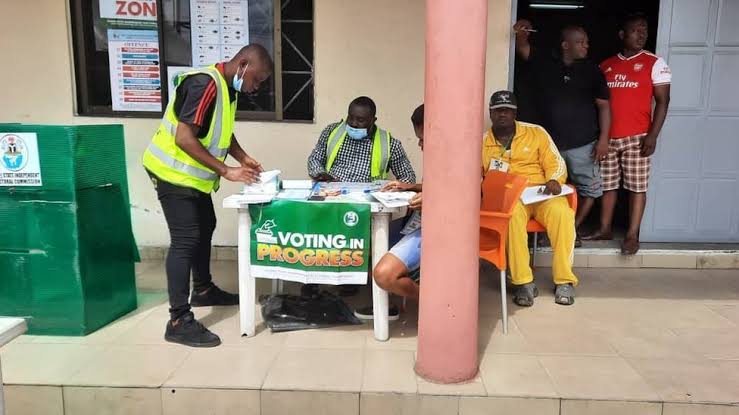
Polling units across the state reported minimal voter turnout, with many stations nearly empty.

The poor turnout was sparked by claims by segments of the society that the Sole Administrator of Rivers State, Ibok Ete Ibas, a retired Navy Admiral, does not have the legal mandate to oversee elections, leading to widespread disillusionment among


Meanwhile some segments of the society have commended the Rivers State Independent Electoral Commission (RSIEC) following what they described as “the successful conduct of the local government elections” across the state on Saturday, with reports from polling units pointing to a peaceful and orderly process.


The commission was responsible for conducting the elections across the 23 LGAs, 319 wards, and 4,442 polling units in Rivers State.


The Sole Administrator of Rivers State, Admiral Ibok-Ete Ekwe Ibas (rtd), visited some areas to assess the conduct of the election. At Okporowo Community in Emohua LGA where he and his entourage monitored the process, the Sole Administrator expressed satisfaction with the turnout of voters for the exercise, which he described as credible, free, and fair.


He was accompanied by the Sole Administrator of Emohua Local Government, Barr. Franklin Ajinwo. Together, they toured several polling units in Ogbakiri, interacting with voters and officials while ensuring everything went on smoothly and transparently.


Senator Magnus Abe, after casting his vote in Bera Ward 16 in Gokana LGA chairmanship and councillorship candidates, described the election as laying the foundation for the proper return of democracy in the state. He admitted initial fears, but commended the orderly and normal conduct of the process.


Also, the member representing Degema/Bonny Federal Constituency in the House of Representatives, Cyril Hart was at his Polling Unit in in Bonny local government area to perform his civic responsibility.


Shortly after casting his vote, he ssid, “I wish to thank RSIEC for a seamless process, the security agencies, particularly the Nigerian Navy FOB Bonny, for ensuring the safety of the voters along the Riverine wards.


“I shall send in a formal appreciation letter for a job well done to serve as a morale booster.”


“Special thanks to everyone who came out to participate in this all-important election, he concluded.


From Opobo/Nkoro Local Government Area, voters showed enthusiasm and conducted themselves in a peaceful and orderly manner in all the wards.


A political leader in the area, Amaopusenibo Ben G. Daminabo, who spoke with The Atlantic Bell, applauded the Rivers State Independent Electoral Commission (RSIEC) for ensuring a peaceful, transparent, and well-coordinated conduct of the local government elections in the area.


Addressing newsmen shortly after casting his ballot at Diepiri Unit 3, Ward 3, Opobo/Nkoro LGA, Amaopusenibo Daminabo commended both the electoral body and the electorate for their commitment to a credible process, noting that the orderly turnout reflected the collective resolve of the people to uphold democracy with dignity and mutual respect.


He emphasized that the peaceful atmosphere in Opobo/Nkoro was a testimony to the maturity of its people and their desire to see democracy thrive. While appreciating RSIEC’s role, he urged citizens to remain committed to peace and unity, stressing that elections must not be seen as a “do-or-die” contest, but rather as a democratic exercise that strengthens the electoral institutions.


Amaopusenibo Daminabo further called on all contestants to demonstrate true sportsmanship by accepting the outcome of the polls in good faith.

“What matters most is the progress and development of our people. We must all move forward together in unity,” he remarked.


RSIEC adopted a seamless process by ensuring the early arrival of officials and voting materials at polling units, while security personnel provided protection for residents and maintained law and order, keeping the exercise free from major disruptions.


The APC Chairmanship candidate for Bonny LGA, Amasenibo Hon. Abinye Blessing Pepple also commended RSIEC for what he described as “a well-organized and credible exercise.”


Ahead of the election, RSIEC had urged Rivers people to come out in their numbers to peacefully exercise their civic duty. The Chairman of the commission, Michael Odey, had advised eligible voters to conduct themselves in line with electoral guidelines and assured the public of adequate security to protect lives and property.


To reinforce this assurance, security agencies staged a “show of force” on Friday, which took off from the Rivers State Police Command Headquarters in Port Harcourt. The convoy, featuring patrol vehicles from the military and paramilitary, moved through major streets in Port Harcourt and Obio/Akpor local government areas.

Stakeholders, including community leaders and political party representatives, acknowledged the efforts in conducting the elections.

By: Miracle Chidinma Amaechi

Poor Leadership, Injustice Fueling Insecurity In Niger Delta- Expert

0

Poor leadership and the skewed justice system in Nigeria are the twin factors fueling insecurity in the Niger Delta.


The Regional Director, Africa Robotics and Autonomous Systems, Dr Chinedu Ogwus stated this while speaking at a two-day Niger Delta Oil and Gas Investment and Security summit, which commenced in August 29 and ended on August. 30 in Calabar.


The summit was themed, “Constructive Engagement for the Protection of Oil and Gas Assets and Supporting Institutions to Drive Implementation of Extent Laws to Deepen Local Content Realisation.”


Dr. Ogwus who is also a member of the International Society of Petroleum Engineers, said the challenges the federal government could drastically reduce the insecurity in the region by simply investing in technology and keeping the youths busy through that means.


He said there was nothing wrong in giving them, scholarships, jobs instead of the expatriates, and develop the region’s infrastructures since the large portion of the nation’s resources came from there.


Dr. Ogwus, however, called on the Niger Delta communities to be united, speak with one voice and eschew greed which was the bane to development in the region.


Earlier, the President of the Senate, Godswill Akpabio had called on Niger Delta youths to shun crime and imbibe the spirit of intellectual persuasion in the pursuit of progress.


The Senate President who was represented by Senator Benson Agadaga, Chairman, Senate Committee on Oil and Gas Host Communities,

said the people of Niger Delta should be known for their intellectual engagement to get things right and not just lamentation and agitation.


Akpabio said that it was through such summit that ideas were shared to enable them move forward, develop their environment, and build their communities, noting that the laws were there but that the people of the region must rise up to give life to them.


According to him the oil industry has a lot of laws, but the implementation of these laws rests with us. ‘’It is a thing of joy that we now have the Petroleum Industry Act, which specifies many functions for us,” the Senate president stated.


Akpabio said that the Local Content Act, and the Environmental Content Development and Monitoring Act provisions could be taken advantage of by the people for their progress.


He urged the people to not only take advantage of the provisions, but to take the bull by the horn and invest in the oil and gas industry.


“There is nothing wrong if two or three people, or organisations, come together to form their own company to invest in the oil and gas sector of the region,” he said.


Also speaking, Mr Ekpirikpe Ekpo, Minister of State for Petroleum Gas, highlighted the various Federal Government investments in the oil and gas sector including the gas to methanol plant in Bayelsa.


Represented by his Senior Technical Advisor, Mr Abel Nsa, Ekpo noted that Cross River was strategically located to attract methanol projects.


He explained that developing a methanol plant in the state would create jobs and promote technology transfer.


He stated that it would also position the state as a hub for a gas-based industrilisation.


Ekpo said that Cross River had enormous gas export potential due to the Eastern Horizon Pipeline.


He explained that gas was being transported from Akwa Ibom through a valve station connected to the Obigbo-Aba line through to Cross River, terminating at UniCem, a factory in Mfamosin in Cross River.


“This infrastructure creates a unique opportunity for Cross River to serve as a gateway for gas exports to Cameroon and the wider Central African markets.


“By leveraging this corridor, Nigeria can generate significant foreign exchange revenues, strengthen regional energy security, and position Calabar as a true export hub,” he said


Ekpo, however, added that all of those opportunities depended on securing the nation’s assets.


He added that oil theft, pipeline vandalism, and sabotage were threatening not only revenue but also investors’ confidence.

Nigeria To Host Lighting Expo On Low-Carbon Technology  

The Nigeria International Lighting Expo (NILE) 2025 will showcase low-carbon technology in Lagos from Sept. 17 to Sept. 19.


The Expo is organised by Zhongsheng International Business (Zhongshan) Co. Ltd.


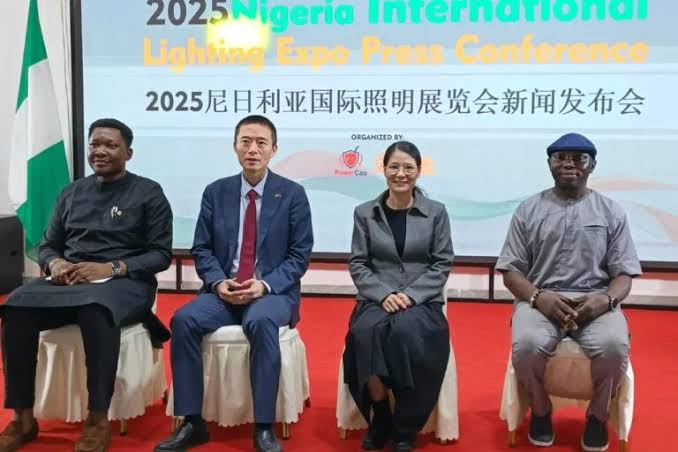
At a news conference on Saturday, Ms Lisa Lin, General Manager of Zhongshan Company Ltd., said the event would hold at the Landmark Centre, Lagos.


She said the Expo would explore the theme ‘Zero-Carbon Lighting: Supporting Nigeria’s Energy Transition Goals’, which aligns with the nation’s energy transformation agenda.


Lin noted that the exhibition would provide a platform to showcase low-carbon and smart lighting technologies, while boosting Nigeria’s lighting industry and enhancing global influence.


She disclosed that the exhibition would attract nearly 100 top exhibitors, including C-TORCH, AKT, VELLMAX, OKELI, BLUE CARBON, SHINNINGSTAR and VANGE SOLAR.


According to her, the Expo will cover 3,000 square metres and host over 5,000 professional visitors and buyers from Nigeria and neighbouring countries.


“The Expo will feature commercial, decorative and outdoor landscape lighting, alongside products for industrial use, stage entertainment, transport, medical applications and vehicle lighting.


“It will also showcase solar-powered lighting, LED innovations, intelligent display systems, advanced manufacturing materials and precision testing equipment,” she added.


Lin stressed that the Expo would drive regional industrial collaboration and position Nigeria as a gateway to the African market.


Also speaking, Mr Emmanuel Akintubosun, Senior Special Assistant to the Lagos State Governor on Energy, reaffirmed government’s commitment to energy transition.


He said this had been demonstrated through solar street lights, energy-efficient public lighting and integration of smart technology.


Akintubosun urged collaboration with international manufacturers and technology providers to foster innovation and create opportunities for Nigeria’s energy sector.


On his part, Mr Xu Fan, Director of Commercial and Trade Affairs at the Chinese Consulate in Lagos, said the Expo would enhance Nigeria-China trade relations.


He noted that demand for high-quality, energy-efficient and environmentally friendly lighting products in Nigeria was growing as consumers increasingly embraced smart and sustainable solutions.


Xu added that China was ready to strengthen partnerships with Nigeria through zero-tariff treatment and deepen bilateral ties under the China-Nigeria strategic partnership framework.


“China is willing to sign an economic partnership agreement with Nigeria, implementing zero-tariff treatment for all tariff lines.


“Through concrete actions, we aim to deepen the China-Nigeria strategic partnership and build a high-level community with a shared future,” Xu said.

Gov Okpebholo Rescues Accident Victims On Benin–Auchi Road 

0

Gov Monday Okpebholo of Edo on Saturday was personally involved in the rescue of victims of a ghastly motor accident along the Benin-Auchi Road after the bypass.

Okpbeholo was en route to Irrua in Esan Central Local Government Area of the state with his entourage when he encountered a heavy gridlock and immediately stopped to assess the situation.

Upon arrival at the accident scene, he found several victims in critical condition, many bleeding profusely, while bystanders were recording videos instead of offering assistance.

Moved by the dire state of the victims, Sen Okpebholo ordered two of his security Hilux vehicles to be converted into emergency transport vehicles.

He personally supervised as injured passengers, including a woman with severe injuries, were lifted into the waiting vehicles and rushed to the hospital for urgent treatment.

Eyewitnesses reported that the accident was caused by the driver of a white Toyota Venza, with registration number ABUJA GWA 50 AW, who drove against traffic, resulting in a collision involving four vehicles.

The vehicles were three commercial mini-buses loaded with passengers and the Venza.

The impact left scores injured and caused a major traffic gridlock.

The governor remained at the accident scene until he was assured that the victims were safely conveyed to a medical facility under the escort of another security vehicle.

His swift action drew applause from motorists, residents, and sympathisers, who hailed him as a humane and God-fearing leader who prioritised the sanctity of life.

An eyewitness praised the governor’s actions, saying, “Before the governor arrived, people were only taking pictures and videos. But he came, took charge, and ensured the victims were rescued.

“This is the kind of leader we need; one who leads with compassion and action.”

The governor’s intervention has been widely appreciated, showcasing his commitment to the welfare of his people.

Rivers State University Don Identifies Impediments To Nigeria’s Economic Growth

0

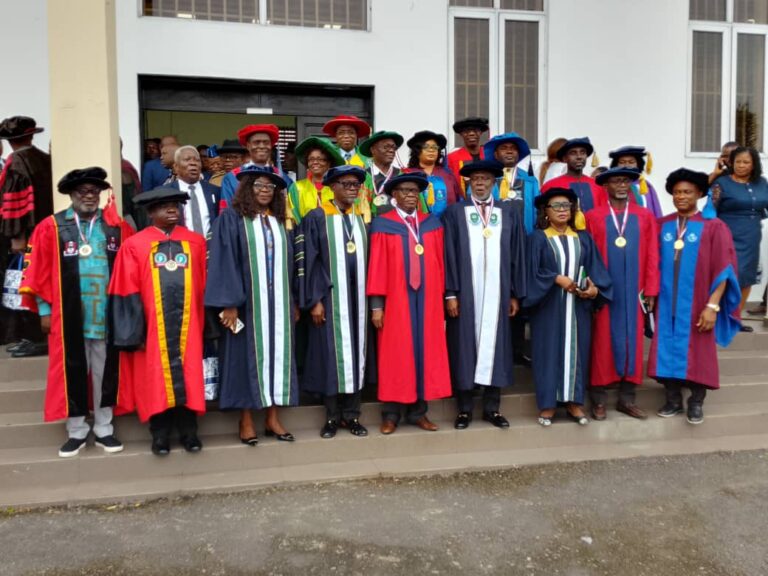
A lecturer in the Rivers State University, Port Harcourt, Professor Loveday Asonye Nwanyanwu, has identified reasons why Nigeria’s economy has failed to show remarkable improvement in the last eleven years. This is in spite of policies and programmes initiated and aimed at improving and stabilising the economy.

According to him, some of the policies initiated by various administrations aimed at resuscitating the economy, including the privatisation of over 121 public enterprises between 1988 and 2009, the removal of subsidy on fuel on May 29, 2023 and the floating of the Naira in the Nigerian Foreign Exchange Market by the Central Bank of Nigeria in June 2023, among others have failed to make significant impact on the economy.

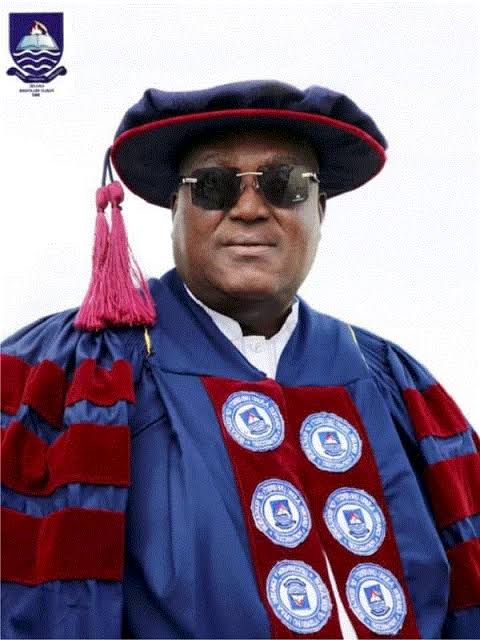
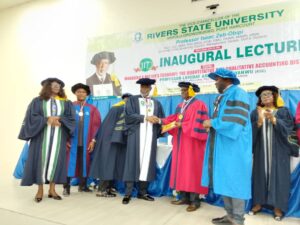
Vice Chancellor, Professor Isaa Zeb-Obipi congratulating Professor Nwanyanwu.

Professor Nwanyanwu stated that for the periods 1992-2008, a study of the impact of financial deepening on economic growth, which drew evidence from Nigeria, found that “broad money velocity and market liquidity promote economic growth while money stock diversification, economic volatility and market capitalization do not,” adding that those studies failed to consider “accountant’s ethics” as a major factor for economic growth.

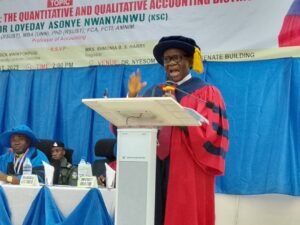
Professor Nwanyanwu, who is of the Department of Accountancy in the Faculty of Administration and Management of the University, made these disclosures while delivering his Inaugural Lecture titled, “Managing A Nation’s Economy: The Quantitative And Qualitative Accounting Distinction,” on Wednesday, August 27, 2025 at the university.

He recognised that for a nation to measure its economic growth, which is through its Gross Domestic Product, that ethical values, a qualitative accounting characteristics must be incorporated as an in-built moderator of human behaviour in the development and implementation of economic policies.

The university Don noted that Accountant’s ethics have the capacity to minimize or eliminate fraud in the environment. He further noted that “an economy devoid of ethics, as seen from the accountant’s perspective of integrity, objectivity, competence, due care and diligence, confidentiality, and professional behaviour aimed at countering negative national value systems of money, ego, power, coercion, ideology, and greed, is an economy devoid of sustainability.”

Prof. Nwanyanwu

Prof. Nwanyanwu, whose model for sustainable national economy, states that budgets and other economic statistics are enriched with two inputs: qualitative accounting measures (accountant’s ethics) and qualitative accounting tools and techniques. He said that the application of this model produces economic blueprints that sustain economic growth and economic development because “it considers today, emphasizes tomorrow and focuses on the people.”

According to him, no meaningful economic policy can survive in the absence of accounting ethics, which is also part of human and business ethics. “If those entrusted with the management of our economy lack integrity, honesty, objectivity, transparency, accountability and reputation, economic blueprints will be devoid of relevance, faithfulness, comparability, verifiable, timeliness, and understandabilty,” he stated.

Prof. Nwanyanwu further stated that accountants who maintain and audit the financial statements of all sectors of the economy, including manufacturing, education, banking and other financial institutions, agriculture, health, oil and gas information and technology, real estate, government ministries, departments and agencies, must rise up to resist fraudulent acts from within and without.
This they can do by instituting and implementing internal control systems and state legislation. Specifically, Prof Nwanyanwu noted that the establishment of institutional structures such as external audit, internal audit, and fraud agencies.

Though he acknowledged that the establishment of fraud control agencies like the Economic and Financial Crimes Commission (EFCC), Independent Corrupt Practices and Other Offences Commission (ICPC) Code of Conduct Bureau, Code of Conduct Tribunal, Fiscal Responsibility and Public Procurement Acts were aimed at safeguarding the economy from corrupt officials and enhance good governance, “the weight of the eroded value system makes these machineries look like a mirage.”

He lamented that , though little achievements have been made in the battle against fraud, “the attainment of good corporate governance and elimination of fraud will remain an illusion until the national value system is reversed and integrity, honesty, regard for productivity, knowledge and creativity, love for the nation and fear of public fund is restored.”

According to Prof. Nwanyanwu, for the economy of Nigeria to become sustainable, ethics must play a key role. He further recommended that “people entrusted with managing and implementing the nation’s economic policies should adopt critical realism or triangulation in generating data.

He also recommended that persons to be appointed to positions of governance and authority should be technocrats that possess honesty and integrity. “This is based on the realisation that the Fiscal health of the treasury depends not only on developing an economically sound policy that increased taxable capacity of the economy through economic development but also on honest and efficient financial management,” he said.

Other measures recommended by Prof Nwanyanwu include stoppage of the “dollarization of the economy, which causes inflation, leads to increase in interest rates and devalues the local currency.

He also recommended the establishment of a legislation prohibiting companies from remunerating their employees in foreign currencies, among other recommendations.

Speaking at the end of the lecture, the Vice Chancellor of the University, Professor Isaac Zeb-Obipi commended the lecturer for a painstaking and well delivered lecture.

He said that the issue of ethics in dealing with financial figures is critical while it is important for government officials and leaders in all sectors to re-examine their conducts to ensure that they comply with expectations of the rules of engagements.

By: Celestine Ogolo