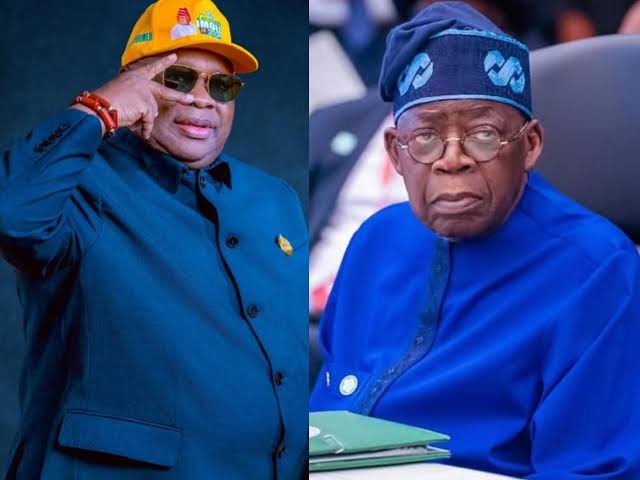
President Bola Ahmed Tinubu has congratulated Osun State Governor, Ademola Adeleke, on his re-election, describing the victory as a confirmation of the confidence reposed in him by the people of the state.
Tinubu, in a statement following the outcome of the election, said Adeleke’s victory was a fitting assurance that democracy would continue to flourish in Nigeria under the All Progressives Congress (APC)-led administration.
The President said he had earlier called Adeleke to congratulate him on his electoral victory, while wishing him success as he prepares to lead Osun State for another four years.
He urged the governor to use his renewed mandate to unite the people of the state and mobilise them towards growth, stability and socio-economic development, irrespective of their political affiliations.
“Now that he has won, Governor Adeleke must unite the people of Osun State and rally them for growth, stability, and social and economic progress, regardless of the political choices they made at the election,” Tinubu said.
The President also commended other contestants in the election for the courage and discipline they displayed throughout the electoral process, saying their participation strengthened Nigeria’s democratic culture.
According to him, the outcome of the election reflected the will of the people of Osun State and demonstrated the resilience of democracy in the country.
Tinubu further commended the Independent National Electoral Commission (INEC) and security agencies for conducting what he described as a peaceful and transparent election that produced a clear winner.
He prayed for the continued growth and strengthening of democracy in Nigeria and wished Adeleke a successful second term in office.
“May our democracy continue to thrive and be strengthened,” the President said.
He also prayed for the continued progress of the Federal Republic of Nigeria.
How Adeleke ‘Bulldozed’ APC, Others to Secure Second Term in Osun
Governor Ademola Adeleke has secured a second term in office after defeating the All Progressives Congress (APC) candidate, Bola Oyebamiji, in the 2026 Osun State governorship election.
The victory was built on Adeleke’s strong performance in his traditional strongholds, sweeping victories across key local government areas (LGAs) and, most significantly, the huge vote margins he accumulated in areas where his support was strongest.
Results collated by the Independent National Electoral Commission (INEC) showed Adeleke, who contested on the platform of the Accord Party, winning 19 of the 30 LGAs, while the APC secured 11.
The African Democratic Congress (ADC), whose candidate was Najeem Salaam, finished a distant third.
At the end of the collation, Accord polled 511,067 votes against APC’s 444,815, giving Adeleke a winning margin of 66,252 votes. ADC garnered 17,180 votes.
But beyond the final figures, Adeleke’s victory reflected a campaign built around confidence and an apparent determination to withstand the political machinery deployed by the APC.
Days before the election, the governor had described himself as a “bulldozer”, insisting that he was not intimidated by federal influence or the governors who supported his opponent.
‘I am a bulldozer’
Speaking at the Arise Townhall Meeting ahead of the election, Adeleke declared his readiness to confront the political forces backing the APC candidate.
“I am a bulldozer. I am talk and do. I am not afraid of federal might and governors backing the APC candidate. If they like, they should bring all the governors,” he said.
The statement became one of the defining moments of Adeleke’s campaign, as the governor sought to portray the election as a contest that would ultimately be decided by Osun voters rather than political influence from outside the state.
The results suggest that he succeeded in converting that confidence into votes.
Ede delivers massive advantage
Perhaps the most decisive factor in Adeleke’s victory was the scale of his victories in some key LGAs.
The Ede axis was particularly crucial.
In Ede-North, Accord secured 35,427 votes against APC’s 10,283, giving Adeleke a massive 25,144-vote advantage.
The governor performed even better in Ede-South, where Accord polled 26,188 votes against APC’s 6,219, representing a margin of 19,969 votes.
Together, the two LGAs produced 61,615 votes for Accord against APC’s 16,502.
That translated to a net advantage of 45,113 votes for Adeleke from just two LGAs — a margin that would prove difficult for APC to recover elsewhere.
Osogbo strengthens Adeleke’s lead
The state capital also contributed significantly to the governor’s performance.
In Osogbo LGA, Accord polled 36,480 votes against APC’s 30,474, giving Adeleke a 6,006-vote advantage.
The result was significant given Osogbo’s political importance and the strength of APC’s support in the area.
The ADC scored 1,503 votes in Osogbo, its strongest performance among the 30 LGAs in the supplied results.
The governor also established a strong advantage across much of the Ife axis.
Accord won Ife-East with 27,201 votes against APC’s 18,600, a margin of 8,601 votes.
In Ife-Central, Adeleke polled 21,171 votes against APC’s 15,913, while Ife-North produced 13,879 votes for Accord against APC’s 9,613.
APC, however, won Ife-South with 14,678 votes against Accord’s 13,507.
Taken together, the four Ife LGAs gave Accord 75,758 votes against APC’s 58,804, producing a combined advantage of 16,954 votes.
Other victories widen gap
Adeleke’s winning coalition extended beyond Ede, Osogbo and Ife.
Accord won Egbedore with 19,278 votes against APC’s 11,194, producing an 8,084-vote margin.
In Iwo, Adeleke scored 27,085 votes against Oyebamiji’s 19,660, giving him a 7,425-vote advantage.
The governor also won Oriade with 21,343 votes against APC’s 14,863, a margin of 6,480 votes.
These victories, combined with his overwhelming performance in Ede and strong showing in other parts of the state, helped build the statewide cushion APC could not erase.
APC remains formidable
Despite losing the election, the results showed that APC remained a major political force in Osun.
Oyebamiji won 11 LGAs and recorded some substantial victories.
His strongest performance in the supplied results came in Irewole, where APC polled 29,972 votes against Accord’s 10,934, giving the party a 19,038-vote advantage.
APC also won Boripe by 19,963 votes to Accord’s 12,448, a margin of 7,515 votes.
The party further carried Olorunda, Ilesa-East, Ife-South, Ola-Oluwa, Isokan, Obokun, Atakumosa-West and Atakumosa-East.
But while APC won several LGAs convincingly, the margins were insufficient to neutralise Adeleke’s larger victories.
The arithmetic was simple: Adeleke won fewer votes in some councils but more than compensated with overwhelming margins in his strongest areas.
The election demonstrated that the number of LGAs won was not, by itself, decisive.
Adeleke won 19 LGAs and accumulated 511,067 votes, while APC’s 11 winning LGAs contributed to its statewide total of 444,815 votes.
The resulting difference was 66,252 votes.
Adeleke’s 45,113-vote advantage from Ede-North and Ede-South alone represented a substantial portion of that statewide lead.
Similarly, his combined advantage across the four Ife LGAs stood at 16,954 votes.
These figures explain why APC’s victories in areas such as Irewole and Boripe could not close the gap.
For instance, APC’s 19,038-vote advantage in Irewole was significant, but Adeleke’s combined margin in the two Ede LGAs was more than twice as large.
ADC fails to challenge frontrunners
The ADC, despite fielding a candidate in the election, failed to mount a serious challenge to the two leading parties.
The party polled 17,180 votes across the 30 LGAs.
Its strongest performance in the supplied results came in Ejigbo, where it scored 5,053 votes. It also recorded 1,503 votes in Osogbo, 935 in Ife-East and 747 in Ife-Central.
The figures showed that the contest had effectively become a two-horse race between Accord and APC, despite the participation of 13 candidates.
The two leading parties collectively secured 955,882 votes, dwarfing the ADC’s statewide total.
Another feature of Adeleke’s victory was the geographical spread of his support.
His 19 victories cut across different parts of the state, rather than being concentrated in a single political bloc.
He carried Ede-North, Ede-South, Osogbo, Ife-Central, Ife-East, Ila, Boluwaduro, Irepodun, Ayedire, Ejigbo, Ayedaade, Ifelodun, Ife-North, Ilesa-West, Egbedore, Orolu, Oriade, Ifedayo, Odo-Otin and Iwo, based on the results supplied.
That spread gave the governor a broad electoral base and ensured that APC could not rely on its strongholds to overturn his overall advantage.
From ‘bulldozer’ boast to ballot-box victory
Before the election, Adeleke’s declaration that he was a “bulldozer” was presented as a direct challenge to the political machinery supporting his opponent.
The ballot-box figures have now given the statement a numerical context.
The governor did not merely win more LGAs than APC; he recorded exceptionally large margins in some of his strongest areas while remaining competitive in several others.
APC, despite its institutional strength and 11 LGA victories, could not convert those wins into enough votes to close the statewide deficit.
The final figures tell the story:
Accord — 511,067 votes
APC — 444,815 votes
ADC — 17,180 votes
Adeleke’s winning margin — 66,252 votes
Ultimately, Adeleke’s second-term victory was built on where he won, how decisively he won and the size of the margins he created.
Ede-North and Ede-South provided the biggest cushion, while Osogbo and the Ife axis further strengthened his position. Victories in Egbedore, Iwo, Oriade and other LGAs widened the gap.
The governor had promised to confront the political heavyweights backing his opponent.
The results showed that, at least in the ballot-box arithmetic of the 2026 Osun governorship election, his “bulldozer” strategy had delivered.