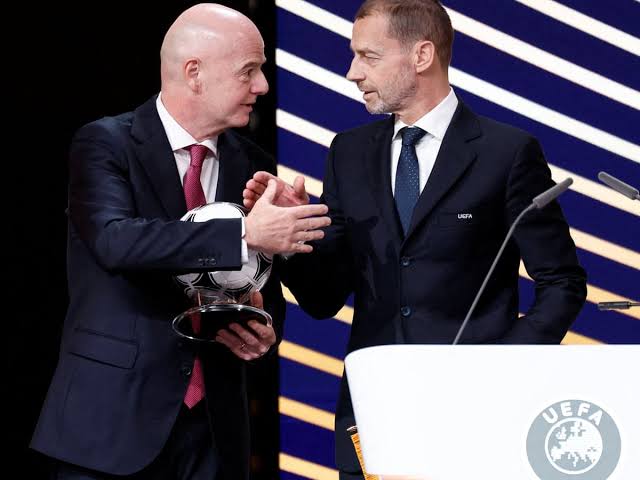
A major power struggle is brewing in world football after UEFA publicly declared it had lost confidence in FIFA President Gianni Infantino over his failed attempt to sell a stake in the FIFA World Cup, setting the stage for a possible leadership battle ahead of next year’s FIFA elections.
The controversy centres on Infantino’s reported plan to sell a £3.1 billion stake in the World Cup’s commercial rights to a consortium of private investors led by Josh Kushner, a relative of US President Donald Trump. The proposal reportedly collapsed on Friday following widespread opposition from football stakeholders, forcing the FIFA chief to abandon the initiative.
In a strongly worded statement issued on Saturday, UEFA accused the FIFA leadership of pursuing what it described as a “shabby, back-room deal” without adequate consultation.
“We cannot keep going on like this with secret schemes on fast-track timescales, cooked up by faceless individuals and of dubious benefit to the game. We must identify those responsible and hold them to account,” UEFA said.
The European governing body added that it would consult its member associations and other continental confederations to ensure similar proposals could not be pursued without proper oversight.
“The current FIFA leadership has not only lost UEFA’s confidence but also that of many other members of the football family,” the statement added.
The unprecedented rebuke has fuelled speculation over whether Infantino could be removed from office before the next FIFA presidential election, where he is expected to seek a fourth term.
However, despite UEFA’s strong position, translating political outrage into Infantino’s removal may prove considerably more difficult.
Under FIFA statutes, a vote of no confidence or an extraordinary process to remove a sitting president would require broad backing from FIFA’s global membership. UEFA controls 55 of FIFA’s 211 member associations, more than enough to surpass the reported threshold of 46 associations required to initiate proceedings.
Yet initiating the process is only the first hurdle.
Any attempt to unseat Infantino would ultimately depend on securing support from other continental confederations, particularly the Confederation of African Football, Asian Football Confederation and Confederation of North, Central America and Caribbean Association Football, where Infantino has traditionally enjoyed significant backing.
Without a broad coalition extending beyond Europe, UEFA’s declaration may amount to a powerful political statement rather than a decisive challenge to the FIFA president’s leadership.
Even so, the episode represents one of the most serious confrontations between UEFA and FIFA in recent years, exposing deep divisions over football’s governance, commercial direction and transparency.
Whether UEFA can rally enough global support to force a leadership change remains uncertain. But its public withdrawal of confidence has undoubtedly intensified pressure on Infantino and ensured that FIFA’s governance will dominate discussions in the build-up to next year’s presidential election.