



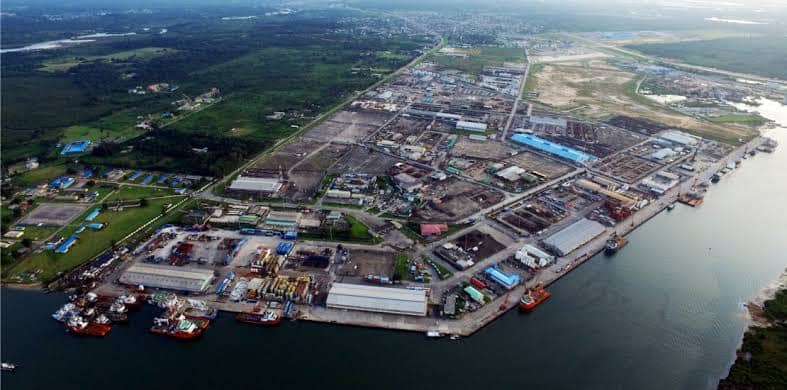
Maritime workers and other stakeholders at the Onne Port in Rivers State have issued a four-day ultimatum to the Federal Government to address the deplorable condition of roads within the port and suspend the controversial E-Call Up levies on trucks, threatening to shut down operations if their demands are not met.
The threatened industrial action, which could commence on Monday, August 17, has raised concerns over the potential economic consequences of a shutdown at one of Nigeria’s major maritime gateways, particularly for the oil and gas industry, importers, exporters, customs agents, transporters and thousands of businesses dependent on the port.
The Maritime Workers Union of Nigeria (MWUN), Association of Nigeria Licensed Customs Agents (ANLCA), Onne youths and other stakeholders said the worsening condition of the port’s internal roads, coupled with what they described as arbitrary E-Call Up charges and inadequate truck holding bays, had made operations increasingly unsafe and difficult.
The Chairman of MWUN, Eastern Ports, Uche Ogbu, issued the ultimatum on Wednesday at a joint press conference in Onne.
Ogbu warned that unless the Federal Government intervened before the expiration of the ultimatum, the unions and other stakeholders would down tools and halt the E-Call Up operations.
“We are the people carrying the burden of the E-Call Up levies. We, the maritime workers, in collaboration with other stakeholders and Onne communities, are going to down tools from Monday,” he said.
He added that the workers would enter the port and ensure that E-Call Up operations were stopped.
“We are going to stop the E-Call Up operations by Monday. I am promising you that,” Ogbu stated.
The planned shutdown could have wider ramifications beyond the immediate port community, as prolonged disruption of cargo movement through Onne could affect supply chains, government revenue, industrial production and the cost of goods and services.
Onne Port serves as a major maritime hub for Nigeria’s oil and gas activities and other commercial operations in the Niger Delta. Any prolonged interruption to cargo clearance and movement could therefore reverberate across sectors already facing high logistics and operating costs.
Ogbu accused the Nigerian Ports Authority (NPA) of failing to provide adequate loading and holding bays for trucks before implementing the E-Call Up system, despite repeated appeals from stakeholders.
He argued that the combination of poor roads and the absence of sufficient truck holding facilities had created dangerous conditions for port users.
“The sorry state of the Onne internal roads and the haphazard ways trucks are lined up for E-Call Up levies is affecting the smooth operation of business at the port,” he said.
According to him, the NPA should communicate the challenges confronting the Eastern ports to the Federal Government and the Ministry of Marine and Blue Economy rather than focusing primarily on revenue collection.
“The NPA is the eyes of the Federal Government. We are not saying that NPA should take action that is beyond their capacity. They should know how to reach out to the Ministry of Marine and Blue Economy, reach out to the Managing Director of NPA and, through that channel, they can get to the Presidency about our plight,” Ogbu said.
He accused the authorities of being more interested in the E-Call Up system than addressing the infrastructure crisis confronting the port.
Also speaking, the Onne Chapter Chairman of ANLCA, Chief Ifeanyi Isikaku, called on the Federal Government to channel part of the revenue generated from the port into repairing its access roads.
Isikaku said customs revenue from the Onne Port Command between January and July 2026 stood at approximately N439 billion, while the Oil and Gas Free Zone Customs generated about N48 billion within the same period, bringing the combined figure to approximately N487 billion.
He argued that a fraction