



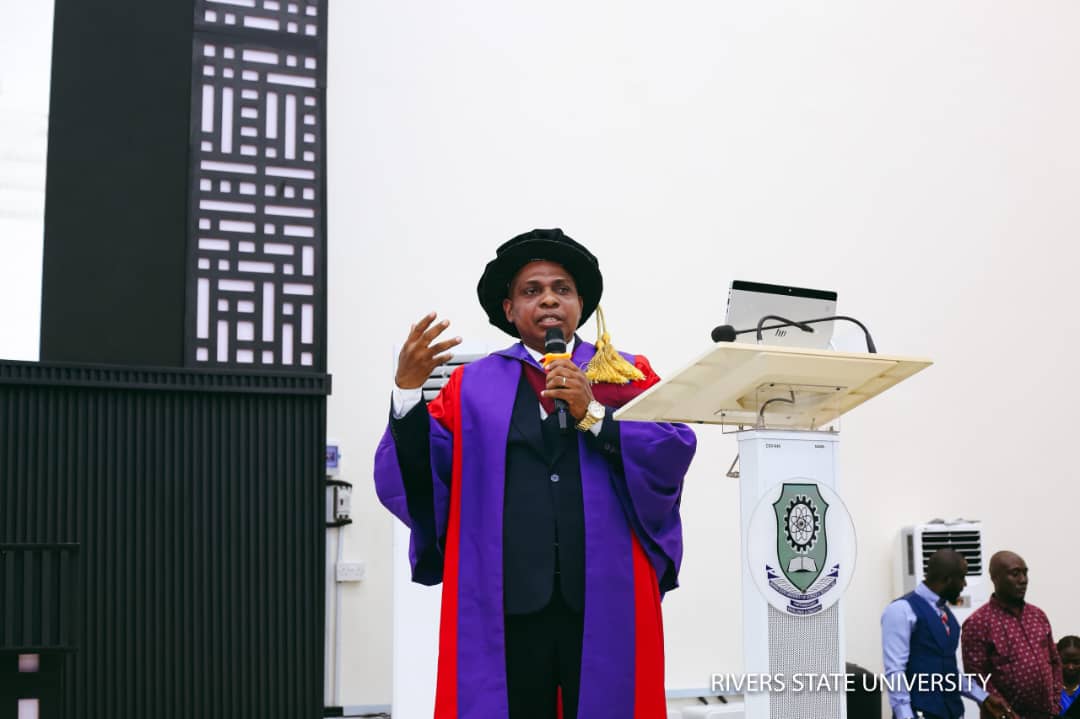
A Professor of Materials Chemistry at Rivers State University (RSU), Port Harcourt, Joshua Lelesi Konne, has unveiled a series of pioneering nanotechnology innovations with the potential to transform crude oil remediation, clean energy production and environmental sustainability in Nigeria.
Presenting the university’s 135th Inaugural Lecture, titled “Naked Coated Nanoseeds: Paradoxical Pathways to Innovations in Catalysis, Energy and Environment,” Prof. Konne highlighted years of interdisciplinary research that has produced novel nanomaterials capable of addressing some of the country’s most pressing environmental and industrial challenges.
The lecture, delivered on Wednesday at the university campus, focused on how nanoparticles described as “naked coated nanoseeds” have been harnessed to develop innovative catalysts and environmentally friendly technologies spanning chemistry, engineering and environmental science.
According to the scholar, one of the most significant outcomes of the research was the development of Starch Stabilised Magnetic Nanoparticles (SSMNPs) from cassava wastewater, a breakthrough achieved in 2014. The technology proved more effective than previously reported methods in removing nickel porphyrin ions from crude oil obtained from the Bomu Oilfield in Gokana Local Government Area of Rivers State.
He disclosed that the research further broke new ground in 2016 when Magnetic Nanoparticles (MNPs) and Starch Stabilised Magnetic Nanoparticles were successfully deployed as Fenton-like catalysts for the remediation of crude oil spill sites, recording superior performance to the conventional Fenton oxidation process widely used for environmental cleanup.
Konne said the findings demonstrate how locally developed nanotechnology can provide cost-effective and sustainable solutions to pollution associated with Nigeria’s oil and gas industry while also advancing clean energy research.
The professor explained that nanomaterials exist in several forms, including nanoparticles, nanorods, nanotubes, nanowires and thin films, all measuring up to one-billionth of a metre.
Despite their microscopic size, he said they possess exceptional chemical and physical properties that make them valuable in catalysis, energy conversion and environmental applications.
Beyond oil spill remediation, the researcher listed several pioneering achievements, including the characterisation and application of Kono Boue clay as a catalyst in biodiesel production, precursor for Zeolite-X production, water filtration composites with activated carbon, enhanced crude oil degradation and improved oil recovery techniques.
He also disclosed breakthroughs in producing starch-coated hydrogenated zinc oxide, hydrogenated copper oxide and hydrogenated nickel oxide, all of which demonstrated enhanced catalytic properties in hydrogenation reactions.
In another innovation, he said his team was the first to utilise plantain peel ash as an alkali source in synthesising binary metal oxides such as zinc oxide, copper oxide and nickel oxide, opening new opportunities for converting agricultural waste into valuable industrial materials.
Despite the scientific advances, Konne lamented the absence of a standard nanotechnology laboratory in Rivers State and the South-South region, noting that students spend millions of naira annually conducting specialised analyses at Umaru Musa Yar’Adua University in Katsina State.
He called for the establishment of a Central University Laboratory and a Centre for Nanotechnology at Rivers State University to strengthen advanced research.
The professor also urged greater investment in the development of local solid minerals, particularly clay deposits in Kono Boue, Chokocho and Omoku, while calling on the Hydrocarbon Pollution Remediation Project (HYPREP) to urgently establish soil treatment facilities for cleaning heavily oil-polluted sites.
He further appealed to the Rivers State Government to prioritise industrial development by engaging young technocrats capable of driving innovation and increasing funding for interdisciplinary research to boost the university’s global ranking and national competitiveness.
Representing the Vice-Chancellor, Prof. Isaac Zeb-Obipi, the Deputy Vice-Chancellor (Administration), Prof. Blessing Jaja, commended the inaugural lecturer for presenting complex scientific concepts with clarity and elegance.
Jaja said the research aligns with the university’s vision of promoting environmentally sustainable innovations, particularly in the remediation of contaminated soils and the application of nanotechnology in the biosciences.
He disclosed that the university management is committed to establishing a central research laboratory, adding that Prof. Konne would play a key role in its development.
He described the lecture as a demonstration of how cutting-edge research can provide practical solutions to environmental degradation, industrial development and sustainable energy challenges confronting Nigeria.