



As the race toward the 2027 governorship election in Rivers State gradually gathers momentum, the political atmosphere is already reflecting what may become one of the most defining contests in the history of the state. More than a battle between political parties, the election is shaping into a referendum on political control, ethnic balancing, leadership independence and the future direction of Rivers politics after years of turbulence.
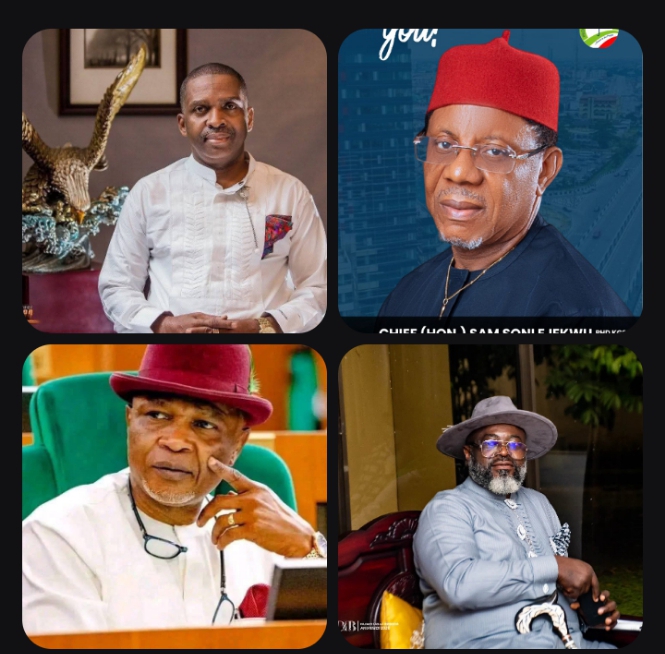
Four major figures have emerged prominently in early political calculations: Dumo Lulu-Briggs who is struggling for the ticket of the NDC, Kingsley Chinda of the APC, Sam Ejekwu of the PDP and Gabriel Pidomson of the ADC. Each represents a different political tendency, ideological perception and power structure within the state.
Perhaps the biggest issue that may determine the election is the growing public resistance to godfatherism. Since the political crisis involving Siminalayi Fubara and Nyesom Wike erupted, many Rivers people have become increasingly sensitive to the question of whether the next governor will govern independently or merely function as a political extension of another power centre.
This perception heavily affects Kingsley Chinda despite his obvious credentials and political experience. Chinda is not an unknown figure in Rivers politics. His long legislative experience, leadership within the House of Representatives and innovations as Chairman of the Public Accounts Committee have earned him recognition beyond the state. He possesses deep political networks, intellectual depth and administrative exposure.
However, the major challenge confronting his candidacy may not be competence, but perception. A significant section of the electorate views him as too closely aligned with Wike and fears that his emergence could represent a continuation of indirect political control over the state.
That sentiment may become stronger because many supporters of Governor Fubara, particularly among riverine communities, feel deeply aggrieved over what they perceive as the deliberate denial of the governor’s second-term opportunity.
In their view, replacing Fubara with another upland candidate — particularly one linked to the same political structure — could be interpreted as political exclusion and disrespect to riverine interests.
Ethnic balancing may therefore become a critical factor in the election.
There is already growing quiet resentment in some parts of the state over the perceived dominance of the Ikwerre ethnic bloc in the political leadership structure of Rivers State.
Though many acknowledge the political sophistication and organizational strength of the Ikwerres, there are concerns that power rotation and inclusiveness are gradually being undermined. Such sentiments could influence voting patterns across Kalabari, Ogoni, Ekpeye, Etche, Ogba, Ikwerre-speaking minorities and other blocs seeking broader participation in power.
This environment may create opportunities for candidates perceived as more independent and consensus-driven.
Chief Dumo Lulu-Briggs may enter the race ,if he secures the NDC ticket, with strong credentials in business, philanthropy and private sector leadership. His extensive investments, grassroots appeal and detribalised posture may resonate with voters seeking economic revival and broader inclusion. His challenge, however, may lie in translating elite goodwill and personal popularity into a formidable statewide political structure capable of competing against the established machinery of larger parties.
Gabriel Pidomson, on the other hand, appears to represent the intellectual and reform-oriented alternative. Though not widely tested in high elective office, his public messaging emphasizes inclusion, competence, accountability and unity.
His calm disposition and perceived independence may appeal to younger voters, professionals and citizens tired of confrontational politics.
However, his greatest hurdle may be organizational reach and whether the ADC possesses enough grassroots strength to compete effectively against the entrenched PDP and APC networks.
Sam Ejekwu’s emergence as PDP candidate has generated mixed reactions. While he possesses grassroots political experience and longstanding loyalty within the Wike political family, many observers see his candidacy as tactical rather than definitive.
Speculation persists that his role may ultimately be to protect political interests pending future alignments within the broader Rainbow Coalition. Whether that perception weakens his credibility remains to be seen.
Ultimately, the 2027 election in Rivers State may revolve around one central question: do the people want continuity of political control by powerful godfathers, or do they desire a governor with independent authority and a fresh developmental vision?
After years of political instability, economic slowdown and governance distractions, many Rivers people appear exhausted by endless supremacy battles. The electorate may therefore prioritize competence, inclusiveness, peace and economic revival over political loyalty or ethnic dominance.
The outcome will depend on who successfully convinces the people that he can restore stability, attract investment, create jobs and govern for the collective interest of Rivers State rather than for any political empire.