



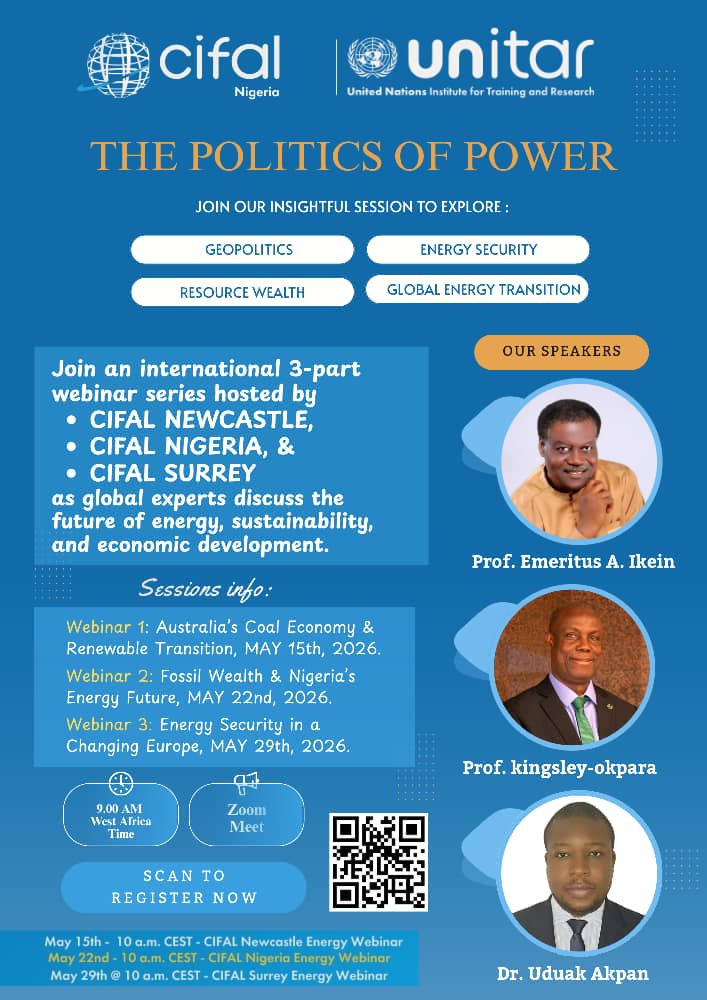
International scholars and policy experts have urged Nigeria to convert its vast oil and gas wealth into sustainable national prosperity before aggressively pursuing the global transition to renewable energy, warning that the country risks deepening poverty and inequality if the shift is poorly managed.
The call formed the central thrust of discussions at the second edition of a three-part global webinar series titled “The Politics of Power: Energy Security, Resource Wealth and the Global Energy Transition,” organised under the CIFAL Global Network and the United Nations Institute for Training and Research (UNITAR).
Hosted by CIFAL Nigeria at Rivers State University, Nkpolu-Port Harcourt, the session examined the challenges facing Nigeria as the world gradually diversifies away from fossil fuels under growing climate policies and environmental pressures.
The scholars argued that while the global transition to cleaner energy is inevitable, Nigeria must first address its developmental crisis, weak infrastructure, poor governance and decades of neglect in oil-producing communities before fully embracing the new energy order.
Leading the discussion, Professor Augustine A. Ikein, Professor Emeritus at the Federal University, Otuoke, Bayelsa State, said the debate should not be limited to oil and gas alone, but should focus on economic development across Africa and the wider developing world.
According to him, the history of the Niger Delta reflects a long cycle of exploitation, beginning from the slave trade era to crude oil production.
“Historically, black gold was linked to the slave trade. The Niger Delta was a major route for the transportation of slaves to America and today the region remains the base of Nigeria’s liquid black gold,” he said.
Professor Ikein noted that the discovery of crude oil in Oloibiri in 1956 transformed Nigeria into a major global energy player, but lamented that the communities producing the wealth had remained impoverished and environmentally devastated.
“The world is entering a new phase driven by climate policies and diversification away from fossil fuels. This transition is unstoppable and Nigeria must rise to the challenge,” he stated.
He, however, maintained that fossil fuel resources could still serve as a pathway to development if revenues were properly managed and invested in infrastructure, industrialisation and social welfare.
“The challenge for Nigeria is how to use fossil fuel resources for economic growth. Fossil fuel can still be a pathway to national development if revenues are properly managed through strong institutions and strategic social investment,” he said.
Professor Ikein stressed the need for strategic intelligence and careful planning in navigating the transition to renewable energy.
“We export energy abroad but still lack reliable electricity at home. Small businesses continue to suffer. Energy success should not only be measured by export revenues but by how well energy serves citizens,” he added.
He further lamented that despite sustaining the Nigerian economy for decades and contributing immensely to national development, including the construction of Abuja, the Niger Delta remained trapped in underdevelopment, pollution and social unrest.
“The region bears the burden of crude oil production, yet remains underdeveloped.
Environmental degradation, youth restiveness and poverty continue to define the region despite its contribution to national prosperity,” he said.
Professor Ikein accused multinational oil companies of abandoning polluted onshore communities while shifting operations offshore.
“If proper attention had been given to the oil-producing communities, we would not have witnessed this level of degradation and pollution,” he said.
Drawing comparisons with countries such as Malaysia, he argued that Nigeria had failed to convert its resource wealth into sustainable prosperity and long-term savings.
“Malaysia used its resources to create wealth and establish post-oil savings. Nigerian government must stand out for the suffering population,” he added.
Also speaking, Professor Kingsley Okpara of the Institute of Geosciences and Environmental Management (IGEM), Rivers State University, described the Niger Delta as one of the most polluted wetlands in the world despite being Africa’s largest oil and gas-producing region.
“The Niger Delta is the economic engine and powerhouse of Nigeria, yet many communities remain in darkness. More than 50 per cent are not connected to the national grid despite decades of oil wealth,” he said.
According to him, more than 50 years of oil extraction, gas flaring and repeated oil spills had devastated ecosystems and livelihoods across the region.
“Over 13 million oil spills have occurred in Nigeria, making fishing almost unbearable in many communities,” he stated.
Professor Okpara disclosed that scientific studies had revealed alarming levels of toxic substances in seafood consumed by coastal residents.
“Researchers discovered that the level of pollution from polycyclic aromatic hydrocarbons is among the highest globally. Chromium levels were recorded at 374 against the acceptable level of 1.5, while lead was 67 against the acceptable level of one,” he said.
He warned that the pollution crisis had triggered serious health implications, including increased cancer risks and declining life expectancy.
“There is need for serious monitoring of human blood samples because the cancer risk is high. Life expectancy in the Niger Delta is about 49 years,” he added.
Okpara criticised the politics surrounding oil governance in Nigeria, saying host communities had remained largely excluded despite existing legal provisions.
“The International Oil Companies are major players in the politics of oil. Communities are left behind despite provisions such as the three per cent host community fund under the Petroleum Industry Act,” he said.
He maintained that the current 13 per cent derivation formula was insufficient considering the environmental burden carried by the communities.
“The oil-producing communities must be carried along, otherwise more crises will erupt,” he warned.
On renewable energy, he said Nigeria possesses the capacity to transition to solar energy but warned that economic bottlenecks and social tensions would accompany the process.
Contributing, Dr. Udauak Akpan questioned whether Nigeria had truly utilised its oil and gas wealth to drive meaningful economic transformation.
“Nigeria has become an important oil and gas market globally, but the major question is whether these resources have promoted real economic development,” he said.
He decried widespread gas flaring, environmental destruction and the abandonment of rural oil-producing communities despite crude oil contributing over 70 per cent of Nigeria’s economic activities.
“The resources should be a blessing and not a curse. The life of the common person, in spite of all the crude oil wealth, has not changed,” he stated.
According to him, weak institutions, poor enforcement of laws and elite-driven politics had worsened inequality and the resource curse in Nigeria.
“We now have the super-rich and the very poor. Government is often more interested in rents than development,” he said.
Dr. Akpan also warned that Nigeria lacked the industrial and technological foundation necessary for a smooth energy transition.
“All our solar panels and renewable energy equipment are imported. Nigeria still lacks the infrastructure and systems needed to support a full transition,” he said.
He insisted that economic transformation and industrial development must come first before any large-scale renewable energy transition.
“Economic transformation should come first. That is what we are fighting for,” he concluded.
In his remarks, Bodie Beales of the CIFAL Global Network stressed the need for African voices to remain central in global discussions on energy transition and climate justice.
“Nigerian voices must be heard as the global conversation continues,” he said.