
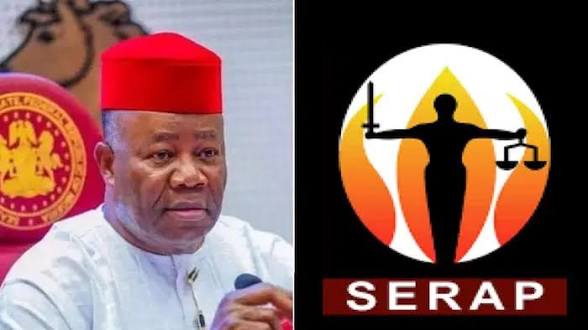
The Socio-Economic Rights and Accountability Project has called on Senate President, Godswill Akpabio, to compel the Senate’s Public Accounts Committee to publish the names and designations of all officials implicated in the alleged ₦200 trillion missing or unaccounted for from the Nigerian National Petroleum Company Limited.
In a letter dated March 21, 2026, and signed by its Deputy Director, Kolawole Oluwadare, the organisation urged the Senate leadership to ensure full transparency in the ongoing investigation, including the disclosure of audit reports, financial records, official communications, and timelines for the appearance of implicated officials and conclusion of the probe.
SERAP stressed that publishing complete records of the proceedings—such as minutes, submissions, and evidence—would enable Nigerians to independently scrutinise the process and reinforce accountability.
The Senate’s Public Accounts Committee is currently probing allegations that about ₦200 trillion is either missing or unaccounted for in NNPCL’s accounts between 2017 and 2023, amid concerns over unreconciled figures and inadequate supporting documentation. Several officials have reportedly failed to honour invitations or provide satisfactory explanations.
The group argued that transparency is critical to preventing political interference and restoring public trust, noting that the magnitude of the alleged discrepancy, whether accurate or overstated, demands a credible and open investigation.
According to SERAP, delays in the probe risk undermining public confidence and could lead to loss or distortion of key evidence. It warned that failure to act decisively may normalise impunity and weaken oversight of public resources.
The organisation further maintained that full disclosure of all relevant records would allow independent assessment of the credibility of the claims and the integrity of the investigative process, while also dispelling any perception of a cover-up.
SERAP gave the Senate a seven-day ultimatum to act on its recommendations or face legal action aimed at compelling compliance in the public interest.
The group also cited constitutional and international obligations, including provisions of the 1999 Constitution, the United Nations Convention against Corruption, and the African Charter on Human and Peoples’ Rights, which mandate transparency, accountability, and proper management of public funds.
The ongoing investigation, triggered by audit findings covering 2017 to 2023, reportedly identified about ₦210 trillion in entries within NNPCL’s accounts that lawmakers say were not properly reconciled. The figures include approximately ₦103 trillion in joint venture and operational costs, and ₦107 trillion in receivables, subsidies, and other obligations.
Despite repeated summons, the continued non-appearance of key officials has heightened tensions and raised fresh concerns over transparency in the management of Nigeria’s primary revenue source.
SERAP insisted that prompt, transparent conclusion of the investigation, alongside full disclosure of findings, is essential to ensuring accountability and safeguarding the nation’s economic future.