Home Blog Page 68

NPO to FG: Act Now Or Risk Collapse Of Nigeria’s Information Order

1

The Nigerian Press Organisation (NPO) has called on the Federal Government and the National Assembly to take urgent steps to protect Nigeria’s information ecosystem, warning that the unchecked dominance of global digital platforms poses a growing threat to national security, social cohesion and democratic governance.

In a strategic appeal addressed to the Presidency and the National Assembly, the NPO said Nigeria was approaching a critical inflexion point in its democratic and digital evolution, noting that decisions taken now would shape the future of journalism and public discourse for decades.

“The question before the Nigerian state is clear: can a democracy of Nigeria’s scale, diversity and complexity afford to surrender control of its information ecosystem to unregulated global digital gatekeepers?” the organisation said.

The NPO, which comprises the Newspaper Proprietors’ Association of Nigeria (NPAN), the Nigerian Guild of Editors (NGE), the Broadcasting Organisations of Nigeria (BON), the Guild of Corporate Online Publishers (GOCOP) and the Nigerian Union of Journalists (NUJ), stressed that its intervention was made in the public interest and not as private advocacy.

According to the organisation, the rapid expansion of global digital platforms has fundamentally altered Nigeria’s media environment, creating a structural imbalance of power that threatens the sustainability of professional journalism.
It noted that global platforms now dominate digital advertising markets, while algorithms controlled outside Nigeria increasingly determine what Nigerians see, amplify or ignore. It added that Nigerian news content is monetised at scale without proportionate reinvestment in local journalism, with revenues that once sustained domestic newsrooms increasingly extracted offshore.

“This is not a conventional market disruption,” the NPO said. “It is the emergence of private, transnational gatekeepers over public discourse, operating beyond the effective reach of national democratic accountability.”
The organisation warned that the implications for Nigeria go far beyond media economics, particularly in a multi-ethnic and multi-religious federation where credible journalism plays a stabilising role.

“When trusted news institutions weaken, misinformation, disinformation and digitally manipulated narratives expand unchecked, fuelling polarisation, grievance mobilisation and insecurity,” it said, adding that no counterterrorism or intelligence framework could fully compensate for a collapsed information order.
On democratic governance, the NPO cautioned that elections and public accountability depend on reliable information, warning that algorithm-driven virality exposes democratic processes to distortion, coordinated falsehoods and foreign influence.

The organisation also linked press freedom to economic viability, arguing that constitutional guarantees alone are insufficient. “A press that struggles to pay salaries, fund investigations and retain talent is, in effect, unfree, regardless of legal protections,” it said.
It further expressed concern over newsroom contraction, job losses and declining professional standards, describing the erosion of journalism revenue as a loss of skilled labour, institutional memory and national capacity.
Describing journalism as strategic national infrastructure, the NPO said its outputs — verified facts, investigative scrutiny and balanced reporting — are public goods comparable to education, public health and the judiciary.

However, it said the current digital market structure allows global platforms to extract disproportionate value from these public goods while weakening their producers, undermining the long-term resilience of Nigeria’s information ecosystem.

The NPO pointed to global precedents, noting that the European Union, the United Kingdom, Australia, Canada and South Africa have adopted regulatory frameworks to curb digital gatekeeper dominance and ensure fair compensation for news content.

“Nigeria would not be acting in isolation,” the organisation said, adding that sovereign states around the world have concluded that non-intervention is no longer a neutral option.

It urged the Federal Government to adopt a Nigerian-designed, legally anchored framework that recognises journalism as a public-interest activity, corrects extreme bargaining power imbalances and ensures fair remuneration for Nigerian news content, while preserving innovation and competition.
The organisation noted that institutions such as the Federal Competition and Consumer Protection Commission (FCCPC) and the Nigerian Copyright Commission (NCC) already have the statutory authority to enforce proportionate remedies.

“This is not a call for protectionism,” the NPO said. “It is a call for strategic leadership to ensure that Nigeria’s democratic conversation is not quietly outsourced to opaque commercial algorithms beyond national control.”

The NPO concluded that protecting the Nigerian press is not an industry rescue but an investment in national stability, democratic durability and Nigeria’s standing as a constitutional democracy.

Beyond The Battlefield: Oluyede’s First 100 Days And Nigeria’s Economic Security

0

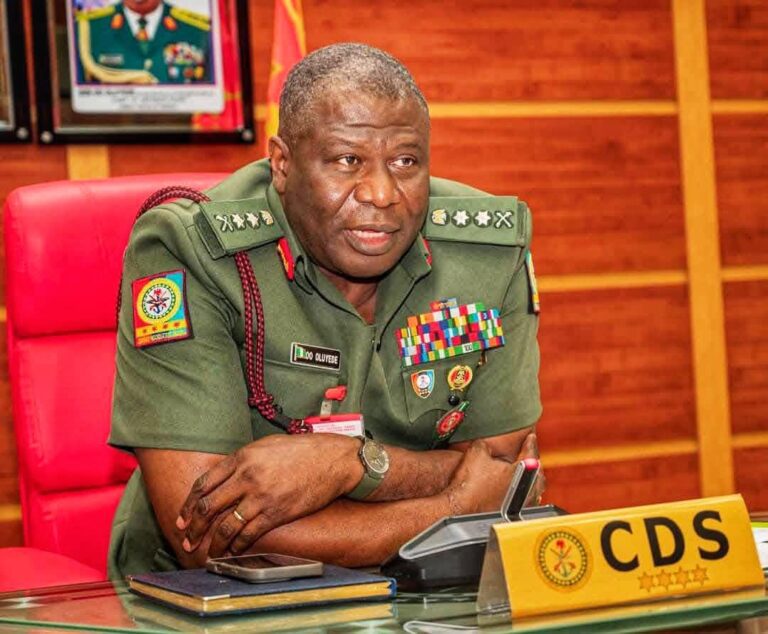
As Nigeria’s Chief of Defence Staff (CDS), General Olufemi Oluyede, marks his first 100 days in office, early signals from Defence Headquarters suggest a tenure defined by coordination, renewed momentum, and a deliberate push to weld the Armed Forces into a more cohesive and professional fighting force.

From the outset, Gen Oluyede made synergy among the Nigerian Army, Navy, Air Force and other security agencies a central plank of his leadership. Defence watchers say this emphasis has translated into tighter joint planning, improved intelligence sharing and more integrated operations across theatres of conflict. Rather than operating in silos, the services are increasingly being deployed as complementary arms of a single national security strategy.

This joint approach has been particularly evident in counter-terrorism operations. In the North East and North West, coordinated air and ground actions have aimed to degrade terrorist networks, disrupt logistics and deny insurgents freedom of movement.

Senior officers point to a clearer command-and-control structure and faster decision-making as key outcomes of the CDS’s early reforms.

Beyond kinetic operations, Gen Oluyede has also placed strong emphasis on building a military that is firmly loyal to the Constitution and anchored on respect for human rights and the rule of law.

In directives to commanders and troops, he has underscored the Armed Forces’ role as protectors of democracy and the civilian population, stressing that operational effectiveness must go hand in hand with professionalism and accountability.

Training and engagement initiatives under his watch are aimed at reinforcing civil-military relations and ensuring that operations are conducted within internationally accepted human rights standards.

In addition, the CDS has placed renewed focus on economic security, especially the long-running challenge of crude oil theft and pipeline vandalism in the Niger Delta.

Under his watch, the anti-oil theft security measures have been strengthened and aligned more closely with land-based and aerial surveillance. This multi-layered posture is intended to protect critical national assets, curb illegal bunkering and restore investor confidence in the oil and gas sector.

In internal engagements, Gen Oluyede has reportedly stressed discipline, troop welfare and ethical conduct, reflecting his belief that morale, legitimacy and effectiveness are inseparable.

By engaging commanders across formations and theatres, he has sought to ensure that strategic directives from Defence Headquarters are clearly understood and uniformly implemented.

While Nigeria’s security challenges remain complex and deeply rooted, analysts say the tone of Gen Oluyede’s first 100 days reflects a leadership intent on unity of effort, constitutional loyalty and sustained pressure on threats to national stability. As his tenure progresses, many will be watching to see how these early initiatives translate into lasting gains on the ground.

For now, the consensus in defence and security circles is that the CDS has used his opening months to lay a solid foundation—one built on cooperation among the services, respect for human rights, and a clear-eyed focus on terrorism and oil theft as critical fronts in Nigeria’s security landscape.

By Chuks Oyema

Chuks Oyema wrote in from Abuja

NECO Releases 2025 SSCE External Results As 86% Record Five credits

0

The National Examinations Council (NECO) has released the results of the 2025 Senior School Certificate Examination (SSCE) External, with 86.26 per cent of candidates achieving five credits and above.

The Registrar and Chief Executive of NECO, Prof. Dantani Wushishi, announced the release on Tuesday during a press conference at the council’s headquarters in Minna, Niger State.

Declaring the results in a video shared on NECO’s official X handle, Wushishi said candidates could access their results on the council’s website using their examination registration numbers.

According to him, a total of 96,979 candidates registered for the examination, comprising 51,823 males (53.43 per cent) and 45,156 females (46.56 per cent). Out of this number, 95,160 candidates eventually sat for the examination across 16 subjects.

He disclosed that in English Language, 93,425 candidates sat for the paper, out of which 73,167 candidates, representing 78.32 per cent, obtained credit and above. In Mathematics, 93,330 candidates participated, with 85,256 candidates (91.35 per cent) scoring credit and above.

Overall, 68,166 candidates, representing 71.63 per cent, obtained five credits and above including English Language and Mathematics, while 82,082 candidates (86.26 per cent) achieved five credits and above irrespective of English and Mathematics.

On examination malpractice, Wushishi revealed that 9,016 candidates were booked for various offences, marking a 31.7 per cent increase compared with the 6,160 cases recorded in 2024.

He added that five supervisors—two from the Federal Capital Territory and one each from Kano, Adamawa and Ondo states—were recommended for blacklisting for aiding and abetting examination malpractice.

In addition, four examination centres—two in Niger State and one each in Yobe and Kano states—were recommended for de-recognition after being found culpable of whole-centre malpractice.

The SSCE External examination is designed mainly for private candidates who seek certification outside the regular school system or those who wish to improve on previously obtained results.

Rivers Deputy Governor Bags UN Peace Award, Projects State As Hub Of Stability, SDG Commitment

0

The Deputy Governor of Rivers State, Prof. Ngozi Nma Odu, has reaffirmed the commitment of the Governor Siminalayi Fubara administration to empowering vulnerable groups and advancing the Sustainable Development Goals (SDGs), following her recognition with the United Nations Global Icon of Peace and Integrity Award.

Prof. Odu received the prestigious award on Monday, February 2, 2026, at the Government House, Port Harcourt, from the International Face of Peace and Integrity Advocates, an organisation affiliated with the United Nations’ peace promotion initiatives.

Describing the honour as both a recognition and a responsibility, the Deputy Governor said the award underscored Rivers State’s growing reputation as a peaceful, stable and development-driven state.

“This is more than an award. It is a wake-up call and a renewed task. Whatever I have been doing that earned this recognition, I must do more in the service of humanity,” she said.

Prof. Odu noted that the Fubara-led administration has deliberately aligned key ministries and agencies with the SDGs, identifying Health, Education, Agriculture and Women Affairs as the core pillars driving inclusive growth and social protection in the state.

She assured that government policies would continue to prioritise vulnerable groups, stressing that the administration remains deeply committed to ensuring that the dividends of governance are felt across all strata of society.

The Deputy Governor also commended the decision to host the 2026 award ceremony in Rivers State, describing it as a powerful statement of confidence in the state’s peace, stability and investment potential.

According to her, the theme of the event, “Peaceful Coexistence,” was particularly timely, noting that dialogue, negotiation and mutual understanding remain essential tools for resolving conflicts and sustaining peace.

Earlier, the Global Director of the International Face of Peace and Integrity Advocates, Dr. Chinaza Jennifer Ugboaja, said Prof. Odu was honoured in recognition of her leadership, integrity and commitment to peace and sustainable development.

She disclosed that Prof. Odu is the first Nigerian and the second African woman to receive the Global Icon of Peace and Integrity Award, describing her achievements as inspirational to younger generations across the continent.

Dr. Ugboaja explained that the organisation works to promote peace, advocate peaceful coexistence, support the SDGs and serve globally as United Nations Peace Promoters with Integrity.

Snakebite: Nigeria’s Overlooked Killer Strikes Again as Expert Warns of Deepening Public Health Crisis

0

Barely days after a fast-rising Nigerian music star, Ifunanya Nwangene reportedly died from complications linked to a snakebite, public health experts have renewed warnings that snakebite envenoming remains one of Nigeria’s most deadly but neglected health emergencies.

Dr. Chukwuma Anyaike, a retired Director of Public Health at the Federal Ministry of Health, described snakebite as a “silent killer” that continues to claim lives quietly, particularly among farmers, herders and rural dwellers who form the backbone of the nation’s food system.

Speaking in an interview on Monday in Abuja, Anyaike noted that snakebite envenoming is classified as a highest-priority Neglected Tropical Disease (NTD) and remains a major public health threat in Nigeria.

Recent data presented during activities marking World NTD Day 2026 indicate that Nigeria is among the world’s highest-burden countries for snakebite envenoming, with the Carpet Viper (Echis ocellatus) responsible for more than 60 per cent of reported cases nationwide.

According to Anyaike, the death of the young entertainer — which has sparked public grief and debate on social media — mirrors the daily reality faced by thousands of Nigerians in rural communities whose cases rarely make headlines.

“Snakebite is not selective. It affects farmers in the fields, herders in grazing routes, and now, as we have seen, even public figures. But the difference is that rural victims often die unnoticed,” he said.

Despite the availability of effective antivenom, outcomes remain poor due to late hospital presentation, weak health systems and widespread dependence on traditional remedies.

“About 82 per cent of snakebite victims first seek traditional treatment. These delays significantly increase the risk of death or permanent disability,” Anyaike explained.

He stressed that snakebite is not merely a medical emergency but a socio-economic crisis.
“When a farmer is bitten, the consequences extend beyond the individual. Household income drops, food production suffers and entire communities become more vulnerable,” he said.

Findings also show that nearly half of health facilities in high-burden areas lack the capacity to administer antivenom, owing to shortages of trained personnel, inadequate cold-chain systems and inconsistent supply of lifesaving drugs.

As a result, specialised centres such as the Kaltungo Snakebite Hospital in Gombe State, along with a few facilities in Bauchi State, have become referral hubs for severe cases — underscoring the limited distribution of functional snakebite treatment centres across the country.

Anyaike emphasised that prevention remains one of the most effective ways to reduce snakebite incidence, particularly among rural residents.

He advised the use of torches or flashlights when walking outdoors at night, wearing thick knee-high boots and long trousers on farms or in tall grass, and keeping surroundings clear of debris, woodpiles and overgrown vegetation where snakes often hide.
He also highlighted the importance of proper first aid.

“If a bite occurs, time is life. Victims should remain calm, move away from the snake, immobilise the affected limb and seek immediate medical attention,” he said.

He warned against harmful practices such as tying tourniquets, cutting or sucking the wound, or applying herbs, noting that such actions often worsen injuries and increase the risk of infection, tissue damage and amputation.

“These practices do not neutralise venom. Delays in accessing antivenom remain the leading cause of snakebite deaths in Nigeria,” he added.

As Nigeria aligns with the World Health Organisation’s target of reducing snakebite deaths and disabilities by 50 per cent by 2030, Anyaike called for improved antivenom access, stronger rural health infrastructure and sustained public awareness campaigns.

“The recent loss of a young music talent should serve as a wake-up call,” he said.

“Snakebite envenoming deserves urgent national attention. With awareness, early treatment and proper investment in the health system, thousands of lives can be saved every year.”


reportedly died from complications linked to a snakebite, public health experts have renewed warnings that snakebite envenoming remains one of Nigeria’s most deadly but neglected health emergencies.

Dr. Chukwuma Anyaike, a retired Director of Public Health at the Federal Ministry of Health, described snakebite as a “silent killer” that continues to claim lives quietly, particularly among farmers, herders and rural dwellers who form the backbone of the nation’s food system.

Speaking in an interview on Monday in Abuja, Anyaike noted that snakebite envenoming is classified as a highest-priority Neglected Tropical Disease (NTD) and remains a major public health threat in Nigeria.

Recent data presented during activities marking World NTD Day 2026 indicate that Nigeria is among the world’s highest-burden countries for snakebite envenoming, with the Carpet Viper (Echis ocellatus) responsible for more than 60 per cent of reported cases nationwide.

According to Anyaike, the death of the young entertainer — which has sparked public grief and debate on social media — mirrors the daily reality faced by thousands of Nigerians in rural communities whose cases rarely make headlines.

“Snakebite is not selective. It affects farmers in the fields, herders in grazing routes, and now, as we have seen, even public figures. But the difference is that rural victims often die unnoticed,” he said.

Despite the availability of effective antivenom, outcomes remain poor due to late hospital presentation, weak health systems and widespread dependence on traditional remedies.

“About 82 per cent of snakebite victims first seek traditional treatment. These delays significantly increase the risk of death or permanent disability,” Anyaike explained.

He stressed that snakebite is not merely a medical emergency but a socio-economic crisis.
“When a farmer is bitten, the consequences extend beyond the individual. Household income drops, food production suffers and entire communities become more vulnerable,” he said.

Findings also show that nearly half of health facilities in high-burden areas lack the capacity to administer antivenom, owing to shortages of trained personnel, inadequate cold-chain systems and inconsistent supply of lifesaving drugs.

As a result, specialised centres such as the Kaltungo Snakebite Hospital in Gombe State, along with a few facilities in Bauchi State, have become referral hubs for severe cases — underscoring the limited distribution of functional snakebite treatment centres across the country.

Anyaike emphasised that prevention remains one of the most effective ways to reduce snakebite incidence, particularly among rural residents.

He advised the use of torches or flashlights when walking outdoors at night, wearing thick knee-high boots and long trousers on farms or in tall grass, and keeping surroundings clear of debris, woodpiles and overgrown vegetation where snakes often hide.
He also highlighted the importance of proper first aid.

“If a bite occurs, time is life. Victims should remain calm, move away from the snake, immobilise the affected limb and seek immediate medical attention,” he said.

He warned against harmful practices such as tying tourniquets, cutting or sucking the wound, or applying herbs, noting that such actions often worsen injuries and increase the risk of infection, tissue damage and amputation.

“These practices do not neutralise venom. Delays in accessing antivenom remain the leading cause of snakebite deaths in Nigeria,” he added.

As Nigeria aligns with the World Health Organisation’s target of reducing snakebite deaths and disabilities by 50 per cent by 2030, Anyaike called for improved antivenom access, stronger rural health infrastructure and sustained public awareness campaigns.

“The recent loss of a young music talent should serve as a wake-up call,” he said.

“Snakebite envenoming deserves urgent national attention. With awareness, early treatment and proper investment in the health system, thousands of lives can be saved every year.”

reportedly died from complications linked to a snakebite, public health experts have renewed warnings that snakebite envenoming remains one of Nigeria’s most deadly but neglected health emergencies.

Dr. Chukwuma Anyaike, a retired Director of Public Health at the Federal Ministry of Health, described snakebite as a “silent killer” that continues to claim lives quietly, particularly among farmers, herders and rural dwellers who form the backbone of the nation’s food system.

Speaking in an interview on Monday in Abuja, Anyaike noted that snakebite envenoming is classified as a highest-priority Neglected Tropical Disease (NTD) and remains a major public health threat in Nigeria.

Recent data presented during activities marking World NTD Day 2026 indicate that Nigeria is among the world’s highest-burden countries for snakebite envenoming, with the Carpet Viper (Echis ocellatus) responsible for more than 60 per cent of reported cases nationwide.

According to Anyaike, the death of the young entertainer — which has sparked public grief and debate on social media — mirrors the daily reality faced by thousands of Nigerians in rural communities whose cases rarely make headlines.

“Snakebite is not selective. It affects farmers in the fields, herders in grazing routes, and now, as we have seen, even public figures. But the difference is that rural victims often die unnoticed,” he said.

Despite the availability of effective antivenom, outcomes remain poor due to late hospital presentation, weak health systems and widespread dependence on traditional remedies.

“About 82 per cent of snakebite victims first seek traditional treatment. These delays significantly increase the risk of death or permanent disability,” Anyaike explained.

He stressed that snakebite is not merely a medical emergency but a socio-economic crisis.
“When a farmer is bitten, the consequences extend beyond the individual. Household income drops, food production suffers and entire communities become more vulnerable,” he said.

Findings also show that nearly half of health facilities in high-burden areas lack the capacity to administer antivenom, owing to shortages of trained personnel, inadequate cold-chain systems and inconsistent supply of lifesaving drugs.

As a result, specialised centres such as the Kaltungo Snakebite Hospital in Gombe State, along with a few facilities in Bauchi State, have become referral hubs for severe cases — underscoring the limited distribution of functional snakebite treatment centres across the country.

Anyaike emphasised that prevention remains one of the most effective ways to reduce snakebite incidence, particularly among rural residents.

He advised the use of torches or flashlights when walking outdoors at night, wearing thick knee-high boots and long trousers on farms or in tall grass, and keeping surroundings clear of debris, woodpiles and overgrown vegetation where snakes often hide.
He also highlighted the importance of proper first aid.

“If a bite occurs, time is life. Victims should remain calm, move away from the snake, immobilise the affected limb and seek immediate medical attention,” he said.

He warned against harmful practices such as tying tourniquets, cutting or sucking the wound, or applying herbs, noting that such actions often worsen injuries and increase the risk of infection, tissue damage and amputation.

“These practices do not neutralise venom. Delays in accessing antivenom remain the leading cause of snakebite deaths in Nigeria,” he added.

As Nigeria aligns with the World Health Organisation’s target of reducing snakebite deaths and disabilities by 50 per cent by 2030, Anyaike called for improved antivenom access, stronger rural health infrastructure and sustained public awareness campaigns.

“The recent loss of a young music talent should serve as a wake-up call,” he said.

“Snakebite envenoming deserves urgent national attention. With awareness, early treatment and proper investment in the health system, thousands of lives can be saved every year.”

FG, States, LGs Share ₦1.969 Trillion As FAAC Meets In Abuja

0

The Federation Account Allocation Committee (FAAC) has shared a total sum of ₦1.969 trillion as the December 2025 Federation Account Revenue among the Federal Government, state governments and local government councils across the country.

The allocation was made at the January 2026 FAAC meeting held in Abuja, according to a statement issued by the Director of Press at the Office of the Accountant General of the Federation, Bawa Mokwa.

The statement disclosed that the ₦1.969 trillion total distributable revenue comprised ₦1.084 trillion from distributable statutory revenue, ₦846.507 billion from distributable Value Added Tax revenue, and ₦38.110 billion generated from the Electronic Money Transfer Levy.

The distributable amount represented an increase when compared with the ₦1.928 trillion shared in November 2025.

According to the FAAC communiqué, a total gross revenue of ₦2.585 trillion was available in December 2025.

From the amount, ₦104.697 billion was deducted as the cost of collection, while ₦511.585 billion was recorded as transfers, refunds and savings.

The communiqué further stated that gross statutory revenue of ₦1.631 trillion was received during the month.

This figure was ₦105.202 billion lower than the ₦1.736 trillion recorded in November 2025.

FAAC noted that gross revenue of ₦913.957 billion was generated from Value Added Tax in December 2025.

This was significantly higher than the ₦563.042 billion recorded in November 2025, showing an increase of ₦350.915 billion.

From the total distributable revenue of ₦1.969 trillion, the Federal Government received ₦653.500 billion, while the State Governments got ₦706.469 billion.

The Local Government Councils received ₦513.272 billion, while ₦96.083 billion, representing 13 per cent of mineral revenue, was shared among the benefiting states as derivation revenue.

Out of the ₦1.084 trillion distributable statutory revenue, the Federal Government received ₦520.807 billion.

The State Governments got ₦264.160 billion, while the Local Government Councils received ₦203.656 billion.

The sum of ₦96.083 billion was distributed to benefiting states as derivation revenue.

From the ₦846.507 billion distributable Value Added Tax revenue, the Federal Government received ₦126.976 billion.

The State Governments received ₦423.254 billion, while the Local Government Councils got ₦296.277 billion.

The communiqué stated that from the ₦38.110 billion Electronic Money Transfer Levy revenue, the Federal Government received ₦5.717 billion.

The State Governments got ₦19.055 billion, while the Local Government Councils received ₦13.338 billion.

FAAC disclosed that in December 2025, Companies Income Tax/Capital Gains Tax, Stamp Duties, Import Duty, and Value Added Tax recorded significant increases.

It added that Oil and Gas Royalty, CET Levies, and Fees increased marginally.

However, Excise Duty, Petroleum Profit Tax/Hydrocarbon Tax, and the Electronic Money Transfer Levy recorded considerable decreases during the period.

Police Urge NLC To Suspend Planned Abuja Protest Over Alleged Extremists Infiltration

0

The Federal Capital Territory (FCT) Police Command has called on the Nigeria Labour Congress (NLC), FCT Council, to suspend its planned protest scheduled for Tuesday, February 3, 2026, citing intelligence reports of serious security threats that could lead to violence and a breakdown of law and order in Abuja.

In a statement issued on Monday by the Police Public Relations Officer, SP Josephine Adeh, the command said credible intelligence indicated that the proscribed Islamic Movement of Nigeria (IMN) and other non-state actors were planning to infiltrate and hijack the protest, raising concerns over public safety.

While reaffirming citizens’ constitutional right to peaceful assembly, the police warned that the prevailing security risks surrounding the planned demonstration outweighed the need for its immediate execution.

“The Command recognizes and respects the rights of citizens to peaceful protest; however, intelligence at our disposal points to plans by proscribed groups and other actors to exploit the protest for purposes inimical to public peace and security,” the statement said.

The police described the appeal to the NLC as a preventive measure aimed at safeguarding lives, property, and public order in the nation’s capital, adding that the protest could severely disrupt residents’ movement and daily activities if it degenerated into unrest.

The warning comes amid an escalating industrial dispute between the FCT Administration and its workforce, with the NLC and the Trade Union Congress of Nigeria (TUC) threatening a solidarity rally in support of members of the Joint Union Action Committee (JUAC).

All NLC and TUC affiliates and state councils in the FCT are expected to converge at the Federal Capital Development Authority (FCDA) premises in Abuja for the rally.

In a joint statement, Acting General Secretary of the NLC, Benson Upah, and Secretary General of the TUC, General N.A. Toro, said the planned rally was intended to demonstrate that “an injury to one is an injury to all,” stressing that the labour movement would not abandon its members.

The labour centres reiterated their solidarity with JUAC members and urged them to remain resolute in defending their rights, describing the struggle as one rooted in justice, fairness, and respect for labour rights.

They also reaffirmed support for striking FCT workers protesting the alleged non-remittance of National Housing Fund and pension deductions, as required under the Pension Reform Act, 2014 (as amended).

“History has taught us that rights are never gifted; they are won through collective resistance and principled struggle,” the statement said, while directing affiliates to mobilise for what they described as a lawful and peaceful rally.

From Street Dust to Stadium Lights: The Coach Shaping Bayelsa’s Next Super Eagles

0

ANDERSON Ebimobowei West does not like being idle. That is why he has started a new football club called Active Life FC. He found a way to cast off his boredom by scouting for young football talents, and offering to coach them to standard.

In August 2025, Anderson effectively began his search for footballers in his Agudama neighbourhood of the Bayelsa State capital, and was pleased with the result. All he did was provide a leather football on an open pitch, and put a whistle between his lips.

From all around the vicinity, eager youngsters showed up to kick the ball around. Anderson readily broke them up into teams, and kicked off the first match with a blast of the whistle. Today, only a few months later, the boys are dreaming of playing in the African Nations Cup, and the World Cup many years to come.

Praise, 14, and Victor, 18, are among his squad of promising midfield maestros. Anderson West is teaching only the basics in football. He counts himself an ex-footballer, currently serving as an assistant coach with Bayelsa United Football Club.

Having received coaching training at the National Institute of Sports, Lagos, and with an advanced coaching certificate in his kitty, West is awaiting his final endorsement as a coach by the Confederation of African Football, CAF.

Anderson Ebimo West began clubside football experience with Calabar Rovers in 2007, before joining Enyimba FC of Aba, and later Bayelsa United. In 2009, he flew out of Nigeria and joined Maccabi Haifa in Tel Aviv, Israel. He later moved to Maccabi Achi in Nazareth, and then to Maccabi Betyam.

After three years in Israel, he pitched tent with Dontam Longman in Vietnam where he played for five years. In due course, he relocated to Myanmar where he played for five different clubs, namely Ayeyawadey Myanmar, Chin United, Rakin United, Zwekapine United, and Yangon United, Myanmar. Back in Nigeria, he returned to Bayelsa United and formally hung his boots before going into full-time coaching.

Ebimo West was also invited to the Under-20 Camp, and the Under-23 Camp under Coach Samson Siasia. He was equally invited to join home-based Super Eagles players under Coach Emodi, where he played two friendly matches.

In like manner, he was among twelve home-based players invited to the main Super Eagles camp in Faro, Portugal, under Coach Austin Eguavoen, ahead of the 2006 African Nations Cup in Egypt. He didn’t make the final list.

Anderson Ebimobowei West hails from Amatolo in Southern Ijaw local government area. He has lived in Yenagoa for the past five years. He picks the best players he can find from the streets, gives them basic football training, and arranges matches.

For agility training, he has acquired moveable obstacles of every kind. He is persuading parents to provide their children and wards under his charge with boots and jerseys to boost their morale. He is convinced that the eventual outcome can only bring pride to the families of individual players and, ultimately, glory to Bayelsa State.

By Nengi Ilagha

NDDC Inaugurates 9.450KM Internal Road Network, Royal Hall In Ogu

0

The people of Wakirike Nation turned out in large numbers to witness the commissioning of the 9.450-kilometre rigid pavement Ogu Internal Road Network and the 1,500-seater Royal Hall, projects executed by the Niger Delta Development Commission (NDDC) and commissioned by the Honourable Minister of the Federal Capital Territory (FCT), Chief Barr. Ezenwo Nyesom Wike, CON, GSSRS.

The historic event commenced with the formal commissioning of the newly completed internal road network, after which dignitaries, traditional rulers, and invited guests proceeded to the Royal Hall for the main ceremony.

Speaking during the commissioning, the FCT Minister expressed delight at the remarkable transformation of Ogu Kingdom since his previous visits.

“I am overwhelmed—not just by the hall, but by the level of development I have seen today. This reflects the original vision of the NDDC: to bring development to all communities of the Niger Delta,” he stated.

The Minister commended the Managing Director/Chief Executive Officer and the management of the NDDC, noting that their effective collaboration with the Executive Director of Finance and Administration had yielded tangible results. He urged public office holders to prioritize development within their home communities.

“If you are given the opportunity to serve, let your people testify that you brought development to your community,” he charged.

He further noted that the current NDDC stands distinct from previous administrations in terms of visible impact, quality delivery, and accountability.

Earlier in his address, the Managing Director and Chief Executive Officer of NDDC, Alabo Dr. Samuel Ogbuku, reaffirmed that the Commission’s development efforts were not limited to Ogu Kingdom but extended across the entire Niger Delta region.

He attributed the successes of the NDDC to the mentorship and leadership of the FCT Minister, describing him as a true champion of development.

“He did it in Rivers State, and he is doing it again in Abuja. We work closely with him and have learned a great deal from his leadership,” Dr. Ogbuku said.

He assured the audience that the quality of the commissioned projects justified the presence of the FCT Minister.

In his welcome remarks, Alabo Boma Iyaye described the FCT Minister as a son of Ogu Kingdom, emphasizing that the visit was a homecoming. He recalled that in 2022, Chief Barr. Nyesom Wike was honoured with the traditional title “Se Belemabo I of Ogu/Bolo Kingdom,” affirming his deep-rooted connection to the community.

“Your Excellency, this event is a side attraction of the grand reception organised by the Wakirike Ethnic Nationality. You are part and parcel of this community, and we warmly welcome you and all those who have accompanied you to Ogu Kingdom,” he stated.

Speaking on behalf of the traditional institution, the Chairman of the Ogu Divisional Council of Chiefs (ODCC), Alabo Barr. Lawrence A., expressed profound gratitude to the FCT Minister, noting that such a landmark project had never before been executed in Ogu Kingdom.

“Without you, we would not have witnessed this level of development today. This project is one of the best Ogu has ever had. On behalf of my people, we say thank you,” he said.

He also praised President Bola Ahmed Tinubu and pledged the unwavering support of the Wakirike people to the FCT Minister in appreciation of his commitment to the region.

“Through you, we say the President has done well. Come 2027, Wakirike will stand firmly behind you,” he added.

The Project Director later presented a comprehensive overview of the Royal Hall, highlighting its modern design and facilities. The hall boasts a 1,500 seating capacity, with an overflow allowance of up to 1,700 persons, and features fully furnished interior with modern fittings, firefighting equipment and strategically positioned fire extinguishers, acoustic wall systems for sound control and heat absorption. Also, air-conditioning and high-quality sound system,
boreholes and modern toilet facilities, dedicated 100KVA generator for uninterrupted power supply.

The facility was described as first-of-its-kind in the area, designed to serve Ogu Kingdom and neighbouring communities.

Following the presentations, the FCT Minister formally commissioned the road network and the Royal Hall, accompanied by political associates and other dignitaries.

The ceremony was attended by high-profile political leaders, traditional rulers, and community members, marking a significant milestone in the development history of Ogu Kingdom and Wakirike Nation.

The commissioned projects stand as enduring symbols of partnership, visionary leadership, and unwavering commitment to grassroots development in the Niger Delta.

Bandits Torch Agwara Police Station, Church, Abduct Residents In Niger

0

Armed bandits have again struck Agwara Local Government Area of Niger State, Nigeria, burning a police station and a church and abducting residents during a coordinated early-morning raid on Sunday.

Residents said the attackers arrived at about 2:00 a.m., parking their motorcycles several kilometres from the town before trekking into the community. The assailants reportedly headed first to the Agwara police station, where officers on duty were overwhelmed by the attackers’ superior numbers and forced to withdraw. The station was subsequently set ablaze.

Eyewitnesses said the bandits then moved from house to house, carting away valuables and foodstuffs, before proceeding to the United African Missionary Church (UAMC), also known as the YMCA, which was completely burnt. A monthly church vigil was said to have been ongoing at the time, but worshippers fled after receiving warnings of the attack.

It was not immediately clear whether there were casualties at the police station or the church.
Confirming the incident, the Reverend Yakubu Yohanna said no worshippers were present when the attackers reached the church. “The town was invaded by bandits, and they came to our church. They did not meet anyone, but they burnt the church building and everything inside,” he said. “So far, no life has been lost, but we are still waiting for people to return from hiding to determine the full extent of the damage.”

The Niger State Police Command also confirmed the attack. In a statement, the Police Public Relations Officer, Superintendent of Police Wasiu Abiodun, said the police station was attacked at about 3:40 a.m.

“Armed bandits attacked the police station, set it ablaze, and also burnt part of a church in Agwara community,” he said.

“Police tactical teams engaged the attackers, but they were overpowered. The assailants used suspected dynamite to set the station on fire.”

According to the police, the attackers later moved to other parts of the community and abducted five persons, whose identities had yet to be confirmed at the time of filing this report.

Agwara has witnessed repeated security breaches in recent times, including the abduction of about 300 pupils, students and teachers from St. Mary’s Catholic School in Papiri last year, an incident that has continued to fuel fear and anxiety among residents over the deteriorating security situation in the area.