
Home Blog Page 158

PENGASSAN-Dangote Dispute: Power Generation Drops By 1,100MW … FG Laments Effect On Economy

0

The Nigerian Independent System Operator (NISO) says industrial action within the gas supply chain resulted in reduction in power generation by more than 1,100MW on Sept 28.
According to NISO’s Management in a statement in Abuja on Tuesday, available generation in the National Grid fell sharply from over 4,300MW in the early hours of Sept. 28, to about 3,200MW at the lowest point.
“NISO wishes to notify the public of recent major generation shortfalls on the National Grid, caused by industrial actions of the Petroleum and Natural Gas Senior Staff Association of Nigeria (PENGASSAN) within the gas supply chain.
“These disruptions triggered widespread gas shortages, reducing available generation from over 4,300 MW in the early hours Sept. 28th to about 3,200 MW at the lowest point”’it said.
NISO said that the development heightened pressure on the grid, prompting emergency measures to stabilise supply and avert a nationwide blackout.
”To mitigate the crisis, the system operator said that it ramped up generation from major hydropower stations, injecting over 400MW to cushion the shortfall from gas-fired plants.
The agency said that it also implemented real-time load adjustments, frequency support measures, and selective load shedding to preserve operational security.
NISO said it promptly deployed contingency measures to preserve the stability, security, and reliability of the National Grid. Key interventions which include
“Hydropower Optimisation: Strategic ramp-ups from major hydro stations, contributing over 400 MW of additional output to cushion the shortfall from gas-fired plants.
“Generation Dispatch and Load Balancing: Real-time load adjustments to match available generation with system demand, while preventing a system frequency collapse.
“Voltage and Frequency Support: Continuous deployment of reactive power compensation and reserve monitoring to safeguard system integrity.
“Demand-Side Management: Selective load shedding, applied as a last resort, to avert a system-wide collapse and ensure fair power distribution,”it said.
According to NISO, these timely actions enabled the it and National Control Centre (NCC) to minimise the impact of the labour-induced gas shortages, sustain operational security, and maintain supply to critical loads, thereby averting a nationwide blackout.
The system operator however reaffirmed its commitment to proactive grid management, operational excellence, and the application of best-in-class practices to guarantee a secure and reliable electricity supply for the nation”.
NAN reports that PENGASSAN attributed its latest action to Dangote Refinery’s alleged unilateral action in sacking over 800 staff members for joining the Association.

The National Executive Council (NEC) of PENGASSAN held an emergency meeting of all its branches on Saturday, and resolved that members should withdraw all services effective 00:01 on Monday..

The federal government has waded into the face-off between the Dangote Refinery and PENGASSAN .

A meeting chaired by the Minister of Finance and the Coordinating Minister of the Economy, Mr Wale Edun, underscored two recent developments, including the purported suspension of the Naira-for-Crude oil arrangement by the Dangote Refinery, and the concerns raised by PENGASSAN.

The conciliation meeting between the Federal Government, the Petroleum and Natural Gas Senior Staff Association of Nigeria (PENGASSAN), and the Dangote Group ended in deadlock late Monday.

The meeting, which lasted more than nine hours, was convened by the Federal Government to resolve the lingering industrial dispute over the alleged sack of 800 workers by the Dangote Refinery.

The Minister of Labour and Employment, Alhaji Muhammad Dingyadi, who chaired the meeting, told newsmen in the early hours of Tuesday that progress had been made but two key issues remained unresolved.

“The only issues on the table are the reinstatement of the sacked workers and unionisation. Apart from these, no other matters are lingering.

“We have made a lot of progress and we are optimistic that by later today, when we resume by 2 p.m., we should be able to arrive at a resolution,” he said.

PENGASSAN President, Mr Festus Osifo, said no agreement was reached on the reinstatement of the more than 800 dismissed workers.

“Unfortunately, there is no solution for now. All we want is that the 800-plus people who were sent home be reinstated.

“These people are fathers and mothers, and their careers are at stake,” Osifo said.

He added that branding some of the workers as saboteurs had further damaged their chances of securing employment in the oil and gas industry.

“If they go home like that, there is no other company in Nigeria that will employ them because they have been seen as saboteurs.

“These are careers that will be damaged if proper remedy is not put in place,” he said.

Osifo stressed that the strike would continue until the workers were reinstated.

“Our position is clear: if you reinstate them now, we will call off our action now.

“But that reinstatement did not happen. So, as it stands, the strike continues until we reconvene later today,” he stated.

He further confirmed that the Dangote Group had admitted to dismissing the workers.

“They agreed that they dismissed 800 people, and the reason was stated in the letter.

“It cannot be false because the letters of dismissal are already in the media.

“It is not our word against theirs, but what they themselves signed in the communication they released last Thursday,” Osifo said.

Also speaking, the Minister of Finance and Coordinating Minister of the Economy, Mr Wale Edun, expressed concern about the economic risks of the prolonged strike.

“We need to limit the damage of this action to the economy. We need gas flowing, we need crude flowing as inputs into production.

“We do not want the current momentum of growth to be broken,” he said.

Edun added that the government was optimistic about breaking the deadlock,adding that putting the issue behind us so the Nigerian economy can move forward.
North Korea Threatens Not To Give Up Nuclear Weapons

0

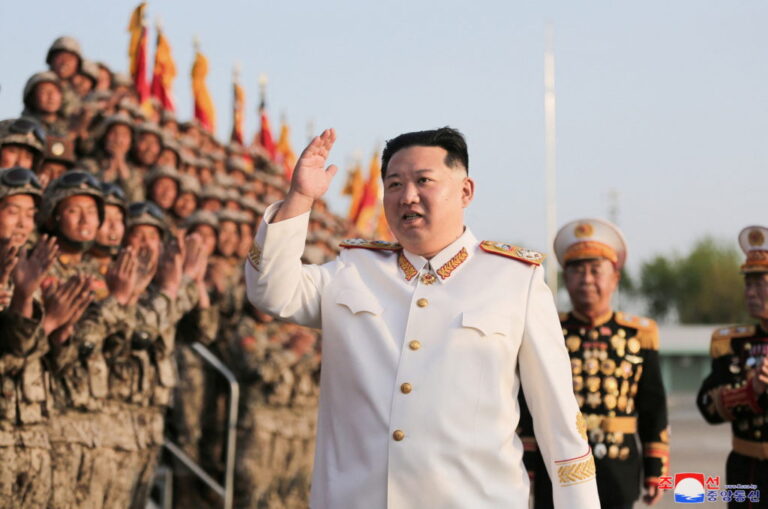
Democratic People’s Republic of Korea (North Korea) has vowed that it will never give up its nuclear weapons

The Vice Minister for Foreign Affairs Kim Son Gyong stated this while addressing the UN General Assembly on the last day of the high-level week on Monday,

“We will never give up nuclear, which is our state law, national policy and sovereign power as well as the right to existence,” Kim said.

Kim gave a muscular defence of North Korea’s stance on nuclear weapons, noting the alliance between the U.S., Japan and the Republic of Korea (South Korea).

He said the alliance could “rapidly evolve into a more offensive and aggressive military bloc.”

He said it was only because of his country’s powerful military deterrent that “the will of the enemy states to provoke a war is thoroughly contained.”

Kim said nuclear weapons were now enshrined in North Korea’s constitution as a “sacred and absolute thing that can never be touched upon and tampered with.”

Imposing denuclearisation on the state “is tantamount to demanding it to surrender sovereignty,” he added.

Kim announced that as part of the effort to develop a self-reliant national economy and to meet output targets, the completion of a five-year economic plan is “definitely within reach.”

He said 50,000 new houses are being built in Pyongyang while a new rural development policy was yielding “tangible results.”

The vice-minister called on Israel to end its genocide and “crimes against humanity” in Gaza and withdraw from the enclave.

“The DPRK will promote multifaceted exchanges and cooperation with the countries that respect and take friendly approaches towards it,” he said.

ECOWAS Parliament Adopts $26m 2026 Budget, Announces 25th Anniversary Plans

0

The ECOWAS Parliament has adopted a budget of 19,636,030 Units of Account (UA) (26 million dollars) for the 2026 fiscal year, and announced plans to commemorate its 25th anniversary in November.

The Speaker of the Parliament, Hadjia Memounatou Ibrahima, disclosed this in a statement, on Tuesday.

Ibrahima said the development followed the recent conclusion of its 2025 Second Extraordinary Session in Port Harcourt, Nigeria.

She said the budget was adopted by the Parliament during plenary, stressing that, beyond being a mere accounting act, it was the engine of parliament’s commitment to West Africans.

”It will enable us to carry out our priority missions, including implementing the conclusions of the seminar on AI, while ensuring virtuous and transparent management of public funds entrusted to us.

”This budget represents a five per cent increase compared to the 2025 fiscal year budget, reflecting an upward adjustment of UA 939,233 from last year’s UA 18,996,897.

”Out of the budget of UA 19,636,030 for 2026, the sum of UA19, 368,394 representing 98.64 per cent is expected to be financed through the proceeds from the Community Levy, while UA257,636, equivalent to 1.36 per cent, will accrue from other sources,” Ibrahima said.

The ECOWAS Community Levy is a mandatory 0.5 per cent tax imposed on goods imported into ECOWAS member states from non-ECOWAS countries.

Member states are under statutory obligation to pay the community levy, which is the main source of funding for ECOWAS institutions and their activities.

She, however, expressed dismay that some members of the community were still defaulting on the payment of the levy, and warned that, going forward; such would be met with sanctions.

Ibrahima also said that the commemoration of its 25th anniversary in November would highlight the ECOWAS Parliament’s achievements in deepening regional democracy, cooperation and growth, amid formidable challenges.

The Speaker describes the forthcoming anniversary as “a chance to showcase resilience and chart a more innovative, youth-focused future for the community”.

Nigeria @65: Time To Prioritise Citizens’ Welfare Over Pursuit of Wealth – Nwoko

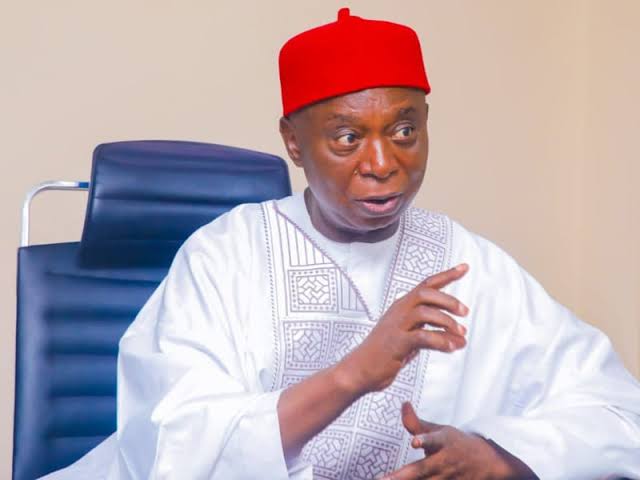
Sen. Ned Nwoko (APC-Delta) urged Nigerian leaders to prioritise citizens’ welfare over the pursuit of wealth

Nwoko, who represents Delta North Senatorial District, said this in his independence message to mark Nigeria at 65 made available to the newsmen Abuja on Tuesday.

He said that as the country marks 65 years of independence, the echoes of her past struggles blend with the urgent cries for renewal, adding that Nigeria was a nation rising beyond challenges.

According to him, 65 years after independence, Nigeria remains a work in progress. A story of resilience, promise, and determination.

“Ours is a nation that has survived turbulence, overcome setbacks, and yet continues to stand as Africa’s most powerful voice.

“Nigeria at 65 must choose to lead, not as a country of wasted potential, but as a nation that transforms its wealth into wellbeing for its people.

“We must secure our communities, empower our youth, modernise our infrastructure, and build institutions that outlive individuals.

“We must insist that no Nigerian is left behind. Not the farmer in the village, not the entrepreneur in the city, not the vulnerable in need of support.”

The law maker added that the 2025 independence anniversary was not just another one, but a clarion call to redefine progress not by the weight of the nation’s wealth but by the welfare of every citizen.

“It is a call to renew our sense of duty to one another and to the generation ahead,” he said.

Nwoko who is the Chairman of the Senate Committee on Reparations and Repatriation noted that the ‘Renewed Hope Agenda’ of the current administration had sparked positive changes across the country .

He said it had stabilised the economy, curbed reckless imports, and was investing in social programmes.

According to him, these are germain and consistency is key. Macroeconomic gains must translate to microeconomic relief.

The lawmaker also said that the vice president’s call for a permanent African seat on the UN Security Council, sovereign debt relief, fair access to trade and financing, equity in resource ownership, and closing the digital divide so that “AI means Africa Included” captured the very essence of Nigeria’s place in the world.

According to him, these are not abstract declarations, they are the lived realities that define our struggle as a nation.”

He added that in the senate, his motions and bills have been guided by these same convictions that justice must be pursued, whether through reparations for historical wrongs or reconciliation for national tragedies.

Nwoko also said that dignity must be guaranteed, whether through attaining veto power at the UN security council, the establishment of a National Social Security Agency or by ensuring healthcare and education reforms that work for Nigerians at home.

“Our sovereignty must be protected, whether by stopping crude oil theft, ending gas flaring, or reclaiming control over our mineral wealth.

“Opportunity must be created, whether through youth entrepreneurship, diaspora voting, indigenous participation in mining, or the expansion of our digital economy.

“Our journey is far from finished. But if we keep faith with one another, strengthen collaboration between the executive and legislature, and place people at the center of our policies, then this decade can be the turning point when Nigeria moves from survival to greatness.

“Happy Independence Day, Nigeria. The struggle continues, but so does the hope,” he added.

ASUU Issues 14-Day Strike Notice To FG Over Seven Points Demand

0

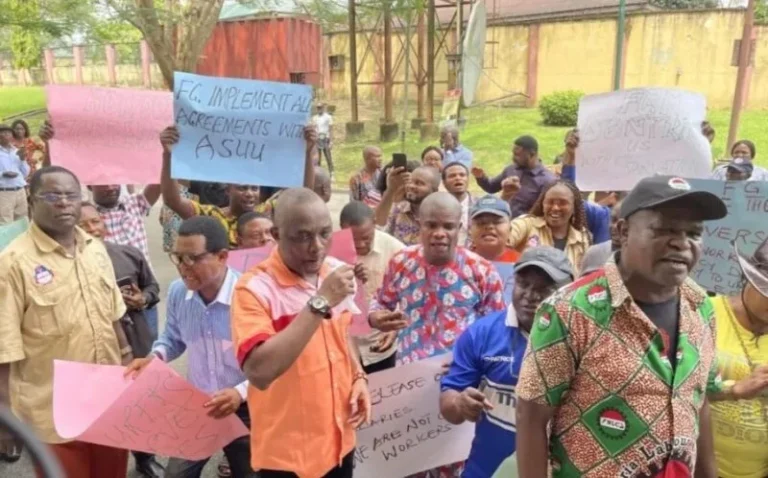
The Academic Staff Union of Universities has issued a 14-day ultimatum to the Federal Government of Nigeria.

The union made the decision following a National Executive Council meeting held on Sunday at the University of Abuja.

The national president of ASUU, Prof. Chris Piwuna made this known in a copy of strike action he personally signed and made available to our correspondent in Abuja.

“ At the National Executive Council meeting held at the University of Abuja on the 28th of September, 2025, the Union decried the neglect of the University system and the government’s consistent refusal to heed its demands.

“Accordingly, ASUU has given the Federal Government of Nigeria an Ultimatum of fourteen (14) days within which to address these issues. If at the end of the fourteen-day ultimatum, the Federal Government fails to address these issues, the Union may have no option but to, first, embark on a two-week warning strike and thereafter, a total and indefinite strike.”

Piwuna listed ASUU’s seven demands as the re-negotiation of the 2009 ASUU-FGN Agreement, sustainable funding of public universities, revitalisation of universities, an end to the alleged victimisation of ASUU members in LASU, KSU (now Prince Abubakar Audu University) and FUTO, payment of outstanding 25–35% salary arrears, settlement of promotion arrears spanning over four years, and remittance of outstanding third-party deductions.

The Federal Ministry of Education had recently set up a committee chaired by the Permanent Secretary of the ministry, Abel Enitan, to review ASUU’s proposals in a bid to restore stability in the university system. However, the committee has yet to make its recommendations public.

At the time of filing this report, the committee has yet to make any decision known to the public.

Continuous Voter Registration: INEC Records 6.2m Online, 1m Physical Registrations

0

The Independent National Electoral Commission (INEC) says it has recorded 6,200,000 online pre-registrations in its ongoing nationwide Continuous Voter Registration (CVR), with in-person registration hitting over one million as at September 28.

The commission disclosed this in its regular update on the exercise released on Monday.

According to the week six update on the online pre-registration, a total number of 6,232,673, representing 52.15 per cent of the figure were female, while 2,982,335 representing 47.85 per cent were male.

The statistics also showed that 4,230,715 of the figure were youths between the age of 18 and 34, while 1,565,824 were students; and 137,865 were Persons Living with Disabilities (PWD).

On the completed online and physical registration, the update showed that at the end of week five; 537, 743 from online registrants, and 466,389 in-persons registrants completed their physical registration.

It also showed that of the figure 555,077 representing 55.28 per cent were female, 449,055 representing 44.72 per cent were male, while 742,379 were youths between age 18 and 34.

It also revealed that 354,406 of the total figure were students, while 13,987 were PWDs.

Air Pollution Killing More Nigerians than Infectious Diseases – Environmentalist

0

The Environmental Health and Public Health Practitioners Association of Nigeria (EPHPAN) asserts that clean air is an indispensable prerequisite for a productive healthy nation.

The National President of EPHPAN, Dr Akingbehin Akinbodunwa, made the assertion at a lecture organised by EPHPAN to mark the 2025 World Environmental Health Day with the theme: ” Clean Air, Healthy People” on Monday in Lagos.

The News Agency of Nigeria (NAN) reports that World Environmental Health Day is celebrated annually on September 26, to raise awareness on the impact of environmental hazards on human health.

According to him, air pollution in Nigeria is not an abstract hazard; it is a major, quantifiable threat to life and productivity.

Akinbodunwa, a health environmentalist, said that national analyses showed that air pollution was the third leading risk factor for premature death in Nigeria in 2019; responsible for roughly 198,000 premature deaths that year.

He added that it caused more deaths than were caused by some familiar infectious diseases, saying that this burden reflects both outdoor (ambient) and household air pollution acting together to harm the citizens.

“In major urban areas the situation is even starker. For example, Lagos — our largest city and economic engine — had an estimated 23,900 premature deaths attributable to air pollution in 2019 alone.

“These are not nameless statistics; they are mothers, fathers, workers, students and children lost prematurely because the air around them was toxic.

“When our children breathe clean air, their brains and lungs develop; when our workers breathe clean air, they are healthier and more productive; when our aged individuals breathe clean air, they live longer, healthier lives.

“The data are clear: air pollution shortens lives and undermines our development goals,” he said.

Akinbodunwa explained that particulate matter with a diameter smaller than 2.5 micrometres (PM2.5) was the pollutant most strongly linked to mortality from heart disease, stroke, chronic lung disease, lung cancer and acute respiratory infections in children.

He said that Nigeria’s population-weighted average particulate pollution has increased over the past two decades — reported increases of about 24 per cent from 1999 to 2021; eroding life expectancy and worsening health across the country.

According to him, in many Nigerian cities and hotspots, short-term PM2.5 readings routinely exceed levels recommended by global health authorities.

He said, “For perspective, the World Health Organisation’s (WHO) updated air quality guidance places the annual safe level for PM2.5 at a very low threshold.

“Compliance with this guidance would protect millions of lives globally.

“The reality is that the vast majority of Nigerians are exposed to PM2.5 levels well above the WHO guidance, which translates directly into higher risks of cardiovascular and respiratory disease, adverse pregnancy outcomes, and lost childhood development.”

The environmental health analyst decried the economic implications of air pollution, saying that it imposes large health-care costs and reduces labour productivity — a double blow to families and to the nation’s development trajectory.

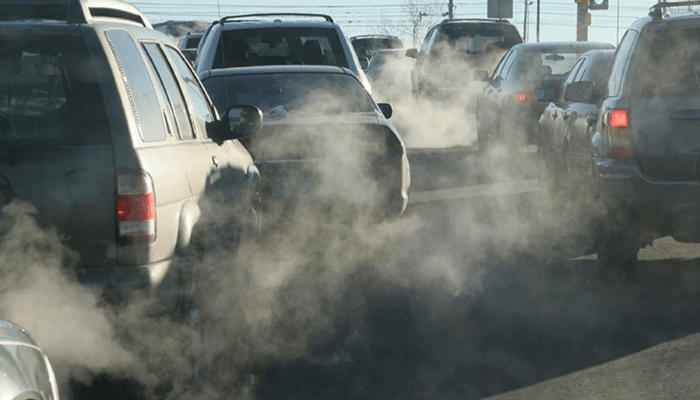
According to him, multiple sources feed Nigeria’s polluted air including vehicular emissions, inefficient combustion of biomass for cooking in households, open waste burning, diesel generators, industrial emissions, brick kilns and agricultural burning.

“Rapid urbanisation and increasing vehicle fleets without commensurate transport planning only magnify exposures; these sectors are where targeted policy and programmatic action will yield measurable health gains.

“Globally, fine particulate pollution (PM2.5) is estimated to contribute millions of deaths annually; nationally, the toll in Nigeria is already tragically high and rising,” Akinbodunwa said.

On measures needed to mitigate air pollution and safeguard Nigeria environment, Akinbodunwa recommended surveillance and data-driven action, household energy transition, cean transport and fuels, control of industrial and waste emissions.

Others are health system readiness and public education, as well as cross-sectoral governance and financing.

“Colleagues, policymakers and citizens, the task before us is large, but the tools and knowledge to reduce pollution and protect health are within our reach.

“Let this World Environmental Health Day mark a renewed, sustained and data-driven commitment: cleaner air for every Nigerian, and healthier people for our nation,” he said.

PENGASSAN/Dangote Clash: FG Reassures On Energy Security, Consumer Protection

0

The Federal Government has reiterated its commitment to remain fully committed to ensuring energy security, protecting consumers, and maintaining stability in the domestic petroleum products market.

The government also assured Nigerians of a steady supply of refined petroleum products in the country.

This is contained in a statement issued by the Director, Information and Public Relations in the Federal Ministry of Finance, Mohammed Manga, in Abuja.

He said that the steering committee of the Domestic Crude Oil and Refined Products Sales in Local Currency Initiative met earlier on Sunday to review developments in the downstream oil sector.

He said that Mr Wale Edun, Minister of Finance and Coordinating Minister of the Economy, raised the issue of the purported suspension of the Naira-for-crude oil arrangement by the Dangote Refinery, adding this had since been amicably resolved.

According to him, the concerns raised by the Petroleum and Natural Gas Senior Staff Association of Nigeria (PENGASSAN) regarding the Dangote Refinery have also been resolved.

Edun, who chaired the committee, gave an assurance that the crude oil for the Naira initiative would continue.

The minister said that all outstanding issues, particularly the dispute between PENGASSAN and Dangote Refinery, are being addressed with urgency and in good faith.

He reaffirmed that there would be no disruption in the supply of refined petroleum products across the country.

In attendance were the Minister of Budget and Economic Planning, Sen. Atiku Bagudu, the Chairman Federal Inland Revenue Service (FIRS) and Mr Zacch Adedeji, who also chairs the Technical Committee,

Also in attendance were the representatives of the Nigerian Midstream and Downstream Petroleum Regulatory Authority, Nigerian National Petroleum Company (NNPC) Ltd., Central Bank of Nigeria (CBN), Afreximbank, and the Dangote Refinery.

PENGASSAN had earlier announced a nationwide strike, directing all its members across offices, companies, institutions and agencies to halt services beginning from 12:01 am Sept. 29

The directive came after PENGASSAN alleged that Nigerian workers were sacked by Dangote Refinery following their joining of the union.

It also claimed that management also withdrew staff buses and denied entry to locals while allowing expatriates access.

The union threatened to picket the refinery if the situation was not addressed.

Dangote Refinery, however, maintained that its restructuring was necessary after alleging acts of sabotage in different units of the facility, posing serious risks to human lives and operations.

Navy Dismantles Six Illegal Refining Sites In Delta, Seize 11,550 Litres of Crude Oil

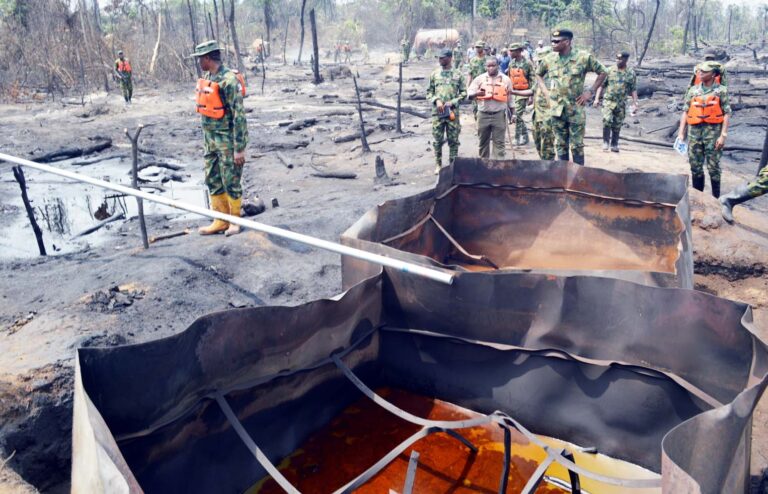
The Forward Operating Base (FOB), Escravos of the Nigerian Navy says it has deactivated six illegal refining sites in Warri South Local Government of Delta.

Navy Capt. Ikenna Okoloagu, the Commanding Officer of the FOB, Escravos, disclosed this in a statement in Warri.

Okoloagu said that the illegal refining sites were dismantled at Obodo Omadino Community.
He said that the feat was achieved in coordinated operations between Sept. 3 and September 24, following credible intelligence at Obodo Omadino Community in Delta.
The naval boss said that the exercise was in line with the ongoing Operation DELTA SANITY II.
He added that the operations aligned with the strategic directives of the Chief of Naval Staff (CNS), Vice Adm. Ikechukwu Ogalla, to rid the maritime space of illegalities.
Okoloagu said that cumulatively, an approximate 11,550 litres of stolen crude oil were seized in the operations.
He added that the product were stored in 52 dugout pits and seven polythene sacks.
The naval boss also said that one pumping machine and about 22 yards of hose were recovered from the illegal sites.

Nigerians In U.S. Set For Colourful Independence Parade, Carnival On Saturday

0

Nigerians in United States will storm the streets of New York City on Oct. 4, for the annual Nigeria Independence Day Parade and Carnival in commemoration of Nigeria’s 65th independence anniversary.

Correspondents report that the event is the largest African celebration outside the continent.

Known as the largest celebration of Nigeria outside the homeland, the annual event promotes the positive image and celebrates Nigerians’ contributions to America.

Some participants at the 2024 Nigeria Independence Day Parade and Carnival being entertained by KCEE at Madison Square Park in New York
The event, which will kick off at 10 a.m. (local time), is being organised by the Nigeria Independence Day Committee (NIDC) comprised of various Nigerian organisations across the U.S.

According to the organisers, the parade will take off at Madison Square and move from East 38th Street to East 24th Street along Madison Avenue.

A carnival atmosphere is expected, featuring food vendors, music, floats, cultural displays and performances by Nigerian and diaspora artists.

Ahead of the parade, the Nigerian flag will be ceremonially raised on Wednesday, Oct. 1 to officially signal the start of the week-long independence celebrations.


The hoisting of the Nigerian flag in Bowling Green, the financial centre of the world, a gala dinner, a welcome party and an after party enriched the week-long event that ended on Sunday morning.

In an earlier address, the Chairman of the Nigeria Independence Day Committee (NIDC), Mr Olayinka DanSalami, described the event as a long-standing symbol of unity and pride for Nigerians abroad.

He recalled that the parade began in 1991 as part of the Organisation for the Advancement of Nigerians (OAN)’s commitment to “showcase Nigeria to the world”.

It was also to counter negative stereotypes of the country prevalent in American media in the 1980s and 1990s.

“OAN itself was formed in 1989 by young, concerned Nigerians who wanted to tell our story differently,” DanSalami said.

“More than three decades later, the parade has become the largest celebration of Nigeria outside the homeland, bringing together people from every background to honour our culture, achievements and contributions.”

The parade has also helped spotlight Nigerian professionals making global strides in medicine, finance, academia, entertainment and technology.

“We look forward to another successful year of showcasing the very best of Nigeria,” DanSalami said.

This year’s edition is expected to draw thousands of Nigerians, African-Americans and New Yorkers of diverse backgrounds to witness the sights and sounds of Nigeria on display.

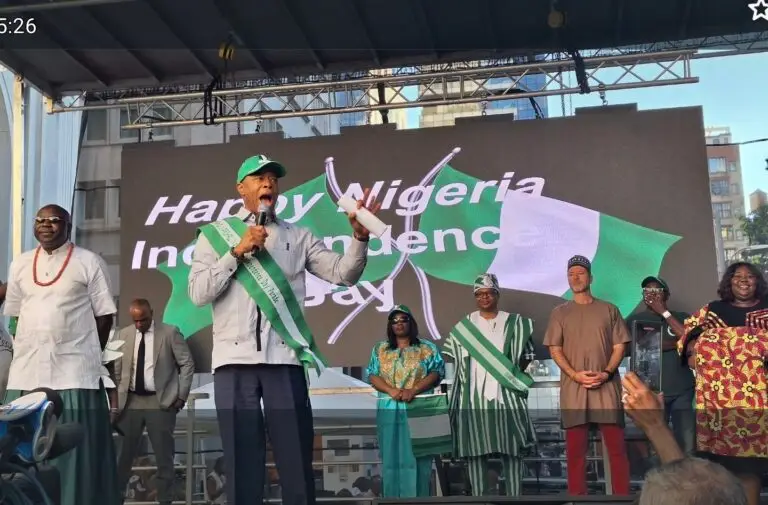
Mayor of New York City, Eric Adams addressing Nigerians flanked by the Consul-General of Nigeria in New York, Amb. Abubakar Jidda at the 2024 Nigeria Independence Day Parade and Carnival, New York
The Consul-General of Nigeria in New York, Amb. Abubakar Jidda, has reaffirmed the mission’s support for the celebration, describing it as “a proud tradition that reflects the resilience, creativity and spirit of our people in the diaspora.”

Jidda said the parade not only strengthens communal bonds but also promotes Nigeria’s image globally.

“From our music and fashion to our entrepreneurship and professional excellence, Nigerians continue to shine abroad,” Jidda noted in a previous message to the community.

“This parade is a reminder of who we are, what we represent and the brighter future we are building together.”

Organisers say this year’s celebration will feature Afrobeats performances, cultural troupes and community groups highlighting Nigeria’s diversity across its regions and ethnicities.

Vendors will also serve popular dishes and snacks while showcasing African-inspired fashion, crafts and merchandise.

Local residents and visitors will have an opportunity to engage with the Nigerian-American community, known to be one of the most educated and entrepreneurial immigrant populations in the United States.

For many participants, the Independence Parade and Carnival serve as both a national commemoration and a bridge between home and diaspora identity.

The event has also served as a diplomatic and cultural platform, drawing dignitaries, state officials and celebrities over the years.

Past editions have hosted city officials, members of the U.S. Congress, entertainers, and business leaders, alongside a cross-section of Nigerian professionals, students, church groups and associations.

New York Mayor Eric Adams, who participated in previous editions, has praised the contributions of Nigerians to the city’s development, describing them as “family-oriented, community-focused and culturally vibrant.”