The Academic Staff Union of Polytechnics (ASUP) has suspended its planned nationwide strike following positive steps taken by the federal government to address the union’s demands.
The suspension was announced on Sunday by ASUP President Shammah Kpanja in a statement in Abuja.
ASUP had earlier threatened to embark on an industrial action following a 21-day ultimatum issued to the Federal Government on August 15.
The union demands include unresolved issues of unpaid salary arrears, delayed implementation of the 25 and 35 per cent salary adjustment, non-release of promotion arrears, and stalled renegotiation of the ASUP/FGN agreement, among others.
”The decision to suspend the strike followed the union’s 115th National Executive Council (NEC) meeting held on October 9 to review government’s response to its 21-day ultimatum.
”The union acknowledges progress on several fronts, including the release of a circular by the National Salaries, Incomes and Wages Commission on Peculiar Academic Allowances,” the president said.
According to him, ASUP also notes measurable progress on the 2025 cycle of the NEEDS Assessment intervention and the resumption of meetings of the Polytechnic Implementation Monitoring Committee.
He added that the union appreciated the reconstitution of the Federal Government Renegotiation Committee to include the Polytechnic sector.
Kpanja further commended the Federal Ministry of Education for addressing issues at the Federal Polytechnics in Nekede and Ekowe.
He said ASUP is also encouraged by efforts to release arrears of the 25 per cent and 35 per cent salary adjustment and promotion arrears owed to polytechnic staff.
“Consequently, our NEC resolved to put on hold the proposed strike to give government more time to conclude ongoing actions,” he said.
Kpanja, however, said the union would review the situation within six weeks to assess the level of implementation of the commitments.
He commended the Minister of Education, the Minister of State for Education and officials of the ministry for their engagement and commitment to resolving the issues.
The National Agency for Food and Drug Administration and Control (NAFDAC) is partnering with the Nigeria Natural Medicine Development Agency (NNMDA) to develop herbal medicines to ensure safety, efficacy, and global acceptance.
This is contained in a statement by NAFDAC resident media consultant, Mr Olusayo Akintola.
NAFDAC Director-General, Prof. Mojisola Adeyeye said Nigerian herbal medicine practitioners have the capacity to formulate safe and effective indigenous natural remedies that meet international standards
She said that NAFDAC has two types of approval for herbal medicines, adding that the first type is a ‘listing’ (L) approval, which is granted after the product has been evaluated in the agency laboratory for toxicology safety tests and with satisfactory results.
Adeyeye said that products in this approval category are listed for a period of two years, with an NAFDAC number bearing the letter “L” at the end.
She said that the second approval type requires that clinical trials be conducted on the product to prove the efficacy of such a product, saying that if this is done in a well-designed protocol with proven efficacy, a full approval with five-year validity is given.
The NAFDAC boss identified cost as a major obstacle preventing herbal medicine practitioners from subjecting their products to clinical trials.
She said that NAFDAC has listed thousands of herbal medicines, with only a few products that have gone through clinical trial outcomes, but such cannot be given 5-year approval without passing the efficacy test through a clinical trial.
“We know that herbal medicine works. It is how to ascertain through clinical trial the level it can be used that patients will be safe, and above which there could be no damage to the liver, the kidney, and other internal organs.
“The fact that it is natural, doesn’t mean that it is all safe. ‘That is where NAFDAC regulation and control comes in,” she stressed.
She recalled that the agency launched the herbal medicine products committee just before the COVID-19 pandemic, which brought the practitioners, Ministry of Health, NAFDAC, and researchers together.
Adeyeye said that this partnership effort is very important because the practitioners know what their forefathers have been using, while the researchers know the science.
According to her, NAFDAC is looking for funding to assist herbal medicine practitioners in the conduct of clinical trials, which is highly capital-intensive.
She equally noted that the agency is working assiduously with the NNMDA to ensure that clinical trial is conducted for the medicines that have met the regulatory requirements for listing.
Adeyeye said that NAFDAC has been educating the herbal medicine practitioners who intend to register products through stakeholders’ meetings.
She said that the agency has gone ahead to published a simple floor plan on the website as a guide for the practitioners, while averting that it does not necessarily to have a big place to use for production.
The NAFDAC boss maintained that the factory must be well-ordered to allow a good workflow so that there will not be contamination.
‘We are working with our practitioners. We are approving herbal medicines daily in NAFDAC, but we are working towards a phase where we will have a national formulary for those that have had clinical trials and have been proven to be very effective,’ she said.
Adeyeye stated that before her appointment at NAFDAC, she was a professor in the United States, adding that at the university, she led a project that developed an anti-sickling polyherbal medicine.
“This medicine, which NAFDAC listed many years before my tenure, was tested in a laboratory setting by incubating it with blood samples from children with sickle cell disease to prove its anti-sickling effect.
“Two research papers were published, confirming both the anti-sickling and anti-infective properties of the medicine.
‘We conducted a clinical trial approved by the Ethics Committee of Bowen University and the Institutional Review Board of my University in the U.S on the polyherbal in July before my assumption of office in NAFDAC in November 2017’.
She added that the trial showed that the product was efficacious but needed more data and funding for completion.
NAFDAC, she said, is determined to assist herbal medicine practitioners, especially in the areas of clinical trials, adding that it will jointly mobilise resources with NNMDA to get some fully registered.
Sterling Oil Exploration and Energy Production Company (SEEPCO) says it has achieved a 25 per cent reduction in emissions, marking a major stride in its transition toward cleaner energy and sustainable operations.
Dr Chris Offokansi, Head of Human Resources and Industrial Relations at SEEPCO, disclosed this at the just-concluded 2025 NAEC Energy Conference in Lagos.
Offokansi said the company’s strategic move to convert over 90 per cent of its vehicle and equipment fleet to run on compressed natural gas (CNG) had played a key role in achieving the reduction.
“Over 90 per cent of our vehicle and equipment fleet now operates on CNG, a bold transition that has significantly contributed to a 25 per cent cut in emissions across our operations,” he said.
He added that SEEPCO had also completed major structural upgrades on its marine barges and implemented extensive environmental safeguards to prevent pollution and accidental spills across its waterways operations.
“These measures are not just compliance efforts; they are deliberate steps to protect the environment and demonstrate that responsible oil and gas production is possible in Nigeria,” Offokansi said.
The company’s efforts, he noted, had not gone unnoticed. SEEPCO recently received the National Sustainability Achievements Award and was named Sustainability Company of the Year, in recognition of its environmental leadership and innovation in the Nigerian energy industry.
Offokansi said SEEPCO’s broader sustainability drive includes robust waste management systems, water conservation initiatives, and a large-scale tree-planting campaign that has seen more than 10,000 trees planted across its host communities.
“These achievements are more than just milestones; they reflect our unwavering commitment to sustainability, accountability, and community impact,” he added.
Founded in 2005, SEEPCO has steadily expanded its footprint in Nigeria’s oil and gas sector, achieving early production success in the Okwuibome (OKW) and Anieze fields within OML 143, and more recently, extending its operations to OML 13 in Akwa Ibom State.
Offokansi said the company’s sustainability philosophy extends beyond operations to how it engages its workforce and host communities.
“My role focuses on ensuring our people thrive, our communities feel respected, and our operations consistently meet the highest environmental and social standards,” he said.
He stressed that SEEPCO’s progress was driven by its belief that economic growth must align with environmental responsibility and social inclusion.
“Progress must go hand-in-hand with protecting human rights, advancing inclusion, and maintaining transparency in all engagements with regulators and stakeholders,” Offokansi said.
He reaffirmed the company’s long-term commitment to innovation and partnerships that would accelerate Nigeria’s energy transition.
“SEEPCO is investing for the future, not just for profit, but for purpose. Our vision is to help Nigeria lead Africa’s journey toward cleaner, more sustainable energy,” he said.
A Data Analyst, Daramola Omoyele, has called for legal reform and data harmonisation to enhance authentication of voters’ National Identification Number (NIN).
Omoyele, in an interview on Sunday in Abuja, said this would not only simplify the voting process but also strengthen data integrity across public institutions.
He wondered why Nigerians with valid NIN should be asked to do separate voter registration, describing the process as redundant.
The data analyst said it would not only waste time and resources but also contribute to the disenfranchisement of millions of eligible voters.
He also pushed for legislation that would recognises NIN (with biometric verification) as sufficient for voter registration, thereby reducing bureaucratic hurdles.
According to him, modern democracies such as India and Estonia utilise centralised, interoperable databases where a national identification serves as a reliable foundation for voter verification without repeated re-registration.
“If Nigeria’s government truly wants to advance digital governance and reduce election fraud, the solution lies not in forcing people to re-register but in harmonising existing data,’’ he said.
Omoyele stated that the NIMC database already holds the essential biometric and demographic information, fingerprints, facial data, date of birth and the address needed to verify voter eligibility.
He advised Independent National Electoral Commission (INEC) and National Identity Management Commission (NIMC) to collaborate on use of NIN for voter authentication.
“This will simplify registration, eliminate redundancy and ensure that no eligible Nigerian is denied their right to vote.
“There is no compelling technical justification for forcing citizens to re-register with INEC.
“Instead, the electoral body should prioritise integration with NIMC through a secure, auditable data-sharing framework,’’ he said.
The data analyst highlighted the gap between Nigeria’s potential voting population estimated to be over 100 million out of a population of over 200 million, and the actual turnout.
He noted that in the 2023 general elections, only 24.9 million people voted, representing only 26.72 per cent of the registered voters.
The figure, according to him, raises serious questions about how less than 10 million votes could decide the outcome of a presidential election in a country with over 200 million.
“Why do tens of millions of eligible Nigerians remain unregistered or, if registered, unable to vote?
“This is not a mere statistical anomaly. It points to systemic exclusion and inefficiencies that effectively silence vast swathes of the population,’’ he said.
He argued that if there’s a mismatch in administrative barriers and duplication of registration among government agencies, millions of eligible citizens could be prevented from being registered or being able to vote, saying this could amount to ‘fraud by omission’.
He recommended that, given the scale of the gap between eligible citizens and actual voters, INEC, under the newly appointed Chairman, Prof. Joash Amupitan, should treat it as “a minor flaw’’ by taking certain pragmatic steps.
The pragmatic steps, according to Omoyele, should include treating NIN as a primary key for voter qualification, eliminating the need for a second manual registration process.
“Once the NIN is verified (that is, age, nationality and biometric match), eligible citizens should automatically be qualified to vote.
“This will eliminate the need for a second, manual registration process for those who already have valid national identity records,’’ he said.
Omoyele also recommended real-time synchronisation and continuous update of data instead of periodic bulk registration drives, using dynamic sync so that NIN updates automatically reflect in the voter register.
He also called for full audit of mismatches between NIMC and INEC records and creation of necessary mechanisms for citizens to resolve such discrepancies via digital portals or local offices.
Omoyele tasked INEC on public transparency and data releases through published anonymised statistics showing the number of potential voters excluded, the reasons and the process of resolving them.
“Where digitisation is weak, deploy mobile units and local kiosks to help verify identity and resolve registration anomalies, using NIMC data as a baseline.
“They must also ensure that no one is turned away solely because INEC’s manual database doesn’t reflect what NIMC holds.
“If Prof. Amupitan implements these changes, Nigeria’s electoral process will move from fragmentation to coherence, from distrust to accountability, and from exclusion to inclusion.
“In a data-driven world, democracy cannot function well when its institutions duplicate, obscure or delay access,’’ he said.
Academic Staff Union of Universities (ASUU) has declared a two-week total and comprehensive warning strike across all public universities in Nigeria.
The National President of the Union, Prof. Chris Piwuna, announced the latest development at a press briefing in Abuja on Sunday at the University of Abuja.
Piwuna stated that all branches of ASUU should withdraw their services with effect from midnight on Monday, October 13, 2025.
He said, “Compatriots of the press, it goes without saying that there is nothing sufficient on ground to stop the implementation of the ASUU-NEC’s resolution to embark on a two-week warning strike at the expiry of the 14-day notice given on the 28th September 2025.
“Consequently, all branches of ASUU are hereby directed to withdraw their services with effect from midnight on Monday, the 13th October, 2025.
Recall that the Federal Government last week appealed to members of the Academic Staff Union of Universities (ASUU) to shelve the proposed strike action, as the government was prepared to resolve all the lingering issues comprehensively and holistically.
Minister of Education, Dr Olatunji Alausa, made the appeal in Abuja at a news conference held before the meeting of the high-level committee on FGN/ASUU 2025 proposed agreement on Wednesday.
Alausa said President Bola Ahmed Tinubu had directed that the ASUU proposed strike be averted, affirming the commitment and political will of the President to resolve all the contending issues that would be mutually acceptable and respectful to all the staff unions.
He said there was no basis for ASUU or any other staff unions in territory institutions to embark on industrial action, stressing that the directive of the President is clear, “strike must be averted for Nigerian children to be in school”.
ASUU, had a fortnight ago, issued a 14-day ultimatum to the Federal Government to meet its demands or face industrial action.
The decision was reached at the union’s National Executive Council (NEC) meeting held on September 28 at the University of Abuja
Some of the demands of ASUU include the re-negotiation of the 2009 ASUU-FGN agreement, sustainable funding and revitalisation of universities, an end to the victimisation of ASUU members at Lagos State University (LASU), Kogi State University (now Prince Abubakar Audu University), and the Federal University of Technology, Owerri (FUTO), among others.
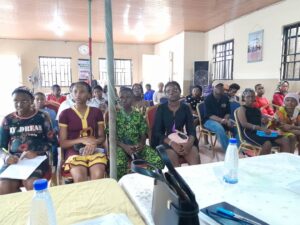
In commemoration of the International Day of the Girl Child 2025, themed “The Girl I Am; The Change I Lead,” the Rivers Secondary School Old Boys and Girls Association, Class of 1983 (ROGBA’83), in collaboration with the Redeemed Christian Church of God (RCCG), hosted an inspiring conference for girls aged 12 to 19 on Saturday at the RCCG Life Chapel Area, Rumubiakani, Rivers State.
Dr. (Mrs) Ibinabo Ogolo
According to Dr. (Mrs.) Ibinabo Ogolo, Secretary General of ROGBA’83, the event was part of the association’s commitment to give back to society and make a lasting impact on young girls. She explained that the goal was to help them find their voice, embrace purpose, and think proactively about shaping a better future for themselves and their communities.
“Our aim is to support and give back to society by helping young females speak up, brace up, and think about what they can do to impact the future,” she said.
The conference featured interactive sessions and mentorship talks led by seasoned speakers who inspired the girls to think big, stay focused, and stand out.
Barrister Ibiwari Waribo emphasized that the future belongs to girls with vision and determination.
“Better futures are created by a girl child who has vision and is driven by greatness,” she said.
Pastor (Mrs) Ngozi Ajayi
She noted that empowering girls means empowering the world, creating room for females to reach their fullest potential.
“Empowering a girl child automatically means empowering the world,” she added.
Waribo also cautioned against drug abuse among youths, urging the girls to embrace integrity and self-discipline rather than following the crowd.
“Timing is everything. Do not procrastinate,” she stressed, highlighting the importance of hard work and focus.
She further called on parents and guardians to remain vigilant and protect the girl child’s rights to education, equality, and safety from abuse.
“Training a girl child is training a nation,” she stated, condemning discriminatory practices against women in inheritance and encouraging girls to value their dignity and reject all forms of abuse or discrimination.
Dame Agnes Tuboalabo, Secretary of the International Day of the Girl Child 2025 Planning Committee, drew lessons from the Bible, reminding the girls that they hold the power to make choices that shape their lives and influence generations to come.
“The girl child carries society upon her shoulders and must make decisions that shape the future of a generation,” she said.
Barrister Ngozi Ajayi, Chairman of the Planning Committee, encouraged participants to visualize the kind of women they want to become. Through an engaging exercise, the girls shared dreams of becoming university graduates, footballers, dermatologists, and business owners.
“Always envision the woman you want to become,” she advised.
Ajayi also emphasized discipline, prayer, and focus, urging the girls not to be pressured into early marriage.
“Though marriage is good, do not be pressured into it. Times and seasons have changed,” she said.
She further highlighted the importance of digital inclusion, noting that while the digital era offers opportunities for innovation and growth, it also comes with risks such as cyberbullying and distractions.
“The digital world opens doors for girls, but wisdom and discipline are key to using it right,” she cautioned.
In her closing remarks, Dr. (Mrs.) Ogolo encouraged parents to be role models and strengthen their children through love, guidance, and example.
The conference ended on a powerful note, leaving the girls inspired to lead change, embrace education, and walk confidently into a brighter, self-defined future.
A traditional ruler in Rivers State, Dr. Felix E. Otuwarikpo, Eze Igbu Upata III of Upata Kingdom, in Ahoada Local Government Area, has called for a complete rethinking of community development in the Niger Delta, urging stakeholders to use public relations as a strategic tool for sustainable growth and social transformation.
Speaking at the 2025 Alabo O.B. Fubara Memorial Gold Paper Lecture organized by the Nigerian Institute of Public Relations (NIPR), Rivers State Chapter, as part of activities marking its maiden Public Relations Week, Eze Otuwarikpo said that the enduring underdevelopment of the Niger Delta stems not only from poor governance and environmental degradation but also from the lack of meaningful engagement with the very people development is meant to serve.
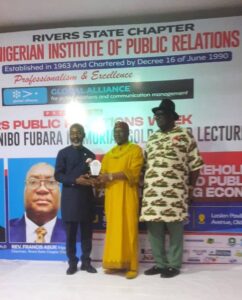
Eze Dr. Otuwarikpo (middle) receiving an award at the ceremony.
Presenting a paper titled “Empowering Community Development in the Niger Delta: Harnessing Public Relations for Sustaining Growth,” the traditional ruler argued that for genuine progress to occur, the people must be treated as partners, not mere recipients of government benevolence.
He expressed the opinion that government must partner with communities to tackle poverty, rebuild trust, and ensure sustainable development in oil-rich region.
“We cannot continue to design policies for our communities without involving them in the conversation.
“Public relations provides that bridge of understanding, participation, and trust that can turn lofty development ideas into living realities,” he said.
Tracing the history of Nigeria’s development trajectory, Dr. Otuwarikpo lamented that since independence in 1960, most government efforts have focused disproportionately on urban areas, leaving the rural majority, especially in the Niger Delta, in a cycle of poverty and neglect.
According to him, the colonial masters set the stage for this inequity through an exploitative model that viewed rural Nigeria as a reservoir of raw materials and food for the cities, noting that “the British colonial interest in rural Nigeria was characterised by two-pronged exploitation—resource extraction and food production for urban comfort.”
“Unfortunately, that pattern has continued long after independence,” Dr. Otuwarikpo said, adding that despite decades of intervention programmes such as the Directorate of Food, Roads and Rural Infrastructure (DFRRI), National Directorate of Employment (NDE), Oil Mineral Producing Areas Development Commission (OMPADEC), and the Niger Delta Development Commission (NDDC), rural life in the region has remained poor.
“We have had too many programmes and too little participation,” he lamented. “Policies without communication, and projects without local ownership, are doomed to fail.”
“Sadly, the Niger Delta’s oil-rich landscape remains mired in poverty, underfunded community projects, and rural-urban migration. Development initiatives are often disrupted by political interference and lack of continuity. Many communities still face poor health care, limited education, low income, and insecurity, which are symptoms of decades of neglect,” he stated
The monarch, who is also a Fellow of the NIPR, emphasized that public relations offers a framework for dialogue and inclusion, which can help rebuild trust between governments, corporations, and the people. He described communication as the missing link in most rural development efforts.
Empowerment in the Niger Delta, he stated, is not just about government intervention but about partnerships—where communities take initiative, and governments provide enabling support.
According to him, development can only thrive when communities and governments jointly pursue shared goals. He said for such a collaboration to succeed, government must deploy persuasive, transparent communication to unite its efforts with the aspirations of the people
“Development is not just about roads, schools, or electricity,” he said. “It is about human connection, about people believing they matter and having a say in shaping their future. That is the essence of effective public relations,” the royal father noted.
Eze Otuwarikpo called for a paradigm shift that integrates traditional leadership, community groups, and the media into development planning and execution. He said the Niger Delta’s narrative should change from one of agitation and neglect to a story of partnership, innovation, and sustainable progress.
“The Niger Delta must begin to tell its own story,” he declared. “We must communicate our aspirations with clarity, responsibility, and unity of purpose. Only then can we take ownership of our development journey.”
The lecture which took place at the La Sien Pavilion in Port Harcourt, also celebrated the enduring legacy of Alabo O.B. Fubara, one of the founding fathers of the NIPR in Rivers State, remembered for his courage, professionalism, and commitment to ethical communication.
“Alabo Fubara believed in truth, dialogue, and the transformative power of communication,” Dr. Otuwarikpo said. “As we honour his memory, we must rededicate ourselves to using public relations as a tool to rebuild trust, empower our people, and sustain development in the Niger Delta,” he declared.
The event drew leading figures from the media, academia, and traditional institutions, all of whom agreed that the time had come to redefine community development through inclusive communication and reportage.
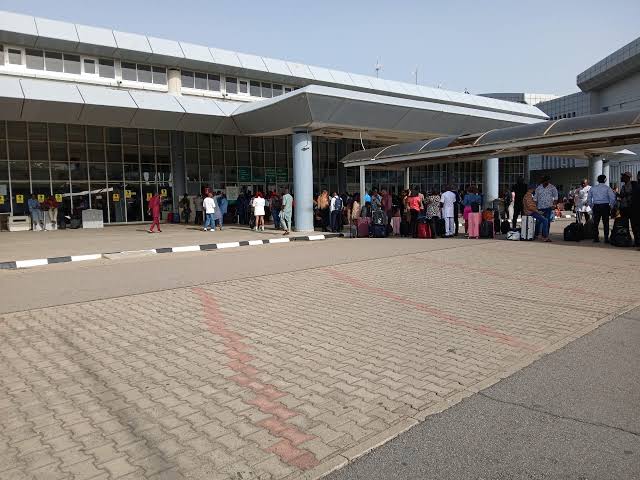
A dispute between two adult sisters who missed their flight at the Nnamdi Azikiwe International Airport, Abuja caused a stir and disrupted operations on Sunday when one of them fainted following a fight between them.
The two sisters, reportedly booked to travel via a NG Eagle flight but they missed the flight after arriving the airport late.
The incident was said to have occurred as the women argued over the missed departure, with the disagreement escalating into a fight.
Luggage and personal items were scattered as airport security intervened, eventually escorting the sisters to the interrogation office.
Spokesperson of the NCAA, Mr. Michael Achinmugu, confirmed the development in a post on his X handle.
The strangest thing just happened at the Abuja airport. Two sisters, both adults, booked to travel via a NG EAGLE flight. They missed the flight because they were late,” Achimugu said.
Perhaps one of them blamed her sibling for their missing flight (not sure), but these two siblings began to fight each other. They scattered luggage and other items before being dragged to the interrogation office by airport security.”
He said when the two sisters got inside, they began to fight again until one of them fainted. Calls were made for an ambulance to take her to the hospital, but her sister said that the problem is more spiritual than medical and, therefore, did not need a hospital.
Standard procedure is that passengers travelling on a domestic flight are expected to arrive at the airport one hour before departure to complete the pre-departure formalities while for the international passengers, they are to arrive two hours before the flight.
Members of the Nigerian Institute of Public Relations (NIPR) must move beyond assumptions and normative hopes if the profession is to thrive in today’s complex business environment, so says its former national president, Amaopusenibo Bobo Sofiri Brown.
Brown made the call in his goodwill message at the Rivers State Chapter’s maiden Public Relations Week. He described the theme of the event, “Refocusing Stakeholder Engagment And Public Trust In A Challenging Economy”, as both “challenging and timely,” noting that PR practice must now be guided by systematic understanding rather than guesswork.
He said the frequent use of the term “stakeholders” without clear definition or research-backed analysis has created a gap in professional practice.
“Too often, we use ‘stakeholders’ as a catchword without a proper understanding of who they are or how they behave. This weakens strategic planning and communication outcomes,” Brown said.
Amaopusenibo Brown, who is also a former Managing Director of defunct Garden City Sunray Newspapers, urged practitioners to rethink the concept of stakeholders and how they differ across sectors.
“Are stakeholders in oil and gas the same as those in aviation or education? Does the business environment shape stakeholders, or do stakeholders shape the environment?” he asked.
He said the Institute must develop frameworks that help members identify and categorize stakeholders, study their behavior, and predict what works best among them.
“NIPR must not only use the term ‘stakeholders’ — we must own it through deeper study, analysis, and application,” he added.
Drawing lessons from experience, the former NIPR national president cited recent events in Rivers State as a practical lesson in stakeholder influence. He noted that during the Sole Administratorship period, citizens, particularly women, raised their voices peacefully against injustice and were able to effect change.
“That episode showed how powerful organized, peaceful stakeholders can be when they understand their role and responsibility,” he said.
Brown stressed that predicting stakeholder behavior is now central to effective Public Relations and should form part of practitioners’ strategic planning.
Insisting that professional standards must be consistent, Brown decried the lack of uniform professional standards across NIPR Chapters, comparing the situation unfavorably to medicine and law.
“A PR professional from Jos should be able to deliver the same standard of work in Asaba or Aba. That’s the hallmark of a true profession,” he maintained.
He lamented that many Chapters tolerate substandard work in the name of convenience, adding that such laxity erodes public confidence. “When a media post or publicity material falls short, we often hear, ‘let it go.’ But no serious client would accept that,” he said.
While calling for a new professional mindset, Brown urged Chapters to function as credible resource centres that promote excellence, accountability, and ethical practice. He said Public Relations will only earn respect when practitioners deliver consistent value based on research and professionalism.
“If we achieve clarity in defining our stakeholders, uphold high standards, and embrace accountability, it will mark a new dawn for Public Relations practice in Nigeria,” Brown concluded.
The maiden Rivers Public Relations Week Week And Alabo Olu Benibo Fubara Memorial Gold Paper Lecture took place at the La Sien Pavilion along Forces Avenue in Port Harcourt Rivers State from October 8 to October 10, 2025.
The Bank Customers Association of Nigeria (BCAN) has urged the Central Bank of Nigeria (CBN) to sustain its ongoing reforms to ensure the steady recovery of the Naira in the foreign exchange market.
BCAN President, Dr Uju Ogubunka, gave the advice in an interview with the News Agency of Nigeria (NAN) on Saturday in Lagos, following the continued appreciation of the Naira at the official foreign exchange market.
NAN reports that the local currency closed bullish on Friday, appreciating to N1,455.17 against the dollar at the official window.
Data from the CBN showed that the Naira gained N11.48, or 0.78 per cent, compared to N1,466.65 to the dollar on Thursday.
The Naira, however, recorded a marginal depreciation of 0.05 per cent on Tuesday, trading at N1,471.08, while it exchanged at N1,470.26 on Monday.
Reacting to the trend, Ogubunka, a financial expert, urged the apex bank to sustain the measures responsible for the recent gains.
“Let the CBN keep doing whatever it has been doing that made the Naira appreciate. Let them do more of it. They should sustain the reforms,” he said.
He attributed the Naira’s improvement to monetary policy controls that regulate money supply, stressing that such measures were helping to stabilise the currency and strengthen economic growth.
The BCAN president, however, called for complementary fiscal measures to boost local manufacturing and productivity for the gains to translate into better living conditions for Nigerians.
“People are still suffering due to low purchasing power. We should increase productivity, tackle insecurity, and attract more investors to bring funds into the system so that more people can be employed.
“Once we can do some of these things, the economy will begin to move up, and as long as the economy grows, the Naira will continue to appreciate.
“However, if there is too much money in circulation, the Naira will not appreciate as expected,” he said.