At Rivers State University’s 121st Inaugural Lecture, Professor Isaac Eyi Ngulube retraced his journey through the “rough beasts” of scholarship, unveiling groundbreaking linguistic theories and urging Nigeria to embrace language as the foundation of culture, identity, and national progress.
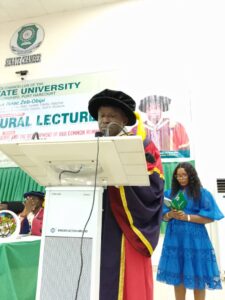
Prof. Ngulube delivering the lecture.
The 121st Inaugural Lecture of Rivers State University (RSU), held on Wednesday, October 29, 2025, at the Dr. Nyesom Ezenwo Wike Senate Building, turned into a celebration of intellect, resilience, and the transformative power of words.
Delivering the lecture titled “The Career of Rough Beasts: Language, Literature, and the Development of Our Common Humanity,” Professor Isaac Eyi Ngulube, a scholar of English and Linguistics, traced his academic journey through trials and triumphs — what he described as a lifelong confrontation with “rough beasts.”
Opening the event, Vice Chancellor Professor Isaac Zeb Obipi hailed the lecture as “a journey through perseverance and growth,” explaining that the “rough beasts” symbolized the defining struggles that shaped Ngulube’s intellectual path.
“In confronting these beasts, he has emerged stronger — a true emblem of intellectual courage and creativity,” Obipi said.
Recalling his early years, Ngulube told the audience that his passion for learning was kindled in childhood.
“The journey into the ring to confront the strange beasts began when I was only seven years old, playing in the living room of my namesake, Mr. Isaac Okparaji Keewi Eyi of blessed memory.”
From those humble beginnings, Ngulube’s curiosity blossomed into groundbreaking work in linguistics and literature. He presented his Coaxal Grid, a linguistic model that unites phonetics, syntax, pragmatics, and applied linguistics to deepen understanding of language as a living system.
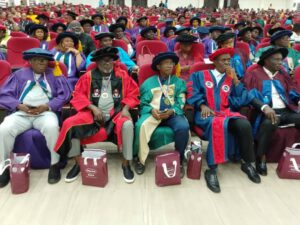
Academics at the lecture
“Language feeds Literature and Literature bleeds Language,” he declared, emphasizing their interdependence as engines of creativity, communication, and civilization.
He described language as “a purely human and non-instinctive means of communicating ideas and emotions,” noting that “the word is a fundamental need in language; you cannot study language without the use of language.”
Quoting Scripture — “Let there be light, and there was light” — Ngulube illustrated the power of words to create and transform. He urged parents to be cautious with their utterances, warning that “what they refer to their children as is what they will automatically end up becoming.”
Drawing inspiration from Chinua Achebe, he reinforced the link between language and civilization.
“If you take away language from us, we return to the primitive era,” he said, adding that any society that seeks progress must “place the study of its language high on its agenda.”
Ngulube called for Nigerian universities to adopt English for Specific Purposes (ESP) — a model that aligns English teaching with students’ academic and professional goals. He also pressed for the inclusion of indigenous languages in tertiary education curricula, describing them as vital for preserving Nigeria’s cultural and linguistic identity.
A pioneer in language development, Ngulube has created government-approved orthographies for four Nigerian languages — Ibani, Ikwerre, Khana, and Ogba — and developed the Lambda Theory, designed to improve translation and comprehension across languages.
He urged the Federal Government to commit more strongly to mother-tongue and multilingual education, supported by structured teacher training, research grants, and a reformed national language policy. He also challenged the media to become “partners in linguistic development, not mere conveyors of borrowed speech.”
In his closing remarks, Vice Chancellor Professor Obipi praised Ngulube for “conquering the rough beasts” of scholarship and for his outstanding contributions to English studies, literature, and education.
He highlighted RSU’s recent victory in the Bilingual Community Project organized by the French Embassy, describing it as proof of the university’s rising excellence in language studies. He reaffirmed RSU’s commitment to strengthening English and Linguistics programs, fostering research collaboration, and expanding facilities for its language centers, including the French Language sector.
The lecture ended with a standing ovation as academics, students, and guests celebrated a scholar whose career reflects the endurance of the human spirit and the timeless truth that language — when understood and valued — remains humanity’s most powerful instrument of light and progress.
Chief Samuel Ogbuku, Managing Director of Niger Delta Development Commission, NDDC, has dissociated himself from a recent report in the Media attributing his rumoured arrest to the Bayelsa State Governor, Senator Douye Diri.
In a statement signed by Dr. Willie Etim, SA Media to the MD of NDDC, Dr. Ogbuku condemned in very strong terms the news report attributed to a former Deputy National Publicity Secretary of the All Progressives Congress (APC), which insinuated a rift between himself and the Governor, and cautioned that there is no rivalry in the APC Family in Bayelsa State.
According to the statement, “it is also important to clarify that any comments or opinions expressed by anyone on political matters in Bayelsa State should be regarded strictly as their personal views and not as a representation of the views or position of Dr. Ogbuku.”
“The attempt to link the governor to political controversies or rumours of arrest is both misleading, mischievous, and unnecessary.
“We want to use this medium to express our sincere apology for any embarrassment the publications may have caused the Governor and call on all party faithful to exercise restraint in public commentary, especially when such remarks could mislead the public or misrepresent facts,” the statement concluded.
It would be recalled that a few days ago, the Niger Delta Development Commission (NDDC) threatened legal action against two national newspapers for allegedly publishing false reports linking its Managing Director, Dr. Samuel Ogbuku, to a purported plot to overthrow the administration of President Bola Ahmed Tinubu.
According to the NDDC, both The Punch and Daily Times newspapers recently published stories suggesting that Dr. Ogbuku was implicated in an alleged coup plan. The Commission has since described the reports as entirely baseless, defamatory, and damaging to the reputation of both the Managing Director and the federal government agency.
In a statement issued in Port Harcourt, the NDDC demanded a public retraction and apology from the two newspapers, calling the publications “false and reckless fabrication
intended to mislead the public.”
The Commission’s counsel, Adedipe and Adedipe Legal Practitioners, led by Chief Ayodeji Adedipe, SAN, has issued a formal legal notice to The Punch, Daily Times, and other media outlets that circulated the report. The letter demanded the withdrawal of the story and an unreserved public apology.
According to Chief Adedipe, the publications “falsely alleged that Dr. Samuel Ogbuku, Managing Director of the Niger Delta Development Commission, was arrested by military intelligence for co-sponsoring a failed coup plot against President Tinubu.”
“The report further claimed, without any factual or evidential basis, that Dr. Ogbuku transferred funds from NDDC contracts to finance the alleged coup. These allegations are entirely false, malicious, and defamatory,” Adedipe stated.
The letter emphasized that Dr. Ogbuku had not been arrested, questioned, or invited by any authority regarding any alleged coup or financial misconduct. It also accused the newspapers of breaching journalistic ethics by failing to contact either Dr. Ogbuku or the NDDC for clarification before publishing the story.
“This reckless and damaging report has caused Dr. Ogbuku and his family deep emotional distress, embarrassment, and reputational harm,” the letter read. “Friends, associates, and colleagues have inundated him with calls expressing concern over the unfounded claims.”
Through his legal representatives, Dr. Ogbuku demanded that The Punch and its editor, Awwal Owolabi, immediately retract the story from all platforms and publish a written apology in at least four national newspapers, including five consecutive editions of The Punch, across print, online, and social media.
The NDDC warned that failure to comply within seven days of receiving the legal notice would result in both civil and criminal proceedings under the Cybercrimes (Prohibition, Prevention, etc.) Act, 2015 (as amended in 2024) and other relevant laws of the Federal Republic of Nigeria.
In Andoni, a new road is emerging from the swamps, cutting through mangroves and waterways, stretching steadily toward the Atlantic Ocean. The 13.52-kilometer Ngo–Atlantic–Oyorokoto Road is far more than an engineering project; it is a bold declaration of purpose. It tells the story of a people long isolated by geography, and a government now determined to connect them to opportunity.
This road is not just a physical link between communities. It is a symbol of resilience, vision, and leadership that refuses to be defined by obstacles. Where others saw impenetrable swamps, creeks and restless tides, Governor Siminalayi Fubara saw a canvas for renewal and growth.
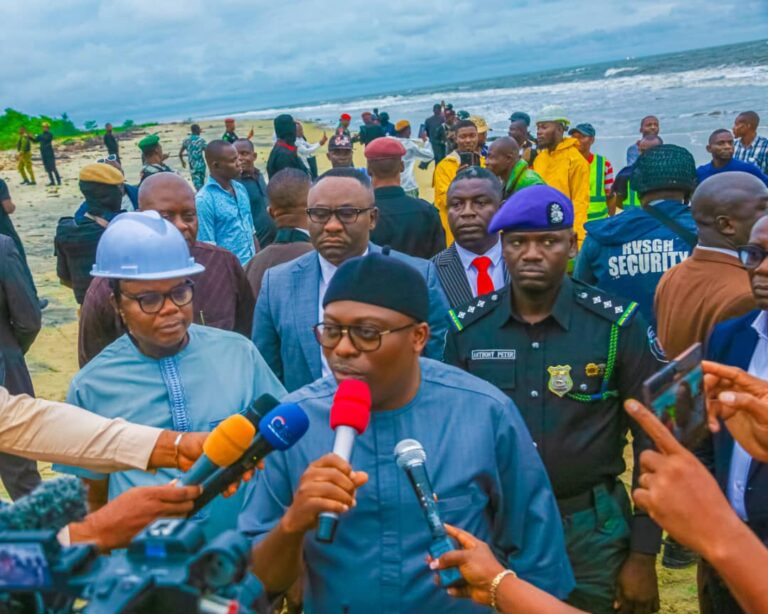
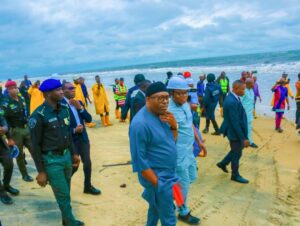
Rivers State Governor, Sir Siminalayi Fubara (middle); inspecting the Atlantic beachfront during an on-the-spot assessment of progress of work on the Ngo-Atlantic-Oyorokoto Road, in Andoni Local Government Area of the State, on Tuesday, October 28, 2025.
On Tuesday, October 28, 2025, the Governor led from the front, personally inspecting the Ngo-Atlantic-Oyorokoto Road project site. His boots sank slightly into the freshly graded earth before stepping onto sandy patches closer to the Atlantic shoreline. He walked quietly but with purpose, embodying his conviction that leadership is about action, not rhetoric.
Journalists, residents, and construction workers followed closely as he surveyed the site. Standing beneath the open evening sky with the salty Atlantic breeze sweeping across the wetlands, Governor Fubara declared, “This is a virgin road, 13.52 kilometers of a new pathway to the blue economy.” His words carried the weight of commitment, echoing a vision already taking physical form.
The terrain here is harsh and unyielding. Thick mangrove forests, deep swamps, and shifting tidal channels have long discouraged development. Yet, under Governor Fubara’s leadership, this difficult landscape is being conquered through engineering innovation, steady funding, and unwavering political will.
A fascinating view of the Atlantic Ocean from the beachfront at the terminus of the Ngo-Atlantic axis of the 13.52kilometers Ngo-Atlantic-Oyorokoto Road in Andoni Local Government Area on Tuesday, October 28, 2025.
Originally, the Ngo–Oyorokoto Road was conceived as a single access route to the famous Oyorokoto Beach, one of Nigeria’s most celebrated coastal destinations. But destiny had other plans. During preliminary works, Governor Fubara drew the attention of engineers and surveyors to a newly discovered, untouched Atlantic-facing beachfront, a pristine expanse of white sand and deep blue waters that revealed enormous potential for tourism, trade, and marine exploration.
Recognising the significance of this discovery, the Governor immediately approved an expanded project scope to open up this new frontier for development. “We will not limit progress to a single beach,” he said. “This new Atlantic-facing front will be developed as part of our blue economy vision.” That decision transformed the project from a local access road into a state-defining infrastructure initiative.
Every meter of the Ngo–Atlantic–Oyorokoto Road now tells a story of determination and transformation. The mangroves, the swampy creeks, and the ever-shifting Atlantic tides are being subdued by vision, planning, and relentless execution. Beyond asphalt and concrete, the road represents hope, a gateway to a more prosperous coastal future.
Andoni’s coastal identity runs deep. It is home to a proud fishing tradition, the vast Ikuru Atlantic Beach, and the legendary Oyorokoto settlement, often described as West Africa’s largest fishing community. For generations, fishing has sustained the people here, but development has been slow. High costs of fishing gear, poor access routes, and the lack of modern facilities, among others, have long limited their full economic potential.
The stretch of the Ngo-Atlantic axis of the Ngo-Atlantic-Oyorokoto Road in Andoni Local Government Area during an inspection visit to the project site on Tuesday, October 28, 2025.
Now, that story is beginning to change. When completed, the Ngo–Atlantic–Oyorokoto Road will usher in a new era for the region’s fishing industry, aquaculture ventures, and marine tourism. Improved access will reduce costs, expand markets, and attract new investors. The Atlantic coastline holds vast opportunities for eco-tourism, recreation, and maritime trade. With strategic port and shipping development, Andoni could emerge as another vital node in Rivers State’s expanding logistics and trade network.
Oyorokoto, the fishing capital of the region, stands to benefit the most. A 2016 study estimated 2,572 active fishermen in the settlement, engaged mainly in artisanal fishing. They harvest a rich variety of seafood, from fish and crabs to shrimps, oysters, and sea snails, sustaining both local consumption and commercial trade.
Scientific data reinforces this productivity. A 2016 study on Black Tiger Shrimp recruitment in the Andoni estuaries recorded about 350 artisanal shrimp fishers, with peak catch rates reaching 78.11 kilograms per person per hour in September. Another study conducted in 2019 near the Bonny Estuary found that 57.7 per cent of fin fish were caught during the dry season, and 42.3 per cent in the wet season, totalling 4,800 individual fish.
Between 1999 and 2000, researchers identified 63 species of fish caught by artisanal fishers in the Andoni River system, with Tilapia guinensis accounting for four per cent of the total. A 2022 study revealed that fish marketing in Andoni was profitable, with vendors earning an average monthly profit of ₦623,386.67. The Food and Agriculture Organisation (FAO) reported over 250 canoes operating in Oyorokoto by 2016, while a 2023 survey found that most male residents aged 41 to 50 were engaged in artisanal fishing, earning a gross margin of about ₦112,092 per month.
Despite this strong foundation, challenges have persisted. Inadequate infrastructure, limited access to capital, and poor storage facilities have long constrained the potential of Andoni’s fisheries. For years, community leaders lamented government neglect, calling for investment in roads, jetties, and cold storage facilities. Governor Fubara’s administration has listened, and acted.
The stretch of the Atlantic-Oyorokoto axis of the Ngo-Atlantic-Oyorokoto Road in Andoni Local Government Area during an inspection visit to the project site on Tuesday, October 28, 2025.
The Ngo–Atlantic–Oyorokoto Road is not just a response to years of neglect; it is a deliberate strategy to open Andoni to the wider world. By linking fishing settlements directly to markets and ports, the road will reduce post-harvest losses, lower transportation costs, and create a more efficient value chain for the fishing industry. It will also stimulate tourism and hospitality opportunities, including cruises, water sports, and coastal resorts. Supporting sectors such as accommodation, transport, logistics, recreation, and local cuisine are expected to flourish as the area opens up to visitors and smart businesses.
One remarkable trait of Governor Fubara’s administration is its refusal to be deterred by difficult terrain. What many once described as impossible has become achievable under his leadership. The completion of the Andoni section of the Ogoni–Andoni–Opobo Unity Road stands as proof. That 27.52-kilometer link, featuring three major bridges, was first initiated under Dr. Peter Odili decades ago but was completed only in 2024 by Governor Fubara. Its delivery finally gave Andoni communities road access to the rest of the state.
The Ngo–Atlantic–Oyorokoto Road builds on that legacy. It carries the same spirit of persistence and transformation. Like the Unity Road, it will not only connect places but also unite people, bridging history and progress, and linking traditional fishing villages to the modern economy they are now poised to enter and relish.
This vision aligns with other major infrastructure projects across the state, notably the Trans-Kalabari Road, which, as of October 27, 2025, had achieved 75 per cent completion in piling works. Together, these projects are weaving a network of connectivity that binds riverine and coastal communities into one thriving economic fabric.
As night falls over the swamps and creeks of Andoni, the Ngo–Atlantic–Oyorokoto Road gleams under floodlights, a silver ribbon cutting through the darkness. To onlookers, it represents more than construction; it is a living symbol of progress, proof that even the most challenging landscapes can yield to determined leadership.
For Governor Fubara, infrastructure is not merely about concrete and steel, it is about people. Roads, he often says, are lifelines that deliver hope, awaken trade, and reconnect forgotten communities to the heartbeat of the state. Every project, in his view, must have a human face and a lasting economic impact.
For the people of Andoni, this road means everything. It is a bridge to prosperity, a path to opportunity, and a guarantee that they will no longer be left behind. It promises to attract tourists, energise local businesses, and improve access to schools, healthcare, and essential services.
Ultimately, the Ngo–Atlantic–Oyorokoto Road sends a clear message beyond Andoni’s borders: Rivers State will not be constrained by geography or history. With vision, courage, and persistence, even the most remote corners can be transformed into engines of prosperity. It reflects a government determined to translate potential into progress and resources into results.
As the Governor’s convoy departed that October 28 evening, the Atlantic waves whispered promises of renewal. The air carried the scent of salt and hope. In the distance, construction lights flickered across the wetlands, marking a future being built one metre at a time. The Ngo–Atlantic–Oyorokoto Road now stands as a monument to bold leadership, resilience, and foresight, a road laid not just on earth and asphalt, but on vision, courage, and the unwavering belief that progress is possible against all odds.
This, indeed, is a dream come true for the present generation! And generations yet unborn will in decades to come remember the driver who brought this vision to manifest reality: a simple but courageous and foresighted leader from neighbouring Opobo, Governor Siminalayi Fubara.
By Nelson Chukwudi
_Chukwudi is the Chief Press Secretary to the Rivers State Governor, and writes from Government House, Port Harcourt.
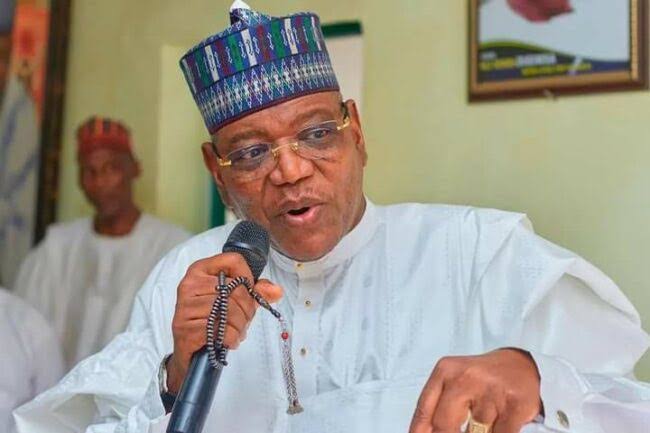
The Federal High Court in Abuja on Friday refused to grant an application filed by former Gov. Sule Lamido of Jigawa, seeking an order restraining the Peoples Democratic Party (PDP) from proceeding with its scheduled national convention.
Lamido, in the motion ex-parte moved by his lawyer, Jeph Njikonye, SAN, had prayed the court to make the interim order, pending the hearing and determination of the motion on notice filed alongside.
Justice Peter Lifu, in a ruling, rather ordered the PDP and the Independent National Electoral Commission (INEC) that are defendants in the suit to come and show cause why the ex-governor’s reliefs should not be granted.
Lamido, who is the plaintiff in the fresh suit marked: FHC/ABJ/CS/2299/2025, named the PDP and INEC as 1st and 2nd defendants.
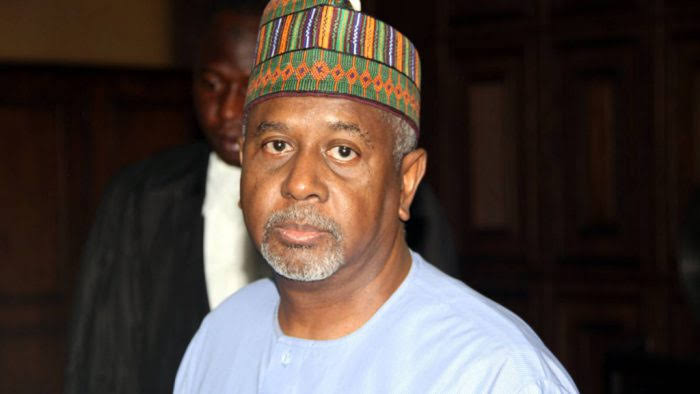
The Economic and Financial Crimes Commission (EFCC) on Friday tendered more evidence in the trial of retired Col. Sambo Dasuki and three others before an Abuja High Court.
Dasuki, a former National Security Adviser (NSA), is charged with an amended 32-count charge bordering on criminal breach of trust, dishonest release, and receiving various sums of money to the tune of N33.2 billion.
He was accused of misappropriation of security funds in the accounts of the Office of the National Security Adviser (ONSA), alongside a former General Manager with the Nigerian National Petroleum Corporation (NNPC), Aminu Baba-Kusa.
Others are two firms: Acacia Holdings Limited and Reliance Referral Hospital Limited.
The EFCC arraigned the four defendants afresh on March 25 in a case that began in 2015.
The anti-graft agency accused Dasuki, among others, of releasing the equivalent of N10 billion in foreign currencies from the NSA’s account.
The account with the Central Bank of Nigeria (CBN) for the 2014 presidential primary election of the then ruling People’s Democratic Party (PDP).
Dasuki and his co-defendants, however, pleaded not guilty to the charges, marked as FCT/HC/CR/43/2015.
At the resumed hearing of the case , PW1, Adariku Michael, a detective with EFCC, informed the court that the commission received an intelligence report on Sept. 21, 2015 bordering on abuse of office and money laundering.
He was taken in evidence by the prosecution counsel, Rotimi Jacobs, SAN.
He alleged that the Office of the National Security Adviser (ONSA) moved huge sums of money between October 2014 and April 2015 to accounts of various companies.
The witness said the report was assigned to a special task force headed by ACE Halimah Kazeem.
The witness said that on receiving the report, the special task force swung into action and wrote a letter to the CBN.
He narrated how money for the ONSA account in the CBN was transferred to different individuals and companies into their different banks.
Responses from requests sent to CBN and other banks were tendered in evidence and marked as exhibits.
The defendants counsel , A A Usman for Dasuki, Solomon Umoh, SAN for Baba-Kusa and Acacia Holdings Limited, and A O Ayodele for Reliance Referral Hospital Limited reserved their objections
The parties, as suggested by Umoh, agreed to be shown the documents before the proceedings so that the trial can go smoothly.
Justice Charles Agbaza then adjourned the case until November 11 for continuation of hearing.
The Federal High Court in Abuja has sacked Rep Abubakar Gummi, for defecting from the Peoples Democratic Party (PDP) to All Progressives Congress (APC).
Gummi, represents Gummi/Bukkuyum Federal Constituency of Zamfara in the House of Representatives,
Justice Obiora Egwuatu, in a judgment, restrained the Speaker, House of Representatives, Tajudeen Abbas, from further recognising Gummi as member representing Gummi/ Bukkuyum Federal Constituency.
Justice Egwuatu also made an order directing the Independent National Electoral Commission. (iNEC) to conduct fresh election to fill the vacancy fot the constituency within 30 days from the day of the judgment.
The judgement was delivered on Thursday, the certified true copy was sighted on Friday.
The suit, marked: FHC/ABJ/CS/1803/2024, was filed by the PDP and its state’s Chairman, Jamilu Jibomagayaki, as 1st and 2nd plaintiffs.
The duo, in the originating summons dated Nov. 28 but filed Nov. 29, 2024, by Ibrahim Bawa, SAN, had sued Hon Abubakar Suleiman Gummi; Speaker of the House of Representatives and INEC as 1st to 3rd defendants respectively.
The plaintiffs had set out four questions for determination and sought nine reliefs for determination.
They asked whether having regard to the provision of Section 68 (1) (9) of the 1999 Constitution (as amended), it was not unconstitutional for Gummies to retain his seat as member in the house.
They said he defected from PDP which sponsored him for the election to Gummi/Bukkuyum Federal Constituency to APC, when there was no division in the party, among other questions.
One of the reliefs sought was a declaration that it was unconstitutional for the speaker to refuse/fail to declare Gummi’s seat vacant.
Gummi, in his response through his lawyer, filed a notice of preliminary objection and a counter affidavit.
The lawmaker, in his argument, argued that his decampment was due to the crisis within the PD..
He said contrary to the deposition of the plaintiffs, the lingering unresolved internal and external crisis both at the national level and in his constituency is the reason for his defection from the party to APC.
Gummi said the crisis resulted into a state where he could no longer represent his constituents properly and ensure that they all benefit from shared distribution of the dividends of democracy within the bounds of law, and without undue interference from anyone or anything.
Delivering the judgment , Justice Egwuatu granted all the plaintiffs’ reliefs.
The judge condemned the attitude of some politicians who see defection as a normal culture.
“Before I take my fingers off the key board, let me just add, that politicians should respect the wishes of the electorates that elected them into office.
“A situation where the electorates have made their choices between different political parties and their candidates based on the manifestos and marketability of such a political party, it is legally and morally wrong for such a politician to abandon the party under which platform he or she was elected into office and move to a rival party without relinquishing the mandate of his or her former party.
“If a person must decamp, don’t decamp with the mandate of the electorates.
“Don’t transfer the votes garnered on the platform of one party to another party.
“A politician has no such rights to transfer votes of a political party to another political party.
“The law must punish such moves by taking away the benefits bestowed upon the decampee politician by the electorates.
“And that is what Section 68 (1) (g) of the Constitution has done.
“Political prostitution must not be rewarded.
“In total, I resolve all the issues in favour of the plaintiffs and against the defendants,” Justice Egwuatu said.
The judge, therefore, ordered that Gummi , having defected from PDP to APC “before the expiration of the period the house was elected, automatically loses his seat as member of the House of Representatives.
He made an order restraining Gummi from further receiving monies as salaries, allowances or howsoever called in his capacity as member representing the constituency.
He also made an order directing the lawmaker to refund to the Federal Government all monies collected as salaries, allowances or howsoever called as member representing the constituency from Oct. 30, 2024 to the date of judgment.
“An order is made directing that the evidence of the refund of all monies collected as salaries, allowances or howsoever called be filed in the registry of this court within 30 days of the judgment of this court,” he said.
Justice Egwuatu consequently awarded a fine of N500, 000 in favour of the plaintiffs and against the defendants.
An environmentalist with the Lower Niger River Basin Authority (LNRBA), Dr Olabisi Awoniyi, has warned that Nigerian rivers continue to face serious pollution challenges.
In an on Friday in Ilorin, Awoniyi described rivers as synonymous with life, noting that they remained vital sources of sustenance for humans, animals, and plants.
He observed that Nigerian rivers suffered from significant pollution, mainly caused by industrial waste, poor sewage management, and agricultural runoff, among other factors.
Awoniyi, who is an instructor and environmental scientist at the LNRBA, said rivers provide water, food, transportation, and energy, and in some areas have become cultural symbols — such as in the Argungu Fishing Festival.
“Through the rivers, we have our drinking water, it supports agriculture through irrigation, and fisheries,” he said.
According to him, rivers provide transport, generate energy through hydropower and support biodiversity; aquatic plants and animals.
He, however, lamented that there were many challenges facing our rivers and that all livelihoods that rally round them were under serious threats, saying this was detrimental to the existence of man.
He described pollution as the introduction of harmful or contaminating substances, or even excess natural materials into the environment at a rate faster than it could disperse, dilute, or decompose.
According to Awoniyi, the result is a negative effects on ecosystems and human health.
“So when harmful substances such as industrial waste, human waste in form of sewage, chemicals and plastics are introduced into our rivers, they become polluted and the effects are better imagined,” he said.
The environmental scientist explained that the Asa River in Ilorin serves as a confluence where other rivers and streams emptied their waters, adding that Asa is a tributary of the River Niger.
“Research findings have shown bacteriological contamination, high faecal coliform counts, and elevated physicochemical parameters downstream of urban and industrial discharges recorded in the river,” he said.
He noted that a healthy community thrived when its rivers were protected and appealed to residents to stop dumping refuse in gutters and channeling sewage into rivers.
“Whatever you do to the rivers have a way of coming back to you. Let us organise community clean-ups to remove plastics and waste from the rivers.
“Plant trees along riverbanks to reduce erosion and organise community education and advocacy programmes to raise awareness in rural and urban areas on the need to protect our rivers,” he advised.
Special Adviser to the President on Economic Matters, Dr Tope Fasua, says Nigeria’s new tax regime is designed to significantly reduce tax burden on majority of Nigerians, particularly the youth and small business owners.
The Atlantic Bell reports that the new tax regime being introduced by the present administration led by President Bola Tinubu will take effect from January 1, 2026.
Fasua spoke during a panellists session on “Nigeria New Tax System: What every youth should know,” at the Youth National Discourse Abuja 2025, organised by the Eleniyancares Leadership Foundation in Abuja.
He said that the primary aim of the new system was to ensure that those who should not be paying taxes in the country were exempted.
“For most youths, the President does not want you to pay any tax. That is the aim of the new tax regime for our youths,’’Fasua said.
He highlighted specific tax reliefs under the new system for low-income earners and small businesses.
“The law says that anybody earning one million naira and below per annum should go tax-free.
“That is N800,000, being the allowance you’re given for zero taxes plus N200,000 allowance for your rent.
“So, that is one million and below. So, that means you’re earning about N83,000 or so naira per month for a whole year you’re not supposed to pay taxes.
“It’s only when you have earned more than one million that you now begin to pay a minimum amount of taxation,” he said.
He added that under the new law, entrepreneurial businesses and small business owners with an annual turnover of N50 million or below would also be exempted from all taxes, including the Value Added Tax (VAT).
Fasua said that the government was only interested to collect tax on profits and not turnover and businesses falling within that turnover bracket would not pay any tax whatsoever.
He explained that the government’s tax focus was being redirected toward high earners, particularly those in the informal sector with high turnover who have historically evaded adequate taxation.
“What we’ve tried to do on the upper end for people earning N50 million and above is to take their taxes to about 24 per cent,” from a previous rate of around 18 per cent,’’ he said.
Fausa said that beyond tax reforms, the broader goal of the new regime was to create a new Nigerian economy that leverages innovation, skips outdated developmental stages and focus on adding value.
He appealed to the youths to move away from business models focused solely on buying and selling, imported goods, encouraging them to embrace innovative entrepreneurship by adding value to products and services.
On the various economic reforms under President Tinubu, the special adviser said that the positive economic indicators were evident that the President’s recent, difficult reforms were working.
Fausa noted that the national growth rate was increasing by 4.23 per cent, with a projection to hit 5 per cent by the end of the year.
“Our inflation rate is dropping month by month. In the past six months now, it’s dropping. Now we’re on 18.02 per cent.
“We’re likely to get to 13 per cent by the end of this year. By 2026 we’ll get to what they call single-digit inflation,” he said.
Fausa said that a leader is actually distinguished from followers by his ability on calculated risk-taking and power of visioning.
He described Tinubu as a bold risk-taker, citing his decisions on petroleum subsidy and on the foreign exchange rate.
“He took the risk on petroleum subsidy to say subsidy is gone right from May 29, 2023. Nigeria is beginning to reap those gains now.
“Even the Naira is getting stronger. Our reserves have gone up to 43 billion dollars, going to 50 billion dollars. Our manufacturing exports have gone up 67 per cent year on year. We’re just seeing positives everywhere.
“In fact, it’s unbelievable that in two years, less than three years, we’re seeing the kind of results that we’re seeing,” he said.
Fasua encouraged young Nigerians to engage positively with the economy and avoid “doom-scrolling” for negative news.
“This is the best country to be in the world and the place where the youths can be most prosperous,” he said.
The Nigeria Data Protection Commission (NDPC) and Meta Platforms, Inc. will, on November 3, adopt the terms of settlement in the dispute on the 32.8 million dollars fine imposed against the latter by the regulatory agency.
Justice James Omotosho of the Federal High Court in Abuja fixed the date following the inability of Meta’s lawyer, Fred Onuobia, SAN, to file the processes on time.
Onuobia, on October 3, had informed the court of Meta’s plan to reconcile with NDPC in the suit the American multinational technology company filed seeking to quash the regulatory agency’s sanction.
The lawyer had told the court after Justice Omotosho had prepared to deliver a ruling on NDPC’s preliminary objection against the suit filed by Meta, the parent company of Facebook and Instagram.
Onuobia begged the court to defer the ruling on NDPC’s preliminary objection and the ruling on the motion on notice to amend their suit.
He told the court that the parties had reached an advanced stage on settlement in the case.
He said the parties “are afraid” that the ruling might affect discussions on settlement.
And after NDPC’s lawyer, Adeola Adedipe, SAN, confirmed Onuobia’s submission, the judge fixed today (Oct. 31) for either adoption of terms of settlement or ruling.
When the case was on Friday, Onuobia, who also appeared for Meta Platforms, Inc., told the court that parties had reached a settlement.
“We are happy to announce to my lord that the parties have reached a settlement,” he said
He, however, apologised to court that though Meta had prepared to settle with NDPC, he was only able to file their documents this morning.
He acknowledged breaching the court protocol for filing processes earlier before proceedings.
He said the development was due to circumstances beyond their control.
“We may ask for a standdown so that the copy for the court can be filed my lord,” Onuobia prayed.
But the judge, who declined to grant application for standdown, said he must perused the terms of settlement thoroughly before delivering his ruling on it.
The judge told the lawyer that it had always been his practice to go through processes filed before his court.
“There are instances that what is not in the claims will be included in the terms of the settlement.
“So I will have to read it,” he said.
Besides, Justice Omotosho said he also had afternoon session where other matters would be heard.
Adedipe, in his response, thanked the judge for accommodating them.
The lawyer observed that earlier, the matter was scheduled for ruling on their objection but the judge reconsidered this to give them the opportunity to explore reconciliation.
Justice Omotosho consequently adjourned the matter until Nov. 3 at 12noon for adoption of the terms of settlement.
The NDPC had, on Feb. 18, imposed both a remedial fee of 32,800,000 million US dollars and eight corrective orders against Meta Inc.
The company was alleged to have violated the fundamental privacy rights of its Nigerian users with respect to behavioural advertising on Facebook and Instagram.
Dissatisfied with the action, Meta Platforms Inc., in a motion ex-parte dated and filed on Feb. 26, dragged the regulatory agency to court as sole respondent.
In the motion ex-parte marked: FHC/ABJ/CS/355/2025 and moved by Fred Onuofia, SAN, on March 4, Justice Omotosho granted one of the two orders sought.
The judge had granted leave to Meta to commence proceedings by way of judicial-review seeking, inter alia, an order of certiorari quashing the compliance and enforcement orders dated Feb. 18 issued by NDPC against the company.
It urged the court to nullify “all other investigations, proceedings and actions taken by respondent against the applicant leading to the ‘Final Orders.’”
The judge, however, refused to grant Meta’s relief seeking a stay of the proceedings of all matters relating to the “Final Orders” issued by NDPC against it, pending the hearing and determination of the judicial review proceedings.
Instead, the judge made an order of accelerated hearing of the suit.
But NDPC, in a preliminary objection filed by its lawyer and the head, ALPHA & ROHI Law Firm, Adedipe, SAN, told the court that the suit was incompetent and the court lacked the jurisdiction to entertain same.
The regulatory agency, in its objection dated April 10 and filed April 11, urged the court to either strike out or dismiss the case.
Adedipe, in two grounds of argument, submitted that the originating summons filed by the company is incompetent for non-compliance with the mandatory provision of Order 34 Rule 6(1) of the FHC (Civil Procedure) Rules, 2019.
Quoting the provision, the lawyer said: “No ground shall be relied upon or any relief sought at the hearing, except the grounds and reliefs sought in the statement.”
He also argued that the suit, as presently constituted, is grossly incompetent and academic, the reliefs sought therein, not being capable of activating the jurisdiction of the court.
“The suit is liable to be struck out/dismissed, in limine,” Adedipe had argued.
The fine against Meta came as one of the measures by the NDPC to protect Nigerians’ data under the Nigeria Data Protection Act, signed into law by President Bola Tinubu in June 2023.
Chairman of the Presidential Committee on Fiscal Policy and Tax Reforms, Mr. Taiwo Oyedele, has said that the proposed 5 per cent fuel surcharge will not be implemented until the economy shows clear signs of improvement.
Speaking at the Haulage and Logistics Magazine Conference and Exhibition in Lagos, Oyedele said the measure, aimed at funding road maintenance, would only take effect when the naira strengthens or global crude oil prices fall.
He explained that the surcharge, first introduced under former President Olusegun Obasanjo, was designed to dedicate part of fuel revenues to road repairs — 40 per cent for federal roads and 60 per cent for states and local governments.
“The idea is brilliant and already in practice in more than 150 countries,” he said, adding that most of Nigeria’s 200,000 kilometres of roads remain in poor condition.
Oyedele disclosed that although the Federal Roads Maintenance Agency (FERMA) had sought to collect the levy after the removal of fuel subsidy, the committee opposed the move, describing it as “insensitive” at this time.
He said the draft tax law includes the surcharge but provides safeguards, requiring the Minister of Finance to issue a formal order before implementation.
Oyedele also assured that ongoing tax reforms will ease the burden on transport operators by eliminating multiple levies, reducing costs, and improving efficiency.
“We are not introducing new taxes; we are removing the many duplicated ones that frustrate businesses,” he said.
He added that under the reforms, small transport and logistics firms with annual turnover below ₦100 million will be exempt from company income tax and eligible for VAT refunds.