


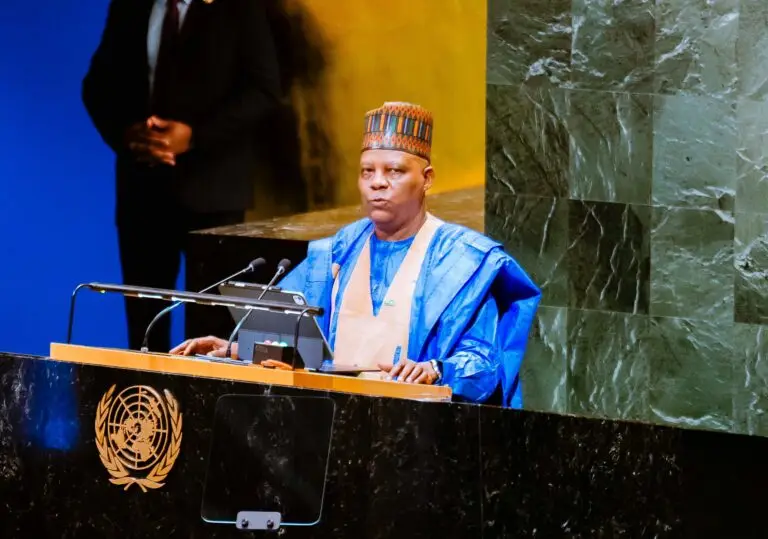
President Bola Tinubu has called on the World Bank, International Monetary Fund (IMF) and African Development Bank (AfDB) to scale up financing
for climate action.
Tinubu, represented by the Vice-President, Sen. Kashim Shettima, made the call at a Climate Submit during the 80th Session of the United Nations General Assembly (UNGA), in New York, United States of America.
The president stated that the climate emergency demands not just words, but courageous and
sustained leadership.
Tinubu said Nigeria was mobilising $20 to $25 billion in climate finance by 2030, including green bonds, blended
finance, and public-private risk-sharing mechanisms.
Tinubu, therefore, called on global partners to scale up concessional
finance, knowledge sharing, and technology transfer, to accelerate not
just Nigeria’s transition, but Africa’s contribution to a safer, more
sustainable world.
He said,” We aim to unlock at least seven – 10 billion dollars in grants and concessional finance from global partners, while promoting technology transfer, regional energy integration, and green entrepreneurship to drive inclusive
growth.
” For Nigeria, a country acutely vulnerable to climate impacts, climate action is not a choice; it is an existential
necessity. “To mobilise resources, we have undertaken significant domestic
reforms.
” We have simplified and modernised our tax laws to ease compliance, removed unproductive fossil fuel subsidies, reduced
burdens on households and businesses, and enhanced revenue
efficiency.
” At the same time, we are strengthening our business environment through legislation and policies that improve the ease of doing business.
“This is to attract private capital and expand opportunities for
investment in clean energy and sustainable infrastructure.”
Tinubu said said in March 2025, Nigeria launched the Nigeria Carbon Market
Activation Policy, which establishes a robust framework for high integrity emissions reductions.
He added, ” While positioning Nigeria as a credible hub for Article 6, Voluntary and Compliance carbon markets.
“Through this mechanism, our target is to mobilise up to 2.5 billion dollars by 2030 in high-quality credits and related investments.
” We are under no illusion: no country can tackle the climate crisis
alone. “Like other developing nations, Nigeria requires significant
support to implement effective mitigation and adaptation strategies.
” We therefore call on International Financial Institutions notably the
World Bank, IMF, and African Development Bank to scale up financing
for climate action.
” Likewise, developed countries must honour their climate finance commitments, including the 100 billion dollars annually
pledged under the Paris Agreement.”
He said that as a demonstration of its unwavering commitment, Nigeria had
updated its Nationally Determined Contributions (NDC 3.0), in line
with UNFCCC guidance.
Tinubu continued ,”This enhanced NDC reflects greater ambition, integrating mitigation and adaptation measures to safeguard our people, protect ecosystems, and accelerate inclusive growth.
” It was formally submitted to the UNFCCC Secretariat on September 21.
“This NDC3.0 departs from the business-as-usual approach to an
absolute economy-wide emission reduction, our highest ambition
level to date.”
The president said that the targets were better defined and will be supported by
an investment plan to accelerate its implementation.
Tinubu added, ” Nigeria’s NDC 3.0 commits to:
I. Significantly increasing mitigation and adaptation ambitions with
clearer target when compared to NDC2.0.
Within the LULUCF sector, Nigeria aims to lower the
deforestation rate by 60 percent, which offers a substantial mitigation
potential of 304.8 MtCO2eq.
” while also pursuing a mitigation
potential of 34.4 MtCO2eq by increasing forest area through
reforestation and afforestation.”
Tinubu said that Nigeria was increasing the adoption and use of cleaner energy systems,
especially in manufacturing and industries.
He added, ” We are increasing
captive generation capacity using cleaner fuels by installing seven
GW, 50 per cent renewable.
” And 50 per cent natural gas, for a practical “Energy Mix Plan”, on our journey to net-zero by 2060; electrifying key sectors such as public transport, industry.
“We are also while implementing national energy efficiency standards
to deliver absolute reductions in energy intensity by 2030.”
The president said that for the first time, “Health” and “Action for Climate
Empowerment” have been included as priority sectors in Nigeria’s
NDC3.0, demonstrating its commitment to an economy-wide climate governance.
He also said that Nigeria was scaling climate-smart agriculture to reach five million smallholder farms by 2030, with a view to increasing yields by 20 – 30 per cent and expanding drought-resistant crops.
” We are building resilient infrastructure, integrating early warning systems,
climate-informed urban planning and resilient housing to reduce climate-related damages by 50 per cent.
” We plan to restore mangroves,
forests, and wetlands to enhance carbon sinks by 200 metric tonnes of
Carbon Dioxide Equivalent (MTCO2e), cumulatively by 2030, while protecting biodiversity and livelihoods.
” Nigeria aims to lower the deforestation rate by 60 per cent , which offers a
substantial mitigation potential of 304.8 MtCO2eq, while also pursuing
a mitigation potential of 34.4 MtCO2eq by increasing forest area through reforestation and afforestation,”Tinubu added.
He said institutionally, Nigeria had established the National Council on
Climate Change (NCCC), supported by a cross-ministerial
Secretariat, to ensure coherence, accountability, and measurable
results.
He reaffirmed that for Nigeria, climate action was not a trade-off between growth and sustainability, it was the pathway to
sustainable growth, innovation, security, and shared prosperity.
Tinubu assured that Nigeria was ready to work with all partners, to lead where necessary, and to deliver because the time for climate action is now.
