


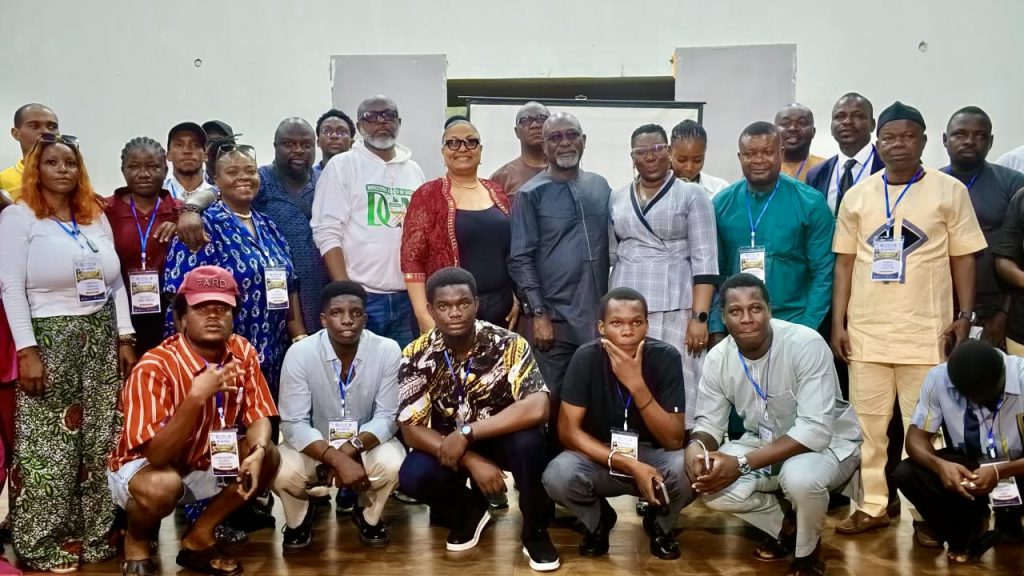
NDDC Head of New Media, Corporate Affairs Department, Dr Selina Dan-Albert and the Head of Department, Theatre Arts and Film Studies, University of Port Harcourt, Professor Edward Imo, surrounded by participants during a four-day technical training programme in film production for filmmakers in the Niger Delta region, at the Theatre Arts and Film Studies auditorium.
The Niger Delta Development Commission (NDDC), in collaboration with the University of Port Harcourt (UniPort), has intensified efforts to strengthen the region’s creative economy through a four-day technical training programme in film production.
The initiative is aimed at equipping filmmakers with practical skills to improve their professional capacity, expand employment opportunities and promote authentic storytelling about the Niger Delta.
Speaking during the training at the auditorium of the university’s Department of Theatre Arts and Film Studies, the NDDC Head of New Media in the Corporate Affairs Department, Dr Selina Dan-Albert, said the commission was exploring opportunities to empower young people with relevant skills to thrive in the creative industry.
In a statement signed by the NDDC Director of Corporate Affairs, Seledi Thompson-Wakama,
Dan-Albert described the programme as an investment in the future of the region’s creative sector, noting that it would encourage greater interest in filmmaking as a viable career and source of livelihood.
She urged participants to maximise the opportunity to develop their technical expertise and establish themselves professionally, while using their creative abilities to tell authentic stories about the Niger Delta.
She assured them that the commission would sustain its support for initiatives aimed at improving the skills and professional competence of young people in the region.
The Head of the Department of Theatre Arts and Film Studies, Prof. Edward Imo, said the programme was designed to equip participants from the Niger Delta and other parts of Nigeria with the technical expertise required for film production and the use of cinema to communicate the region’s experiences and stories.
Imo described the partnership with the NDDC as an indication of growing opportunities for the department and commended the commission for recognising its contributions to practical film production.
He said the department had a pool of skilled personnel and industry professionals, including individuals with experience in Nigeria’s film industry, adding that the training would further strengthen the creative sector.
On the growing influence of artificial intelligence and digital technologies, Imo said filmmakers should embrace emerging tools without losing the human experiences, emotions, aspirations and social realities that give stories their meaning.
He urged participants to deploy technology responsibly in addressing societal concerns and promoting development, while calling on other government agencies to emulate the NDDC’s investment in human capital development.
According to him, sustained investment in skills acquisition and professional training would strengthen the Nigerian film industry and expand opportunities for young people.
The Consultant and Managing Director of GreenHedge Resource Consults Limited, Mr Francis Abayomi, said the Niger Delta had considerable potential for growth in the creative industries.
He explained that the training was designed to provide young people with practical filmmaking skills, noting that the University of Port Harcourt was selected because of its pool of talent and contribution to producing professionals for the creative sector.
The National President of the Directors Guild of Nigeria, Mr Uche Agbo, described filmmaking as an important driver of employment and economic growth, with the potential to help young people develop sustainable livelihoods and reduce poverty and crime.
Agbo said the film industry offered accessible entry points for aspiring professionals, making it a viable avenue for youth empowerment and economic inclusion.
He urged participants to develop distinctive storytelling styles and remain committed to integrity and authenticity, stressing that filmmakers must remain faithful to their stories and avoid distorting facts in their creative work.
Also speaking, veteran Nigerian actor, Mr Bimbo Manuel, described the programme as timely, given the growing contribution of the Nigerian film industry to the creative economy and national development.
