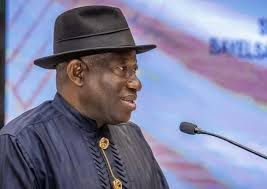
As Nigeria’s political class gradually shifts attention to the 2027 presidential election, no single figure has generated as much intrigue, uncertainty and quiet anxiety across party lines as former President Goodluck Jonathan.
Unlike many politicians already openly positioning themselves for the next contest, Jonathan has neither declared interest nor publicly ruled himself out.
Yet his name continues to dominate conversations within the opposition Peoples Democratic Party (PDP), particularly among factions determined to present him as a consensus candidate capable of challenging President Bola Tinubu.
The latest development came when the Kabiru Turaki-led faction of the PDP reportedly moved to adopt Jonathan as its presidential candidate, despite the former president neither attending the congress nor issuing any statement acknowledging the decision.
That silence has become the most powerful statement in Nigeria’s evolving political equation.
Only days ago, a Federal High Court in Abuja dismissed a suit seeking to bar Jonathan from participating in the 2027 presidential race and effectively affirmed that he remains constitutionally eligible to contest.
Ordinarily, such a judgment would have prompted a clear political response from the man at the centre of the controversy.
Instead, Jonathan has maintained the same studied silence that has characterised his public posture for months.
Political observers say that silence is precisely what has kept speculation alive.
Across Abuja, party offices and political gatherings, three dominant interpretations have emerged.
The first is that Jonathan may genuinely be considering a return but is carefully weighing the political terrain before making any commitment. Supporters of this view point to reports that consultations have intensified around him and that influential figures within the PDP and other political blocs see him as a unifying figure capable of attracting support across regional and religious divides.
The second interpretation is that Jonathan is deliberately allowing various groups to test public sentiment on his behalf. In Nigerian politics, prospective candidates often prefer to appear “drafted” into contests rather than openly ambitious.
By remaining silent while supporters campaign for him, Jonathan avoids the risks associated with an early declaration while benefiting from constant media attention and political momentum.
A third school of thought argues that the former president may ultimately have no intention of running at all.
According to this view, his reputation as an elder statesman, election observer and international diplomat may make a return to partisan politics less attractive than many assume. Such analysts note that Jonathan has repeatedly cultivated an image above everyday political battles since leaving office in 2015.
Yet even among sceptics, one question persists: if he has no interest whatsoever, why has he not publicly shut down the speculation?
That question continues to unsettle both allies and opponents.
Within sections of the PDP, Jonathan is increasingly viewed as one of the few personalities capable of helping the party overcome its lingering internal divisions. Having previously occupied the presidency and retained a relatively moderate national image after conceding defeat in 2015, he remains one of the party’s most recognisable political assets.
His supporters also argue that nostalgia may work in his favour. At a time of economic hardship, insecurity and growing public frustration, some Nigerians look back at the Jonathan years with greater sympathy than they did while he was in office. Political groups in several parts of the country have openly urged him to return, insisting that his experience and perceived temperament could help stabilise the country.
However, a Jonathan comeback would not be without obstacles.
Questions about zoning and power rotation remain potent in Nigerian politics. Although Jonathan comes from the South-South, critics may argue that another southern candidacy immediately after Tinubu would complicate demands from northern political interests seeking a return of power to their region.
There is also the challenge of political organisation. Winning a presidential election in contemporary Nigeria requires far more than name recognition. It demands a nationwide political structure, substantial resources, strategic alliances and a united party platform. The PDP itself remains divided, and Jonathan would have to navigate multiple competing interests before emerging as a broadly accepted candidate.
Furthermore, his opponents would likely revisit unresolved debates from his previous administration, including issues of security, corruption perceptions and governance challenges that contributed to his defeat in 2015.
Yet despite those hurdles, few analysts dismiss his electoral viability.
Unlike many aspirants whose popularity remains confined to particular regions, Jonathan retains a level of national familiarity that could prove valuable in a highly competitive race. His status as the first Nigerian president to concede defeat peacefully continues to earn him goodwill both locally and internationally.
For now, however, the greatest source of Jonathan’s political strength may be uncertainty itself. Everyday he refuses to speak, speculation grows.
Every endorsement issued in his name generates fresh debate. Every court ruling, party declaration or political consultation deepens the mystery surrounding his intentions.
Whether the former president is genuinely preparing for a return to Aso Rock or merely watching events unfold from a distance, one reality is becoming increasingly evident.
In the battle for 2027, Goodluck Jonathan is already shaping the conversation without officially entering the race.
And until he finally speaks, Nigeria’s political establishment will continue reading meaning into his silence.