


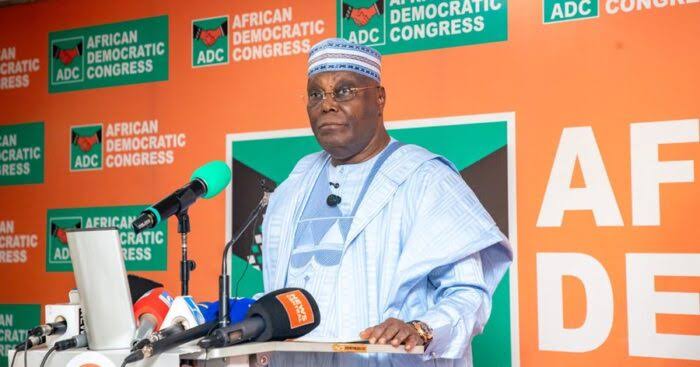
Former Vice President Atiku Abubakar has demanded that the Independent National Electoral Commission (INEC) subject its proposed artificial intelligence (AI) system for processing election results to independent scrutiny before its deployment in the 2027 general elections.
Atiku warned that allowing an opaque algorithm to delay, reject or interfere with the transmission of polling unit results could undermine electoral integrity and public confidence in the democratic process.
The former presidential candidate made the demand in a petition addressed to INEC Chairman on behalf of the African Democratic Congress (ADC) and allied democratic stakeholders, calling for full disclosure of the technology’s operational framework, independent audit and clearly defined human oversight.
In a statement issued on Thursday by his Director of Strategic Communication, Phrank Shaibu, Atiku said the commission must explain how its proposed AI system would operate and guarantee that no valid vote was withheld because of technological errors.
The petition follows INEC’s announced integration of artificial intelligence and intelligent document processing into the process linking its Data Verification and Authentication System (DIVAS) with the INEC Result Viewing portal (IReV).
Atiku expressed concern that Nigerians could be denied access to critical information about a system capable of influencing the handling of election results.
“INEC cannot ask Nigerians to trust a system whose rules they are forbidden to see,” he said, insisting that the commission must disclose what triggers an algorithmic flag, who determines the thresholds and how flagged results are subsequently treated.
He warned that legitimate result sheets could be delayed or rejected because of poor lighting, unfamiliar handwriting or worn-out paper, stressing that such technical limitations must not become grounds for withholding valid votes.
The former vice president also cautioned against inconsistent treatment of similar discrepancies across polling units, arguing that any such decisions could undermine the credibility of the electoral process.
Atiku demanded that INEC publish the system’s technical and operational framework, including its training data, discrepancy-detection criteria, source code, decision logs and the identities of its developers and third-party vendors.
He further called for independent cybersecurity experts, political party technology representatives and civil society technologists to be granted access to the system for a comprehensive audit before the nationwide mock accreditation exercise scheduled for November 28, 2026.
According to him, transparency must extend beyond the disclosure of the technology to the procedures governing its decisions.
He urged INEC to establish and publish clear guidelines for handling result sheets flagged by the system, including who reviews them, how decisions are documented, how political parties are notified and how erroneous assessments can be challenged without undue delay.
Atiku maintained that artificial intelligence should remain an administrative support tool subject to human supervision and must not be empowered to delete, alter or permanently block election results.
He also demanded that INEC publicly reaffirm the legal status of Form EC8A, the polling unit result sheet completed and signed by electoral officials and party agents, and explain how conflicts between the physical document and an AI assessment would be resolved.
“The polling unit result sheet, Form EC8A, records what happened where the people voted,” he said, warning that a machine’s assessment must not silently override evidence witnessed by voters and party agents.
The ADC chieftain further called for real-time monitoring access for political parties through a dedicated dashboard or observer interface to enable them to track unusual patterns of result flagging, upload delays and blocked submissions during elections.
He urged the National Assembly to summon INEC’s leadership and Information and Communication Technology Directorate to explain the system’s design, safeguards and audit arrangements.
Atiku also called on election observers and international partners to pay greater attention to the digital processing and transmission of results, beyond monitoring activities at polling units.
He advised voters to lawfully document results as announced and displayed at their polling units, saying such records would provide a basis for checking electronically uploaded results.
The former vice president said INEC had an opportunity to address the concerns before public distrust over the technology escalated into an electoral crisis.
He insisted that Nigerians must be able to understand how their votes are handled after polling unit results enter the commission’s digital system.
Atiku added that the right of citizens to determine their political future must not be compromised by hidden algorithms or technological failures.
He urged INEC to open the system to independent testing, publish the rules governing corrections and demonstrate before election day that its technology would protect, rather than jeopardise, valid votes.
