



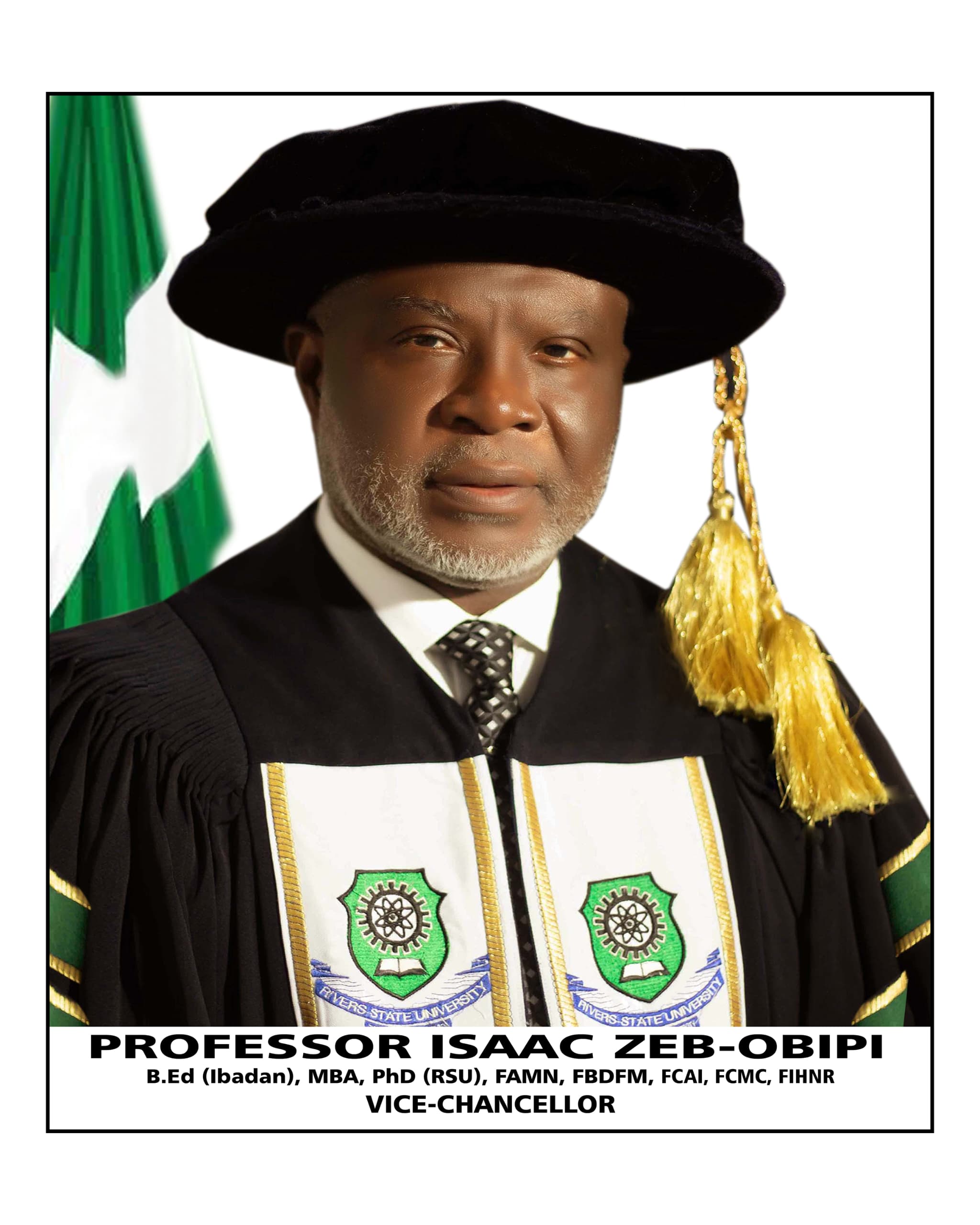
The Vice-Chancellor of Rivers State University, Prof. Isaac Zeb-Obipi, has declared that the future of higher education depends on how academics deploy emerging technologies to advance learning, research and societal impact, stressing that lecturers must embrace innovation without compromising academic integrity.
Speaking on Monday at a capacity building workshop for lecturers held at the university in Port Harcourt, Zeb-Obipi said the institution had already taken a major step by approving an Artificial Intelligence policy to guide the responsible use of technology in teaching and scholarship.
The workshop, themed “Emerging Technologies for University Academics,” was organised by the Quality Assurance Directorate in collaboration with the Directorate of Staff Development.
Describing the programme as timely, the Vice-Chancellor said universities could no longer ignore the sweeping influence of digital technologies and artificial intelligence on teaching and research.
“The lecture hall is changing. Our students arrive as digital natives, AI tools can draft an essay in 30 seconds, and research that once took months of library visits now begins with a prompt,” he said.
According to him, the challenge before universities is not whether technology will reshape higher education, but how academics will shape technology to serve learning, inquiry and truth.
He explained that the workshop was designed to strengthen the capacity of lecturers to use generative AI, learning analytics, open-source platforms, virtual laboratories and digital pedagogy to improve teaching effectiveness, research collaboration and community impact.
“For decades, the Nigerian university lecturer was defined by the chalk, the textbook and the office hour. Today, we add to that toolkit data dashboards, collaborative cloud workspaces, simulation software and even the responsible use of ChatGPT and its peers,” he stated.
The Vice-Chancellor, however, cautioned that technology without sound pedagogy would amount to “noise,” insisting that innovation must reinforce intellectual rigour and human mentorship rather than weaken them.
He urged participants to embrace curiosity, discernment and collegiality in adapting to emerging technologies, stressing that lecturers must be willing to experiment, uphold the university’s core values and share knowledge with colleagues.
Zeb-Obipi further noted that competence and continuous training were critical to staff development and promotion within the institution.
“This workshop is key because we cannot promote workers without competence. We want to be intentional about training. We need to use AI for critical thinking. We need to use every new tool to help us refine the university,” he added.
In his remarks, the Chairman of the programme and Provost of the College of Postgraduate Studies, Prof. Tamunoene Abam, said technology had become central to the survival and global competitiveness of universities.
Drawing comparisons with Imperial College London, he observed that institutions that embraced technological innovation were increasingly dominating global rankings.
“We need to embrace these AI tools. Technology is only as effective as the mind that uses it,” he said.
Earlier in a welcome address, the Director of Staff Development, Dr. Sydney Enyindah, said the workshop was aimed at strengthening the capacity of lecturers to fulfil the university’s teaching and research mandate while embracing innovation and best practices.
In his view, the Director, Quality Assurance Directorate, Engr. Prof. Asinyetogha Igoni said that the workshop is apt because the university is digitalizing and every staff must be on board to fit in.
The workshop featured presentations by the Managing Director of CINFORES Limited, Mr. Ibifuro Asawo, on “Revolutionizing University Academic Activities with Emerging Technologies,” and Director of the Information and Communication Technology Centre, Engr. Prof. Sunny Orike, who spoke on “Adoption of Contemporary Technological Tools for Lecturing, Examinations and Results Computation.”
Another paper, “Understanding and Exemplifying the Code of Conduct for University Academics,” was delivered by the University Librarian, Dr. (Mrs.) Juliet Alex-Nmecha.