
A law professor at Rivers State University, Port Harcourt, Professor Grace Akolokwu, has cautioned Nigerians against treating a Certificate of Occupancy (C of O) as conclusive evidence of land ownership, warning that such titles remain subject to government control and revocation.
Delivering the institution’s 130th inaugural lecture titled “Land As Man’s Epicentre: Interrogating the Roses and Thorns Under Nigerian Law,” Akolokwu said widespread assumptions about land ownership in Nigeria are “false and misleading.”
According to her, many Nigerians erroneously believe that once a C of O is issued, ownership is fully secured, that rural lands fall outside government control, and that compensation is automatic whenever land is revoked.
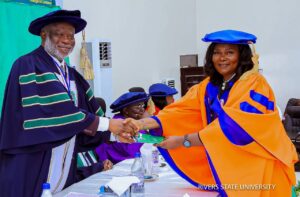
“These positions are false,” she said, stressing that a Certificate of Occupancy “is not inviolable but can be revoked.”
Akolokwu, who is a Professor of Property and Human Rights Law at the University, explained that a C of O does not confer absolute ownership but merely grants a right of occupancy, typically for 99 years, subject to conditions imposed by the state. She noted that the same authority that issues the certificate retains the power to withdraw it.
She further observed that while the Constitution of the Federal Republic of Nigeria 1999 guarantees property rights, its incorporation of the Land Use Act 1978 effectively subordinates those rights to government control.
“What appears as a guarantee with one hand is quietly withdrawn with the other,” she said.
The professor added that the Land Use Act and other related laws have continued to complicate land ownership in the country, creating uncertainties that discourage investment.
Despite these constraints, Akolokwu described land as central to human existence and development, likening it to a “rose” that provides economic value and opportunities, including leasing, agriculture, mortgages, and inheritance.
However, she maintained that the “thorns” embedded in Nigeria’s land laws must be addressed through urgent reforms.
Among her recommendations is the amendment of the Constitution and the Land Use Act to remove restrictive provisions and reduce the sweeping powers of state governors over land administration.

She also called for a review of key sections of the Land Use Act that require gubernatorial consent for land transactions and allow revocation of occupancy rights, arguing that such provisions hinder economic activities and access to credit.
Akolokwu advocated the adoption of a dual land tenure system that distinguishes between government-controlled urban land and community-owned rural land, allowing greater autonomy for individuals and communities in managing their property.
She further urged government to prioritise fair compensation through compulsory purchase rather than acquisition, promote resettlement policies, and protect the interests of mortgagees in land transactions.
On land administration, the professor recommended strict timelines for approval of building plans, sanctions for delays, and the establishment of digital land registries to enhance transparency and efficiency.
She also called for reforms to eliminate discriminatory customary practices that limit women’s rights to land ownership, as well as policies to address housing deficits through affordable financing.

To tackle land-related conflicts and insecurity, Akolokwu proposed legislation to regulate livestock ranching and curb clashes between herders and farmers, alongside stricter enforcement against illegal arms.
She equally recommended criminalising land grabbing and unauthorised levies, while advocating constitutional amendments to grant host states and communities a greater share of proceeds from mineral resources found on their land.
The professor stressed that meaningful progress in Nigeria’s real estate sector depends on comprehensive legal reforms, particularly the amendment of the Land Use Act, despite the challenges posed by its constitutional status.
She also highlighted the need for electronic land registration systems, drawing lessons from global best practices, and called for the establishment of independent bodies to oversee land acquisition and compensation processes.
Akolokwu urged citizens to take proactive steps in securing their land rights by registering titles and developing their properties, noting that compensation in cases of revocation is based on improvements made on the land.
She concluded that without decisive reforms to streamline land rights and government roles, Nigeria’s development aspirations may remain constrained.
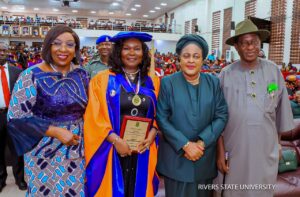
The inuagural lecture was attended by eminent personalities including Rivers State Deputy Governor, Professor Ngozi Nma Odu, former Supreme Court Justice, Mary Odili, Vice Chancellor of RSU, very distinguished academics and political elites, and the husband of the inaugural lecturer, Chief Shedrack Akolokwu.