



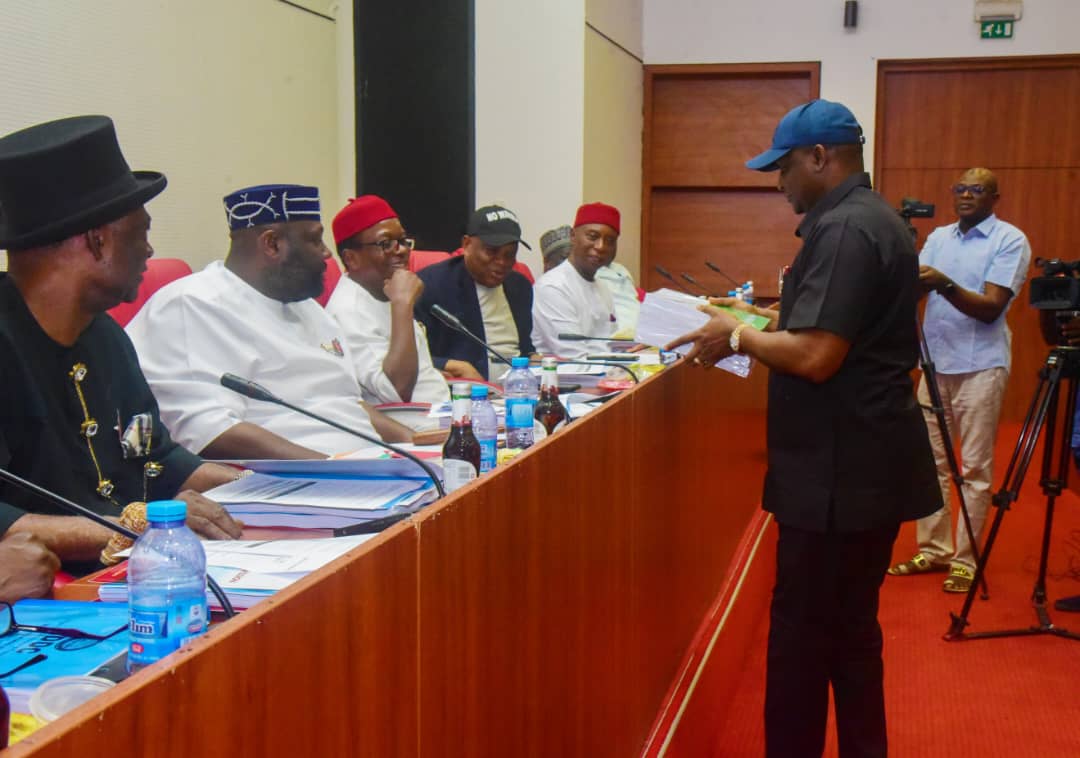
The Niger Delta Development Commission (NDDC) has presented a ₦1.75 trillion budget proposal for the 2025 fiscal year to the National Assembly, underscoring a strategic shift towards transformational development and a departure from traditional line-item budgeting.
Presenting the proposal to the Senate Committee on NDDC, chaired by Senator Asuquo Ekpenyong, and the House of Representatives Committee chaired by Hon. Ibori-Suenu Erhiatake, the Managing Director of the Commission, Dr. Samuel Ogbuku, said the 2025 appropriation, themed “Budget of Consolidation,” builds on the gains of the 2024 Budget of Renewed Hope and aligns with President Bola Ahmed Tinubu’s Renewed Hope Agenda.
Ogbuku explained that a key reform embedded in the 2025 budget is the Commission’s decision to abandon line-item budgeting in favour of sectoral allocations.
According to him, the new approach is designed to tackle long-standing challenges of project delays, fragmentation and inefficiency, which had characterised the old budgeting system.
He noted that sectoral budgeting would allow the Commission to focus on priority development areas—such as roads, education, health, shoreline protection and youth empowerment—rather than spreading resources thinly across numerous isolated projects.
This, he said, would enhance coordination, improve monitoring, reduce abandoned projects and ensure measurable impact across the Niger Delta.
“The shift to sectoral allocations reflects our resolve to move from transactional interventions to transformational development,” Ogbuku said, adding that the reform would also strengthen accountability and deliver better value for money.
The Managing Director expressed appreciation to President Tinubu for his support and confidence in the current management, as well as to the Supervising Minister of Regional Development, Engr. Abubakar Momoh, for providing strategic direction. He also commended the leadership of the 10th National Assembly for what he described as constructive oversight anchored on partnership rather than confrontation.
He disclosed that the ₦1.75 trillion estimate represents a nine per cent reduction from the ₦1.985 trillion budgeted for 2024 and would be funded from multiple sources, including ₦776.5 billion from the Federal Government, ₦752.8 billion from oil companies, ₦109.4 billion as revenue brought forward from 2024, ₦53.67 billion in recoveries from federal agencies and ₦8.35 billion in internally generated revenue.
A breakdown of the proposal showed that ₦1.631 trillion is earmarked for project execution across the Niger Delta, while ₦223 billion is allocated to internal projects. Personnel costs are estimated at ₦47.56 billion, with ₦49.93 billion set aside for overheads.
On the 2024 budget performance, Ogbuku told lawmakers that as of October 31, 2025, the Commission had realised ₦1.985 trillion in actual revenue, surpassing the initial target of ₦1.911 trillion. He attributed the improved performance largely to the extension of the 2024 budget implementation to December 31, 2025.
After a closed-door session with the NDDC management, Senator Ekpenyong said the Senate Committee would embark on an extensive oversight tour of projects across the nine Niger Delta states in January 2026 to verify claims of completion and progress.
While acknowledging improved project delivery by the Commission, he stressed that expectations remained high, particularly in ensuring timely completion and value for money.
Similarly, the House of Representatives Committee on NDDC cautioned that the proposed budget would not be treated as a routine legislative exercise.
Hon. Erhiatake Ibori-Suenu said legislative support would be strictly tied to performance, transparency and verifiable outcomes that positively impact communities in the oil-producing region.
She described the 2025 budget as an opportunity to translate renewed hope into tangible development for millions of Niger Delta residents, insisting that the new sectoral approach must deliver results on the ground.