


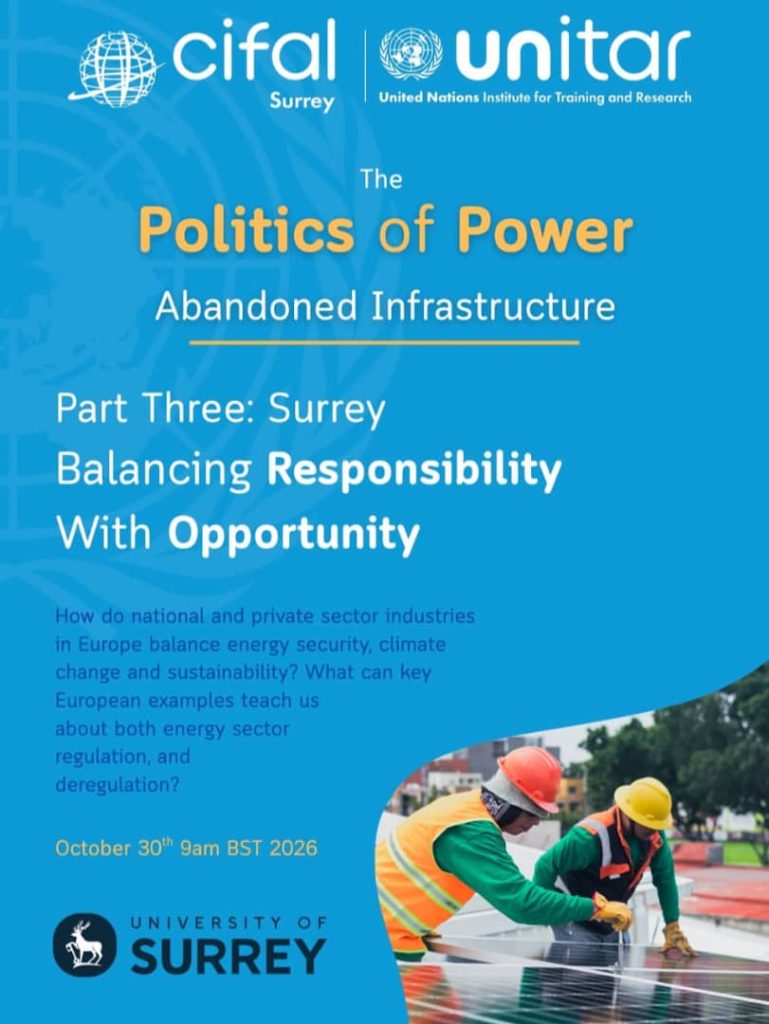
The final session of an international webinar series examining abandoned infrastructure, energy transitions and sustainable development will hold on Friday, October 30, 2026 with experts expected to explore how governments and private-sector operators can balance energy security, climate change and sustainability.
The webinar, titled The Politics of Power: Abandoned Infrastructure –Part Three: Balancing Responsibility with Opportunity, will be hosted by CIFAL Surrey in collaboration with the University of Surrey, United Kingdom.
Scheduled for 9 a.m. British Summer Time (10 a.m. Central Africa Time), the virtual event will examine lessons from European experiences in energy-sector regulation and deregulation, as well as the responsibilities of governments and industries in shaping the future of energy systems.
The session will conclude a three-part webinar series organised through the CIFAL Global Network, affiliated with the United Nations Institute for Training and Research (UNITAR), with sessions hosted by CIFAL Newcastle in Australia, CIFAL Nigeria and CIFAL Surrey in the United Kingdom.
The discussions are designed to examine the political, economic, social and environmental consequences of energy transitions, particularly the challenges faced by communities and economies dependent on resource extraction.
Participants will also consider how governments, industries and local communities can turn the challenges associated with decommissioned energy infrastructure into opportunities for sustainable development.
The organisers have invited policymakers, academics, energy-sector professionals, development practitioners and other interested participants to join the online discussion.
Registration is available through the webinar’s official portal.
The first session, hosted by CIFAL Newcastle on August 28, 2026 focused on The Long Goodbye, examining what happens to communities, economies and livelihoods when resource-dependent industries wind down.
Drawing on experiences from Newcastle and the Hunter Valley in Australia, the discussion explored the long-term social, economic and environmental consequences of resource extraction, including the challenges of mine closures, land rehabilitation and finding new uses for former industrial sites.
The session brought together experts, including Stephen Barr of Barr Planning, Kylie Woodham of Magiers Farm and Associate Professors Liam Phelan and Hedda Askland of the University of Newcastle, Australia. Discussions highlighted the need for long-term planning to help communities adapt to economic changes as major resource operations decline or close.
The second session, hosted by CIFAL Nigeria on September 25, 2026 shifted attention to Nigeria, with particular emphasis on Ogoniland and the enduring consequences of oil extraction for communities, infrastructure and sustainable development.
The discussion examined the political, social and environmental dimensions of abandoned infrastructure, environmental restoration and the challenges of achieving a just energy transition in resource-rich communities.
Environmental experts which included Professor Augustine Ikein, Professor Kingsley Okpara of Rivers State University, Professor Onyeka Mbalisi of University of Port Harcourt and Dr. Eleraobari Nworgu Efe-Inotu of the Federal University of Environment and Technology, Rivers State also considered the roles of government, universities, development partners and local communities in promoting environmental justice, community participation, sustainable livelihoods and long-term restoration.
The Nigerian session was part of a broader effort to connect international experiences with local realities and identify practical approaches to managing the legacies of resource extraction.
The final session in Surrey,United Kingdom is expected to build on these discussions by examining how energy-sector policies and regulatory frameworks can support a balance between economic opportunities, reliable energy supplies and environmental responsibilities.
The broader debate is particularly relevant to Nigeria, one of Africa’s leading oil and gas producers, where dependence on hydrocarbons coexists with persistent infrastructure deficits, environmental degradation and the need to diversify the economy.
As countries pursue cleaner energy systems, the challenge remains how to protect livelihoods, sustain economic growth and address the environmental costs of existing energy infrastructure without leaving resource-dependent communities behind.
Interested participants can register for the final webinar through the official registration portal: Register for the webinar via https://uonewcastle.zoom.us/webinar/register/WN_TKxnQNiNRp-vTeo_OIZcBA#/registration
