The Federal Government has prohibited recipients of honorary degrees from using the title “Dr” in official, academic or professional settings, citing widespread abuse and politicisation of the honour.
Minister of Education, Tunji Alausa, announced the directive on Wednesday at the Presidential Villa, Abuja, while briefing State House correspondents after the Federal Executive Council (FEC) meeting.
Alausa said the decision followed growing concerns over the misuse of honorary degrees, which he noted have increasingly been deployed for political patronage and financial inducement.
“The recent trend we’ve seen with the award of honorary degrees has revealed a growing abuse and politicisation of this academic privilege,” he said.
“We’ve seen awards being used for political patronage, for financial gain, as well as the conferral of awards on serving public officials, which, as part of the ethics of honorary degree awards, should not happen.”
Under the new directive, holders of honorary doctorates are barred from prefixing their names with “Dr.” Instead, they are required to indicate the full honorary qualification after their names in line with established academic conventions.
The government said the measure is aimed at preserving the integrity of academic titles and restoring public confidence in the nation’s higher education system.
The Unity Advocacy Group (UAG) has called on Nigerians to exercise restraint following reports attributed to Amnesty International alleging that about 150 members of the Fulani community, including children, died in a military-controlled detention facility in Kwara State.
The group said the claim, which has gained traction on social media, remains unverified and should not be treated as established fact pending proper investigation and confirmation by relevant authorities.
UAG Convener, Ifeanyi Aigbedion, noted that the Nigerian Armed Forces have a longstanding record of professionalism and adherence to human rights standards, both in domestic operations and international peacekeeping missions under the United Nations, African Union and ECOWAS.
He warned that the circulation of sensitive and unconfirmed reports could inflame ethnic tensions and undermine national cohesion at a critical time.
“While allegations of this nature are serious and deserve attention, they must be subjected to thorough, transparent and independent investigation through appropriate legal and institutional channels,” Aigbedion said.
The group cautioned against narratives that could unfairly generalise or mischaracterise security institutions based on unverified claims, stressing the importance of balance and factual accuracy.
UAG also urged relevant authorities to conduct a comprehensive and transparent probe into the allegations and make credible findings public to address speculation and restore confidence.
Reaffirming its commitment to national unity and peaceful coexistence, the group called on the media, stakeholders and citizens to prioritise accuracy, restraint and responsible communication when handling sensitive security-related issues.
Amnesty International expresses grave concern over today’s judgment of the Federal Capital Territory High Court, Abuja, in the case involving the Socio-Economic Rights and Accountability Project (SERAP) and officials of the Department of State Services (DSS).
The case arises from events on 9 September 2024, when DSS officials visited SERAP’s Abuja office without prior written notice, questioned staff, and were reportedly accompanied by operatives stationed outside the premises. SERAP publicly raised concerns about intimidation and harassment.
Two DSS officials subsequently filed a defamation suit against the organization—an action widely characterized as a Strategic Lawsuit Against Public Participation (SLAPP), aimed at deterring legitimate human rights advocacy.
Today’s judgment, which imposes significant financial penalties and orders public apologies, raises serious concerns regarding Nigeria’s obligations under its Constitution and binding international human rights law.
“The judgment risks undermining the rights to freedom of expression, association, and civic participation, and may have a chilling effect on civil society organizations, journalists, and human rights defenders working to promote transparency and accountability.”
“This judgment sends a deeply troubling signal about the state of civic space in Nigeria,” said Isa Sanusi, director of Amnesty International Nigeria.
“The judgment appears to depart from these principles and may embolden further use of SLAPPs against civil society actors in Nigeria. Such developments risk weakening public oversight, discouraging whistleblowing, and undermining efforts to combat corruption and illicit financial flows.”
“Nigerian authorities must quash the judgment and end judicial harassment against SERAP and other civil society organizations in the country. Authorities must stop using judicial harassment as a tool to silence critics, activists and other Nigerians solely for the peaceful exercise of their human rights.
“Efforts to promote transparency and accountability—including challenging allegations of corruption in public institutions—are squarely within the legitimate mandate of civil society organizations. Undermining these efforts ultimately harms the public interest and erodes trust in democratic institutions.”
“Civil society organizations must be able to carry out their legitimate work without fear of harassment, intimidation, or punitive legal action. The use of defamation laws in this context appears inconsistent with international standards and risks silencing critical voices.”
“Amnesty International recalls that Section 39 of the Nigerian Constitution 1999 (as amended) guarantees the right to freedom of expression, including the freedom to hold opinions and to receive and impart ideas and information without interference. Section 40 further protects the right to peaceful assembly and association.”
“These rights are essential pillars of democratic governance and accountability.”
“Nigeria is also a State Party to several international and regional human rights instruments that impose binding obligations to respect, protect, and fulfil these rights.”
“The United Nations Human Rights Council Special Rapporteurs on the promotion and protection of the right to freedom of opinion and expression, and on the situation of human rights defenders, have consistently warned against the misuse of defamation laws and civil litigation to stifle dissent.
“They have emphasized that public authorities and officials should tolerate a higher level of scrutiny and criticism, particularly on matters of public interest such as corruption, governance, and the management of public resources.”
The organization urges Nigerian authorities to refrain from using defamation laws and civil litigation to suppress legitimate criticism and public interest advocacy;
to ensure that security agencies, including the DSS, operate strictly within the bounds of the law and respect human rights; protect human rights defenders, journalists, and civil society organizations from harassment, intimidation, and reprisals; align domestic laws and judicial practice with Nigeria’s international human rights obligations.
Amnesty International will continue to closely monitor developments in this case and stands in solidarity with SERAP and all individuals and organizations working peacefully to advance human rights, accountability, and justice in Nigeria.
The Niger Delta Development Commission (NDDC) has reaffirmed its commitment to institutional reforms through the full adoption of the Federal Government’s digital transformation policy, with a strong focus on modernising procurement processes to enhance transparency, efficiency and accountability.
Speaking at a stakeholders’ sensitisation and training workshop in Warri, Delta State, the Commission’s Director of Procurement, Dr Chuks Osuji, said the initiative was designed to equip key actors—including government officials, procurement officers, consultants, contractors, private-sector vendors and civil society organisations—with the knowledge required to navigate a fully digitised procurement system.
Represented by the Deputy Director of Procurement, Mr Tumi Grant, Osuji noted that the Commission was aligning its processes with global best practices to improve service delivery. He stressed that digital procurement would eliminate bottlenecks associated with manual systems and foster greater accountability.
“This effort reflects our commitment to modern procurement practices that reduce inefficiencies and ensure value for money.
Digitisation simplifies bidding processes, allowing stakeholders to participate from any location, while curbing nepotism, bureaucracy and irregularities,” he said.
Also speaking, the NDDC Director for Delta State, Engr. Onoriode Omo-Udoyo, underscored the Federal Government’s directive mandating all Ministries, Departments and Agencies (MDAs) to digitise their operations.
He noted that procurement, as a critical interface between the Commission and service providers, requires a tailored digital framework.
Omo-Udoyo explained that the workshop was convened to deepen stakeholders’ understanding of the Commission’s digital procurement architecture and ensure seamless integration into the new system. He added that the transition would improve efficiency, strengthen transparency and accountability, and significantly reduce delays linked to manual processes.
In a presentation on policy reform and procurement transparency, Dr Rex Ugulu, Research Coordinator in Procurement Management at the Federal University of Technology, Owerri, highlighted the central role of public procurement in economic development, service delivery and governance.
He emphasised that automation of procurement systems enhances transparency, curbs corruption and drives operational efficiency, urging stakeholders to embrace the transition to digital platforms.
The National Youth Service Corps (NYSC) has announced Thursday, May 21, 2026, as the official passing-out date for corps members of the 2025 Batch ‘A’ Stream II.
The disclosure was contained in a statement issued on Monday by the scheme’s Director of Information and Public Relations, Caroline Embu.
According to the statement, activities preceding the passing-out parade will commence on Tuesday, May 5, 2026, with programmes designed to prepare corps members for life after national service.
These include Job Advisory and Counselling (JAC) sessions organised by the NYSC in collaboration with relevant agencies, as well as the signing of final clearance by Zonal Inspectors.
The scheme noted that this year’s passing-out ceremony would be conducted on a low-key basis nationwide, with certificates to be distributed at the local government level.
“The event will feature the distribution of Certificates of National Service to deserving corps members in all the Local Government Areas of the country,” the statement said.
Meanwhile, the Director-General of the NYSC, Olakunle Nafiu, congratulated the outgoing corps members and urged them to remain committed to the ideals of the scheme.
He encouraged them to uphold the values of discipline, patriotism and service as they transition into the next phase of their lives, stressing the importance of being worthy ambassadors of the NYSC.
A leading promoter of the All Democratic Alliance (ADA), Umar Ardo, has raised fresh concerns over the registration of the Nigerian Democratic Congress (NDC), vowing to challenge the process in court over alleged procedural breaches.
ADA is among the 171 political associations that applied to the Independent National Electoral Commission (INEC) for registration as political parties. However, the commission announced in February 2026 that only two associations were successfully registered.
Speaking at INEC’s quarterly consultative meeting with political party leaders in Abuja, the commission’s chairman, Joash Amupitan, disclosed that the Democratic Leadership Alliance (DLA) emerged as the only association registered independently by the commission, while the NDC was registered in compliance with a court order.
According to INEC, the applications were assessed in line with relevant provisions of the 1999 Constitution (as amended), the Electoral Act 2022, and the commission’s guidelines for political parties.
However, in an interview on Trust TV, Ardo accused INEC of deviating from its established procedures by registering a party that, he claimed, did not undergo the standard screening process.
He alleged that the NDC neither filed a formal application nor submitted key documents, including its constitution, manifesto and executive list, as required under the law, yet secured registration through a court ruling.
“The NDC obtained registration without properly applying. It did not meet the requirements set by the Constitution or INEC guidelines. This is clearly irregular, and we will challenge it,” Ardo said.
He maintained that ADA fulfilled all stipulated requirements, including payment of fees and submission of necessary documents, and was even cleared by INEC to proceed to the final verification stage before being denied registration alongside other groups.
Ardo further questioned the speed and outcome of the judicial process that led to the NDC’s registration, noting that while his group’s case has lingered in court for months, the NDC secured judgment within weeks.
He also criticised INEC for failing to appeal the court ruling and proceeding to issue the NDC a certificate of registration.
“We followed due process and were denied, while another group that did not comply was registered.
This inconsistency undermines confidence in the system and threatens democratic stability,” he added, disclosing that he had invested about ₦200 million in the registration process.
The ADA promoter said he would pursue legal redress against both INEC and the NDC, insisting that the integrity of Nigeria’s electoral system must be upheld.
Meanwhile, the NDC has dismissed Ardo’s claims. In a statement, its National Secretary, Ikenna Enekweizu, described the allegations as “mischievous and misleading,” maintaining that the party’s registration followed due legal process.
The controversy comes amid shifting political alignments ahead of the 2027 general elections, following the recent defection of former Labour Party presidential candidate, Peter Obi, and ex-Kano State governor, Rabiu Musa Kwankwaso, to the NDC.
Ardo, however, dismissed suggestions that his legal challenge is politically motivated, insisting that his actions are consistent with his history of seeking judicial interpretation on governance issues.
He added that any political party that emerges through what he described as a flawed process must be subjected to legal scrutiny, warning that such developments could have far-reaching implications for Nigeria’s democracy.
Former presidential candidate, Peter Obi, has explained his decision to resign from the African Democratic Congress (ADC) and join the Nigerian Democratic Congress (NDC) alongside former Kano State governor, Rabiu Musa Kwankwaso, describing the move as a continuation of his quest to build a “new Nigeria.”
In a statement shared via his X (formerly Twitter) account on Monday, Obi said his defection was not driven by anger, personal ambition or convenience, but by deep reflection on Nigeria’s current challenges and the urgent need for national rescue.
He noted that his political journey has always been anchored on service to the people, particularly Nigerians grappling with rising poverty, economic hardship and dwindling hope.
Obi disclosed that his exit from the ADC mirrors his earlier departure from the Labour Party, attributing both decisions to “severe, orchestrated litigation and internal crises” allegedly aimed at excluding him and other stakeholders from active participation in the electoral process.
While expressing gratitude to the ADC leadership, particularly its chairman, David Mark, Obi also acknowledged the support of former Vice President, Atiku Abubakar, and other party leaders.
He, however, cautioned against the weaponisation of political disputes, urging the Federal Government to refrain from encouraging unresolved litigations and internal party conflicts that could undermine democratic stability.
According to him, a functional democracy depends on strong institutions, credible opposition and the freedom of citizens to make political choices without fear or manipulation.
Obi described Nigeria as being at a critical juncture, citing worsening poverty, widespread hunger, insecurity and declining business activity as indicators of systemic failure. He stressed that leadership must prioritise competence, accountability, and compassion over propaganda and division.
He maintained that joining the NDC does not represent a shift in values, but rather a continuation of his long-standing mission to promote responsible governance, institutional independence and inclusive national development.
Obi further called on Nigerians, especially youths and women, to remain resilient and committed to the nation’s progress, urging them not to lose faith despite prevailing challenges.
“The task before us is bigger than any individual or political party,” he stated, adding that national transformation requires sustained belief, sacrifice and collective action.
A law professor at Rivers State University, Port Harcourt, Professor Grace Akolokwu, has cautioned Nigerians against treating a Certificate of Occupancy (C of O) as conclusive evidence of land ownership, warning that such titles remain subject to government control and revocation.
Delivering the institution’s 130th inaugural lecture titled “Land As Man’s Epicentre: Interrogating the Roses and Thorns Under Nigerian Law,” Akolokwu said widespread assumptions about land ownership in Nigeria are “false and misleading.”
According to her, many Nigerians erroneously believe that once a C of O is issued, ownership is fully secured, that rural lands fall outside government control, and that compensation is automatic whenever land is revoked.
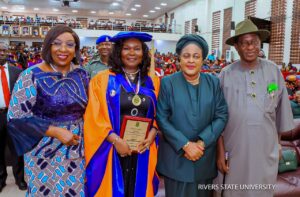
Vice Chancellor, Rivers State University, Professor Isaac Zeb-Obipi congratulating Professor Grace Akolokwu shortly after her presentation of the 130th Inaugural Lecture of the institution.
“These positions are false,” she said, stressing that a Certificate of Occupancy “is not inviolable but can be revoked.”
Akolokwu, who is a Professor of Property and Human Rights Law at the University, explained that a C of O does not confer absolute ownership but merely grants a right of occupancy, typically for 99 years, subject to conditions imposed by the state. She noted that the same authority that issues the certificate retains the power to withdraw it.
She further observed that while the Constitution of the Federal Republic of Nigeria 1999 guarantees property rights, its incorporation of the Land Use Act 1978 effectively subordinates those rights to government control.
The Inaugural lecturer, Professor Grace Akolokwu (2nd left) flanked by Rivers State Deputy Governor, Prof Ngozi Nma Odu (left), Justice Mary Odili and Chief Shedrack Akolokwu, after the lecture.
“What appears as a guarantee with one hand is quietly withdrawn with the other,” she said.
The professor added that the Land Use Act and other related laws have continued to complicate land ownership in the country, creating uncertainties that discourage investment.
Despite these constraints, Akolokwu described land as central to human existence and development, likening it to a “rose” that provides economic value and opportunities, including leasing, agriculture, mortgages, and inheritance.
However, she maintained that the “thorns” embedded in Nigeria’s land laws must be addressed through urgent reforms.
Among her recommendations is the amendment of the Constitution and the Land Use Act to remove restrictive provisions and reduce the sweeping powers of state governors over land administration.
Professor Grace Akolokwu, delivering the inaugural lecture.
She also called for a review of key sections of the Land Use Act that require gubernatorial consent for land transactions and allow revocation of occupancy rights, arguing that such provisions hinder economic activities and access to credit.
Akolokwu advocated the adoption of a dual land tenure system that distinguishes between government-controlled urban land and community-owned rural land, allowing greater autonomy for individuals and communities in managing their property.
She further urged government to prioritise fair compensation through compulsory purchase rather than acquisition, promote resettlement policies, and protect the interests of mortgagees in land transactions.
On land administration, the professor recommended strict timelines for approval of building plans, sanctions for delays, and the establishment of digital land registries to enhance transparency and efficiency.
She also called for reforms to eliminate discriminatory customary practices that limit women’s rights to land ownership, as well as policies to address housing deficits through affordable financing.
Group photograph after the lecture.
To tackle land-related conflicts and insecurity, Akolokwu proposed legislation to regulate livestock ranching and curb clashes between herders and farmers, alongside stricter enforcement against illegal arms.
She equally recommended criminalising land grabbing and unauthorised levies, while advocating constitutional amendments to grant host states and communities a greater share of proceeds from mineral resources found on their land.
The professor stressed that meaningful progress in Nigeria’s real estate sector depends on comprehensive legal reforms, particularly the amendment of the Land Use Act, despite the challenges posed by its constitutional status.
She also highlighted the need for electronic land registration systems, drawing lessons from global best practices, and called for the establishment of independent bodies to oversee land acquisition and compensation processes.
Akolokwu urged citizens to take proactive steps in securing their land rights by registering titles and developing their properties, noting that compensation in cases of revocation is based on improvements made on the land.
She concluded that without decisive reforms to streamline land rights and government roles, Nigeria’s development aspirations may remain constrained.
The inuagural lecture was attended by eminent personalities including Rivers State Deputy Governor, Professor Ngozi Nma Odu, former Supreme Court Justice, Mary Odili, Vice Chancellor of RSU, very distinguished academics and political elites, and the husband of the inaugural lecturer, Chief Shedrack Akolokwu.
The De Gratia Centre for Media Rights and Education based in Rivers State has called for renewed commitment to press freedom, describing it as a fundamental pillar for democracy, human rights, and sustainable development.
In a statement signed by the Executive Director of the Centre, Pastor Paulinus Nsirim to mark the 2026 World Press Freedom Day, the organisation joined the global community in celebrating the principles of a free press while urging stakeholders to safeguard the independence of the media.
The Centre noted that this year’s theme, “Shaping a Future at Peace: Promoting Press Freedom for Human Rights, Development and Peace,” highlights the critical role of a responsible and independent media in fostering peaceful societies and strengthening democratic institutions.
It stressed that press freedom remains essential to accountability and informed citizenship, warning that any attempt to silence journalists poses a direct threat to truth, justice, and societal stability.
“Where the media operates without fear or intimidation, truth prevails, accountability is strengthened, and citizens are empowered.
Conversely, suppressing journalists undermines justice and endangers peace,” the statement said.
Reaffirming its position, the organisation declared that press freedom is not a privilege but a right, vital for the protection of all other freedoms. It also described journalists as indispensable partners in nation-building, not adversaries of the state.
The Centre, however, expressed concern over ongoing challenges confronting media practitioners, including harassment, censorship, economic constraints, misinformation, and increasing digital surveillance. According to the statement, these threats not only endanger journalists but also weaken the integrity of information systems.
It called on governments to uphold constitutional guarantees that protect press freedom and ensure the safety of journalists.
Media organisations were urged to strengthen professionalism and adhere strictly to ethical standards, while citizens and civil society groups were encouraged to actively defend media independence.
The organisation further emphasised the responsibility of the media in an era of rapid technological change, urging practitioners to promote dialogue, counter misinformation, and contribute to peacebuilding efforts.
The De Gratia Centre reaffirmed its commitment to advancing media rights through training, advocacy, and research aimed at nurturing a new generation of ethical and courageous media professionals.
“As we mark this important day, all stakeholders must work collaboratively to build a future where press freedom is fully realised, human rights are protected, and peace becomes a shared and sustainable reality,” the statement added.
The African Democratic Congress (ADC) has released a detailed timetable for its 2026 primary elections, setting out a compressed schedule that begins with the sale of nomination forms from May 5 to May 10.
In a statement issued on Sunday by its National Publicity Secretary, Bolaji Abdullahi, the party said the timetable underscores its commitment to internal democracy, transparency, and compliance with electoral guidelines.
According to the schedule, submission of completed nomination forms will take place between May 11 and May 13, while screening of aspirants is slated for May 14 and May 15. The results of the screening exercise will be published on May 17.
The party further disclosed that appeals arising from the screening will be entertained from May 18 to May 19, with the final list of cleared aspirants to be released on May 20.
Primary elections are scheduled to commence on May 21, with contests for State Houses of Assembly, the House of Representatives, and the Senate to be conducted simultaneously at the ward level. Governorship primaries will follow on May 22, while the presidential primary is fixed for May 25.
The process will culminate in a meeting of the National Executive Committee on May 26 and a Special National Convention on May 27 for final ratifications.
ADC also announced a structured fee regime for nomination forms across elective offices. The presidential form is priced at ₦100 million, governorship at ₦50 million, Senate at ₦20 million, House of Representatives at ₦10 million, and State House of Assembly at ₦3 million.
To promote inclusivity, the party introduced concessions, offering a 50 per cent discount for youths and a 25 per cent reduction for women and persons with disabilities.
The party urged members, stakeholders, and aspirants to adhere strictly to the timetable and guidelines to ensure a smooth and credible primary process.