

Home Blog Page 161

Opinion – Rivers State: After The Storm, We Can Begin Again

0

When you have been a combatant or supporter in a conflict, there is no doubt that it can be difficult to be the one to call for reconciliation and restoration of relationship, especially if you were and perhaps are convinced of the rightness of your position.

I have been on the side of Governor Siminilayi Fubara in the crisis that rocked Rivers State due to his disagreement with his political father, my professional colleague and ethnic compatriot, the immediate past Governor of the State and current Minister of the Federal Capital Territory, Chief Nyesom Ezenwo Wike.

I had not received any favour nor had I ever met Governor Fubara when my dear senior friend, Dr. Obidinma and I filed an action in the High Court of Rivers State praying for Rt. Hon. Martins Amaewhule, our compatriot and representative, to vacate his seat as member of the House of Assembly upon his defection and because in seeking to impeach the Governor, which was the trigger of the crisis, he was doing what we had not sent him to do.

As a matter of fact, I had just led an epic litigation battle against Fubara’s election as Governor at the Governorship Election Tribunal and the Court of Appeal against the wave of support of Wike and his followers. Later, by what I can only ascribe to God’s mysterious way of performing His wonders, Governor Fubara appointed me into the 14th Governing Council of the Rivers State University from which the 13th Council, headed by the man I can describe as my father in legal practice, peremptorily removed me as a senior lecturer.

Less than two weeks after the disagreement between Governor Fubara and Minister Wike blew open, Wike paid me a sort of respect I do not remember ever receiving from any government official in Nigeria. In front of the St. Cyprian’s Anglican Church, Port Harcourt, in the presence of judges and lawyers, he came down from his official FCT 001 limousine shook my hand and that of another colleague, entered his car and zoomed off. It means I could easily have fought on his side. But I did not. I fought on the side of Governor Fubara with conviction. In the end, we ‘lost’. No regrets.

Many, if not most, Rivers persons would share in my view and pain that we lost. And for good cause, whether personal or altruistic. Altruistically, I believe that Wike was wrong on his rage against Fubara.

On a personal ground, Fubara not only appointed me to the 14th Council of RSU, through the instrumentality of Chijioke Ihunwo, but also approved my reinstatement as a senior lecturer. The least I could do to show appreciation was to support him politically. I did and would still do.

It is now the time to show that support. Support of a political leader I have come to learn is measured not in the view of the supporter but the leader.

The greatest and Eternal Political Leader, Jesus Christ, the Righteous, taught it when He said that one cannot be His follower if he is not ready to hate and deny, father, mother, even oneself to follow Him. What a supporter would always pray is that the leader leads him not into a path of eternal regret.

That is the challenge of Rivers people today, especially Governor Fubara’s teeming supporters. I know we are praying that he should lead us along the right path. I think we can trust him to do so. The crisis that erupted between Fubara and Wike has had one salutary effect: it enabled Rivers people to know Fubara for whom he truly is.

We did not have the opportunity to see or hear him closely in the lead-up to the 2023 election. He was a mystery figure, and all sorts of myths were spun against and of him. Like the breaking of an incubated egg by hatching, the crisis brought him out. It revealed the great qualities that his ‘mother hen’ saw but wanted it only to serve her.

We saw the qualities we thought could not be found in anything coming from ‘Nazareth’. The crisis, which turned out to have a dimension neither the mother hen, the chick nor the people imagined, only revealed one thing: all the parties and those concerned have to find the best way to manage our expectations to make Rivers State no more a State known for the wrong reasons but for ability to emerge from the ashes to a great society.

We have seen perhaps, and hopefully so, the worst we can see; we have been to the pit of shame and embarrassment. We have fallen. We can now tell our detractors, ‘rejoice not over me oh my enemy, when I fall, because I shall rise again’. It is time to rise from the dung.

The crisis did not do harm only to Fubara or Wike or members of the House of Assembly led by Rt. Hon. Martins Amaewhule. It hurt their families, communities, relationships, and, of course, the whole of Rivers State in unimagined and unimaginable ways. We can make a choice: to continue in acrimony, claiming to have won or lost, or decide to dust ourselves, embrace each other and go to the Ecumenical Centre to call on God to forgive all of us as we forgive each other.

Understandably, the former Sole Administrator went there for Thanksgiving. Rivers people should return to the Centre for repentance, reconciliation, and restoration. He that tried us as silver is tried, allowed us to pass through fire and water and ‘caused’ men to ride over our heads can in mercy bring us to the place of peace and abundance again.

My people of Oroigwe, Ward I, Obio/Akpor Local Government Area, were unwittingly thrown up to the centre of the crisis: Rt. Hon. Martins Amaewhule, Chief (Amabassador) Chijioke Ihunwo, Dr. Obidinma Obidinma and Dr. Chukwuma A.J. Chinwo each played well his part.

From the same Oroigwe is coming this call for 3Rs – Repentance, Reconciliation and Restoration. It may be hackneyed and self-deceptive to say, ‘no victor, no vanquished’, as there were victory and vanquish, but it is edifying for all to return and rebuild.

The best place to start rebuilding is where the crisis started. I am old enough to advise the governor, Wike, and all the current political gladiators in the state.

I counsel that Chief Nyesom Wike and Governor Fubara should, notwithstanding whatever they may have agreed before the election and after the crisis, if they have not done so, take a retreat in the spirit of grace (may God give them when they ask) to find out where each went wrong, where each offended the other, where each offended the others’ followers and where they offended the corporate interest of the State, blessed by God and now ravaged by men, and seek to let the right things be done.

It can be a difficult task with human beings. So the fewer, humans, if any, are involved the better. But it is easy with God. So God should be at the centre of such a meeting, and the participants should fear him.

To the House of Assembly of Rivers State, I would like to proffer this gratuitous counsel: The House of Assembly, the legislature in any society not only makes the law, it provides the platform for the people of the State to be heard in the running of the affairs of the State. We have suffered for the past 10 years in having a House of Assembly that seemed absent.

My brother always says that when a dumb man is forced to speak, his utterance may be too forceful for comfort. I, and I am sure most persons in Rivers State, want the House to be seen and heard.

But we do not want a House that acts as a trade union and not a representative of different persons and communities with varied needs. We do not want a House that appears deaf and dumb to the cries and afflictions of the people they represent. Irrespective of how the members emerged, it is crucial that each should know that he is there in the name and for the interest of his people as claimed. A representative is a proxy for his constituents and for no other, not even his sponsor.

While every member of the RSHA must stand up for and on the interest of his constituents, he should see himself or herself as a co-builder of the State. While he should appreciate the support and sponsorship of any person for getting into the House, he should realise that his obligation is first and foremost to the State and his people. While he should not be an executive stooge or rubber stamp or anybody’s tool, he should for the sake of the people cooperate with the other arms of government. Real democracy can only be seen through the legislature.

Governance is not about ego trips. Neither the Governor nor the FCT Minister should allow any group in the open or in secret to fan their egos by sycophancy, backbiting, genuflection, spying, and reporting. They have caused the state enough pain and stress and held us down. We can only be free when the truth reigns. The good thing is that every political leader, especially Chief Wike and Governor Fubara, can easily identify the real from the pretentious supporters. They know who is seeking for themselves and who is seeking for the interest of all. Everyone’s antecedent goes before him to proclaim what sort of person he or she is, especially with a leader that is not ready to be deceived.

There must be a determination to allow the people to have their say and democratically have their way. Our state has become one in which everything and anything goes because there is the perpetual thought of seeing each other as from not just different but enemy ethnic groups for absolutely little or no cause. The Rivers person seems eager to rather let an outside take everything than allow his compatriot of any other ethnic group to have a bite! That is why I join Club 401 to urge that this state is in urgent need of a state conference of ethnic nationalities. We can not continue to allow the State to be run like a territory conquered by a few opportune men and women and expect it to develop.

Dr. C.A.J. Chinwo wrote in from Port Harcourt

Public Administration As Weapon Of Mass Destruction: A Present And Grave Danger Of Nigeria’s Underdevelopment, Says University Don

0

In spite the vast and potential human and material resources that abound in Nigeria, the country continues to be weighed down by deliberate institutional mechanisms, policies, and corrupt practices that erode accountability, promote elite capture, and entrench a culture of underdevelopment.

These have been identified as “public administrative weapons of mass destruction,” which manifest in infrastructural decay, brain drain, rising inequality, youth unemployment, and a growing disillusionment with the state. The situation can only be reversed through a moral reawakening and civic responsibility, driven by value-based education, ethical leadership, and robust institutional reform aimed at restoring integrity and trust for a better country.

These were some of the postulates put forward by Professor Jacob Sunday Akikibofori while presenting the 70th Inaugural Lecture of the Ignatius Ajuru University of Education (IAUE) in Port Harcourt on Thursday, September 25, 2025 at the school’s auditorium.

Professor Akikibofori, whose lecture titled, “The Conscientious Individual And The Debased Social System: Unmasking Public Administration Weapons Of Mass Destruction In Nigeria”, noted that that public service in Nigeria has largely deviated from its core values of neutrality, efficiency, and responsiveness, to become an arena for personal aggrandizement and political patronage.

According to him, the weaponization of public administration in Nigeria is visible in the deliberate use of state institutions to stifle positive dissent, encourage examination malpractice, manipulate electoral outcomes, and protect political cronies, while regulatory bodies, anti-corruption agencies, and internal audit mechanisms are frequently captured by powerful interests and turned into instruments of vendetta or political control.

He noted that beyond leadership failure in Nigeria, “lies an ecosystem of impunity protected by law enforcement institutions, judicial compromise, and regulatory agencies that have lost their moral compass. These are hidden under the “weapons of mass destruction,” not in the traditional sense of nuclear or biological warfare, but as tools that destroy the human spirit, democratic accountability, and national aspirations.”

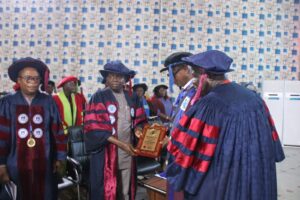
Professor Akikibofori (2nd right) receiving a commemorative plaque from the representative of the VC after his presentation

Akikibofori, who is a product of the University of Port Harcourt and a professor of Sociological Theory at IAUE further lamented that the public administrative sector which should serve as an engine of development and democratic consolidation has, “instead become a cesspool of maladministration, rent-seeking, and policy somersaults.

“From ghost workers in public payrolls to misappropriation of funds in constituency projects, from nepotism in civil service recruitment to politicised budgeting and procurement processes, the Nigerian administrative system presents a deeper rot that affects the very foundation of governance,” he stated.

Dissecting how corrupt practices, ranging from academic malpractices, symbolised by the the misuse of the “red pen”, ordinarily a neutral tool for marking scripts and assessing performance, becomes a tool for manipulation, rather than instruments of scholarly assessment, he said the consequences, “echo far beyond classrooms into the health sector, judiciary, infrastructure, and governance systems, producing leaders and administrators who perpetuate dysfunction rather than challenge it.”

To address the entrenched challenges of corruption, nepotism, and weak institutional frameworks, Professor Akikibofori recommended urgent holistic reform agenda anchored on integrity, transparency, and meritocracy that promotes the concept of the “Conscientious Individual.”

For him, the conscientious individual becomes the metaphor for ethical resistance, moral clarity, and a civic responsibility in the face of systemic decay. He becomes an individual whose actions are guided by a profound moral awareness and unwavering commitment to ethical principles, regardless of the social, political, and economic consequences.

He stated that rather than allow the conscientious Nigerian who insists on institutional integrity to be victimised by the instruments meant to uphold justice and threatened by a “debased elite,” that thrives on administrative dysfunction of survivalism, sycophants and systemic inertia, such individuals should be encouraged to become catalysts of national renewal.

“The conscientious individual, whether a student refusing to bribe, a lecturer grading fairly, a judge rejecting inducement, or a civil servant committed to transparency, represents the hope for a better Nigeria.

“Such individuals, empowered by knowledge and guided by conscience, can pierce through the fog of moral collapse and become catalysts of national renewal,” he noted.

Citing developed countries such as China, Germany, and South Korea where deliberate and strategic reforms to build resilient, transparent, and development-focused public systems worked, Prof. Akikibofori stated that those countries have proven that the ideal system is not a myth.

He described them as a product of intentional design, strong institutions, leadership commitment, and some cultural ethos that value transparency, merit, and accountability, noting that only a reformed public administration anchored on justice, equity, and conscience would be the foundation for a prosperous Nigeria.

For this to happen, Professor Akikibofori recommended that the education sector must undergo a comprehensive transformation to uproot academic malpractices and restore trust in the learning process, recruitment and promotion frameworks in public institutions should be built on standardised, verifiable and performance-based criteria, while strong legal enforcement and an independent judiciary, with robust mechanisms for prosecutingacts of impunity should be put in place.

Speaking at the end of the lecture which was well attended by academics from the institution and sister institutes in the state, community members of the lecturer, friends and associates, the Vice Chancellor of the institution, Professor Okechuku Onuchuku, commended the lecturer for the insights and recommendations and urged relevant agencies of government to note the recommendations.

Represented by the Director Academic Planning Professor Joseph Kinanee, the Vice Chancellor commended Prof Akikibofori for contributing immensely towards the growth of knowledge and being a vanguard for moral reawakening.
Represented by the Deputy Vice Chancellor (Academics), Professor Joseph Kinani, the Vice Chancellor commended Prof Akikibofori for contributing immensely towards the growth of knowledge and being a vanguard for moral reawakening.

UNGA: Tinubu Seeks Total Elimination of Nuclear Weapons … Urges AU To Renew Focus On Diplomacy To Resolve Conflicts

0

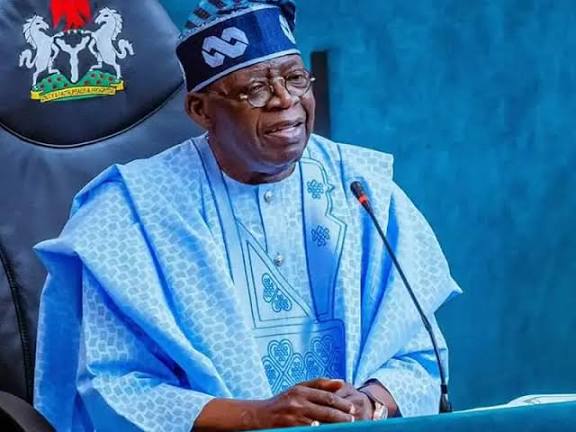
President Bola Tinubu has called for total elimination of nuclear weapons all over the world.

Tinubu made the call while delivering Nigeria’s statement at the high-level meeting to commemorate the International Day for the Total Elimination of Nuclear Weapons at the UN headquarters in New York.

Represented by the Minister of Foreign Affairs, Amb. Yusuf Tuggar, Tinubu said the event reminds the world of shared responsibility and collective resolve to eradicate dangerous weapons.

“Nigeria will continue to do its part to ensure total elimination of nuclear weapons is achieved,” Tinubu said.

According to him, the total elimination of nuclear weapons remains the only absolute guarantee against their use or threat of use.

“The catastrophic humanitarian consequences that could result from either intentional use or unintentional explosion of these dangerous weapons are dire,” he said.

Tinubu urged Nuclear Weapons States to be mindful of the impact of weapons of mass destruction on human health, the environment, and vital economic resources among others.

“We need to see action toward the dismantling of these weapons,” he said.

According to him, the continued existence of nuclear weapons is a huge challenge to international peace and security.

The Nigerian leader reiterated his concern over the resistance and lack of political will by Nuclear-Weapon States to ensure total elimination of their nuclear arsenals.

“We, therefore, urge all the Nuclear Weapons States to implement all agreed measures toward achieving total elimination of nuclear weapons.

“Nigeria also wishes to renew its call on all States to work assiduously toward the actualisation of the goals and objectives of a nuclear weapons-free world.

“We are convinced that the universalisation of the NPT is dependent upon strict compliance with its three pillars,” he said.

The three pillars are disarmament, non-proliferation and peaceful uses of nuclear energy

He commended all states that had ratified the TPNW and urged those yet to do so to accede without delay.

“My delegation takes pride in having actively contributed to the negotiation process and in being among the first countries to sign the treaty,” he said.

He said the the treaty represented a significant step toward achieving a world free of nuclear weapons.

“In this regard, my delegation also calls on all Nuclear-Weapon States to cease the testing, development, and modernisation of nuclear weapons, including associated research activities, ” he said.

He said the existential threat posed by nuclear weapons to humanity prompted African countries to adopt the Pelindaba Treaty, declaring Africa as a nuclear-weapons-free zone.

The Pelindaba Treaty prohibits, among other things, stationing of nuclear explosive devices and their testing in the entire space that constitutes the African continent.

Tinubu enjoined all member states from other regions, especially those regions that are not yet free of nuclear weapons to emulate Africa in their respective regions.

“Nigeria underscores the importance of the peaceful uses of nuclear energy and, like many other developing countries, has embraced nuclear technology to advance its development goals,” he said.

Tinubu further reminded all states of their obligation to comply fully with existing frameworks in order to uphold global nuclear safety, security, and non-proliferation norms.

According to him, the benefits of nuclear disarmament are enormous and cannot be underestimated.

“Member States must demonstrate sincerity of purpose and commitment to the goal of the total elimination of nuclear weapons.

“While there are no easy solutions, we must remain resolutely focused on getting to a world free of nuclear weapons and be better assured of our survival as human race,” he said.

Meanwhile, President Bola Tinubu has implored the African Union (AU) to reinvigorate diplomacy as the primary and most effective means of conflict resolution in Africa.

Tinubu made the call during a meeting of the AU Peace and Security Council at the level of Heads of State and Government.

The meeting was held on the sidelines of the 80th Session of the United Nations General Assembly (UNGA) in New York.

The Nigerian leader, represented by the Vice-President Kashim Shettima, acknowledged the role played by the AU’s Peace Support Operations (PSOs), a unit designed to maintain, monitor and build peace in Africa.

Tinubu said with the current UN administration and growing interest by traditional partners in conflicts outside Africa, it was becoming increasingly difficult for countries to shoulder the total cost of peace support operations on the continent.

He said: “Our continent must continue to maintain a diplomatic approach in its conflict prevention and resolution endeavours.

” We urge this council to ensure that the concept of future peace operations, particularly the UN mandated ones, make provision for diplomatic and political strategies that would ultimately address the root causes of conflict.

“We also urge the council to ensure that the existing strategies for future AU PSO’s include elements that would ensure that national and local institutions can effectively anticipate and manage shocks and relax multiplies.”

The president said this was the only way the continent’s peace support operations can leave behind resilient and self sustaining peace infrastructure wherever they find themselves.

“We further wish to underscore the current practice of proliferation of numerous peace initiatives on our continent with counter AU’s prevention and resolution processes,” he added.

Tinubu warned against external interference in crisis situation in Africa, including the presence of foreign military forces, mercenaries and defence contractors in some AU states.

He said that meddling in crises on the continent remained contrary to the African Conflict Prevention and Resolution Initiatives.

The president called on the council to consider adopting a communique to address the loopholes in conflict resolution.

The Nigerian leader urged the council to consider the call for the immediate and unconditional withdrawal of foreign forces from member countries.

He also told the council to ” expeditiously address obstacles to the operationalisation of the African standby force.

Tinubu further called for the adoption of strategy for the deployment of the African standby force in conflict situations on the continent.

He noted that the council would be more successful if it regularly coordinates, consults and strategically engages similar structures or mechanism of regional economic communities.

“It’s our view that conflict prevention and resolution on the continent is a solidarity, and working in silence should be avoided completely.

” The AU has adequate mechanism for prevention of the ever changing conflict and crisis dynamics on our continent.

” What we lack, however, is trust in our processes and institutions as well as consistency in the application of our normative instruments,” he said.

According to him, the current practice where African leaders rely on mechanisms outside the continent for solutions to their security challenges without exhausting internal processes should be
addressed.

Tinubu also urged the council to encourage AU member states to recommit to subjecting themselves to its peace and conflict resolution processes.

He said Nigeria welcomed the prevailing practice of appointing Special Envoys to countries in conflict on the continent.

Tinubu, however, said that there is need to equip members of these AU Ad–Hoc peace initiatives, particularly the Special envoys and high-level representatives, with the required skills.

The skills, he said, would enable them to become effective instrument for the prevention or de-escalation of conflicts in Africa.

” This requires the adoption of criteria that ensures that only well–respected pan– Africanist leaders that are willing to use their influence and connections to compel parties to conflict to sheath their swords, ” he said.

He underscored the importance of adequate funding and provision of strategic logistics as success enablers of Peace Support Operations.

” This is why we support the call for the operationalisation of UN Security Council Resolution 2719 on Somalia.

” This is important given the primary responsibility of the UN Security Council for the maintenance of international peace and security in accordance with relevant provisions of the United Nations Charter,” he said.

Earlier, Mr Parfait Onanga-Anyanga,
Special Representative of the Secretary-General to the African Union, decried the surge in arms conflict and dwindling funding for peace interventions in Africa.

Onanga-Anyanga, who is also the Head of the UN Office to the African Union, urged member countries to establish their own national peace building and conflict prevention mechanism.

“Prevention, indeed, must start at home and must be consistent with the United Nations Charter regional organisations such as the African Union.

” Of course, regional economic commissions and regional mechanisms have a key role to play in this regard,” he said.

Ogoni Re-entry, Historic Turning Point For Nigeria —NNPC Ltd.

0

The Nigerian National Petroleum Company Limited (NNPC Ltd.), says re-entry into Ogoniland marks a historic turning point for Nigeria, not just in terms of oil production, but reflects President Bola Tinubu’s Renewed Hope Agenda.

Speaking during the presentation of the Ogoni Consultations Report at the State House in Abuja, Tinubu said that the re-entry reflected the government’s recognition of their sacrifices.

According to a statement on Friday by Andy Odeh, Chief Corporate Communications Officer, NNPC Ltd., the President acknowledged that the Ogoni people have endured long years of pain.
“This milestone reflects the spirit of the President’s Renewed Hope Agenda, which commits to building a stronger country, attracting responsible investment and ensuring community development for national progress.

“We are not, as a government, taking lightly the years of pain endured in Ogoniland. We recognise that, otherwise we would not be here today. We declare with conviction that hope is here and is back with us,” Tinubu said.

Mr Bashir Ojulari, Group Chief Executive Officer, NNPC Ltd., reiterated the President’s sentiments, describing the development as a re-affirmation of NNPC’s commitment to the Ogoni re-entry plan and a bold step towards justice, healing and national prosperity.

He emphasised that the re-entry demonstrates that Nigeria can confront its past, honour the sacrifices of its communities and forge a new path with a vision of prosperity and justice for all.
“The re-entry into Ogoniland is not just about oil and gas. It is about justice, healing, and charting a new future for our nation,” Ojulari said.

“Ogoni re-entry can be seen as both a test and an opportunity for the country. It demonstrates that equity can exist in national development, and oil can co-exist with environmental stewardship and inclusive nation-building.

“This milestone is a practical example of how President’s Renewed Hope Agenda translates into reality by strengthening our country, creating conditions for responsible investment, while prioritising the prosperity of host communities,” he said.

Ojulari acknowledged the pivotal leadership of the National Security Adviser, Malam Nuhu Ribadu, in convening a committee that brought diverse stakeholders together, creating the platform for dialogue and consensus that made this breakthrough possible.
He also praised the work of Prof. Don Baridam and members of the Presidential Committee, who engaged tirelessly and transparently with relevant parties to produce a report that showed fairness and inclusivity.

“The lesson is that this journey cannot be driven solely by production volumes. It must be anchored on justice, equity, sustainability, and most importantly, collaboration with the very people whose land bears this wealth,” he said.
Ojulari was categorical that in resuming operations in Ogoni, NNPC Ltd. will continue to build trust by prioritising community engagements with key stakeholders, investing in infrastructure and empowering local enterprise.

He confirmed that NNPC has already began initiatives in road construction, infrastructure upgrades and economic empowerment programmes designed to rebuild trust and demonstrate accountability in an inclusive manner.

“NNPC Ltd. is determined to transform Ogoni land from a symbol of conflict into a beacon of reconciliation, renewal, and sustainable progress,” he concluded.
In his remarks, Ribadu, said sustainable progress was possible and proven through collaboration with all parties concerned.
Ribadu said that the report was the outcome of an intensive, methodical and transparent engagement.

Baridam, on behalf of the Committee, thanked the President for his unwavering commitment to the well-being of the Ogoni people, adding that through diplomacy and relentless insistence on dialogue, host community trust was earned, and hope restored.

Why Nigeria Electricity Employees suspended Nationwide Strike

0

Why Nigeria Electricity Employees suspended Nationwide Strike’


Two major electricity unions have suspended their planned nationwide strike following the intervention of the Federal Government.
The National Union of Electricity Employees (NUEE) and the Senior Staff Association of Electricity and Allied Companies (SSAEAC)
had threatened to embark on industrial action over unresolved issues in the power sector.
The workers had earlier planned to down tools to press home their demands from the Transmission Company of Nigeria (TCN) over non implementation of the national minimum wage and other operational issues,
The union decided to suspend the strike after extensive discussions with representatives of the Minister of Power, Mr Adebayo Adelabu and the labour unions.
The Atlantic Bell learnt that a Memorandum of Understanding (MoU) was signed at the end of the meeting in Abuja on Thursday night.
A copy of the Memorandum of Understanding (MoU), sighted by NAN in Abuja on Friday, revealed that the agreement was signed by representatives of the Ministers of Power and Labour, as well as leaders of the labour unions.

Other signatories to the MoU include representatives of the TCN, and the National Independent System Operator(NISO), who signed on behalf of the federal government.

While the General Secretary of SSAEAC, and the acting General Secretary of NUEE signed for the labour unions.
The MoU said” after extensive discussions, the following agreements were reached:
Among the agreements was the decision for the unions to consider the report of a standing committee between October 6 and October 7, with a view to commencing its implementation in the same month.
In addition, TCN and NISO are to jointly evaluate the financial implications of the report and prepare an implementation plan for presentation to the minister and the unions.
It was further resolved that both unions would reconvene with TCN and NISO management to address other outstanding issues.
The MoU also directed the Nigerian Electricity Regulatory Commission (NERC) to fast-track the review of tariffs for TCN and NISO to enable implementation of the committee’s recommendations.
The MoU also included a key clause stating that no employee would be victimised for participating in the industrial action.
Following the agreement, and in a show of good faith, the unions announced the suspension of the planned strike to allow for the implementation of the resolutions reached during negotiations.

Sustain Momentum Against Terrorists, Adopt Innovation For Enhanced Security, Army Chief Charges Soldiers

0

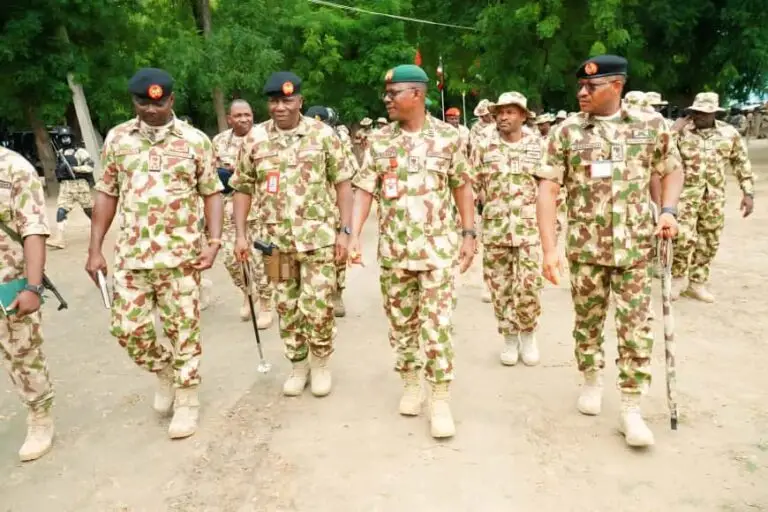
The Chief of Operations (Army), Maj.-Gen. Uwem Bassey, has charged commanders of Operation Hadin Kai (OPHK) to sustain momentum and adopt innovative strategies in combating terrorism in the North East.

Bassey gave the charge during a two-day operational assessment visit to the Headquarters Theatre Command, Maiduguri, from Sept. 24 to 25.

This is contained in a statement issued on Friday by Lt.-Col. Sani Uba, Media Information Officer, OPHK.

Bassey said that the visit was intended to assess operational effectiveness, boost troop morale, ensure strategic alignment, and provide direct support on behalf of the Chief of Army Staff, Lt.-Gen. Olufemi Oluyede.

He urged commanders and troops to dominate all areas of operation and deny terrorists any freedom of movement, stressing the importance of fresh, adaptive approaches to achieve decisive outcomes.

The Army’s operations chief also emphasised the need for strengthened joint operations involving land, air, and maritime components, along with other security agencies.

He warned against indiscipline and cowardice, calling on troops to apply full firepower against terrorist elements.

Bassey also interacted with members of the Civilian Joint Task Force (CJTF) and Hybrid Forces.

He conveyed the COAS’s appreciation and urged all personnel to remain loyal, disciplined, and steadfast in defending their communities and the nation.

Bassey cautioned against double-dealing and leaking intelligence to terrorists, noting that such acts endangered troops and civilians alike.

“Some individuals may appear friendly by day but operate as enemies at night. Such conduct will not be tolerated,” he warned.

Bassey assured that troops, working closely with other components and agencies, would sustain aggressive operations to deny terrorists any operational space in the region.

During the visit, he toured formations and units including the 21 Armoured Special Brigade in Bama, the 151 and 152 Battalions in Banki, and the Forward Operating Base in Bula Yobe.

He also held interactive sessions with sector and component commanders, assuring them that operational challenges raised, would receive urgent attention

250,000 MSMEs To Benefit From SMEDAN, CAC Free Business Registration

0

The Corporate Affairs Commission (CAC) and Small and Medium Enterprises Development Agency of Nigeria (SMEDAN) are deepening partnerships to ease business registration for small business owners in the country.

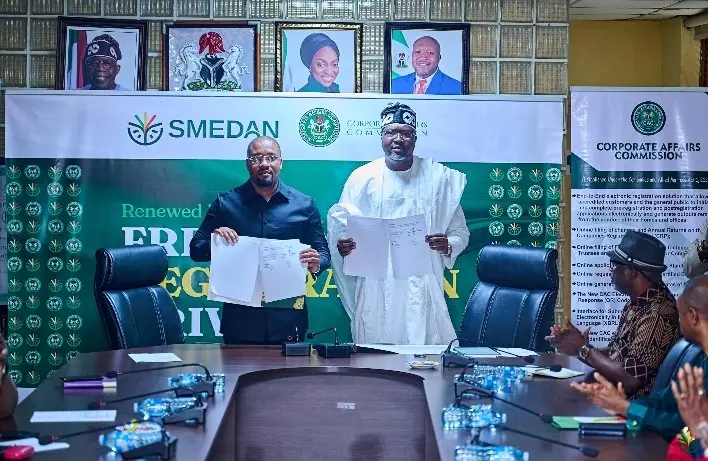
The Registrar-General of CAC, Mr Hussaini Magaji, said this during the signing of a Memorandum of Understanding (MoU) between both organisations on Friday in Abuja.

The agreement will provide the framework for free registration of 250,000 Micro Small and Medium Enterprises across the country.

Magaji said that the framework provided under the Renewed Hope Agenda of President Bola Tinubu’s administration would eliminate cost barriers by waiving all statutory fees.

He said that entrepreneurs would now be able to obtain certificates seamlessly, without delays or middlemen, through the CAC portal.

He said: “Formalising a business is more than obtaining a certificate.

“It provides entrepreneurs with a legal identity, improve access to finance and markets, enhances record keeping and strengthen compliance with tax or regulatory obligations.

“For the government, it expands the tax base, improves policy design and reflects the two sides and contribution of our MSME sector.

“By formalising an additional 250,000 enterprises under this initiative, we are helping to create jobs, foster innovation and build a more inclusive economy,” he said.

The registrar-general, while commending SMEDAN on the partnership urged the MSMEs to take advantage of this opportunity to formalise their businesses, access new opportunities and become part of Nigeria’s growth story.

Magaji also appealed to the media to help amplify this message so that no deserving entrepreneur is left behind.

On his part, the Director-General of SMEDAN, Charles Odii, hailed the initiative as a milestone for small businesses, describing it as one of the “big wins” of the current administration.

Odii explained that SMEDAN would mobilise, profile and guide eligible businesses for registration through its dedicated online portal.

According to him, the platform will eliminate the role of middlemen, who previously inflated registration costs, sometimes charging between N30,000 and N100,000 against the official CAC rate of about N11,000.

Odii said the initiative would complement the President’s N200 billion economic assistance programme, which provides N50 billion in grants for nano businesses, N75 billion in single-digit loans for SMEs and N75 billion for manufacturers.

He said that the interventions demonstrated the resolve of government to ease the cost of doing business and expand opportunities for entrepreneurs.

The director-general said that the MoU was timely, especially as CAC prepared to review its fees by October, reiterating that the initiative ensures 250,000 businesses will benefit from free registration before the review.

According to Odii, many businesses collapse within their first five years due to a lack of structure, noting that registration was the first step to building resilience.

The SMEDAN boss assured that beyond registration, SMEDAN would continue to support entrepreneurs through business clinics, advisory services, and linkages.

He said this would be done in collaboration with other agencies such as the Standards Organisation of Nigeria (SON) and the Nigerian Export Promotion Council (NEPC).

Odii also commended the President’s move to raise the tax exemption threshold for small businesses with N25 million to N50 million annual turnover, saying it will reduce the burden on enterprises and encourage compliance.

He thanked the Registrar-General of CAC, the Federal Ministry of Industry, Trade and Investment, and the Chief of Staff to the President for their support in bringing the initiative to fruition.

Nigeria Targets 106 million Children In Massive Vaccination Campaign, October … Roles Out Measles-rubella Vaccine

0

The National Primary Healthcare Development Agency (NPHCDA), has announced plans to introduce the Measles-Rubella Vaccine (MRV), into Nigeria’s immunisation as part of what it tagged “Mother of All Campaigns”.

The immunisation agency said that it was an integrated nationwide health drive targeting more than 106 million Nigerians aged 0 to 14 years in October.

Dr Ladan Aliyu, Director of Advocacy and Communications, NPHCDA, disclosed this on Friday in Abuja, during a Media Orientation on the Integrated Campaign.

Aliyu said that measles and rubella spread rapidly but can be prevented with a simple vaccine.

“A single measles and rubella vaccine dose gives lasting protection, saves lives and builds a healthier community. Vaccinate your child today,” he urged.

He said that the upcoming campaign would integrate measles-rubella, polio, nutrition, HPV, routine immunisation, malaria prevention and efforts against neglected tropical diseases (NTDs).

He described the media as critical partners in ensuring the success of the campaign.

“The media remain critical partners in creating awareness, educating caregivers, dispelling misinformation and mobilising communities to ensure Nigeria reaches the 95 per cent measles vaccination coverage needed for herd immunity,” he said.

Also speaking, Dr Frank Obi, Consultant Community Health Physician and Epidemiologist, explained that Nigeria is aligning its measles elimination plan with global strategies by integrating vaccination and disease control efforts.

Obi noted that instead of separate campaigns, the new approach would combine interventions for stronger outcomes.

He highlighted Nigeria’s burden of zero-dose children, those who have never received a single vaccine, stressing that the campaign aims to reduce the figure by at least 15 per cent.

“Nigeria remains the headquarters of zero-dose children, especially for measles.

“Strengthening routine immunisation is the backbone of disease control. Without 95 per cent coverage, outbreaks will continue to spread,” he warned.

He added that while 85 per cent of children respond to the first measles dose given at nine months, a second dose at 15 months is crucial to achieve full protection.

Currently, he said that only 51 per cent of Nigerian children receive the first dose and just 30 per cent receive the second, leaving millions unprotected.

The October campaign will mobilise health workers, community leaders, and the media nationwide to boost coverage and close immunity gaps.

The Atlantic Bell recalls that measles is a highly contagious viral disease. It spreads through coughing, sneezing, or close contact with an infected person.

Symptoms include high fever, cough, runny nose, red eyes, and a characteristic rash. It can lead to serious complications such as pneumonia, diarrhoea, blindness, brain death, especially in children under five, and vaccination is the only effective prevention.

Rubella, also called German measles, is a contagious viral infection that is usually mild in children and adults. Symptoms include fever, rash, swollen lymph nodes, and joint pain.

The greatest risk is when pregnant women get infected, especially in the first trimester. It can cause Congenital Rubella Syndrome (CRS) in babies, leading to deafness, heart defects, intellectual disabilities and blindness.

The rubella vaccine prevents infection and protects future generations.

The Measles-Rubella vaccine protects against both measles and rubella in a single shot. It is safe, effective, and recommended by the World Health Organisation (WHO).

Adding MRV to Nigeria’s immunisation schedule will save thousands of children’s lives and prevent birth defects linked to rubella.

Why FG Imposed $200m Fine on Meta – NDPC

0

The Federal Government says that the investigation into the operations of tech giant, Meta was to ensure that it operated within the within the ambits of the nation’s laws.

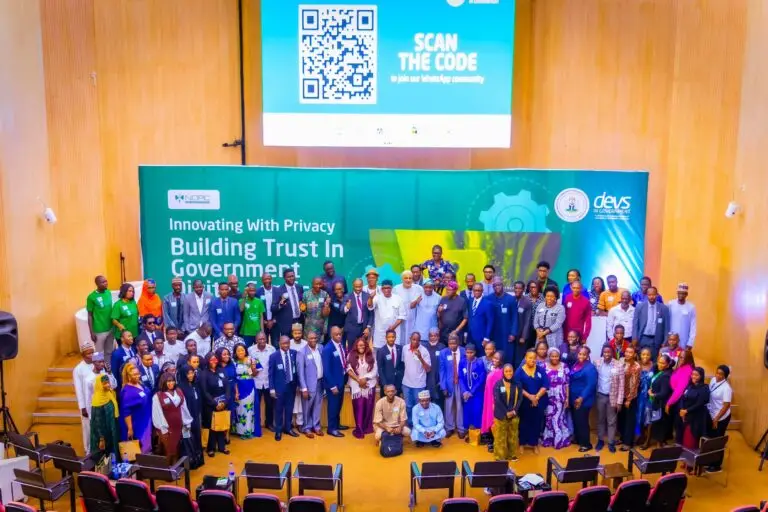
The National Commissioner, Nigeria Data Protection Commission (NDPC), Dr Vincent Olatunji, said this in Abuja on Friday at Training for DevsInGovernment which had as its them: “Innovating with Privacy: Building Trust in Government Digital Services.”

The U.S,-based company are the operators of social media platforms such as Facebook, Instagram, WhatsApp, Messenger and Threads.

IT would be recalled that the government through the Federal Competition and Consumer Protection Commission (FCCPC) recently imposed a $220 million fine on Meta for data breaches.

“We are not necessarily being punitive. However, any institution that fails to cooperate or comply with our laws will be sanctioned,” Olatunji said.

The initiative is meant to equip workers of Ministries, Departments and Agencies (MDAs) of government with digital knowledge and skills.

Olatunji said the probe of Meta Platforms Inc. required multi-agency approach to ensure a thorough and detailed investigation with appropriate mechanisms to resolve the issues.

“We are concerned about the ways and manners in which data of citizens are collected and managed in Nigeria and outside Nigeria.

“In so doing, we also consider the economic values for the citizens and the country and we want the global best standards and practices to be entrenched here.

“We are not necessarily being punitive. However, any institution that fails to cooperate or comply with our laws will be sanctioned,” he said.

He said given the sensitive nature of data in governance and businesses, the federal government would do everything legally necessary to sanitise the area.

“The future of government is digital, but the success of digital governance will depend on one thing above all. Trust and privacy is the foundation of that trust.

“Deploying trusted digital services is not a task for government alone it requires all of us across public and private sectors, civil societies and citizens working together.

“Together we can build a citizen-centric, innovative digital nation that others will look to as a model of trust and progress,” he said.

WHO To Recruit Candidates For Technical Advisory Group On Maternal Mortality, Cause Of Death Estimation

0

The World Health Organization (WHO) is seeking to engage experts to serve as members of the Technical Advisory Group on Maternal Mortality and Maternal Cause of Death Estimation.

The Technical Advisory Group on Maternal Mortality and Maternal Cause of Death Estimation (the “TAG”) acts as an advisory body to WHO in the field of maternal mortality measurement and maternal cause of death measurement. The TAG provides guidance in relation to on-going methodological improvements and strategies for reporting and enhancing country level reporting.

The TAG on Maternal Mortality and Maternal Cause of Death Estimation will be multidisciplinary, with members who have a range of technical knowledge, skills and experience relevant to maternal mortality and morbidity measurement.

WHO expects expressions of interest from expert scientists, healthcare professionals, health management information systems and data specialists with expertise in the following areas epidemiology, biostatistics, data science, modelling of health estimates; maternal health, obstetrics and gynecology, midwifery, reproductive health.

Other areas include, monitoring and measurement within health systems; and censuses, civil registration and vital statistics, health and demographic surveillance systems, maternal death review, verbal autopsy, other surveillance systems, as relates to mortality and cause of death data.

In its capacity as an advisory body to WHO, the TAG has the following functions, to provide independent evaluation of the scientific, technical and strategic aspects relating to maternal mortality and maternal cause of death measurement and estimation methods;

The TAG will recommend priorities relating to the development of a research agenda to address maternal mortality measurement challenges required for global monitoring purposes;

It will also advise on linkages with related advisory groups, including those working on the measurement and estimation of perinatal, neonatal, and infant mortality.

Furthermore, the TAGwill advise on strategies to promote linkages to broader strategies to strengthen national statistics systems as relates to maternal mortality measurement, including civil registration and vital statistics, standardized coding and classification according to the rules of the International Classification of Diseases (ICD) framework; and to advise on strategies in relation to the effective dissemination and use of the maternal mortality estimates and related products.

The TAG shall normally be expected meet at least once per year, either in-person or virtually at WHO Headquarters in Geneva, Switzerland, usually for 2-3 days each time. Meetings may be convened in other locations if determined by WHO. Additional meetings and/or interim teleconferences may be required of members where input is requested on specific issues.

Active participation is expected from all TAG members, including in working subgroups, teleconferences and interaction via e-mail. TAG members may be requested to review meeting documentation in advance of TAG meetings.

The working language of the TAG will be English

Applicants who wish to be considered for the TAG on Maternal Mortality and Maternal Cause of Death Estimation, are requested to submit the following documents, a cover letter, indicating motivation to apply and how expertise meets the criteria earlier stated.

Applicants are also to submit curriculum vitae; one example of a work product or report in the relevant area; and a signed and completed Declaration of Interests (DOI) form for WHO Experts (available for download).

Applications are to be forwarded to maternalestimates@who.int using the subject line “Expression of interest for the TAG on Maternal Mortality and Maternal Cause of Death Estimation”: Applicants are advised not to use the letterhead or other identification of there employers.The deadline for submission of applications is October 15, 2025.

All expression of interests will be reviewed by WHO, and due to an expected high volume of interest, only selected individuals will be contacted.

Background
WHO is the leading agency of the United Nations (UN) Maternal Mortality Estimation Inter-Agency Group (MMEIG), a UN initiative comprising WHO, UNICEF, UNFPA, the World Bank Group and the UNDESA/Population Division. The MMEIG has the function to update the inter-agency estimates of maternal mortality. The MMEIG contributes to monitoring progress towards the achievement of Sustainable Development Goal 3 – “Ensure healthy lives and promote well-being for all at all ages” by producing estimates of the maternal mortality ratio (MMR) (target 3.1.1)