

Home Blog Page 119

University Auditors Urged to Embrace AI, Technology In Auditing …Experts Advocate Digital Transformation In University Audit Practices

0

Heads of Internal Audit Departments and Units in Nigerian universities have been advised to adopt Artificial Intelligence (AI) and technology-driven approaches to strengthen transparency, prevent financial leakages, and improve efficiency in institutional financial oversight.

The call was made at the 38th National Conference and Annual General Meeting of the Committee of Heads of Internal Audit Departments and Units of Nigerian Universities, held at the University of Port Harcourt.

In a statement signed by Dr Sam Kpenu, Public Relations Officer,
University of Port Harcourt, the Vice-Chancellor of the University of Port Harcourt, Professor Owunari Abraham Georgewill, in his opening remarks described the theme, “Revolutionising University Internal Auditing Through Technology and Innovation,” as timely and significant. He emphasized that the internal audit function plays a critical role in ensuring accountability and credibility in the management of university resources, adding that the adoption of modern audit tools will help institutions align more effectively with global best practices.
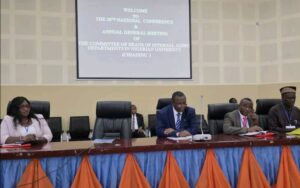
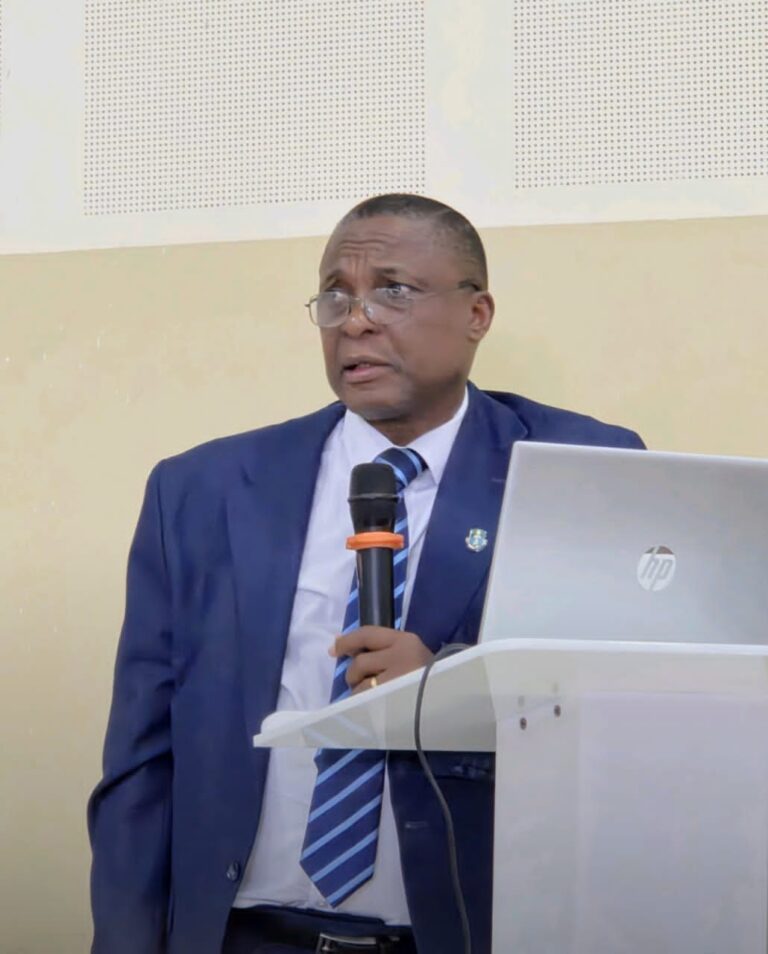
Delivering the keynote address, Professor Emmanuel Ibanichuka stressed the importance of transitioning from manual audit systems to data-driven, technology-enabled procedures. He explained that AI, data analytics, and automation have become essential tools for detecting financial irregularities, strengthening oversight, and supporting evidence-based decision-making within the university system.

In his goodwill message, the Acting Auditor-General of Rivers State, Dr Yorkina Christian, encouraged audit professionals to develop practical capacity in digital auditing tools and foster stronger collaboration with ICT units in their respective institutions. He noted that the successful integration of technology into auditing requires not only improved systems but also consistent ethical conduct, professional discipline, and sustained capacity development.

Earlier in his welcome remarks, the Chairman of the Committee of Heads of Internal Audit Departments and Units of Nigerian Universities, Dr Boniface Woke, stated that the conference was designed to equip practitioners with contemporary competencies for technology-assisted assurance and advisory services. He emphasized that continued peer learning, supportive policy frameworks, and professional training are vital for embedding innovation across audit functions nationwide.

Participants at the conference resolved to promote the use of AI-assisted analytics, strengthen institutional compliance frameworks, and uphold ethical conduct in audit practice, with the overall goal of enhancing transparency, accountability, and financial governance in Nigerian universities.
Paramilitary CBT Exam: Board Advises Candidates On Login Procedure To Avoid Failure

The Civil Defence, Correctional, Fire and Immigration Services Board (CDCFIB) has advised candidates shortlisted for the online Computer-Based Test (CBT) to login 30 minutes each day ahead of the commencement time.

This is contained in a statement by the Secretary to the Board, retired Maj.-Gen. Abdulmalik Jibril, on Wednesday in Abuja.

Jibril said that the online CBT phase of the recruitment exercise commencing on Wednesday (today) would be on till next week and commence at 9:00 a.m., daily.

The paramilitary agencies include the Nigeria Security and Civil Defence Corps (NSCDC), Nigeria Immigration Service (NIS), Federal Fire Service (FFS) and the Nigerian Correction Service (NCoS).

According to the secretary, only candidates who have been officially scheduled will be permitted to login as the portal will open 30 minutes before each scheduled exam.

”To access the exam, candidates are to log into the board’s portal at recruitment.cdcfib.gov.ng at the exact exam window selected during registration.

”They are to complete the photo verification process, and remain in the virtual waiting room until the exam begins automatically at the scheduled time.”

He also advised all candidates to carefully study and adheres to the examination rules to avoid disqualification.

”The system has been designed to monitor and detect all forms of malpractice, third-party interference as well as device manipulation.

”The CBT will be Al-proctored throughout the entire session; so candidates are advised to have a stable internet connection, steady power, as well as the right device-preferably a laptop.

”While mobile phones and tablets may be used, interruptions such as calls or switching applications will trigger violation alerts. Repeated violations will result in automatic failure.

”Candidates who are disconnected after starting, can rejoin within the allotted time and continue from where they stopped,” the secretary added.

Nigeria, Home To World’s Largest Open-access Fibre -Minister …Plans 4,000 Telecom Towers To Connect Communities

0

Dr Bosun Tijani, Minister of Communications and Digital Economy, said that Nigeria had the highest number of unicorns in Africa worth over one billion dollars.

Tijani said that they had continued to attract investment that deliver jobs, products, and innovation that drive national growth.

He said Nigeria was leading a World Bank-sponsored project to deploy 90,000 kilometres of open-access fibre, developing world’s largest, alongside plans to install 4,000 telecom towers to connect 20 million unserved Nigerians.

Tijani said this at the opening ceremony of the Digital Nigeria International Conference and Exhibition (DNICE 2025) organised by the National Information Technology Development Agency (NITDA) in Abuja.

The three-day event had its theme as “Innovation for a Sustainable Digital Future: Accelerating Growth, Inclusion, and Global Competitiveness.”

Earlier, the Vice President of Nigeria, Kashim Shettima had reassured Nigerians that the government’s reforms across sectors and especially the technology ecosystem was yielding significant impact and reposing the confidence of investors.

“The uncertainties of the global economy, shocks, shifting alliances and the rapid displacement of traditional jobs by emerging technologies have compelled us to act boldly.

“Our economic reforms are stabilising the sector, and I am proud to share that these reforms have inspired investor confidence.

“The world is taking note of our steady progress and this is our motivation to stay on course because digital innovation offers us a highway to reach our destination,” he said.

According to him, digital innovation is a sustainable and inclusive answer to our quest for relevance, opportunity and transformation.

The V-P further said the government was ensuring that the gains of economic development trickled down to the common man.

“If we must move beyond the quick means of simple application of technology to building deep tech solutions that address foundational challenges.

“This is such areas as agriculture, health, logistics and governance, we must set our priorities right, build a digital approach that works seamlessly across the country,” he said.

Shettima said that government’s strategy to reshape the country was anchored on developing people, infrastructure development and strong policy frameworks.

“The success of our cashless reforms has positioned Nigeria as one of the most dynamic fin tech ecosystems in the world and now we are opening the next frontier.

“We are in the advanced stage of passing the National Digital Economy and e-governance bill into law.

“This new bill will unlock the era of smarter governance, greater transparency and inclusive service delivery,” he said.

Malam Kashifu Inuwa, Director-General of NITDA, said that with a population of over 220 million and an average age of 18 years, it was imperative for Nigeria to harness the creativity of the youth.

“If we harness the energy, the creativity and talent of our youth, we are not just going to power Nigeria, but we can power the entire Africa into a new era of prosperity.

“If we fail to do that and provide a platform for our youth to create value, we are squandering the most valuable and precious asset we have as a nation.

“The answer to this challenge is our collective ambition to bring these youths together, engage them, provide a platform for them to showcase their creativity and their talents,” he said.

The conference, he said, was being attended by no fewer than 4,800 participants from 12 countries and from 25 states across the country.

Fubara Rebukes Contractor Handling 14km Ndele–Omofo–Egamini-Agba-Ndele Road Project …Threatens To Review Contract

0

Rivers State Governor, Sir Siminalayi Fubara, has expressed dissatisfaction over the slow progress of work on the 14.5-kilometer Ndele/Omofo/Egamini/Agba-Ndele Road project located off the East–West Road in Emohua Local Government Area of the state.

Addressing newsmen during an inspection tour of the project on Tuesday, the Governor noted that the pace and quality of work being delivered by the contracting firm, Messrs Stream Co. & Equipment Limited, fell below acceptable standards.

He was accompanied on the tour by the Permanent Secretary, Ministry of Works, Dr. Austin Ezekiel-Hart, who briefed the Governor on the status of the project and adjoining infrastructure.

Governor Fubara, who appeared visibly unsatisfied with what he saw on the stretch of the road, said his administration would not condone mediocrity or allow public funds to be wasted on underperforming projects. He, therefore, hinted that a review of the contract may be imminent to ensure the delivery of quality infrastructure to the people.

“I can say here already that the contractor handling the road from the bridge to the East–West Road is not doing a good job. I’m not happy about it. When I get back, there will be a need to review that contract because I’m not impressed. They don’t have the capacity, and we need capacity because we must have value for whatever money we’re spending,” the Governor said.

The Governor, however, commended Setraco Nigeria Limited for the standard and pace of work on the 240-meter Agba-Ndele/Abua Bridge, which forms a major component of the project. He explained that the bridge, which his administration inherited, would significantly improve connectivity among communities in the area once completed.

Governor Fubara stated that the bridge will serve as a key link between communities in Abua/Odual, Ahoada-East, and Emohua Local Government Areas, reducing travel time and providing an alternative route to the East–West Road.

He emphasised that the project demonstrates his administration’s commitment to rural connectivity and inter-community access, which are central to his development vision for Rivers State.

“Where we are standing on is a bridge connecting Abua/Odual, Ahoada-East, and Emohua Local Government Areas. The community that is connected to this bridge is Agba-Ndele.

“Instead of running through the East–West Road to Ahoada-East and heading into Port Harcourt or out of it, this bridge provides easy access for the Abua/Odual people to cross into Emohua, Agba-Ndele, and access the East–West Road in minutes,” he explained.

Governor Fubara also expressed optimism that the bridge would be ready for use in early 2026, noting that Setraco’s expertise and performance met his administration’s expectations for quality and delivery timelines.

He highlighted that projects of such importance should be handled by firms with the capacity to meet government standards.

The Governor further remarked that once completed, the bridge would serve as a crucial economic corridor for farmers and traders, especially those involved in agriculture and cultivation of local produce across the beneficiary local government areas.

He maintained that his administration is determined to deliver people-oriented projects that promote connectivity, strengthen commerce, and enhance livelihoods across the State.

“I’m really impressed with what I’ve seen on the bridge. I’m very sure that before the end of January, it might be completely ready for us to walk through and even drive across,” Governor Fubara said.

Reaffirming his vision for Rivers people, the Governor noted that his development plan seeks to integrate all parts of the State through strategic infrastructure investments that promote mobility, social cohesion, and economic growth.

He explained that his government is executing projects across multiple local government areas to ensure balanced development and inclusivity.

Governor Fubara stated that the administration will soon address the deplorable state of the Abua/Ahoada Road, which he said, will be included in the 2026 state budget.

“Our vision is to connect the entire Rivers State together, especially communities that have challenges of access. The bridge here connects Abua/Odual and Ahoada-East to Emohua and Port Harcourt. It will ease movement, promote trade, and boost our economy because agriculture is strong on this side. Moving goods to the city won’t be a problem anymore,” he said.

Governor Fubara reiterated his administration’s commitment to delivering quality infrastructure that provides value for public funds and meets the aspirations of Rivers people.

Rivers Launches BEPPARSH-S Project For Improved Health Service Delivery

0

Rivers State Hospitals Management Board has launched a pilot programme towards the dissemination/ roll-out of the balanced scorecard implementation in public secondary hospitals in Rivers State.

Flagging off the programme, the Chief Medical Director of Rivers State Hospitals Management Board, Dr. Bright Ogbonda, ably represented at the occasion by the Director, Medical and Dental Services of the Board, Dr. Ishmael Jaja reiterated that the scorecard launch is part of the concerted and determined efforts of the board to see to it that all secondary hospital facilities operate at maximum level in the state.

Dr. Jaja then enjoined all the medical doctors and representatives of the various secondary health facilities to ensure that they always applied the knowledge in the scorecard for better service delivery.

The representative of the CMD gave the assurance that the concerns expressed in the scorecard will be improved upon at the various secondary health facilities in such a way that by the next assessment meeting, they would have been fully dealt with.
The CMD also promised that the board would own up the project, even as they hoped to scale up the needed improvement and sustain it.

In a goodwill message at the event, a former chairman of the board, Supervisor co-investigator of the project, Prof. Daprim Ogaji described the scorecard project as a very important management tool that will integratively improve the health system.
Prof. Ogaji commended the Chief Medical Director, the doctors from the various secondary health facilities, and all stakeholders for owning up the project, assuring them that the innovation will benchmark performance within secondary health facilities.

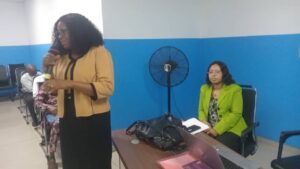
Dr. Juliet Aleme, Principal Investigator of the scorecard project, making a speech, while Dr. Foluke Adeniji, looks on.


Also, speaking at the event, a second co-investigator and supervisor of the project, Dr. Foluke Adeniji decried a misnomer in health practice in Rivers State, where patients are directly referred from a primary health facility to a tertiary hospital, expressing optimism that with the launch of the scorecard in the state, the processes will be normalised.

Earlier, in her welcome remarks, the principal investigator of the project, Dr. Juliet Aleme has emphasised that the launch is to disseminate and show the balance scorecard framework, which is envisaged to improve the performance of secondary hospitals in Rivers State.

Dr. Aleme, informed all that the objective of the event was to officially introduce the scorecard project and to build ownership and commitment among hospital managers.

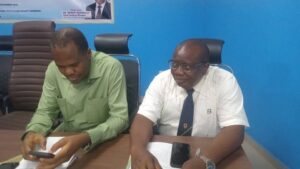
Dr. Ishmael Jaja, representative of the CMD of Rivers State Hospitals Management Board ( in white), and Prof. Daprim Ogaji at the event.


It would be noted that the project, which has the theme, ” Balanced Scorecard for the Enhancement of Performance and Accountability in Public Secondary Hospitals in Rivers State- BEPPARSH-S ,” is supported by Robert Koch Institute ( RKI) under the CARE Project, funded by the German Federal Ministry of Health.

Insurance Cover: RIVCHPP Commences Registration Of Health Workers In Rivers

0

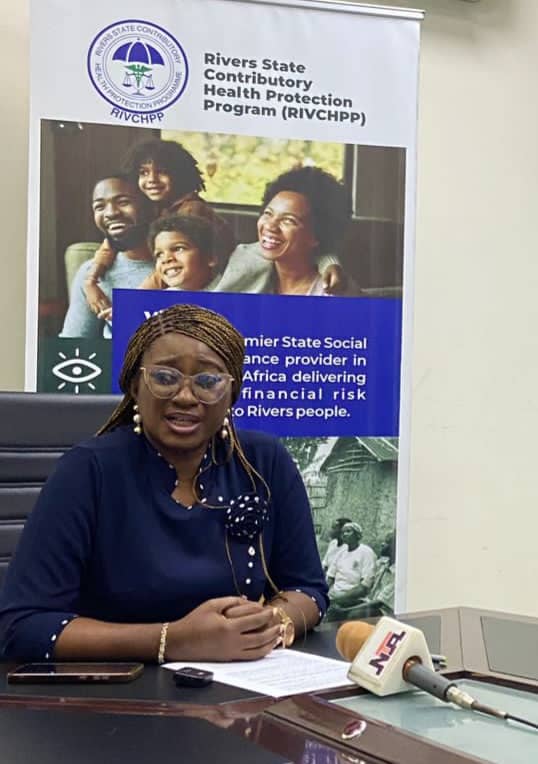
Rivers State Contributory Health Protection Programme (RIVCHPP), the state health insurance agency, is to begin the enrolment of the health workforce, following the mandate of the Governor, Sir Siminialayi Fubara, to have alll health workers in the state enrolled.

Based on the governor’s mandate, the Honourable Commissioner for Health, Dr. Adaeze Chidinma Oreh has directed the immediate enrolment of health workers starting from Wednesday, 12th November 2025, by RIVCHPP.

Consequently, the Executive Secretary of RIVCHPP, Dr. Vetty Agala, in a statement on Monday, in her office, instructed that enrolment teams will be first deployed to the Ministry of Health, Rivers State Primary Health Management Board (RSPHCMB), Rivers State Hospital Management Board (RSHMB), and Rivers State University Teaching Hospital (RSUTH).

In the statement, Dr. Agala urged heads of the MDAs to kindly grant RIVCHPP’s team members a space to carry out the enrolment, inform their staff of the enrolment exercise and provide any other support necessary for the seamless enrolment of the health workforce.

The Executive Secretary of RIVCHPP added that all health workers, including non clinical staff, will be covered, saying that nominal rolls will be required from each MDA, while staff should present their ID cards or letters of employment.

Dr. Agala, however, pointed out that only those workers who have valid national identification numbers ( NIN) are eligible for enrolment in line with National Health Insurance Authority (NHIA) guidelines.

Tinubu, Governors, Media Giants To Kick Off 21st Editors Conference In Abuja

0

All os now set for the commencement of the 21st All Nigeria Editors Conference (ANEC) taking place in Abuja, Federal Capital Territory, from Wednesday, November 12, 2025.

President Bola Tinubu will officially open the two-day event at the State House Conference Centre, Aso Villa, on Wednesday. The conference will also welcome governors, top media executives, diplomats, academics, and other distinguished guests.

Anticipation is high as key national and media figures converge to discuss pressing issues shaping Nigeria’s media landscape, foster collaboration, and chart the future of journalism in the country.

According to a press statement by the NGE President, Eze Anaba and General Secretary, Onuoha Ukeh, no fewer than 500 editors from across the country will attend the conference.

The Guild said that Sultan of Sokoto, His Eminence, Alhaji Muhammad Saad Abubakar and Prince Nduka Obaigbena, Chairman of Arise New and This Day newspaper, will be Chairman of conference, while Imo State Governor, Senator Hope Uzodimma, will be keynote speaker.

The statement said that Governors Dauda Lawal (Zamfara), Caleb Muftwang (Plateau), Abdullahi Sule (Nasarawa), and Abba Kabir Yusuf (Kano), among others, are also billed for the conference.

Media leaders, like Chief Segun Osoba, former Governor of Ogun State; Chief Onyema Ugochukwu; Mr. Femi Adesina, former Special Adviser to the President (Muhammadu Buhari) on Media and Publicity; Mallam Garba Shehu, Special Assistant to the President (Muhammadu Buhari) on Media and Publicity; Dr. Orji Ogbonnaya Orji, Executive Secretary, Nigeria Extractive Industries Transparency Initiative (NEITI) and the National Coordinator of EITI implementation in Nigeria; and Mr. Ukpe Anietie, Deputy Chief of Staff to the Senate President, among others, are also expected at the conference.

Publishers/Chairmen, Board of Directors of newspapers, Managing Directors/Editors-in-Chief from newspaper and broadcast organizations, Chairmen of media organisation’s Editorial Boards, and top editors will be attending the conference.

With the theme, “Democratic Governance and National Cohesion: The Role of Editors,” and sub-theme: “Electoral Integrity and Trust Deficit: What Nigerians Expect in 2027,” the conference will examine the role of editors in promoting democratic governance and national cohesion, discuss challenges and opportunities facing editors in promoting democratic values and national cohesion and identify best practices and strategies for editors to promote democratic governance and national cohesion, the Guild said.

The statement further said that Prof Awa Kalu, eminent lawyer, Senior Advocate of Nigeria (SAN) and Managing Partner, Awa Kalu & Partners, will address the conference on November 12, 2025, speaking on “Election Disputes and Judicial Integrity: Navigating the Thin Line Between Law and Politics.

Prof Sheriff Ghali Ibrahim, HOD, Political Science and International Relations, University of Abuja, will take the stage thereafter to speak on: “State of the Nation: Imperative of Economic and Political Reforms in Challenged Nation.”

On the second day of the conference on November 13, 2025 at the Nigerian Air Force (NAF) Conference Centre, former Chief of Defence State, Gen Lucky Irabor, will speak on “Media, Terrorism, and National Security: Addressing the Complexities,” while Prof Abiodun Adeniyi, Dean, School of Post-Graduate Studies, Baze University, Prof Abiodun Adeniyi, will talk about “The Evolving Face of Journalism: Battling Misinformation, AI Disruption, and Credibility Gap.”

The NGE said that there will be an Executive Session on the second day of the conference, where editors will interrogate government officials, political and business leaders.

ECCIMA Hails FG’s 15% Tax On Imported Petrol, Diesel

0

The Enugu Chamber of Commerce, Industry, Mines and Agriculture (ECCIMA) has hailed the decision of the Federal Government to impose a 15% tax on imported petrol and diesel.

The chamber gave the commendation in a statement on Tuesday in Enugu by its President, Sir Odeiga Jideonwo.

According to him, the chamber considers this a step in the right direction—one that will not only help grow the economy but also encourage local production and create more employment opportunities for our teeming youths.

He said that ECCIMA had consistently maintained that the naira cannot appreciate if more than 80 per cent of the country’s needs remained import-dependent.

“The excessive importation of finished goods continues to weaken the value of the naira, particularly when such goods can be produced locally.

“We believe that imposing higher tariffs on imported products that can be manufactured within Nigeria will help protect and revitalize local industries,” he said.

The president recalled that the importation of refined petroleum products into Nigeria dated back to the 1990s, marking the beginning of a gradual economic decline.

This, he noted, had continued to depreciate the country’s naira, stressing the inability of the Nigerian National Petroleum Company (NNPC) Limited to revive the three refineries owned by the Federal Government.

“This is coupled with the indiscriminate issuance of fuel importation licenses which has significantly worsened our economic challenges that have proven difficult to overcome.

“Countries such as the United States of America and China have maintained strict policies discouraging the importation of goods that can be produced locally.

“These nations support indigenous industries to meet 100 per cent of domestic needs and also to export,” Jideonwo said.

He explained that satisfying local demand through local production strengthens a country’s balance of trade, disclosing that any government that seeks real change must adopt policies that support domestic industries.

“This is as seen in the economic strategies of leaders like the U.S. President Donald Trump.

“We commend the Chairman of the Dangote Group, Alhaji Aliko Dangote, for his visionary and determined efforts to restore Nigeria’s reputation in refined petroleum production through his investment in the Dangote Petroleum Refinery.

“The refinery is already meeting domestic needs while earning foreign exchange for Nigeria. More investments of this nature are crucial to saving and strengthening our economy.”

According to him, the planned expansion of the refinery’s capacity from 650,000 barrels per day to 1.4 million barrels per day will ensure adequate supply for national consumption.

Jideonwo calls for the issuance of more licenses to indigenous companies to establish refineries in Nigeria since oil remained the nation’s major source of foreign earnings.

He highlighted that players in the sector who demonstrate the capacity to transform Nigeria from a net exporter of crude oil to a net exporter of refined petroleum products should be actively supported by the government and other stakeholders.

“The Federal Government should also eliminate bureaucratic bottlenecks that hinder local investors in obtaining refinery licenses. Such reforms will encourage more investors to join the industry, enhance competition, and ensure sufficient supply of petroleum products for both domestic and export markets

“Nigeria can indeed become a global leader and the largest exporter of refined petroleum products if this policy is properly implemented. ECCIMA fully supports every private sector initiative aimed at reviving local refining of our God-given crude oil.

“Accordingly, we endorse any government policy that protects and promotes such private sector efforts.

“We therefore urge all stakeholders to support this policy, while calling on the government to allow more indigenous investors into the refining sector for the sustainable growth of the national economy,” Jideonwo appealed.

1bn Illicit Weapons Fuelling Conflicts In Africa, Worldwide, UN Warns

0

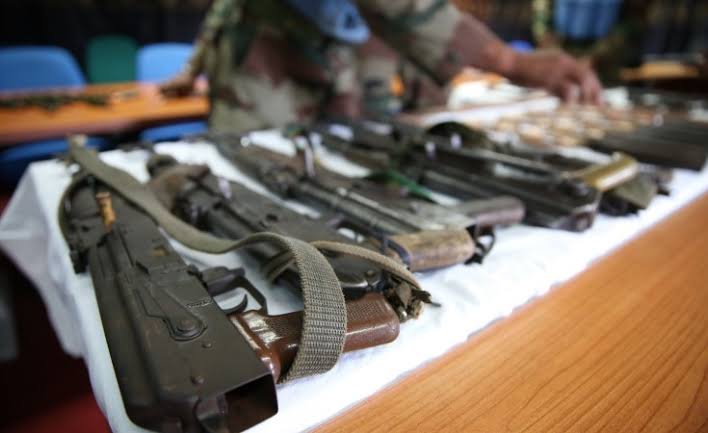
The UN has warned that the widespread proliferation of approximately one billion small arms and light weapons (SALW) in circulation globally, fuelling conflicts in Africa and around the world.

Adedeji Ebo, the Director and Deputy High Representative, UN Office for Disarmament Affairs, told the Security Council in New York that illicit weapons are sustaining conflict, terrorism and criminal networks across multiple regions.

Ebo said “more than one billion firearms are in circulation globally”.

“The illicit trade and misuse of small arms and light weapons fuels armed violence, terrorism and organised crime,” he said.

“Weapons diverted from national stockpiles, or at any point throughout the supply chain, could end up in the hands of non-State armed groups.”

The UN deputy disarmament chief highlighted that in spite of recent steps to strengthen arms control frameworks, illicit weapons still found their way to non-State armed groups.

Ebo warned that “the weapons produced and transferred today risk fuelling the instability of tomorrow.”

He urged the Security Council to integrate small arms controls into peace operations, peacebuilding strategies and sanctions monitoring.

“Our responsibility is clear,” he said.

“We must prevent the diversion and illicit manufacturing of small arms and light weapons or we will face the consequences of deepening insecurity.”

The UN official urged coordinated global action to stop the illicit flows that are driving conflict, organised crime and displacement in the Sahel and other places.

Ebo pointed to the growing spread of 3D-printed “ghost guns” without serial numbers, increasingly found in illicit markets in Western Europe and Latin America.

The human toll is stark, he said.

In 2024, the UN recorded at least 48,000 conflict-related civilian deaths, with small arms responsible for up to 30 per cent in some contexts.

“These abuses are preventable,” he stressed, calling for stronger stockpile controls, tracing systems and compliance with arms embargoes.

He said controlling small arms is “a prerequisite for sustainable peace” and highlighted AU-led efforts to harmonise stockpile management, support amnesty and disarmament initiatives.

Africa Amnesty Month and related programmes have led to the destruction of tens of thousands of weapons, he said, but the scale of the problem remains vast.

Mohamed Ibn Chambas, the African Union High Representative for Silencing the Guns, said small arms proliferation is “a cancer” driving instability across the continent, from the Sahel to the Great Lakes region.

“These weapons are being used to unleash horrific violence and suffering in the Darfur region of Sudan,” he said, referring to the ongoing atrocities reported in El Fasher.

Roraima Andriani, UN Special Representative to INTERPOL, the international police and crime fighting organisation, warned that illicit firearms trafficking is now deeply enmeshed with cross border organised crime.

Andriani said networks use weapons to control territory, protect illicit economies and expand influence.

“This is a transnational chain of violence, that can only be addressed through transnational cooperation,” she said.

INTERPOL’s global iARMS database contains more than two million records of lost, stolen and trafficked weapons, she noted.

The INTERPOL’s data support multinational operations that have seized thousands of firearms and dismantled networks tied to terrorism, trafficking and illegal mining.

“No measure taken in isolation can prevent the flow of such weapons across the globe,” she said, urging the Security Council to explicitly incorporate INTERPOL’s role into sanctions and arms embargo mandates.

DisCos Record 70, 888 Meter Customers In August -NERC

0

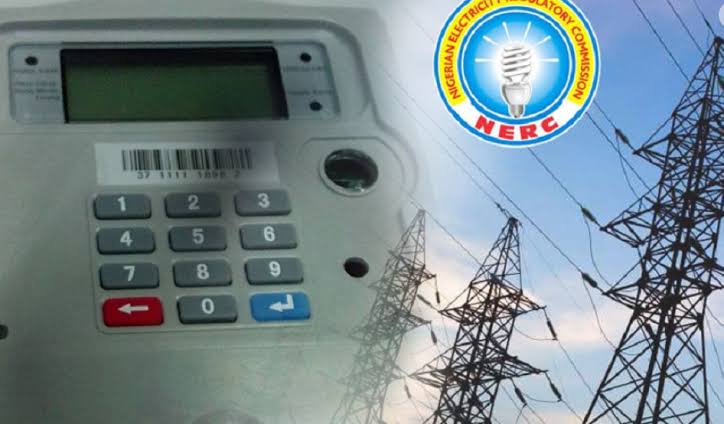
The Nigerian Electricity Regulatory Commission (NERC) says Electricity Distribution Companies (DisCos), metered no fewer than 70,888 new electricity customers in August, 2025.

This is made known in the commission’s Metering Factsheet for July and August 2025, released on its website on Monday in Abuja.

According to the factsheet, 70,888 customers were metered in August, compared to 76,783 in July thus reflecting ongoing metering efforts across the Nigerian Electricity Supply Industry (NESI).

According to the factsheet, the total number of active customers across all DisCos increased from 11.89 million in July to 11.96 million in August 2025.

”Out of this figure, 6.58 million customers were metered, resulting in a metering rate of 55.01 per cent which went up slightly from 54.71 per cent recorded in July.”

The factsheet listed the top performing DisCos to include Eko with 84.25 per cent, Ikeja, 84.83 per cent, and Abuja, 73.92 per cent.

It said that these figures highlighted gradual progress in closing Nigeria’s metering gap and improving transparency and billing accuracy for electricity consumers.

NERC recently approved the sum of N28 billion for the DisCos, to procure and install meters for unmetered Band ‘A’ and ‘B customers within their franchise areas.

According to NERC, the funds approved under Tranche B of MAF scheme aside from metering all outstanding unmetered Band A customers, is also to expedite the closure of the metering gap for customers currently classified under Tariff Band B.