


…Call for environmental justice, infrastructure, community ownership as scholars lament slow pace of oil pollution recovery
Environmental experts and scholars have called for a comprehensive cleanup and restoration of the Niger Delta, warning that decades of oil exploration have devastated ecosystems, disrupted traditional livelihoods and deepened socio-economic challenges across the oil-producing region.
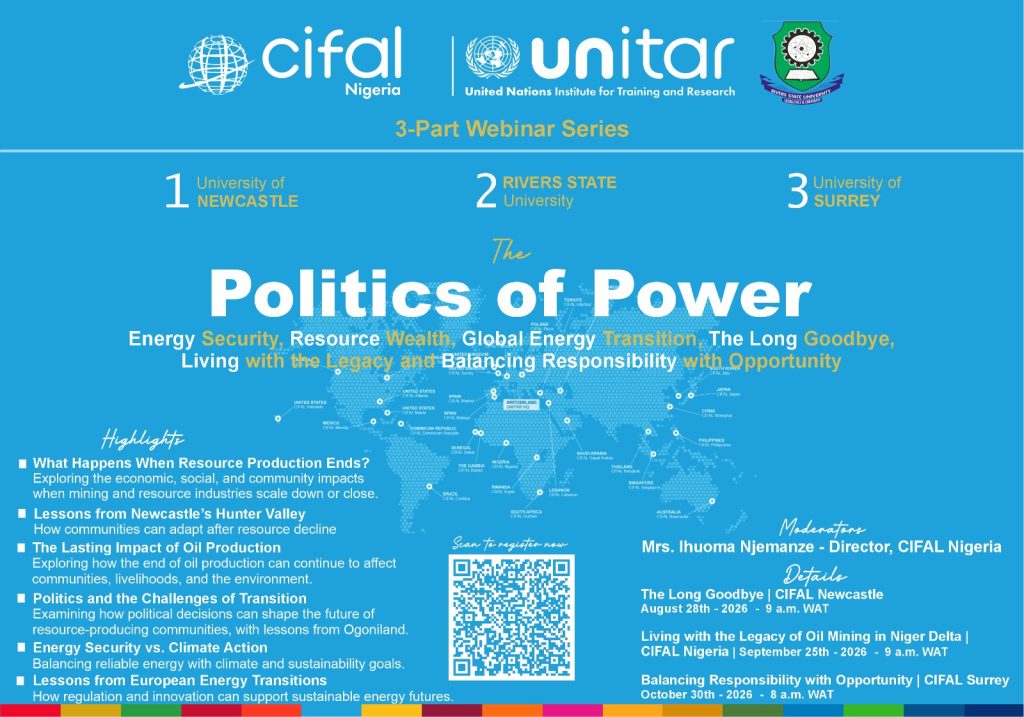
The experts made the call during an international webinar, “Politics of Power,” organised by the United Nations Institute for Training and Research (UNITAR)-CIFAL Nigeria in collaboration with Rivers State University (RSU).
Ogoniland, one of the most prominent examples of the environmental and socio-economic consequences of petroleum extraction in the Niger Delta, featured prominently in discussions on pollution, remediation, environmental justice and sustainable development.
The speakers stressed that while efforts to clean up Ogoniland were necessary, remediation should not be confined to the area, insisting that other oil-producing communities facing similar environmental challenges also deserved urgent attention.
They called on the Federal Government, oil companies and relevant institutions to intensify cleanup operations, restore degraded ecosystems, provide basic infrastructure and empower host communities to participate meaningfully in decisions concerning the resources extracted from their land.
Speaking at the webinar, Professor Augustine Ikein, Professor Emeritus of Management Sciences, described the Niger Delta as a region endowed with tropical wetlands and rich ecological resources that have been severely affected by oil exploration and spills.
He said environmental degradation had remained a major source of conflict between oil companies and host communities over the years, adding that the region needed practical development interventions beyond its contribution to Nigeria’s oil and gas revenue.
According to Ikein, Rivers State occupies a strategic position in Nigeria’s petroleum industry, yet the Niger Delta continues to bear the environmental consequences of resource extraction.
He argued that remediation should extend beyond the physical treatment of contaminated land to include the restoration of essential services and economic activities.
“The environmental university can only provide data but cannot help in the physical remediation of the land,” he said, stressing the need to restore basic amenities such as potable water and electricity, alongside agricultural systems, rivers, creeks and degraded ecological zones.
Ikein also called for the preservation of Nigeria’s petroleum history, using Oloibiri in Bayelsa State, where commercial oil production began, as an example of the disconnect between resource extraction and community development.
He argued that Oloibiri should not merely be preserved as a historical site but developed into an economically viable community capable of offering opportunities to its people and future generations.
Drawing a comparison with first oil-producing location in Texas, United States, he questioned why Nigeria’s historic petroleum community-Oloibiri had not received comparable industrial and infrastructural development.
The professor urged oil companies to align their operations with a broader vision of environmental sustainability and inclusive economic growth.
“We must not only see the Niger Delta as an oil hub but also as Nigeria’s transition capital. We must be ready to transit the Niger Delta,” he said.
Ikein called for a new social contract that would give people living in resource-producing communities a meaningful stake in the ownership and management of the resources extracted from their environment.
He maintained that a transition towards a green economy would require strategic planning, infrastructure investment and the active participation of host communities.
In a presentation titled “From Pollution to Restoration: Assessing Three Decades of Environmental Recovery,” Professor Kingsley Okpara of Rivers State University examined the scale of environmental contamination in Ogoniland and the challenges confronting ongoing remediation efforts.
Okpara recalled that commercial petroleum production began in Ogoniland in the late 1950s, making the area part of the foundation of Nigeria’s petroleum industry and national revenue generation.
He cited the 2011 United Nations Environment Programme (UNEP) assessment of Ogoniland, which documented extensive contamination of groundwater, agricultural soils and fragile mangrove ecosystems.
According to him, the report identified benzene, a carcinogenic substance, at levels reportedly reaching 900 times the World Health Organisation’s guideline value in some locations. It also documented the presence of polycyclic aromatic hydrocarbons and heavy metals.
He said the UNEP assessment revealed that the ecological damage was more extensive and systematic than previously understood, warning that full environmental recovery could take up to 30 years.
Okpara expressed concern about the pace of remediation, stating that only 30 of the 65 sites identified for cleanup in Ogoniland had been remediated, according to the figures he presented.
He urged the Hydrocarbon Pollution Remediation Project (HYPREP) to ensure that its operations remained consistent with the scientific recommendations contained in the UNEP report.
The professor also called on UNEP to provide long-term technical audits to independently verify that remediation activities met the original scientific standards and recommendations.
He stressed that effective environmental recovery required more than the commencement or completion of cleanup activities, insisting that independent verification was necessary to establish whether contaminated sites had been restored to acceptable environmental standards.
Also speaking, Dr Eleraobari Nworgu Efe-Inotu of the Federal University of Environment and Technology, Rivers State, highlighted the wider social consequences of oil-related conflicts and environmental degradation across the Niger Delta, adding that, people died in oil wars all over the Niger Delta, not only in Ogoniland.
She said the disruption of traditional occupations had affected communities throughout the region,leaving many residents struggling to sustain their livelihoods.
Efe-Inotu described the establishment of the Federal University of Environment and Technology as timely, given the region’s longstanding environmental challenges.
She said the institution could help bridge the gap between environmental research and practical community development by transforming environmental challenges into real-world learning opportunities.
According to her, tailoring the university’s curriculum to the local economy would help connect academic training with community needs, create employment opportunities and improve the livelihoods of farmers and fishermen.
She added that the institution could serve as a platform for collaboration among the Federal Government, host communities, oil companies and non-governmental organisations to develop practical solutions to environmental problems.
Such collaboration, she maintained, would enable research findings to translate into interventions that directly benefit communities affected by pollution.
Professor Onyeka Mbalisi of the University of Port Harcourt also called for increased funding for environmental remediation, arguing that the resources devoted to cleaning up Ogoniland were inadequate compared with the scale of the damage and the investments required for effective restoration.
He urged the Federal Government to provide additional funding to HYPREP, while emphasising that the cleanup should not end with Ogoniland.
“Ogoniland is not an island,” he said, arguing that the environmental crisis confronting the Niger Delta required a regional response.
Mbalisi cited persistent gas flaring in Okrika and other oil-producing areas as evidence of the need for wider remediation and ecological restoration across the region.
Describing the environmental situation as pathetic, he called for environmental justice and greater public awareness of the dangers posed by illegal refineries and other activities that further degrade the environment.
He also urged governments to support research, generate real-time environmental data and train young people in environmental management.
According to him, restoring the Niger Delta’s mangrove ecosystems and other natural resources could create opportunities for ecotourism, attract visitors and generate revenue while improving the livelihoods of local communities.
The experts’ contributions underscored the need to approach the Niger Delta’s environmental crisis as both an ecological emergency and a development challenge.
They maintained that sustainable recovery would require coordinated action involving government institutions, oil companies, universities, environmental agencies and affected communities.
Beyond cleaning up contaminated sites, they argued, meaningful restoration must include the rehabilitation of water sources, agricultural land, rivers and creeks, alongside measures to revive traditional livelihoods and strengthen local economies.
They also emphasised that communities whose lands and waters have sustained Nigeria’s petroleum industry must have a stronger voice in decisions concerning environmental recovery, resource ownership and the region’s economic future.
For the Niger Delta, the central challenge remains how to translate decades of resource extraction into tangible improvements in the lives of its people.
The experts said a comprehensive cleanup, backed by adequate funding, independent scientific monitoring and sustained investment in infrastructure and human capital, would be essential to restoring public confidence and securing a more sustainable future for the region.