



Commandant, National Institute for Security Studies, Mr Joseph Odama(right), presenting an Award to the NDDC MD, Dr Samuel Ogbuku, during the Distinguished Personality Lecture at the NISS in Abuja.
The Niger Delta Development Commission (NDDC) has intensified efforts to secure community buy-in for its development projects through stakeholder engagement, community monitoring committees and partnerships with traditional institutions, youth and women’s organisations, as part of a strategy to achieve lasting peace in the oil-rich region.
The Commission’s Managing Director, Dr Samuel Ogbuku, said sustainable peace in the Niger Delta would depend not just on security operations but on making communities active participants in development planning, implementation and monitoring.
Ogbuku spoke in Abuja while delivering the Distinguished Personality Lecture at the National Institute for Security Studies (NISS), with the theme, “Peace Building Through Development: The Strategic Role of the NDDC in Stabilising the Niger Delta Region.”
He said the Commission had moved away from a transactional approach to development towards a transformational model designed to build public trust, strengthen community ownership and create sustainable economic opportunities.
A major component of the strategy, according to him, is the introduction of Community Monitoring Committees, which gives host communities a direct role in monitoring development projects and ensuring that interventions meet their needs.
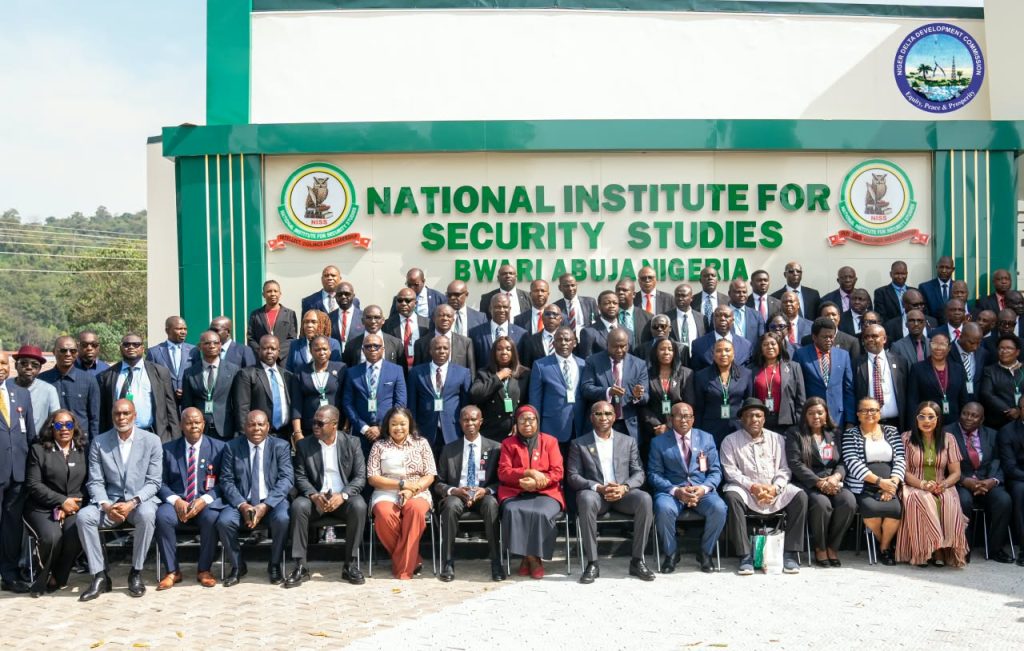
NDDC MD, Dr Samuel Ogbuku, and the Commandant, National Institute for Security Studies, Mr Joseph Odama, in a group photograph with NISS Course Participants and NDDC Directors during the Distinguished Personality Lecture at the NISS, in Abuja.
He explained that the initiative, unveiled at the Commission’s 2026 Partners for Sustainable Development Conference in Port Harcourt, was intended to make communities stakeholders and owners of development projects rather than passive beneficiaries.
Ogbuku said the Commission had also presented a Stakeholder Document to strengthen engagement with communities and provide a framework for more inclusive development interventions.
“When a community monitors a project, it has a greater stake in protecting that project. When governments listen to communities, they are more likely to trust them. Transparency underpins trust, and trust underpins peace,” he said.
He added that the NDDC had introduced its ‘Rewind to Rebirth’ initiative to recalibrate its engagement with Niger Delta stakeholders and reposition its intervention programmes to deliver more meaningful results.
The managing director maintained that decades of relying largely on security enforcement had shown that lasting peace could not be achieved without addressing the development deficits and economic frustrations confronting the region.
“Experience has taught us that you cannot sustainably secure what you have persistently failed to develop,” he said.
He stressed the importance of coordinating development interventions across the region, warning that duplication of projects and perceived inequality in resource allocation could fuel resentment and undermine peace.
Ogbuku said the NDDC was collaborating with the Ministry of Regional Development, under Engr Abubakar Momoh, to harmonise regional development master plans within the framework of a National Policy on Regional Development.
He identified the Partners for Sustainable Development Forum, established under the NDDC Act, as a key platform for coordinating interventions by government agencies, state and local governments and development partners.
The NDDC boss cited the 27-kilometre Ogbia-Nembe Road in Bayelsa State, which connects 14 communities through 99 culverts and 14 bridges, as an example of the benefits of collaboration.
The project was executed in partnership with Shell Petroleum Development Company.
He also highlighted the Commission’s memorandum of understanding with the Nigeria LNG Limited for the Bonny Ring Road and the 3.65-kilometre Okrika-Borikiri Road, featuring three bridges, in Rivers State.
On youth restiveness, Ogbuku said the Commission was convinced that providing viable economic alternatives was more effective than relying solely on security measures to discourage criminality.
He argued that young people needed access to jobs, skills acquisition, agriculture, business opportunities and finance to make legitimate livelihoods more attractive than illicit activities.
“You cannot simply tell a young person to drop the arms without providing an alternative pathway to dignity and livelihood. That alternative may be a farm, a skill, a business, access to finance or a job,” he said.
Ogbuku further disclosed that the Commission had strengthened its corporate governance framework through measurable Key Performance Indicators and the digitisation of internal processes, including e-procurement, electronic contract award letters and the Electronic Memo platform.
He commended President Bola Tinubu for directing the NDDC to complete ongoing projects and introducing a performance bond to strengthen accountability in project delivery.
The managing director also announced the completion of the 1.2-kilometre Kaa-Ataba Bridge in Rivers State, linking Khana and Andoni local government areas, which he said would be named the President Tinubu Bridge.
He called for collective responsibility in sustaining peace, urging traditional rulers to serve as peace ambassadors, youth and women’s groups to participate in project monitoring, and state and local governments to work with the Commission as development partners.
He also urged security agencies to recognise development institutions as partners in preventive security, rather than viewing peace-building solely through the lens of enforcement.
Earlier, the Commandant of the National Institute for Security Studies, Mr Joseph Odama, said the lecture brought together members of the intelligence and security community, opinion leaders and analysts to explore a new approach to national development.
Odama described Ogbuku as a pragmatic leader whose contributions to the Niger Delta were informed by experience and knowledge.
The NISS Commandant subsequently presented the NDDC managing director with the Distinguished Personality of the Year Award in recognition of his contributions to peace in the region.
