


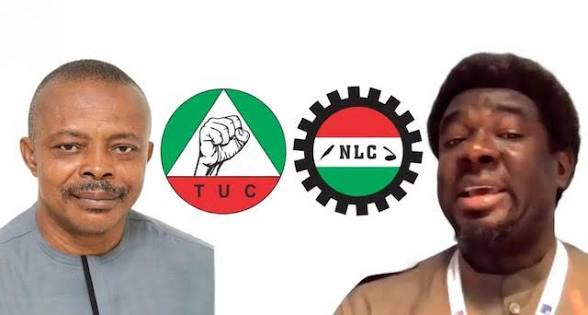
The leadership crisis rocking Nigeria’s organised labour movement deepened on Monday as President of the Nigeria Labour Congress (NLC), Joe Ajaero, launched a scathing attack on his Trade Union Congress (TUC) counterpart, Festus Osifo, accusing him of being an absentee leader who resides in the United States and only returns to Nigeria for labour meetings.
The accusation, which came amid a disagreement over the authority of the NLC to negotiate workers’ salaries and allowances without the participation of the TUC, has exposed a growing rift between the two major labour centres.
While Ajaero questioned Osifo’s commitment to Nigerian workers, arguing that a leader who lives abroad could hardly understand their economic hardship, the TUC president insisted that his union could not be excluded from negotiations affecting its members.
The dispute centres on the N70,000 transport allowance recently approved by President Bola Tinubu following discussions between labour representatives and the Federal Government.
Osifo described the agreement as an aberration, insisting that the NLC lacked the authority to negotiate on behalf of workers represented by the TUC without consulting the union or securing its participation.
The two labour leaders aired their grievances on Channels Television’s The Morning Brief on Monday, turning what had been a disagreement over labour representation into a public exchange of accusations over leadership credibility and workers’ welfare.
In a particularly damaging intervention, Ajaero accused Osifo of abandoning the workers he claims to represent, arguing that his alleged residence in the United States disconnected him from the economic realities confronting Nigerian employees.
“He is an absentee president of the TUC. He doesn’t live in Nigeria. He comes in from the United States to attend meetings and rush back,” Ajaero declared.
The NLC president questioned how Osifo could effectively lead Nigerian workers and negotiate their welfare while allegedly living outside the country.
He argued that a leader who did not experience the daily realities of the Nigerian economy could hardly appreciate the hardship workers faced in paying rent, school fees, buying fuel and providing food for their families.
Ajaero also contrasted the economic conditions he attributed to Osifo’s alleged life in America with the challenges confronting Nigerian workers, including high petrol prices, poor living standards and rising household expenses.
“How can you lead workers you don’t live with? How can you negotiate for people whose suffering you don’t feel? He has abandoned workers,” he added.
The NLC president further argued that his organisation, which has more than 60 affiliate unions, could not be expected to wait for the TUC’s participation before negotiating improved wages and allowances for workers.
However, Osifo countered that the size of the NLC’s membership did not confer on it the authority to negotiate on behalf of another independent labour centre.
Expressing disappointment with Ajaero’s position, the TUC president said the dispute raised fundamental questions about representation and consultation in organised labour.
“Listening to Ajaero again today, I really pity the labour movement and the quality of leaders that have been inflated on the NLC,” Osifo said.
He maintained that neither the NLC nor the TUC could unilaterally negotiate on behalf of the other where their respective affiliates and members were concerned.
According to him, the International Labour Organisation’s tripartite framework, involving labour, government and employers, does not establish that one labour centre can negotiate for another without its involvement.
Osifo acknowledged that the NLC had more affiliates than the TUC but insisted that this numerical advantage did not justify excluding the latter from negotiations affecting its members.
“We are not contesting the fact that NLC has more affiliates,” he said, adding that the two organisations should sit together and reach an agreement on matters affecting their respective constituencies.
He challenged Ajaero to produce any International Labour Organisation regulation that expressly authorised one labour centre to negotiate on behalf of the other without consultation.
The TUC president also disputed the suggestion that the meeting at which the N70,000 transport allowance was agreed upon constituted a valid meeting of the Joint Public Sector Negotiating Council (JNC).
Osifo argued that the meeting did not satisfy the requirements for a properly constituted council meeting, insisting that the council’s membership and quorum provisions had to be observed before decisions could be regarded as binding.
He further accused Ajaero of mishandling the consequential salary adjustments arising from the increase in the national minimum wage from N30,000 to N70,000.
According to Osifo, the difference between the previous and new minimum wages was treated as a flat N40,000 adjustment across the board, rather than being subjected to the appropriate consequential adjustments through the established negotiating framework. He argued that this approach had contributed to what he described as the poor earnings of federal workers.
Osifo said he had confronted Ajaero privately over the matter, insisting that the process adopted was fundamentally flawed.
He also dismissed Ajaero’s invocation of the JNC, arguing that the NLC president needed a better understanding of the council’s constitution and mandate.
The public confrontation has raised fresh concerns about the unity of Nigeria’s organised labour movement at a time when workers are grappling with rising living costs and pressing for improved welfare.
Beyond the personal accusations, the disagreement exposes unresolved questions about the representation of workers by the two labour centres, the procedures for negotiating allowances and the extent to which agreements reached by one organisation can affect members of another.
With Ajaero questioning Osifo’s physical presence in the country and commitment to workers, and Osifo challenging the NLC’s authority to negotiate without the TUC, the dispute threatens to shift attention away from the welfare issues both organisations are expected to champion.
Whether the two leaders can resolve their differences through consultation or allow the public exchange to deepen the division within organised labour remains to be seen.
