


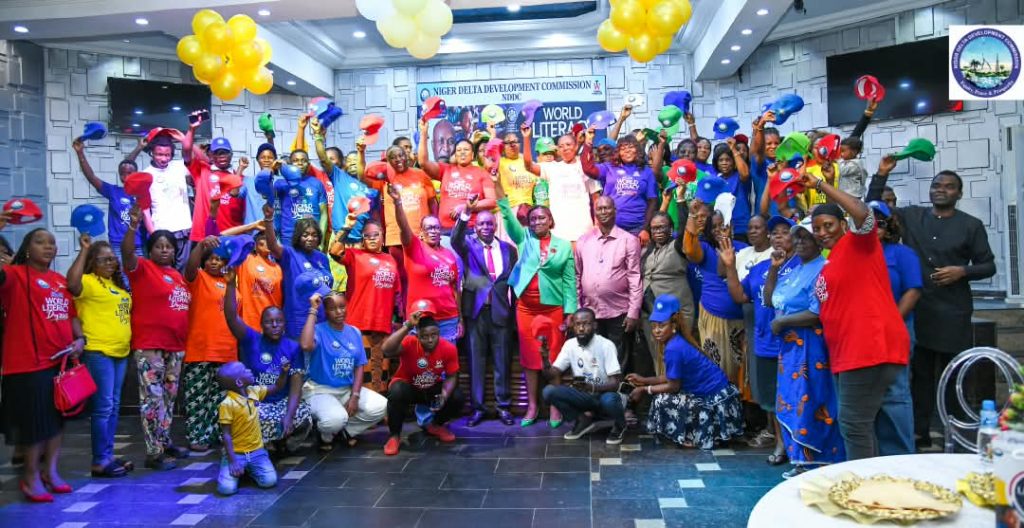
NDDC Director of Education, Dr Awele Chukwudifu; the guest speaker, Prof. Joseph Kinanee; the programme Facilitator, Dr Adesina Osho; the NDDC Deputy Director, Dr Josephine Joe-Kinanee; and the NDDC Deputy Director, EHSS, Dr Esther Benibo (middle), posing with participants during World Literacy Day in Port Harcourt.
The Niger Delta Development Commission (NDDC) has pledged to sustain its investment in education across the region, with renewed emphasis on infrastructure, scholarships, digital literacy and skills development.
Managing Director of the Commission, Dr Samuel Ogbuku, made the commitment yesterday in Port Harcourt, Rivers State, during activities marking World Literacy Day.
Ogbuku, who was represented by the Director of Education, Dr Awele Chukwudifu, said the NDDC would continue to provide hostels, school facilities and educational equipment to institutions across the Niger Delta.
He said sustained investment in education and literacy remained critical to empowering people in the region to become self-reliant and better prepared for sustainable livelihoods.
According to him, literacy provides access to opportunities and equips individuals with the knowledge and skills required to contribute meaningfully to economic growth and development in the Niger Delta.
Ogbuku also assured Niger Deltans that the Commission would continue to sponsor both local and foreign postgraduate scholarship programmes, enabling beneficiaries to advance their academic and professional careers.
He noted that the growing importance of digital literacy had further expanded opportunities for young people, stressing that education remained a major pathway to economic empowerment.
Speaking on the theme, “Literacy for People, the Planet and Prosperity,” a facilitator from the Department of Business Administration, University of Lagos, Dr Adesina Osho, said digital literacy had transformed human activities by improving access to information and creating new economic opportunities.
Osho called for greater efforts to educate communities across the Niger Delta on the importance of literacy, particularly digital literacy and entrepreneurship.
He said literacy was central to economic development, social participation and the exercise of civic responsibilities, urging individuals and institutions to embrace lifelong learning.
The university lecturer also called on tertiary institutions to establish continuing education centres where adults could enrol in part-time programmes to improve their knowledge and skills.
He urged faith-based organisations, non-governmental organisations and community groups to complement government efforts by supporting literacy initiatives and scholarships as part of their corporate social responsibility.
Osho further stressed the role of parents in promoting literacy, saying education begins at home. He advised parents to cultivate reading habits among their children, encourage curiosity, provide access to books and educational materials, and share educational opportunities within their communities.
Also speaking, the Director, Academic Planning Unit, Ignatius Ajuru University of Education, Rumuolumeni, Port Harcourt, Prof. Joseph Kinanee, identified several dimensions of literacy to include traditional literacy, environmental literacy, numeracy, cultural literacy, critical literacy, functional literacy, media and information literacy, financial literacy, digital literacy and artificial intelligence literacy.
Kinanee said literacy must be inclusive and accessible to all, irrespective of gender, adding that environmental literacy deserved greater attention because of its implications for human health and wellbeing.
Citing UNESCO figures, he said about 739 million people globally lacked basic literacy, while four out of every 10 children did not attain minimum reading proficiency.
Kinanee commended the NDDC for its contributions to improving literacy and education in the Niger Delta, urging the Commission and other stakeholders to strengthen continuous learning through digital platforms.
He said expanding access to different forms of literacy would not only improve individual lives but also strengthen the human capital required for sustainable development in the Niger Delta.
