


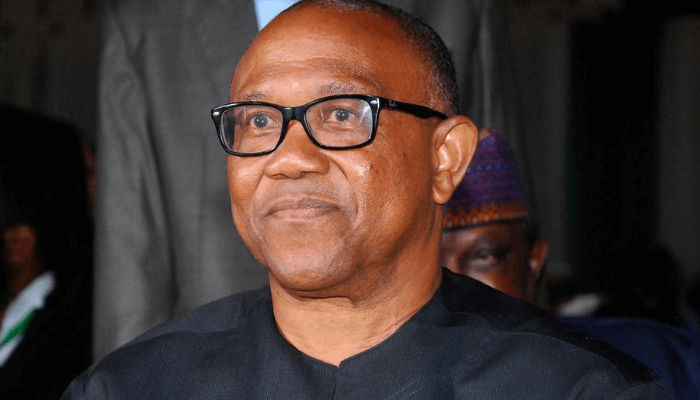
Presidential candidate of the Nigeria Democratic Congress (NDC), Peter Obi, has promised to transform Nigeria within a single four-year term if elected in 2027, saying competent leadership, disciplined spending, economic productivity and decisive action on insecurity would form the foundation of his administration.
Obi, who made the pledge in an exclusive interview with Arise TV on Thursday as part of the station’s presidential campaign series, said four years was sufficient to set Nigeria on a new development trajectory if the right priorities, policies and people were put in place.
The former Anambra State governor said he would take personal responsibility for running the government and would not govern through proxies, stressing that the president must be directly accountable to Nigerians for every decision and expenditure.
“I will be in charge and I will not run government by proxy. I will be answerable to the people,” he said.
Obi said his administration would focus on a limited number of clearly defined priorities rather than spreading resources across numerous projects, insisting that Nigerians would begin to see tangible changes within his first term.
“I will not spend one extra day. Four years is enough to engender change and I did it as Governor of Anambra State,” he said.
He identified competent appointments, effective teamwork, economic reforms, infrastructure rehabilitation, security and direct engagement with citizens as key pillars of his proposed four-year transformation agenda.
On infrastructure, Obi said his government would prioritise the rehabilitation of existing roads, schools and other public facilities before embarking on new construction.
“We will not build new roads until we fix the existing ones,” he said, arguing that government should focus on completing and maintaining critical infrastructure rather than continually commissioning new projects.
He also criticised what he described as excessive government spending, arguing that resources deployed to less critical projects could be redirected to healthcare, education and other sectors that directly affect citizens.
Using cancer treatment as an example, Obi said Nigeria needed to invest more in healthcare infrastructure, noting that the country’s limited number of cancer treatment centres required urgent expansion.
Subsidy savings for jobs, production
On fuel subsidy, Obi said he would eliminate the corruption and criminality associated with the old regime but ensure that savings from its removal were invested in productive sectors.
He cited the Federal Government’s disclosure that subsidy removal had generated about N15.8 trillion, which he said explained his frequent reference to approximately N16 trillion.
According to him, such resources should be channelled into agriculture, small businesses, manufacturing, skills development and job creation to expand economic opportunities and improve living standards.
“The subsidy regime in Nigeria was enmeshed with corruption and criminality. I have said it clearly that I will remove subsidy and fight that corruption and criminality,” he said.
Obi said lower fuel prices could also be achieved by ensuring regular crude oil supply to domestic refineries and creating a competitive refining environment.
He rejected calls for a return to the old subsidy regime, saying his approach would be to make the economy productive enough to create wealth, employment and opportunities.
“We’re going to make sure that we do the right thing that will make the country productive and create wealth, opportunities and employment, a win-win,” he said.
Agriculture, Northern development
Obi said agriculture would be central to his economic transformation programme, particularly in Northern Nigeria, which he described as possessing vast arable land capable of driving food production, industrialisation and exports.
He promised to invest in agriculture while providing education and skills for vulnerable young Nigerians, including almajiris, and revive manufacturing activities across the region.
“The north has an asset. Nobody in this country, none of us, none of the areas, can say they have what the north has. I will deal with that asset, and that asset is agriculture,” he said.
He said the strategy would enable Nigeria to produce more food, provide raw materials for industries, create employment and increase export opportunities.
“I’m committed to their future by tapping into the huge arable land that has remained uncultivated,” he added.
Competence, security
On insecurity, Obi promised to take direct responsibility for the country’s security architecture as Commander-in-Chief, beginning with the appointment of competent heads of security agencies and giving them clear mandates to confront terrorism, kidnapping and other threats.
“In the first week, it’s for me to appoint competent heads of security agencies with a decisive instruction: We must deal with this,” he said.
He said he would not remain in Abuja while communities were under attack, promising to personally engage stakeholders and visit states affected by insecurity.
“I’m not going to sit in Abuja if there’s a problem in Zamfara. We’ll call the people in Zamfara and see what this problem is, and deal with it decisively,” he said.
Obi said his government would consider every necessary measure to improve security, including the use of modern surveillance technology and possible state policing arrangements.
He, however, rejected ransom payments to kidnappers, saying technology should be deployed to locate criminals and rescue victims.
Obi faults Tinubu
Assessing the administration of President Bola Tinubu, Obi said it had fallen short of Nigerians’ expectations, describing its leadership and spending as reckless.
“I think you should ask the people. But if you ask me, they’ve not done well. They’ve been a bit reckless in what they’re doing,” he said.
He also questioned whether Tinubu was fully in control of government, saying: “At times, I believe he’s not in charge.”
Obi said his own presidency would be physically present and directly accountable, with regular engagement with citizens and visits to communities across the country.
“Nobody will talk for Peter. Because I’m the one that’s elected. I’ll be answerable to the people. And for every penny, I’ll be answerable to the people,” he said.
He further promised to spend his holidays in Nigeria if elected, saying the president should experience the conditions under which ordinary Nigerians live.
“The Nigerian President must spend his vacation in Nigeria. We cannot continue with this nonsense,” he said.
Four-year, one-term presidency
Obi reiterated his pledge to serve only one four-year term, saying he would not remain in office beyond the period.
“I will not stay a day longer,” he said.
According to him, the purpose of the single term would be to reverse what he described as Nigeria’s wrong direction and establish the foundations for sustainable development.
“In four years, people will see the difference,” he declared.
He said his proposed administration would be judged by measurable results rather than rhetoric, with emphasis on productivity, employment, infrastructure, security and improved public services.
Electoral reforms
Obi also promised electoral reforms that would strengthen transparency and accountability in elections.
He said he would not establish a parallel electoral commission but would ensure that technology was deployed at polling units to transmit election results in real time to a central situation room.
“I won’t set up a parallel INEC but will make sure that in every polling unit we have a system that transmits results in real time to our Situation Room,” he said.
2023 election
The NDC candidate maintained that he won the 2023 presidential election but said he would accept the outcome of the 2027 election if it was free, fair and credible.
“If the election is free, fair and credible, I will. That’s it. Because it’s an election. I’m not the one that will say who they want to serve. And I will respect the will of the people. That’s democracy,” he said.
Asked why he did not concede the 2023 election, Obi said he remained convinced that he won the poll.
“As long as I live, I will maintain that I won the 2023 presidential election,” he said.
He also rejected the argument that Nigeria’s presidency should be determined by ethnicity or religion, insisting that competence should be the primary consideration.
“Our elections should not be driven by tribe or religion. Today, in terms of qualification, I’m qualified to be president of Nigeria. I have the competence,” he said.
Obi said his objective, if elected in 2027, would be to use the four-year mandate to demonstrate that Nigeria could achieve meaningful transformation through competent leadership, prudent management of resources and decisive implementation of clearly defined priorities.
