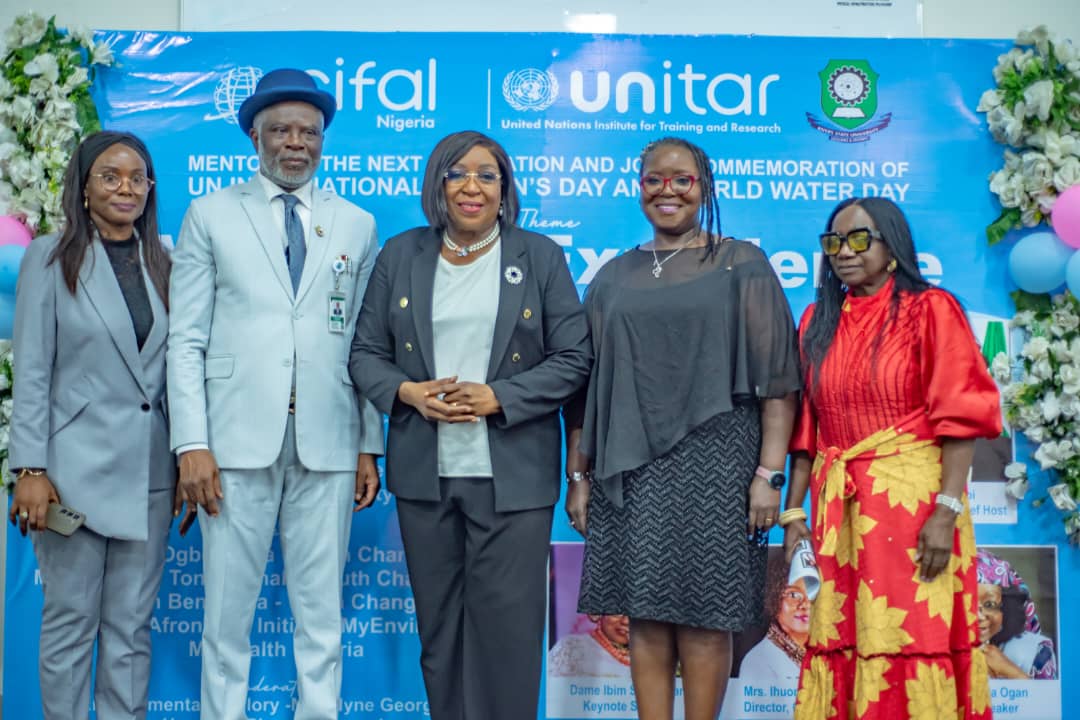
It began as a formal gathering, distinguished guests, policymakers, academics, and young leaders seated in quiet anticipation. But what unfolded at the Rivers State University was far more than ceremony. It became a powerful narrative of convergence, delivered through the voice and vision of the CIFAL Nigeria representative, Mrs Ihuoma Nzemanje.
Speaking with clarity and conviction, Mrs Nzemanje framed the launch of the ‘Voices of Experience’ at CIFAL Nigeria not as an isolated milestone, but as part of a larger global movement, rooted in collaboration, continuity, and purpose.
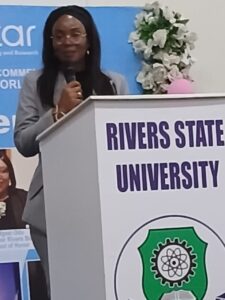
According to her, the moment demanded more than applause. It demanded alignment. “This is not just an event,” she emphasised. “It is a call to reflection, to celebration, and most importantly, to commitment—a commitment to building bridges between generations.”
At the centre of her address was CIFAL Nigeria itself, now fully operational at the Rivers State University. She traced its origins to the CIFAL Global Network, established in 2003 by UNITAR to advance the Sustainable Development Goals through training and multistakeholder collaboration across continents.
But for Mrs Nzemanje, institutions alone do not create change, people do.
She painted a vivid contrast between generations. On one side, she reflected, stand the women who fought relentlessly, often against entrenched systems, to secure rights now taken for granted. Their victories, she noted, were slow, deliberate, and deeply structural.
She referenced the landmark 1995 Beijing Conference as a defining example, where sustained advocacy led to the recognition of gender-based violence as a human rights issue. “It was painstaking work,” she said, “but it built frameworks that endure.”
On the other side stands Gen Z—digital natives who, in her words, are “impatient with slow progress and bold in their demands for justice.” She pointed to recent youth-led mobilisation in Nigeria, where activists used social media platforms to rally support for girls’ education in flood-affected communities, achieving in weeks what once took years.
“Their speed is remarkable,” she observed. “Their visibility is undeniable.”
Yet, rather than positioning these approaches in opposition, Mrs Nzemanje offered a unifying perspective.
“The future,” she said, “does not lie in choosing one over the other. It lies in bringing both together.”
She illustrated this through a compelling example from Kenya, where women elders who once championed land rights are now collaborating with youth climate activists. By combining lived experience with digital innovation, they are advancing both gender equality and climate action.
“This,” she noted, “is what progress looks like when generations work together.”
It is precisely this model that the Voices of Experience Forum seeks to institutionalise.
Describing the Forum as a “bridge,” Mrs Nzemanje outlined its purpose with precision: a platform for intergenerational dialogue, mentorship, and capacity building; a space where historical perspective informs modern strategy; and a hub where advocacy evolves into measurable outcomes.
She was particularly emphatic about the role of elders—not as distant figures of authority, but as active mentors. “They carry the memory of struggle,” she said. “They remind us that persistence is as important as speed.”
At the same time, she acknowledged the transformative energy of youth. “They challenge us to move faster, think differently, and act boldly.”
Between the two, she suggested, lies the true engine of sustainable development.
Her speech also paid tribute to women whose leadership continues to shape Nigeria and the wider world. Ngozi Okonjo-Iweala, she noted, exemplifies how activism can evolve into institutional reform. Oby Ezekwesili demonstrates the power of persistence amplified on a global stage, while Funmilayo Ransome-Kuti reminds us that transformative movements often begin at the grassroots.
Beyond Nigeria, she highlighted figures such as Ellen Johnson Sirleaf, Leymah Gbowee, and Graça Machel—women whose contributions underscore the global nature of the struggle for equality.
Closer to Rivers State, she recognised leaders like Ngozi Nma Odu and Henrietta Ogan, whose careers reflect the powerful intersection of education, governance, and community impact.
“These are not just stories,” Mrs Nzemanje said. “They are blueprints.”
Looking ahead, she outlined the Forum’s ambitions: to engage young changemakers, mobilise stakeholders, and position CIFAL Nigeria as a centre for inclusive leadership and sustainability. Through initiatives such as training programmes, exchanges, entrepreneurship platforms, and SDG-focused learning, the Centre will link local action to global priorities.
But it was her closing reflection that lingered most powerfully.
“Change is not a baton passed,” she said. “It is a bridge built.”
In that single line, Mrs Nzemanje captured the essence of the moment—not as a transfer of responsibility, but as a shared construction of the future.
At Rivers State University, that bridge is no longer an idea. Under her vision, it is taking shape—rooted in history, driven by youth, and strengthened by collaboration.
And if her words are any guide, the path forward is clear: the future will not be claimed by one generation, but built—together.