The Federal Government has reiterated its commitment to strengthening the integrity of academic records and improving institutional compliance across the education sector as part of reforms aimed at safeguarding the credibility of Nigeria’s educational system.
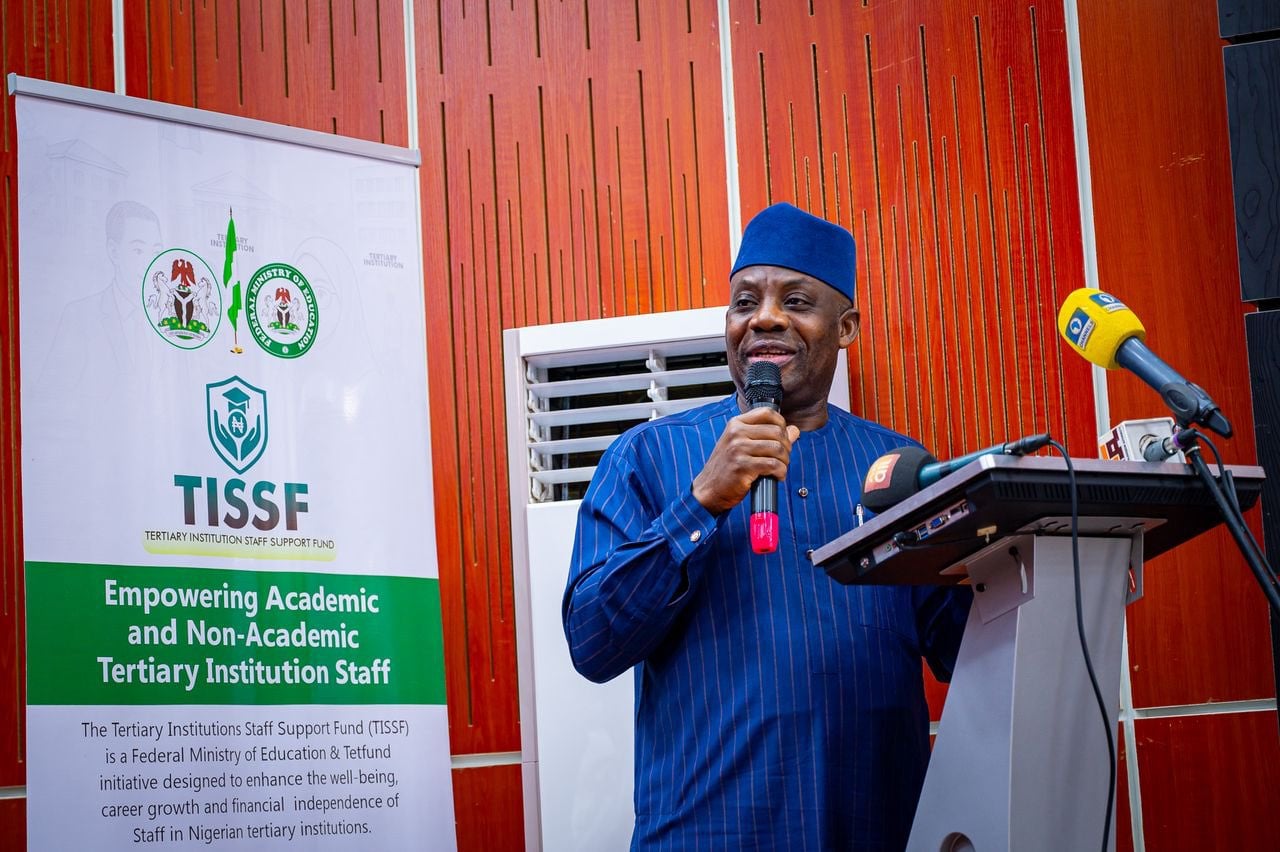
Minister of Education, Maruf Tunji Alausa, disclosed this on Thursday during a national capacity-building programme organised to support the implementation of the Nigeria Education Repository and Data Bank (NERD).
The programme, themed “Strengthening Institutional Compliance and Academic Records Integrity,” was organised to reinforce compliance frameworks and ensure the accuracy, security and authenticity of academic records across institutions nationwide.
Alausa said the Federal Government had taken decisive steps to curb certificate fraud following reports that some Nigerians obtained questionable degrees from unaccredited institutions abroad.
According to him, the government launched investigations after whistleblower reports revealed that some individuals were acquiring academic qualifications from dubious institutions, particularly in parts of West Africa.
He said the government acted swiftly on the directive of President Bola Ahmed Tinubu to halt the trend and restore credibility to Nigeria’s education system.
“Education is a covenant between the state and its citizens. When a certificate is issued, it is not merely paper; it is a national guarantee that due process was followed and standards were upheld,” the minister said.
He disclosed that individuals who obtained fraudulent certificates had been removed from the public service following investigations by the government.
Highlighting the importance of reliable data for governance, Alausa described data as the foundation for effective policymaking and monitoring of government reforms.
“Data is the lifeblood of effective governance. It enables us to understand the challenges we face, design effective solutions and monitor our progress. Without data, we are flying blind,” he said.
The minister explained that NERD is a strategic national digital infrastructure designed to digitise, standardise and authenticate academic records across tertiary institutions in Nigeria.
He said the platform would administer national credential numbers, a National Credential Revocation Service, a National Student Clearinghouse, and a federated repository of academic theses and abstracts, alongside a national academic publication and indexing database.
According to him, within four months of enforcement, the platform has preserved nearly 100,000 digital student submissions and onboarded more than 250 universities, polytechnics, monotechnics and colleges of education for real-time credential verification.
Alausa added that over 133,000 students and more than 6,800 lecturers had been enrolled on the platform, supported by over 655 focal persons across the country.
He further disclosed that the initiative had led to the establishment of more than 1,000 digital service centres in partnership with Nigeria Digital Entrepreneurs, creating over 3,000 jobs within four months.
To promote academic excellence, the minister also announced the establishment of the NERD Annual National Laureate Prize and Awards Programme to recognise outstanding academic research.
He said the awards would reward exceptional undergraduate, master’s and doctoral theses with prizes ranging from N5 million to N20 million, with the maiden edition scheduled for November.
Alausa directed ICT directors and institutions nationwide to fully cooperate with the initiative, stressing that compliance with the NERD platform was now compulsory.
He explained that adherence to the system had become a prerequisite for participation in or exemption from the National Youth Service Corps (NYSC), as well as for accessing services from agencies such as the Tertiary Education Trust Fund, National Universities Commission, National Board for Technical Education, National Commission for Colleges of Education and the Industrial Training Fund.
He noted that the platform would maintain a national digital footprint of every academic award obtained in accredited Nigerian institutions and help eliminate disputes over academic credentials.
The minister also encouraged institutions to prioritise locally developed technology platforms in line with the government’s local content policy.
“I challenge myself that the only platform we deploy from the Federal Ministry of Education will be a platform built by Nigerians in this country,” he said.
Alausa commended the Chief Executive Officer of NERD, Tunji Ariyomo, for championing the preservation of educational data in Nigeria.
In his remarks, Ariyomo described the initiative as a crucial step toward preserving Nigeria’s academic knowledge and research history.
He noted that weak documentation systems had historically resulted in the loss of valuable academic records and research outputs in the country.
According to him, nations that preserve and validate knowledge over long periods are better positioned to drive development and lead the global knowledge economy.
Nigeria has faced persistent challenges with certificate fraud and weak academic record systems, raising concerns over the credibility of some qualifications obtained locally and abroad.
In recent years, investigations exposed the proliferation of illegal degree mills in neighbouring countries where some Nigerians were reported to have obtained academic certificates within unusually short periods, prompting renewed government efforts to strengthen oversight and verification mechanisms in the education sector.