Home Blog Page 79

Rivers Assembly Bye Election: RSM Diaspora Endorses Jude Lawrence Nwibie for KHANA II Constituency

0

Arising from an extra ordinary meeting of the body, the leadership of River Sim Movement (RSM) Diaspora wing have endorsed one of her members – Mr. Jude Lawrence Nwibie who is in the race for the House of Assembly Seat to represent the good people of Khana in the Khana II Constituency.

The body decided to throw her weight behind Mr. Jude because he is an astute politician who is loved by his people of Khana, a dedicated and loyal member of RSM who has stood tall behind the Governor of Rivers State, His Excellency Sir. Siminalayi Fubara, GSSRS.

In a Statement released by the body and signed by the Director, Diaspora Mobilization, Amaopusenibo Shedrack Fubara, RSM Diaspora urge all members of the group at Home to immediately mobilize members across the State and especially in Khana II Constituency to massively support Mr. Jude Nwibie to win the House of Assembly Seat. It also called on the leadership of the APC at the Local Government and State Level to support the emergence of Mr. Nwibie to fly the flag of the party in the upcoming election scheduled to hold on 21 February 2026.

RSM Diaspora also called on all her members around the world to continue to rally support for our leader & Grand Patron, His Excellency Sir. Siminalayi Fubara, GSSRS, Governor, Rivers State as he continues to embark on people oriented leadership, projects and programs that are uplifting the State and living standards of the people.

The group finally called on the good people of Rivers State to avoid any attempt at using them to cause another round of political tension & instability in the State and urged the people to remain calm and peaceful because it is only in an atmosphere of peace that good Governance can be achieved.

Military Unmasks Alleged Ringleader Of North-East Suicide Bombing Network

0

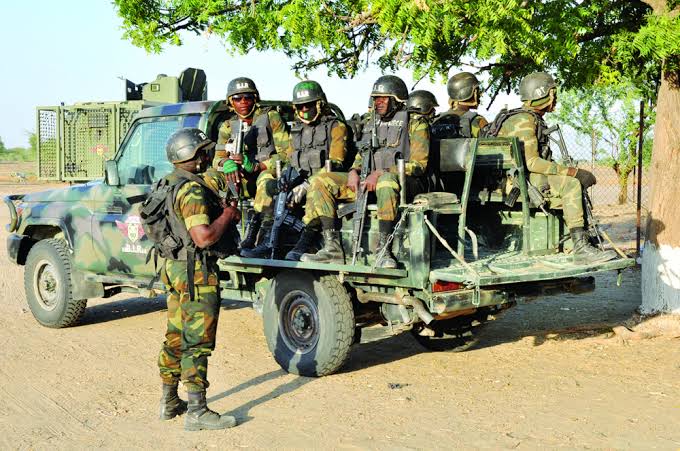
The Nigerian military has identified Shariff Umar, also known as Yusuf, as the alleged mastermind behind a network of suicide bombings responsible for recent deadly attacks in the North-East, including the December 24 bombing at the Gamboru Market Mosque in Maiduguri.

The disclosure followed intelligence-led operations conducted by troops of the Joint Task Force North East, Operation Hadin Kai (OPHK), in the Kalmari area of Maiduguri on December 31, 2025, during which 14 suspects linked to suicide bombing activities were arrested.

In a statement issued on Saturday in Maiduguri, the Media Information Officer of OPHK, Lt. Col. Sani Uba, said investigations uncovered the structure, roles and operational linkages of the terror cell.

According to the military, a detained suspected suicide bomber, Ibrahim Muhammad, provided critical information during interrogation, identifying Shariff Umar as the coordinator and ringleader of the network.

Lt. Col. Uba said Umar was responsible for recruiting, indoctrinating and deploying suicide bombers, as well as coordinating logistics and the supply of improvised explosive device (IED) components.
Investigations further revealed that Umar allegedly coordinated the suicide bombing at the Gamboru Market Mosque on December 24, 2025, during which an accomplice, Adamu, now deceased, detonated a suicide vest.

He was also accused of organising a foiled suicide bombing attempt in Damaturu, Yobe State, and personally delivering IED components to a would-be bomber.

The military said additional links within the network had been uncovered, including the alleged involvement of Umar’s wife, Yagana Modu, while his stepdaughter, Amina, reportedly confirmed seeing a suspected bomber within their residence.

“All suspects remain in custody and are undergoing intensive, multi-layered investigations aimed at dismantling the network, identifying additional collaborators and recovering any remaining explosives or logistical assets,” the statement said.

The military also urged residents to continue supporting security agencies with timely and credible information, stressing that cooperation between civilians and security forces remains critical to preventing attacks and saving lives.

APC Governors Lead Party Structures in States, National Chairman Clarifies

0

The National Chairman of the All Progressives Congress (APC), Professor Nentawe Goshwe Yilwatda, has clarified the party’s leadership structure at the state level, stating that governors are recognised as the leaders of the party in their respective states, including Rivers State.

Yilwatda made the clarification during an interview on Channels Television aired on Friday, January 1, 2026, while responding to questions on the party’s hierarchy in the southern part of the country.

Asked specifically who heads the APC in Rivers State, the national chairman said the party operates a uniform structure nationwide, with governors providing leadership at the state level.

“In all the states, we have the state governors. They lead their parties in their own respective states,” he said, adding that this arrangement is a deliberate policy of the APC. “In APC, we give that privilege to the governors.”

However, Yilwatda stressed that the leadership role accorded to governors is guided by principles of inclusion and collective participation, particularly where there are other influential party figures.

“At the same time, we normally ask the governors, where we have leaders at national level, to respect inclusion in all the states,” he said.

He cautioned against the concentration of authority, noting that leadership within the party does not translate to the exclusion of other stakeholders. “You being the leader doesn’t mean that you can disenfranchise people who are within the state,” he added.

The APC chairman said the party deliberately creates space for broad participation, describing inclusion as a core element of its internal governance.

Drawing a parallel with his own role, Yilwatda described the office of the national chairman as largely coordinative. “Just like I’m more or less a coordinator,” he said. “As National Chairman of the party, I only coordinate what’s happening at the local government and state levels.”

His comments come amid ongoing discussions over party leadership and influence within the APC across several states.

Rivers EXCO Approves N1.8tn 2026 Budget, Targets Recovery, Growth

0

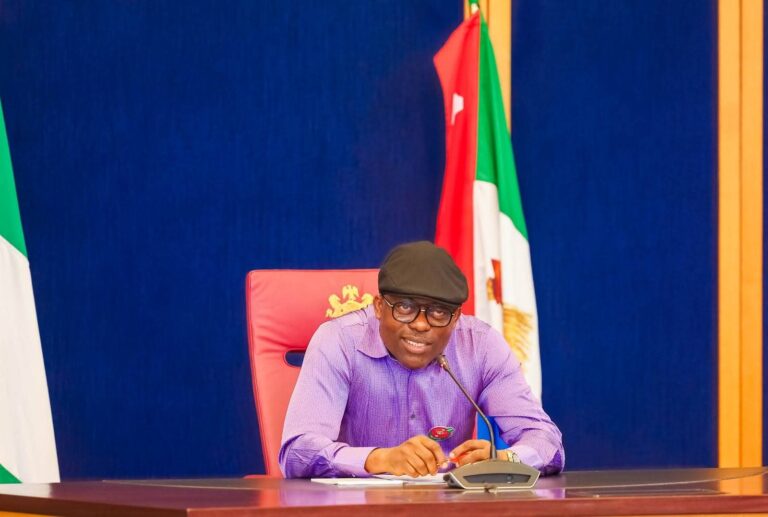
The Rivers State Executive Council has approved a N1.8 trillion budget proposal for the 2026 fiscal year, signaling the Siminalayi Fubara administration’s determination to consolidate ongoing reforms and accelerate development across critical sectors of the state.

The approval was granted at the State Executive Council meeting held on Friday evening.
Briefing journalists after the meeting, the newly sworn-in Special Adviser to the Governor on Economic Matters and Social Development, Prof. Peter Medee, said the 2026 appropriation proposal was crafted to enable the state complete ongoing projects, advance priority programmes and clear outstanding obligations.

According to Medee, the budget has been christened the “Budget of Resilience for Growth and Development,” reflecting the administration’s resolve to sustain governance momentum despite prevailing challenges.

He explained that the thrust of the 2026 estimates is anchored on recovery, restoration, reassurance, consolidation and inclusivity, noting that the government has remained focused and committed to delivering dividends of democracy to the people.

“The proposed estimate has been fashioned to enable the state accomplish and conclude ongoing projects as well as address obligations in critical sectors such as infrastructure, health, education, agriculture, human capacity development, youth empowerment, culture, tourism and information and communications technology,” Medee said.

Earlier, the Permanent Secretary, Ministry of Information and Communications, Dr Honour Sirawoo, said the robust budget size was a deliberate decision aimed at bridging developmental gaps and repositioning Rivers State for sustainable growth.

He noted that the Fubara administration remains determined to reclaim lost ground and place the state on a firm trajectory of economic and social advancement.

Fubara Sets Agenda For New Special Advisers, Stresses Results-Driven Service

0

Rivers State Governor, Sir Siminalayi Fubara, has charged newly appointed Special Advisers to see their appointments as a call to serious service, stressing that effective governance thrives on collective responsibility, discipline and unwavering commitment to public good.

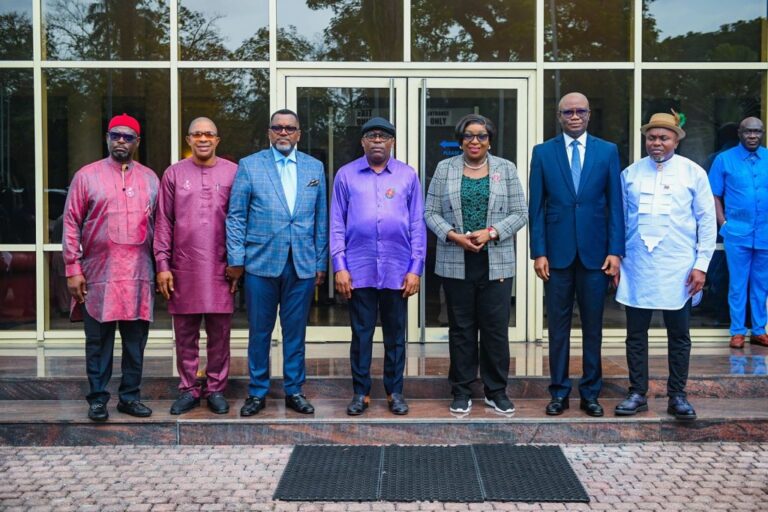
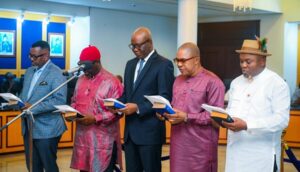
The governor gave the charge on Friday, January 2, at the Executive Council Chambers, Government House, Port Harcourt, shortly after administering the oath of office to five Special Advisers — Barrister Eloka Tasie-Amadi, Professor Peter Medee, Barrister Emmanuel Frank Fubara, Hon. Victor Ekaro and Dr. Darlington Orji.

Governor Fubara explained that the appointments were carefully considered and strategically made to deepen collaboration within government and enhance the efficiency of the state’s administrative machinery.

According to him, the advisers were selected based on their familiarity with the philosophy, vision and direction of his administration.

“We have deliberately brought these individuals on board because they understand what this administration stands for and where we are headed. They are well positioned to contribute meaningfully to the realisation of our goals,” the governor said.

He cautioned that the roles were not ceremonial, but demanding responsibilities that require hard work and selfless service. “This is not about pleasure or titles. Governance is about shared responsibility and delivering results that positively impact the lives of Rivers people,” he noted.

Governor Fubara expressed confidence that the new advisers would work as a cohesive team to translate government policies into measurable outcomes, reaffirming his administration’s commitment to purposeful leadership and people-centred service delivery across the state.

King Charles Mac Pepple Jaja’s Emergence And Sustenance Of Opobo’s Royal Legacy: A Convergence of Civility And Culture

0

The emergence of King Charles Mac Pepple Jaja as the Amanyanabo-elect of Opobo Kingdom, following the transition of Dandeson Douglas Jaja, represents more than a royal succession; it is a profound reaffirmation of heritage, continuity, and enlightened leadership.

Rooted in the illustrious legacy of King Jaja of Opobo, the choice of the new monarch embodies a rare convergence of civility and culture, where tradition is preserved without resisting the demands of modern governance and social harmony.

Opobo Kingdom, long celebrated for its disciplined monarchical institutions and deep respect for ancestral customs, once again demonstrated its maturity through a seamless transition that balanced reverence for the past with clarity of purpose for the future.

King Charles Mac Pepple Jaja’s emergence reflects the strength of a system that prioritises order, consensus, and legitimacy, ensuring that royal authority remains a unifying force rather than a source of contention.

Hi emergence on December 31, 2025, truly underscores the depth, order and resilience of Opobo’s traditional governance system.

Alabo Charles Mac-Pepple Jaja, now proclaimed Amanyanabo-Elect, King Charles Douglas Mac Pepple Jaja, Jeki VI, Treaty King, Amanyanabo and Natural Ruler of Opobo Kingdom, ascended the throne following the passing of his elder brother, King (Dr.) Dandeson Douglas Jaja, Jeki V, whose death was formally announced by the Amanyanabo-in-Council at dawn the same day.

At 65, the new monarch brings to the throne a lineage deeply rooted in Opobo’s royal history. He is a son of a former Amanyanabo, King Douglas Jaja, and a member of the ruling Mac-Pepple War Canoe House, where he has served as head since January 10, 2010.

His emergence is, therefore, seen not only as a constitutional outcome but also as a continuation of a long-established royal tradition.

Educated and widely exposed, King Charles Mac-Pepple Jaja is a graduate of Political Science and Administration from the University of Port Harcourt.

He also attended Government Technical College, Abak, and the Rivers State School of Basic Studies, and holds a Diploma from the Sondore Institute of Management as well as a Postgraduate Certificate in Law from Rivers State University. His academic and administrative background is regarded as an asset as the kingdom navigates the intersection of tradition and modern governance.

Despite the grief that followed the death of the late monarch, Opobo’s traditional institutions acted with remarkable speed and discipline.

Guided by Ibani customs and under the authority of the Council of Alapu (Chiefs), a traditional election was convened by late afternoon to prevent any leadership vacuum.
Three princes contested the succession. Alabo Fredrick Sunday Jaja polled one vote, Alabo Reuben Saturday Jaja secured seven votes, while Alabo Charles Mac-Pepple Jaja emerged with nine votes, a clear majority that affirmed the council’s confidence in his leadership.

The process, completed within hours of the former king’s passing, reflected Opobo’s long-held belief that continuity and stability are essential to effective traditional governance. Founded in 1869 after its historic break from the Bonny Kingdom, Opobo has endured as a major cultural and commercial force in the Niger Delta, sustained by institutions built on consensus, defined authority and respect for tradition.

The new Amanyanabo is generally described as calm, measured, and approachable—qualities considered vital at a time when the kingdom is mourning a revered monarch while preparing for renewal under new leadership.

As Opobo Kingdom enters a formal period of mourning for the late King Dandeson Douglas Jaja, the emergence of King Charles Mac-Pepple Jaja has provided reassurance of continuity.

Official details and timelines for his coronation and formal installation are expected to be announced by the Opobo Council of Alapu (traditional rulers) in due course, marking the next chapter in a living tradition that continues to guide the kingdom through loss, renewal and the demands of modern leadership.

Beyond the ceremonial weight of the crown lies a responsibility to sustain the values that have defined Opobo for generations—dignity, unity, and cultural pride.

As custodian of this enduring legacy, the monarch stands at the intersection of history and progress, charged with preserving Opobo’s identity while guiding its people through evolving social and economic realities. In this balance lies the true essence of Opobo’s royal legacy.


Rivers Leaders Endorse Fubara’s Support For Tinubu, Hail Synergy With Centre

0

Political leaders in Rivers State have rallied behind Governor Siminalayi Fubara, citing his decision to align with the Federal Government and support President Bola Ahmed Tinubu as a strategic move for peace, stability and development in the state.

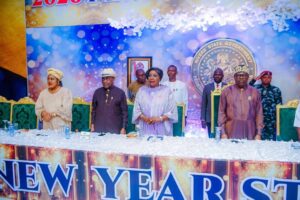
Former Secretary to the Rivers State Government, Alabo Tammy Wenike Danagogo, gave the assurance during the 2026 New Year banquet held on Thursday at the Government House, Port Harcourt.

He said influential political stakeholders in the state were united in their support for the governor, describing his posture as one driven by national interest rather than personal ambition.

Danagogo commended Fubara’s decision to pitch his tent with the ruling All Progressives Congress (APC), noting that cooperation with the centre would enhance governance outcomes and accelerate development in Rivers State.

According to him, synergy between the state and the Federal Government under President Tinubu would open doors to greater opportunities, policy alignment and infrastructural growth.


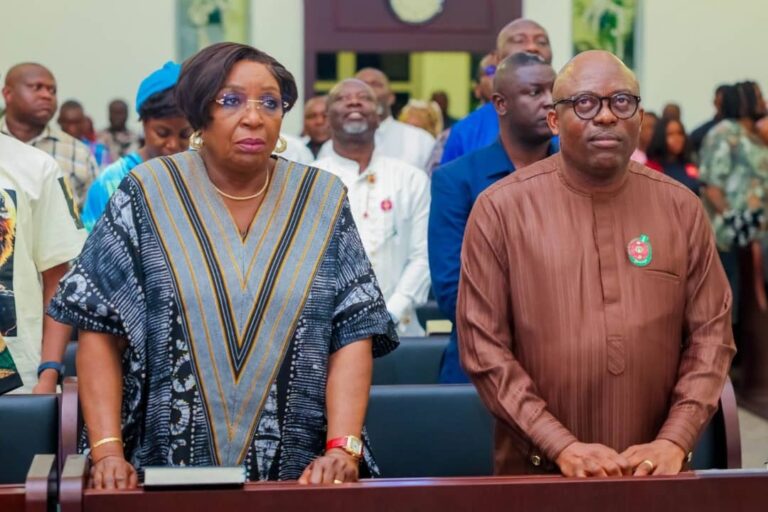
(R-L) Gov. Siminalayi Fubara, his deputy, Prof. Ngozi Odu, former governor, Dr. Peter Odili and wife, Justice Mary Odili during the State New Year Banquet in Government House, Port Harcourt on Thursday.

He described Fubara as a peacemaker and bridge-builder, stressing that the governor had consistently demonstrated a commitment to unity and reconciliation, even in the face of opposition.

“We may not always say it individually, but we are all behind you,” Danagogo said.

“In this effort to align with the centre, to create synergy with the ruling party and the Federal Government, we are with you.”

He added that the governor’s approach would not only benefit Rivers State but also contribute to national progress, urging him to remain steadfast in his pursuit of peace and cooperation.

“It will certainly bring progress to Rivers State and Nigeria. You are a peacemaker and a unifier. No matter the opposition, God remains in charge,” he said.

Danagogo reaffirmed that political leaders across divides were solidly behind Governor Fubara, particularly in his support for President Tinubu, which they see as a pragmatic pathway to stability, inclusive governance and sustainable development for the state.

Fubara Vows To Overcome Political Hurdles, Welcomes PDP Leaders’ Support For Tinubu

0

Fubara Vows To Overcome Political Hurdles, Welcomes PDP Leaders’ Support For Tinubu

Governor of Rivers State, Sir Siminalayi Fubara, has expressed confidence that his administration will surmount any political challenge when the time comes, declaring that his government remains focused, unafraid and guided by truth.

Fubara spoke at the New Year banquet organised by the Rivers State Government at the Banquet Hall of Government House, Port Harcourt, where leaders of the Peoples Democratic Party (PDP) and prominent supporters of former Vice President Atiku Abubakar publicly resolved to work with him in his support for President Bola Ahmed Tinubu.

Urging his supporters to always take the path of righteousness, the governor said he would not compel anyone to do what is wrong, stressing that history would judge decisions taken at critical moments.

“We will not ask you to do what is not right. We will never do that. But stand on the side of truth wherever you find yourself,” Fubara said. “At the end of the day, it is about you and the decision you took when it mattered most. We have no fear anywhere. When the time comes, we will cross the bridge.”

He noted that his administration has put in place all that is required to ensure a smooth political and governance journey, assuring that those who have stood by him would ultimately be proud of their decision.

The governor declared that 2026 would usher in what he described as a period of “complete liberation” for Rivers State, pledging that his government would continue to deliver on its mandate with renewed vigour.

“We are not barking because we understand. We know where we are going, and we have set all the things needed to make the journey smooth,” he said. “Governance will continue in its full force. By the time we are done, everyone who stood with us will be proud.”

Fubara named former PDP National Chairman, Uche Secondus; former Deputy Speaker of the House of Representatives, Austin Opara; former Rivers State Governor, Celestine Omehia; and former Minister of Transport, Abiye Sekibo, as PDP leaders who have aligned with him in the state.

He said their decision had effectively laid to rest claims and blackmail suggesting that he was working with forces opposed to the interests of President Tinubu.

Reaffirming his resolve in the face of political pressure, Fubara said his faith in God remains the source of his confidence and strength, assuring Rivers people that his administration would remain steadfast and purposeful.

Court Halts Nationwide Enforcement Of Tinted Glass Permit Policy

0

A Federal High Court has issued an interim order restraining the Nigeria Police Force (NPF) from enforcing the Tinted Glass Permit policy nationwide.

The Police had earlier announced on December 15, 2025, that enforcement of the policy would resume from January 2, 2026, as part of efforts to enhance public safety and internal security. However, the plan has now been suspended following a court directive.

According to the Force, it was served with an interim order on December 17, 2025, in Suit No. HOR/FHR/M/31/2025, which barred it from proceeding with the enforcement pending the hearing and determination of the substantive suit or the vacation of the order.

In compliance with the order, the NPF said it has entered appearance in the matter, raised preliminary objections and applied for the vacation of the interim injunction. The court has adjourned the case to January 20, 2026, for further proceedings.

Consequently, the Police have placed the enforcement of the Tinted Glass Permit policy on hold across the country until the court reaches a decision.

The Inspector-General of Police, IGP Kayode Adeolu Egbetokun, reaffirmed the commitment of the Force to the rule of law, stressing that the Police would always respect judicial authority while carrying out their constitutional mandate of protecting lives and property.

He noted that the NPF would continue to rely on lawful and intelligence-driven strategies to tackle security challenges and safeguard public safety nationwide.

The Police also assured members of the public that further updates and clear guidance would be communicated after the court’s determination of the matter, in the interest of public order and national security.

The statement was signed by the Force Public Relations Officer, CSP Benjamin Hundeyin, and issued from Force Headquarters, Abuja, on January 1, 2026.

NDDC Targets Transformational Impact With N1.75 trillion 2025 Budget, Shifts To Sectoral Allocations

0

The Niger Delta Development Commission (NDDC) has presented a ₦1.75 trillion budget proposal for the 2025 fiscal year to the National Assembly, underscoring a strategic shift towards transformational development and a departure from traditional line-item budgeting.

Presenting the proposal to the Senate Committee on NDDC, chaired by Senator Asuquo Ekpenyong, and the House of Representatives Committee chaired by Hon. Ibori-Suenu Erhiatake, the Managing Director of the Commission, Dr. Samuel Ogbuku, said the 2025 appropriation, themed “Budget of Consolidation,” builds on the gains of the 2024 Budget of Renewed Hope and aligns with President Bola Ahmed Tinubu’s Renewed Hope Agenda.

Ogbuku explained that a key reform embedded in the 2025 budget is the Commission’s decision to abandon line-item budgeting in favour of sectoral allocations.

According to him, the new approach is designed to tackle long-standing challenges of project delays, fragmentation and inefficiency, which had characterised the old budgeting system.

He noted that sectoral budgeting would allow the Commission to focus on priority development areas—such as roads, education, health, shoreline protection and youth empowerment—rather than spreading resources thinly across numerous isolated projects.

This, he said, would enhance coordination, improve monitoring, reduce abandoned projects and ensure measurable impact across the Niger Delta.

“The shift to sectoral allocations reflects our resolve to move from transactional interventions to transformational development,” Ogbuku said, adding that the reform would also strengthen accountability and deliver better value for money.

The Managing Director expressed appreciation to President Tinubu for his support and confidence in the current management, as well as to the Supervising Minister of Regional Development, Engr. Abubakar Momoh, for providing strategic direction. He also commended the leadership of the 10th National Assembly for what he described as constructive oversight anchored on partnership rather than confrontation.

He disclosed that the ₦1.75 trillion estimate represents a nine per cent reduction from the ₦1.985 trillion budgeted for 2024 and would be funded from multiple sources, including ₦776.5 billion from the Federal Government, ₦752.8 billion from oil companies, ₦109.4 billion as revenue brought forward from 2024, ₦53.67 billion in recoveries from federal agencies and ₦8.35 billion in internally generated revenue.

A breakdown of the proposal showed that ₦1.631 trillion is earmarked for project execution across the Niger Delta, while ₦223 billion is allocated to internal projects. Personnel costs are estimated at ₦47.56 billion, with ₦49.93 billion set aside for overheads.
On the 2024 budget performance, Ogbuku told lawmakers that as of October 31, 2025, the Commission had realised ₦1.985 trillion in actual revenue, surpassing the initial target of ₦1.911 trillion. He attributed the improved performance largely to the extension of the 2024 budget implementation to December 31, 2025.

After a closed-door session with the NDDC management, Senator Ekpenyong said the Senate Committee would embark on an extensive oversight tour of projects across the nine Niger Delta states in January 2026 to verify claims of completion and progress.

While acknowledging improved project delivery by the Commission, he stressed that expectations remained high, particularly in ensuring timely completion and value for money.

Similarly, the House of Representatives Committee on NDDC cautioned that the proposed budget would not be treated as a routine legislative exercise.

Hon. Erhiatake Ibori-Suenu said legislative support would be strictly tied to performance, transparency and verifiable outcomes that positively impact communities in the oil-producing region.

She described the 2025 budget as an opportunity to translate renewed hope into tangible development for millions of Niger Delta residents, insisting that the new sectoral approach must deliver results on the ground.