Home Blog Page 67

Amid Political Tension, Fubara Reappears In Public, Vows To Stay Focused On Governance

0

Rivers State Governor, Siminalayi Fubara, on Wednesday made his first public appearance in days amid heightened political tension in the state, pledging that his administration would remain focused on governance despite the ongoing turbulence.

Fubara spoke shortly after inspecting the ongoing construction of the Borokiri and Creek markets in the Town Area of Port Harcourt, a visit that drew cheers from residents and market users, many of whom expressed relief at the governor’s presence.

Addressing the crowd, the governor said he had a duty to continue delivering on the mandate freely given to him by the people of Rivers State, stressing that political distractions would not derail his administration’s commitment to development.

“I promised our people that no matter the situation we are in, we will not lose focus on governance,” Fubara said. “Our people have given us their trust, and the little we owe them is to give them confidence in leadership and ensure that governance continues strongly.”

The governor said the market project was part of broader efforts by his administration to restore order and the aesthetic appeal of Port Harcourt’s Town area, particularly by addressing the problem of roadside trading along Creek Road and other major streets.

Recalling a previous visit to the area last year, Fubara said the decision to reconstruct the markets was informed by the need to provide proper trading spaces for residents while freeing major roads for rehabilitation.

“You are aware that sometime last year I visited this place and promised that to bring back the beauty of the town to its old ambience, we needed to address the issue of people trading along Creek Road and other major streets,” he said.

He explained that the ongoing inspection followed visits to several road projects across the township, adding that market reconstruction was necessary to ensure the success of planned road rehabilitation.

“From what you can see, the contractor has already mobilised to site, and I believe that within the next one week, work will fully commence,” the governor said.

According to him, the absence of properly organised markets has contributed to traffic congestion and poor road conditions along Creek Road, a situation his administration intends to correct.

“What are we trying to do? You can see the difficulty driving through Creek Road because we don’t have a proper settlement for markets,” Fubara said. “If we fix this market, those trading along the streets will move inside. Once that happens, the roads can be properly rehabilitated and the beauty of the town will start reflecting.”

The governor added that the road rehabilitation programme would cover Borokiri and extend across key parts of Port Harcourt township, as part of a coordinated effort to improve urban infrastructure and ease movement within the city.

Fubara’s appearance comes after days of public anxiety and speculation surrounding the political situation in Rivers State, with his outing widely interpreted as a signal of resolve to continue governance amid uncertainty.

Senate Rejects Mandatory Electronic Transmission Of Election Results

0

The Senate has rejected a proposal to make the electronic transmission of election results compulsory, a decision seen as a setback to efforts to entrench real-time upload of polling unit results into Nigeria’s electoral law.

Lawmakers, during clause-by-clause consideration of the Electoral Amendment Bill on Wednesday, voted down an amendment to Clause 60(3) which sought to compel presiding officers of the Independent National Electoral Commission (INEC) to electronically transmit polling unit results to the INEC Result Viewing (IREV) portal immediately after Form EC8A is signed and stamped.

Instead, the upper chamber retained the existing provision in the Electoral Act, which grants INEC discretion over the mode of result transmission. The clause states that “the presiding officer shall transfer the results, including the total number of accredited voters and the results of the ballot, in a manner as prescribed by the Commission.”

By this decision, electronic transmission of results remains optional rather than mandatory, with the procedure to be determined by INEC’s operational guidelines rather than fixed by statute.

In the same session, the Senate also moderated penalties relating to the trading of Permanent Voter Cards (PVCs), rejecting a proposed 10-year jail term for offenders. Lawmakers retained a two-year imprisonment term but increased the fine from ₦2 million to ₦5 million under Clause 22 of the bill.

Senators also approved amendments shortening key electoral timelines. Clause 28 was revised to reduce the notice of election period from 360 days to 180 days before polling day. Under the original provision, INEC was required to publish election notices in all states of the federation and the Federal Capital Territory at least 360 days ahead of an election.

Similarly, Clause 29 was amended to cut the deadline for political parties to submit their lists of candidates from 180 days to 90 days before a general election. The new provision requires parties to submit names of candidates who emerged from valid primaries not later than 90 days to the poll.

On ballot paper format, the Senate retained the existing provision in Clause 44, which mandates INEC to invite political parties, not later than 20 days before an election, to inspect samples of electoral materials bearing their names, logos or symbols. Political parties are required to respond within two days, indicating approval or raising objections.

Regarding voter accreditation, lawmakers replaced the use of smart card readers with the Bimodal Voter Accreditation System (BVAS) under Clause 47. However, the Senate rejected electronically generated voter identification and retained the Permanent Voter Card as the recognised means of identification at polling units.

The Senate also struck out Clause 142, which dealt with the effect of non-compliance with the Act. The deleted provision would have allowed political parties to rely solely on documentary evidence, without oral testimony, to prove alleged violations. Senators argued that the clause could encourage procedural shortcuts and potentially waste judicial time.

The decisions form part of the Senate’s ongoing consideration of the Electoral Amendment Bill, which is expected to reshape Nigeria’s electoral framework ahead of future general elections.

Collaborate With NDDC, Minister Charges South East Development Commission

0

The Minister of Regional Development, Engr. Abubakar Momoh, has charged the South East Development Commission to collaborate with the Niger Delta Development Commission, NDDC, in the execution of regional projects that will benefit the South East and the South South states.

In a statement issued and signed by Seledi Thompson-Wakama,
Director, Corporate Affairs of the NDDC, the Minister stated this yesterday during the South East Vision 2050 Stakeholders’ Forum at the International Conference Centre, Enugu.

The NDDC Board Chairman, Mr Chiedu Ebie, the Managing Director, Dr Samuel Ogbuku and the Bayelsa State Representative on the Board, Senator Dimaro Denyanbofa joined other stakeholders at the event.

The Minister said the creation of the South East Development Commission by the administration of President Tinubu reflected an institutional commitment to the coordinated, targeted transformation of the region through the revitalisation of critical infrastructure, including the rail sector and the agricultural value chain.

Momoh said the event was a crowning moment in the development of the South East region, especially in fostering a united and prosperous future.

Declaring the Vision 2050 Stakeholders’ Forum open, the Vice President, Kashim Shettima, said that the 25-year development blueprint for the South-East region was a central pillar of Nigeria’s economic future.

He announced that President Bola Ahmed Tinubu had approved the establishment of the South East Investment Company Limited, designed to mobilise resources from the diaspora, capital markets, and development finance institutions for the region’s development.

The Vice President said the gathering was a decisive break from short-term governance cycles toward a structured, multi-decade development framework.

“This forum reflects foresight, responsibility, and a shared understanding that the future is not something we wait for, but something we must deliberately design.

“In recognition of the distinctive character of the South-East, its entrepreneurial spirit, its global diaspora, and its long-standing relationship with international capital, President Bola Ahmed Tinubu approved the establishment of the South East Investment Company Limited.”

Speaking earlier, Governor Peter Mbah of Enugu State joined his colleagues in the region in endorsing the vision 2050, explaining that the vision is an opportunity for the South East region to tap into the national agenda tagged vision 2060.

He applauded the unity of purpose among leaders and stakeholders in the region and proposed the birthing of a South East common market, describing the moment as the awakening of an economic giant.

He urged a paradigm shift in the planning and execution of projects across the region while calling on the people of the area to complement the renewed drive by the Federal Government to improve the security of lives and livelihoods as well as integrate all parts of the region’s plan for inclusive development.

In his welcome speech, the Chairman of the South East Development Commission, Sir Emeka Wogu, thanked President Tinubu for his commitment to the progress and development of the South East region and its people.

Speaking in the same vein, the Managing Director of the SEDC, Mr Mark Okoye, thanked President Tinubu for creating the commission as a special-purpose vehicle to champion the region’s economic transformation.

He said the SEDC will seek the partnership of state governments, the diaspora community, and the organised private sector in implementing the 2050 vision, aimed at charting a shared path to sustainable prosperity for South East Nigeria, focusing on infrastructure, power, peacebuilding, and connectivity, among others.

In a goodwill message, the President of Ohanaeze Ndigbo Worldwide, Sen. Azuta Mbata, commended the Federal Government for prioritising regional integration and development through the summit.

He said the integration of the South East in the broader national development agenda is key, and pledged the support of the people of the region for the aspirations of the Vision 2050 and the Renewed Hope Agenda of the administration of President Bola Ahmed Tinubu.

NPO to FG: Act Now Or Risk Collapse Of Nigeria’s Information Order

1

The Nigerian Press Organisation (NPO) has called on the Federal Government and the National Assembly to take urgent steps to protect Nigeria’s information ecosystem, warning that the unchecked dominance of global digital platforms poses a growing threat to national security, social cohesion and democratic governance.

In a strategic appeal addressed to the Presidency and the National Assembly, the NPO said Nigeria was approaching a critical inflexion point in its democratic and digital evolution, noting that decisions taken now would shape the future of journalism and public discourse for decades.

“The question before the Nigerian state is clear: can a democracy of Nigeria’s scale, diversity and complexity afford to surrender control of its information ecosystem to unregulated global digital gatekeepers?” the organisation said.

The NPO, which comprises the Newspaper Proprietors’ Association of Nigeria (NPAN), the Nigerian Guild of Editors (NGE), the Broadcasting Organisations of Nigeria (BON), the Guild of Corporate Online Publishers (GOCOP) and the Nigerian Union of Journalists (NUJ), stressed that its intervention was made in the public interest and not as private advocacy.

According to the organisation, the rapid expansion of global digital platforms has fundamentally altered Nigeria’s media environment, creating a structural imbalance of power that threatens the sustainability of professional journalism.
It noted that global platforms now dominate digital advertising markets, while algorithms controlled outside Nigeria increasingly determine what Nigerians see, amplify or ignore. It added that Nigerian news content is monetised at scale without proportionate reinvestment in local journalism, with revenues that once sustained domestic newsrooms increasingly extracted offshore.

“This is not a conventional market disruption,” the NPO said. “It is the emergence of private, transnational gatekeepers over public discourse, operating beyond the effective reach of national democratic accountability.”
The organisation warned that the implications for Nigeria go far beyond media economics, particularly in a multi-ethnic and multi-religious federation where credible journalism plays a stabilising role.

“When trusted news institutions weaken, misinformation, disinformation and digitally manipulated narratives expand unchecked, fuelling polarisation, grievance mobilisation and insecurity,” it said, adding that no counterterrorism or intelligence framework could fully compensate for a collapsed information order.
On democratic governance, the NPO cautioned that elections and public accountability depend on reliable information, warning that algorithm-driven virality exposes democratic processes to distortion, coordinated falsehoods and foreign influence.

The organisation also linked press freedom to economic viability, arguing that constitutional guarantees alone are insufficient. “A press that struggles to pay salaries, fund investigations and retain talent is, in effect, unfree, regardless of legal protections,” it said.
It further expressed concern over newsroom contraction, job losses and declining professional standards, describing the erosion of journalism revenue as a loss of skilled labour, institutional memory and national capacity.
Describing journalism as strategic national infrastructure, the NPO said its outputs — verified facts, investigative scrutiny and balanced reporting — are public goods comparable to education, public health and the judiciary.

However, it said the current digital market structure allows global platforms to extract disproportionate value from these public goods while weakening their producers, undermining the long-term resilience of Nigeria’s information ecosystem.

The NPO pointed to global precedents, noting that the European Union, the United Kingdom, Australia, Canada and South Africa have adopted regulatory frameworks to curb digital gatekeeper dominance and ensure fair compensation for news content.

“Nigeria would not be acting in isolation,” the organisation said, adding that sovereign states around the world have concluded that non-intervention is no longer a neutral option.

It urged the Federal Government to adopt a Nigerian-designed, legally anchored framework that recognises journalism as a public-interest activity, corrects extreme bargaining power imbalances and ensures fair remuneration for Nigerian news content, while preserving innovation and competition.
The organisation noted that institutions such as the Federal Competition and Consumer Protection Commission (FCCPC) and the Nigerian Copyright Commission (NCC) already have the statutory authority to enforce proportionate remedies.

“This is not a call for protectionism,” the NPO said. “It is a call for strategic leadership to ensure that Nigeria’s democratic conversation is not quietly outsourced to opaque commercial algorithms beyond national control.”

The NPO concluded that protecting the Nigerian press is not an industry rescue but an investment in national stability, democratic durability and Nigeria’s standing as a constitutional democracy.

Beyond The Battlefield: Oluyede’s First 100 Days And Nigeria’s Economic Security

0

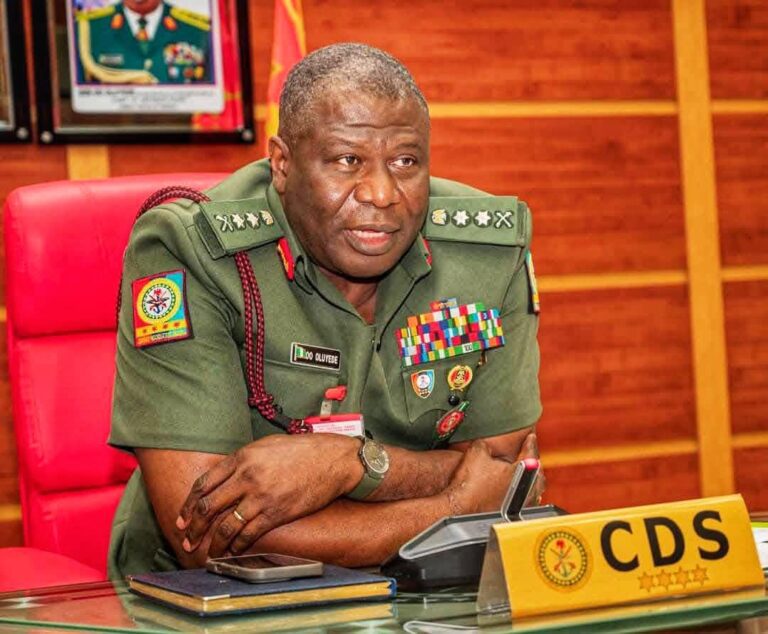
As Nigeria’s Chief of Defence Staff (CDS), General Olufemi Oluyede, marks his first 100 days in office, early signals from Defence Headquarters suggest a tenure defined by coordination, renewed momentum, and a deliberate push to weld the Armed Forces into a more cohesive and professional fighting force.

From the outset, Gen Oluyede made synergy among the Nigerian Army, Navy, Air Force and other security agencies a central plank of his leadership. Defence watchers say this emphasis has translated into tighter joint planning, improved intelligence sharing and more integrated operations across theatres of conflict. Rather than operating in silos, the services are increasingly being deployed as complementary arms of a single national security strategy.

This joint approach has been particularly evident in counter-terrorism operations. In the North East and North West, coordinated air and ground actions have aimed to degrade terrorist networks, disrupt logistics and deny insurgents freedom of movement.

Senior officers point to a clearer command-and-control structure and faster decision-making as key outcomes of the CDS’s early reforms.

Beyond kinetic operations, Gen Oluyede has also placed strong emphasis on building a military that is firmly loyal to the Constitution and anchored on respect for human rights and the rule of law.

In directives to commanders and troops, he has underscored the Armed Forces’ role as protectors of democracy and the civilian population, stressing that operational effectiveness must go hand in hand with professionalism and accountability.

Training and engagement initiatives under his watch are aimed at reinforcing civil-military relations and ensuring that operations are conducted within internationally accepted human rights standards.

In addition, the CDS has placed renewed focus on economic security, especially the long-running challenge of crude oil theft and pipeline vandalism in the Niger Delta.

Under his watch, the anti-oil theft security measures have been strengthened and aligned more closely with land-based and aerial surveillance. This multi-layered posture is intended to protect critical national assets, curb illegal bunkering and restore investor confidence in the oil and gas sector.

In internal engagements, Gen Oluyede has reportedly stressed discipline, troop welfare and ethical conduct, reflecting his belief that morale, legitimacy and effectiveness are inseparable.

By engaging commanders across formations and theatres, he has sought to ensure that strategic directives from Defence Headquarters are clearly understood and uniformly implemented.

While Nigeria’s security challenges remain complex and deeply rooted, analysts say the tone of Gen Oluyede’s first 100 days reflects a leadership intent on unity of effort, constitutional loyalty and sustained pressure on threats to national stability. As his tenure progresses, many will be watching to see how these early initiatives translate into lasting gains on the ground.

For now, the consensus in defence and security circles is that the CDS has used his opening months to lay a solid foundation—one built on cooperation among the services, respect for human rights, and a clear-eyed focus on terrorism and oil theft as critical fronts in Nigeria’s security landscape.

By Chuks Oyema

Chuks Oyema wrote in from Abuja

NECO Releases 2025 SSCE External Results As 86% Record Five credits

0

The National Examinations Council (NECO) has released the results of the 2025 Senior School Certificate Examination (SSCE) External, with 86.26 per cent of candidates achieving five credits and above.

The Registrar and Chief Executive of NECO, Prof. Dantani Wushishi, announced the release on Tuesday during a press conference at the council’s headquarters in Minna, Niger State.

Declaring the results in a video shared on NECO’s official X handle, Wushishi said candidates could access their results on the council’s website using their examination registration numbers.

According to him, a total of 96,979 candidates registered for the examination, comprising 51,823 males (53.43 per cent) and 45,156 females (46.56 per cent). Out of this number, 95,160 candidates eventually sat for the examination across 16 subjects.

He disclosed that in English Language, 93,425 candidates sat for the paper, out of which 73,167 candidates, representing 78.32 per cent, obtained credit and above. In Mathematics, 93,330 candidates participated, with 85,256 candidates (91.35 per cent) scoring credit and above.

Overall, 68,166 candidates, representing 71.63 per cent, obtained five credits and above including English Language and Mathematics, while 82,082 candidates (86.26 per cent) achieved five credits and above irrespective of English and Mathematics.

On examination malpractice, Wushishi revealed that 9,016 candidates were booked for various offences, marking a 31.7 per cent increase compared with the 6,160 cases recorded in 2024.

He added that five supervisors—two from the Federal Capital Territory and one each from Kano, Adamawa and Ondo states—were recommended for blacklisting for aiding and abetting examination malpractice.

In addition, four examination centres—two in Niger State and one each in Yobe and Kano states—were recommended for de-recognition after being found culpable of whole-centre malpractice.

The SSCE External examination is designed mainly for private candidates who seek certification outside the regular school system or those who wish to improve on previously obtained results.

Rivers Deputy Governor Bags UN Peace Award, Projects State As Hub Of Stability, SDG Commitment

0

The Deputy Governor of Rivers State, Prof. Ngozi Nma Odu, has reaffirmed the commitment of the Governor Siminalayi Fubara administration to empowering vulnerable groups and advancing the Sustainable Development Goals (SDGs), following her recognition with the United Nations Global Icon of Peace and Integrity Award.

Prof. Odu received the prestigious award on Monday, February 2, 2026, at the Government House, Port Harcourt, from the International Face of Peace and Integrity Advocates, an organisation affiliated with the United Nations’ peace promotion initiatives.

Describing the honour as both a recognition and a responsibility, the Deputy Governor said the award underscored Rivers State’s growing reputation as a peaceful, stable and development-driven state.

“This is more than an award. It is a wake-up call and a renewed task. Whatever I have been doing that earned this recognition, I must do more in the service of humanity,” she said.

Prof. Odu noted that the Fubara-led administration has deliberately aligned key ministries and agencies with the SDGs, identifying Health, Education, Agriculture and Women Affairs as the core pillars driving inclusive growth and social protection in the state.

She assured that government policies would continue to prioritise vulnerable groups, stressing that the administration remains deeply committed to ensuring that the dividends of governance are felt across all strata of society.

The Deputy Governor also commended the decision to host the 2026 award ceremony in Rivers State, describing it as a powerful statement of confidence in the state’s peace, stability and investment potential.

According to her, the theme of the event, “Peaceful Coexistence,” was particularly timely, noting that dialogue, negotiation and mutual understanding remain essential tools for resolving conflicts and sustaining peace.

Earlier, the Global Director of the International Face of Peace and Integrity Advocates, Dr. Chinaza Jennifer Ugboaja, said Prof. Odu was honoured in recognition of her leadership, integrity and commitment to peace and sustainable development.

She disclosed that Prof. Odu is the first Nigerian and the second African woman to receive the Global Icon of Peace and Integrity Award, describing her achievements as inspirational to younger generations across the continent.

Dr. Ugboaja explained that the organisation works to promote peace, advocate peaceful coexistence, support the SDGs and serve globally as United Nations Peace Promoters with Integrity.

Snakebite: Nigeria’s Overlooked Killer Strikes Again as Expert Warns of Deepening Public Health Crisis

0

Barely days after a fast-rising Nigerian music star, Ifunanya Nwangene reportedly died from complications linked to a snakebite, public health experts have renewed warnings that snakebite envenoming remains one of Nigeria’s most deadly but neglected health emergencies.

Dr. Chukwuma Anyaike, a retired Director of Public Health at the Federal Ministry of Health, described snakebite as a “silent killer” that continues to claim lives quietly, particularly among farmers, herders and rural dwellers who form the backbone of the nation’s food system.

Speaking in an interview on Monday in Abuja, Anyaike noted that snakebite envenoming is classified as a highest-priority Neglected Tropical Disease (NTD) and remains a major public health threat in Nigeria.

Recent data presented during activities marking World NTD Day 2026 indicate that Nigeria is among the world’s highest-burden countries for snakebite envenoming, with the Carpet Viper (Echis ocellatus) responsible for more than 60 per cent of reported cases nationwide.

According to Anyaike, the death of the young entertainer — which has sparked public grief and debate on social media — mirrors the daily reality faced by thousands of Nigerians in rural communities whose cases rarely make headlines.

“Snakebite is not selective. It affects farmers in the fields, herders in grazing routes, and now, as we have seen, even public figures. But the difference is that rural victims often die unnoticed,” he said.

Despite the availability of effective antivenom, outcomes remain poor due to late hospital presentation, weak health systems and widespread dependence on traditional remedies.

“About 82 per cent of snakebite victims first seek traditional treatment. These delays significantly increase the risk of death or permanent disability,” Anyaike explained.

He stressed that snakebite is not merely a medical emergency but a socio-economic crisis.
“When a farmer is bitten, the consequences extend beyond the individual. Household income drops, food production suffers and entire communities become more vulnerable,” he said.

Findings also show that nearly half of health facilities in high-burden areas lack the capacity to administer antivenom, owing to shortages of trained personnel, inadequate cold-chain systems and inconsistent supply of lifesaving drugs.

As a result, specialised centres such as the Kaltungo Snakebite Hospital in Gombe State, along with a few facilities in Bauchi State, have become referral hubs for severe cases — underscoring the limited distribution of functional snakebite treatment centres across the country.

Anyaike emphasised that prevention remains one of the most effective ways to reduce snakebite incidence, particularly among rural residents.

He advised the use of torches or flashlights when walking outdoors at night, wearing thick knee-high boots and long trousers on farms or in tall grass, and keeping surroundings clear of debris, woodpiles and overgrown vegetation where snakes often hide.
He also highlighted the importance of proper first aid.

“If a bite occurs, time is life. Victims should remain calm, move away from the snake, immobilise the affected limb and seek immediate medical attention,” he said.

He warned against harmful practices such as tying tourniquets, cutting or sucking the wound, or applying herbs, noting that such actions often worsen injuries and increase the risk of infection, tissue damage and amputation.

“These practices do not neutralise venom. Delays in accessing antivenom remain the leading cause of snakebite deaths in Nigeria,” he added.

As Nigeria aligns with the World Health Organisation’s target of reducing snakebite deaths and disabilities by 50 per cent by 2030, Anyaike called for improved antivenom access, stronger rural health infrastructure and sustained public awareness campaigns.

“The recent loss of a young music talent should serve as a wake-up call,” he said.

“Snakebite envenoming deserves urgent national attention. With awareness, early treatment and proper investment in the health system, thousands of lives can be saved every year.”


reportedly died from complications linked to a snakebite, public health experts have renewed warnings that snakebite envenoming remains one of Nigeria’s most deadly but neglected health emergencies.

Dr. Chukwuma Anyaike, a retired Director of Public Health at the Federal Ministry of Health, described snakebite as a “silent killer” that continues to claim lives quietly, particularly among farmers, herders and rural dwellers who form the backbone of the nation’s food system.

Speaking in an interview on Monday in Abuja, Anyaike noted that snakebite envenoming is classified as a highest-priority Neglected Tropical Disease (NTD) and remains a major public health threat in Nigeria.

Recent data presented during activities marking World NTD Day 2026 indicate that Nigeria is among the world’s highest-burden countries for snakebite envenoming, with the Carpet Viper (Echis ocellatus) responsible for more than 60 per cent of reported cases nationwide.

According to Anyaike, the death of the young entertainer — which has sparked public grief and debate on social media — mirrors the daily reality faced by thousands of Nigerians in rural communities whose cases rarely make headlines.

“Snakebite is not selective. It affects farmers in the fields, herders in grazing routes, and now, as we have seen, even public figures. But the difference is that rural victims often die unnoticed,” he said.

Despite the availability of effective antivenom, outcomes remain poor due to late hospital presentation, weak health systems and widespread dependence on traditional remedies.

“About 82 per cent of snakebite victims first seek traditional treatment. These delays significantly increase the risk of death or permanent disability,” Anyaike explained.

He stressed that snakebite is not merely a medical emergency but a socio-economic crisis.
“When a farmer is bitten, the consequences extend beyond the individual. Household income drops, food production suffers and entire communities become more vulnerable,” he said.

Findings also show that nearly half of health facilities in high-burden areas lack the capacity to administer antivenom, owing to shortages of trained personnel, inadequate cold-chain systems and inconsistent supply of lifesaving drugs.

As a result, specialised centres such as the Kaltungo Snakebite Hospital in Gombe State, along with a few facilities in Bauchi State, have become referral hubs for severe cases — underscoring the limited distribution of functional snakebite treatment centres across the country.

Anyaike emphasised that prevention remains one of the most effective ways to reduce snakebite incidence, particularly among rural residents.

He advised the use of torches or flashlights when walking outdoors at night, wearing thick knee-high boots and long trousers on farms or in tall grass, and keeping surroundings clear of debris, woodpiles and overgrown vegetation where snakes often hide.
He also highlighted the importance of proper first aid.

“If a bite occurs, time is life. Victims should remain calm, move away from the snake, immobilise the affected limb and seek immediate medical attention,” he said.

He warned against harmful practices such as tying tourniquets, cutting or sucking the wound, or applying herbs, noting that such actions often worsen injuries and increase the risk of infection, tissue damage and amputation.

“These practices do not neutralise venom. Delays in accessing antivenom remain the leading cause of snakebite deaths in Nigeria,” he added.

As Nigeria aligns with the World Health Organisation’s target of reducing snakebite deaths and disabilities by 50 per cent by 2030, Anyaike called for improved antivenom access, stronger rural health infrastructure and sustained public awareness campaigns.

“The recent loss of a young music talent should serve as a wake-up call,” he said.

“Snakebite envenoming deserves urgent national attention. With awareness, early treatment and proper investment in the health system, thousands of lives can be saved every year.”

reportedly died from complications linked to a snakebite, public health experts have renewed warnings that snakebite envenoming remains one of Nigeria’s most deadly but neglected health emergencies.

Dr. Chukwuma Anyaike, a retired Director of Public Health at the Federal Ministry of Health, described snakebite as a “silent killer” that continues to claim lives quietly, particularly among farmers, herders and rural dwellers who form the backbone of the nation’s food system.

Speaking in an interview on Monday in Abuja, Anyaike noted that snakebite envenoming is classified as a highest-priority Neglected Tropical Disease (NTD) and remains a major public health threat in Nigeria.

Recent data presented during activities marking World NTD Day 2026 indicate that Nigeria is among the world’s highest-burden countries for snakebite envenoming, with the Carpet Viper (Echis ocellatus) responsible for more than 60 per cent of reported cases nationwide.

According to Anyaike, the death of the young entertainer — which has sparked public grief and debate on social media — mirrors the daily reality faced by thousands of Nigerians in rural communities whose cases rarely make headlines.

“Snakebite is not selective. It affects farmers in the fields, herders in grazing routes, and now, as we have seen, even public figures. But the difference is that rural victims often die unnoticed,” he said.

Despite the availability of effective antivenom, outcomes remain poor due to late hospital presentation, weak health systems and widespread dependence on traditional remedies.

“About 82 per cent of snakebite victims first seek traditional treatment. These delays significantly increase the risk of death or permanent disability,” Anyaike explained.

He stressed that snakebite is not merely a medical emergency but a socio-economic crisis.
“When a farmer is bitten, the consequences extend beyond the individual. Household income drops, food production suffers and entire communities become more vulnerable,” he said.

Findings also show that nearly half of health facilities in high-burden areas lack the capacity to administer antivenom, owing to shortages of trained personnel, inadequate cold-chain systems and inconsistent supply of lifesaving drugs.

As a result, specialised centres such as the Kaltungo Snakebite Hospital in Gombe State, along with a few facilities in Bauchi State, have become referral hubs for severe cases — underscoring the limited distribution of functional snakebite treatment centres across the country.

Anyaike emphasised that prevention remains one of the most effective ways to reduce snakebite incidence, particularly among rural residents.

He advised the use of torches or flashlights when walking outdoors at night, wearing thick knee-high boots and long trousers on farms or in tall grass, and keeping surroundings clear of debris, woodpiles and overgrown vegetation where snakes often hide.
He also highlighted the importance of proper first aid.

“If a bite occurs, time is life. Victims should remain calm, move away from the snake, immobilise the affected limb and seek immediate medical attention,” he said.

He warned against harmful practices such as tying tourniquets, cutting or sucking the wound, or applying herbs, noting that such actions often worsen injuries and increase the risk of infection, tissue damage and amputation.

“These practices do not neutralise venom. Delays in accessing antivenom remain the leading cause of snakebite deaths in Nigeria,” he added.

As Nigeria aligns with the World Health Organisation’s target of reducing snakebite deaths and disabilities by 50 per cent by 2030, Anyaike called for improved antivenom access, stronger rural health infrastructure and sustained public awareness campaigns.

“The recent loss of a young music talent should serve as a wake-up call,” he said.

“Snakebite envenoming deserves urgent national attention. With awareness, early treatment and proper investment in the health system, thousands of lives can be saved every year.”

FG, States, LGs Share ₦1.969 Trillion As FAAC Meets In Abuja

0

The Federation Account Allocation Committee (FAAC) has shared a total sum of ₦1.969 trillion as the December 2025 Federation Account Revenue among the Federal Government, state governments and local government councils across the country.

The allocation was made at the January 2026 FAAC meeting held in Abuja, according to a statement issued by the Director of Press at the Office of the Accountant General of the Federation, Bawa Mokwa.

The statement disclosed that the ₦1.969 trillion total distributable revenue comprised ₦1.084 trillion from distributable statutory revenue, ₦846.507 billion from distributable Value Added Tax revenue, and ₦38.110 billion generated from the Electronic Money Transfer Levy.

The distributable amount represented an increase when compared with the ₦1.928 trillion shared in November 2025.

According to the FAAC communiqué, a total gross revenue of ₦2.585 trillion was available in December 2025.

From the amount, ₦104.697 billion was deducted as the cost of collection, while ₦511.585 billion was recorded as transfers, refunds and savings.

The communiqué further stated that gross statutory revenue of ₦1.631 trillion was received during the month.

This figure was ₦105.202 billion lower than the ₦1.736 trillion recorded in November 2025.

FAAC noted that gross revenue of ₦913.957 billion was generated from Value Added Tax in December 2025.

This was significantly higher than the ₦563.042 billion recorded in November 2025, showing an increase of ₦350.915 billion.

From the total distributable revenue of ₦1.969 trillion, the Federal Government received ₦653.500 billion, while the State Governments got ₦706.469 billion.

The Local Government Councils received ₦513.272 billion, while ₦96.083 billion, representing 13 per cent of mineral revenue, was shared among the benefiting states as derivation revenue.

Out of the ₦1.084 trillion distributable statutory revenue, the Federal Government received ₦520.807 billion.

The State Governments got ₦264.160 billion, while the Local Government Councils received ₦203.656 billion.

The sum of ₦96.083 billion was distributed to benefiting states as derivation revenue.

From the ₦846.507 billion distributable Value Added Tax revenue, the Federal Government received ₦126.976 billion.

The State Governments received ₦423.254 billion, while the Local Government Councils got ₦296.277 billion.

The communiqué stated that from the ₦38.110 billion Electronic Money Transfer Levy revenue, the Federal Government received ₦5.717 billion.

The State Governments got ₦19.055 billion, while the Local Government Councils received ₦13.338 billion.

FAAC disclosed that in December 2025, Companies Income Tax/Capital Gains Tax, Stamp Duties, Import Duty, and Value Added Tax recorded significant increases.

It added that Oil and Gas Royalty, CET Levies, and Fees increased marginally.

However, Excise Duty, Petroleum Profit Tax/Hydrocarbon Tax, and the Electronic Money Transfer Levy recorded considerable decreases during the period.

Police Urge NLC To Suspend Planned Abuja Protest Over Alleged Extremists Infiltration

0

The Federal Capital Territory (FCT) Police Command has called on the Nigeria Labour Congress (NLC), FCT Council, to suspend its planned protest scheduled for Tuesday, February 3, 2026, citing intelligence reports of serious security threats that could lead to violence and a breakdown of law and order in Abuja.

In a statement issued on Monday by the Police Public Relations Officer, SP Josephine Adeh, the command said credible intelligence indicated that the proscribed Islamic Movement of Nigeria (IMN) and other non-state actors were planning to infiltrate and hijack the protest, raising concerns over public safety.

While reaffirming citizens’ constitutional right to peaceful assembly, the police warned that the prevailing security risks surrounding the planned demonstration outweighed the need for its immediate execution.

“The Command recognizes and respects the rights of citizens to peaceful protest; however, intelligence at our disposal points to plans by proscribed groups and other actors to exploit the protest for purposes inimical to public peace and security,” the statement said.

The police described the appeal to the NLC as a preventive measure aimed at safeguarding lives, property, and public order in the nation’s capital, adding that the protest could severely disrupt residents’ movement and daily activities if it degenerated into unrest.

The warning comes amid an escalating industrial dispute between the FCT Administration and its workforce, with the NLC and the Trade Union Congress of Nigeria (TUC) threatening a solidarity rally in support of members of the Joint Union Action Committee (JUAC).

All NLC and TUC affiliates and state councils in the FCT are expected to converge at the Federal Capital Development Authority (FCDA) premises in Abuja for the rally.

In a joint statement, Acting General Secretary of the NLC, Benson Upah, and Secretary General of the TUC, General N.A. Toro, said the planned rally was intended to demonstrate that “an injury to one is an injury to all,” stressing that the labour movement would not abandon its members.

The labour centres reiterated their solidarity with JUAC members and urged them to remain resolute in defending their rights, describing the struggle as one rooted in justice, fairness, and respect for labour rights.

They also reaffirmed support for striking FCT workers protesting the alleged non-remittance of National Housing Fund and pension deductions, as required under the Pension Reform Act, 2014 (as amended).

“History has taught us that rights are never gifted; they are won through collective resistance and principled struggle,” the statement said, while directing affiliates to mobilise for what they described as a lawful and peaceful rally.