Home Blog Page 61

Lagos Airport Reopens Swiftly After Fire Scare, Flights Resume

0

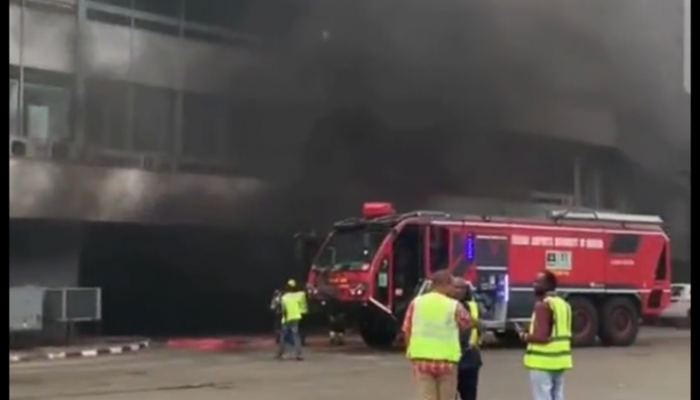
Normal operations have resumed at the Murtala Muhammed International Airport (MMIA), Lagos, following a fire incident that briefly disrupted activities and led to the diversion of three international flights.

The Federal Airports Authority of Nigeria (FAAN) confirmed that the affected airspace at Terminal One has been fully reopened, with arrivals and departures gradually returning to schedule.

Managing Director of FAAN, Mrs Olubunmi Kuku, assured passengers and airlines that the situation had been brought under control within hours of the outbreak.

She noted that emergency procedures were promptly activated, enabling the safe evacuation of passengers and airport personnel without any fatalities.

Although six persons sustained minor injuries, authorities emphasised that the rapid containment of the fire prevented more extensive damage and prolonged disruption.

Three international carriers — Emirates, British Airways and Lufthansa — had earlier diverted flights as a precautionary measure.

However, FAAN confirmed that flight operations are now stabilising, with most departures relocated to Terminal Two to ensure seamless service.

Kuku said the airport’s Emergency Operations Centre coordinated the response in line with established safety protocols, while firefighters remain on ground as a precaution against lingering smoke.

She added that engineers have begun structural assessments of the affected section to guarantee safety and operational integrity.

“In terms of the full operations affected, not a lot,” she said, underscoring that services would continue unhindered as the airport consolidates on its swift reopening.

The reopening of the nation’s busiest gateway within hours of the incident has been hailed as a demonstration of improved emergency response coordination among aviation and security agencies.

Nigeria’s Power Sector Nears Collapse As GenCos Cry Out Over N6.2tn Debt

0

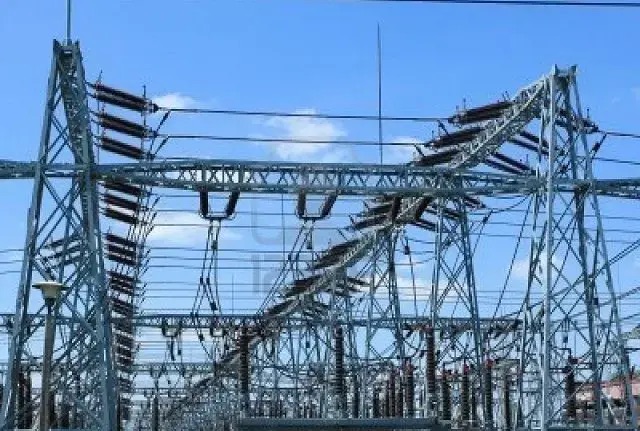
Nigeria’s electricity generation companies have raised a grave alarm over what they describe as an imminent collapse of the nation’s power sector, citing a staggering N6.2 trillion in unpaid capacity and energy invoices.

Under the umbrella of the Association of Power Generation Companies (GenCos), the firms warned that chronic liquidity shortfalls and failure to honour contractual obligations have crippled their ability to sustain operations and invest in expansion.

In a statement signed by the Chief Executive Officer of the GenCos, Dr Joy Ogaji, the companies disclosed that since 2015, they have received payment for only about 35 per cent of power generated and consumed, despite making capacity available to the national grid.

The GenCos argued that the prevailing market practice of recognising only “called-up” capacity — the volume of electricity the transmission and distribution networks can evacuate — while ignoring available capacity, sends negative signals to both local and international investors.

They noted that average grid generation has remained stagnant at about 4,000 megawatts (MW), far below the country’s installed capacity of 15,500MW, attributing the gap largely to liquidity constraints and infrastructure bottlenecks.

“This has severely impacted our ability to invest in capacity maintenance and expansion. We are not being paid for available capacity, and this discourages investment in recovering mechanically unavailable capacity estimated at 7,000MW,” the statement read.

The companies stressed that electricity, once generated, cannot be stored at power plants, explaining that it is transmitted and consumed almost instantaneously. The absence of guaranteed returns on investment, they warned, makes the sector increasingly unattractive.

Describing the situation as a vicious cycle of underperformance, the GenCos identified the lack of enforceable Power Purchase Agreements (PPAs), weak transmission infrastructure and inefficiencies in distribution as major impediments to market stability.

They maintained that since taking over the successor generation companies on November 1, 2013, following the privatisation of the power sector, they have honoured the terms of industry agreements. In return, they claimed, they have faced mounting liquidity crises, contractual defaults, regulatory uncertainties and heightened market volatility.

The companies called for urgent reforms to entrench a contract-based electricity market and uphold the sanctity of agreements, warning that the sustainability of the sector hangs in the balance.

“We need a level playing field to operate efficiently and effectively. The sustainability of the sector is at stake, and immediate government intervention is imperative,” the statement added.

Catholic Bishops to Tinubu: End Killings, Secure 2027 Polls or Risk Nigeria’s Democracy

0

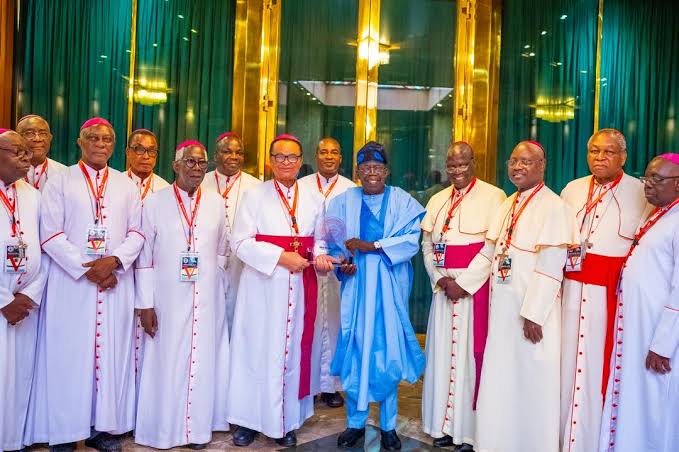
The Catholic Bishops’ Conference of Nigeria (CBCN) has charged the Federal Government to urgently stem the tide of bloodshed across the country and guarantee credible elections in 2027, warning that persistent insecurity and dwindling voter turnout pose grave threats to Nigeria’s democratic future.

The call was made at the opening of the CBCN’s 2026 First Plenary Meeting in Abuja by its president, Lucius Ugorji, who painted a grim picture of a nation under siege.

“Our country has continued to experience rising security challenges. We continue to hear sad tales of senseless massacres, mass burials, endless tears and grief. Nigeria continues to bleed endlessly,” Ugorji lamented.

He cited repeated kidnappings and mass killings in several states, particularly condemning reported attacks in Woro and Nuku communities of Kwara State. According to him, armed groups are exploiting weaknesses in the nation’s security architecture and operating with alarming boldness.
“In all, the gunmen operate boldly, freely and unchallenged… Yet, they are not arrested through their digital footprints,” he said.

While acknowledging steps taken by the administration of Bola Ahmed Tinubu, including the declaration of a national security emergency, the bishops said government efforts remain largely reactive.

“To effectively tackle insecurity, government must go beyond declaring a national emergency on security and reactive interventions to invest more in modern technological equipment for surveillance,” Ugorji stated.

He warned that delays in prosecuting arrested suspects, as well as the reintegration of repentant insurgents under the Operation Safe Corridor initiative, could erode public trust.

“Delaying the prosecution of arrested terrorists or pardoning and reintegrating perceived repentant Boko Haram members through Operation Safe Corridor gives the impression of complicity on the side of government,” he added.

Beyond security, the bishops expressed concern over declining voter turnout in recent elections, describing it as a troubling indicator of citizens’ waning confidence in the electoral process.

“This decline says a lot about citizens’ trust in the electoral process and calls into question the legitimacy of elected officials in a democratic dispensation,” Ugorji said.

He urged the National Assembly to revisit the amended Electoral Act and make real-time electronic transmission of results mandatory ahead of the 2027 general elections.
“This is the will of the people and has to be respected,” he insisted.

On the 2025 Tax Act, which came into effect on January 1, 2026, the bishops acknowledged its potential benefits but warned of unintended consequences.

“When all is said and done, there are widespread fears that the reforms could raise the living cost for consumers, aggravate hardship and push more jobless youths into criminality,” Ugorji cautioned.

The conference also identified illegal mining as a key driver of insecurity and revenue loss, noting that proceeds from minerals such as gold and lithium are being used to finance violent activities.

“Criminal groups use proceeds from the sale of minerals, such as gold and lithium, to buy weapons and fund terrorist activities across the country,” he said, calling for stricter enforcement and the deployment of drone technology and artificial intelligence to monitor remote mining sites.

In his keynote address, Dr. Mike Omeri underscored the need for leadership anchored on service and the common good.

“Leadership of purpose is courageous and does not seek power. Rather, it seeks to serve,” Omeri said, urging leaders to bridge inequality and champion justice, equity and compassion.

Delivering the homily at the opening Mass, Ignatius Kaigama warned political and religious leaders against abusing authority and distorting the Christian message for material gain.
“We fervently hope that the 2027 elections will be different and every single vote… will count, and the genuine will of the people, respected,” Kaigama said.

He cautioned against prosperity teachings that reduce faith to material acquisition, saying some “so-called powerful men of God” preach a distorted gospel focused solely on wealth.

Earlier, Ugorji announced a Special Jubilee Year of St. Francis of Assisi proclaimed by Pope Leo XIV, describing it as a call to deeper spiritual renewal and peace.

He also disclosed that he would step down as CBCN president at the close of the plenary.

“I take advantage of this opportunity to thank you for the cooperation and support I received from you all during my tenure as your chief servant,” he said.

The bishops’ intervention adds to mounting pressure on authorities to address insecurity decisively and rebuild public trust ahead of the 2027 polls.


Bonny Residents Repel NNPC Officials Over Alleged Breach Of Court Order

Tension flared at Ntamoku Ayambo Pipeline Estate in Bonny, Rivers State, on Friday as residents chased away representatives of the Nigerian National Petroleum Company Limited (NNPC Limited) and its subsidiary, NNPC Exploration and Production Limited (NEPL), over what they described as a violation of a subsisting court order.

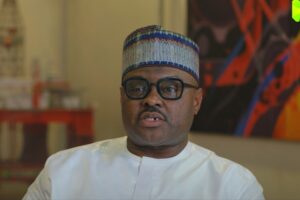
Managing Director/CEO, WAGL Energy Limited, Mohammed Bello.

The incident followed an ex parte order issued on February 13, 2026, by Justice Rita Oguguo of the Rivers State High Court sitting in Port Harcourt, in Suit No.: BYHC/17/CS/2026. The court restrained Renaissance Africa Energy Company Limited, NNPC Exploration and Production Company Limited (NEPL), WAGL Energy Limited and Kristal Polis Limited from carrying out further activities in the disputed area pending the determination of the suit.

The order was granted after submissions by Chief Eugene Odey, counsel to the residents of Ntamoku Ayambo Pipeline Estate, who are claimants in the matter. The court specifically halted alleged demolition activities within the estate.

However, residents alleged that officials of NNPC Limited and its partners, led by the company’s Community Liaison Officer (CLO), Romeo Waribo, visited the area on Friday to inspect the extent of earlier demolitions. The move was widely interpreted by locals as a disregard for judicial authority.

Eyewitnesses said the officials hurriedly left the community after residents mobilised to confront them.

“When they came, we mobilised our people to confront them, but by the time we got there, they had fled. Why are they running away?” a resident, who identified himself simply as Francis, queried.

Another resident, Fubby, described the visit as an affront to the court, stressing that the matter was sub judice and that all parties were expected to maintain the status quo.

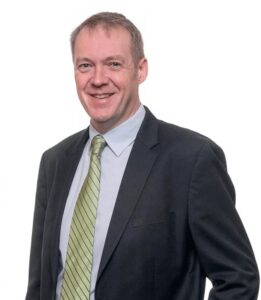
Managing Director, NNPC Exploration and Production Limited (NEPL), Nicolas Foucart.

“It is surprising that a company established by law would act in a lawless manner,” he said, warning that any attempt to dispossess residents of their properties would be resisted.

The residents further declared that land grabbing through intimidation would not succeed in the community, alleging that certain individuals were attempting to undermine collective interests.

In what appeared to be an averted confrontation, the company representatives reportedly drove off in a white Toyota Hummer bus and two Toyota Hilux vans as residents gathered at the scene.

Efforts to reach the Chairman of Ntamoku Ayambo Pipeline Estate for comment were unsuccessful at the time of filing this report.

The Atlantic Bell reports that this development adds a new twist to the simmering dispute, with residents insisting that the rule of law must prevail while the court determines the substantive issues before it.

Ogu Community Applauds Rivers GBV Sensitisation Drive, Seeks Sustained Engagement

0

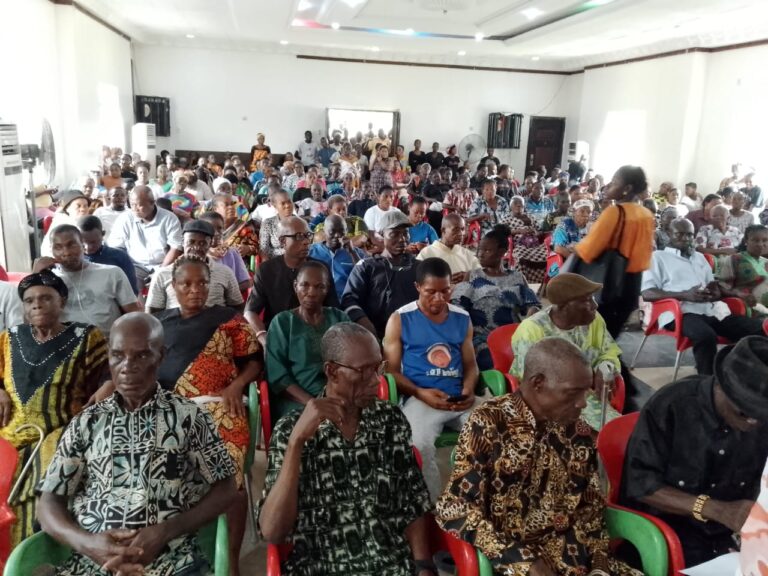
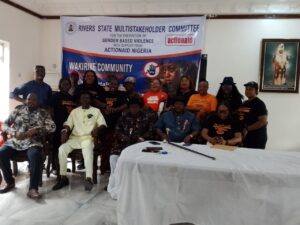
Stakeholders in Ogu town, Ogu/Bolo Local Government Area of Rivers State, have lauded the Rivers State Multi-Stakeholder Action Committee on Gender-Based Violence (GBV) Prevention for its sensitisation programme, describing it as timely and impactful.

The Chairman of Ogu Divisional Council of Chiefs, Chief (Barr.) Lawrence Abiabiari, who was represented by Chief Stephen Mina-Omubo, said the initiative was a welcome development and an eye-opener for many in the community.

According to him, the engagement illuminated critical issues such as rape and abandonment, adding that some residents were previously unaware that women could also be perpetrators of sexual violence.

He commended the committee for addressing sensitive but pressing concerns and expressed optimism that participants would cascade the knowledge gained to others within the community. He also called for regular sensitisation programmes and assured the organisers of the community’s full support.

In her remarks, the Coordinator of the Rivers State Multi-Stakeholder Action Committee on Gender Based Violence Prevention, Barr. Evelyn Membere-Asimiea, said the programme was designed to equip residents with knowledge needed to prevent and respond effectively to GBV cases.
She described the turnout as impressive and beyond expectations, attributing the success of the programme to collaborative support from partners, including ActionAid Nigeria and the Ford Foundation.

Membere-Asimiea urged survivors of GBV to seek help at the Rivers State Sexual Assault Referral Centre, located at No. 32 Nembe Street, Borokiri, Port Harcourt, and managed by the Rivers State Ministry of Social Welfare and Rehabilitation. She also advised victims to contact the Office of the Public Defender under the state Ministry of Justice for legal support on GBV-related matters.

She further disclosed plans to extend the sensitisation campaign to other local government areas, including Ikwerre LGA, as part of efforts to deepen awareness and foster safer communities across the state.

“We plan to replicate this success in other communities to create a safer environment for all in Rivers State,” she said.

Earlier, the Head of the Advocacy Sub-Committee, Barr. Ere Boma, provided an overview of gender-based violence, outlining its various forms — sexual, domestic, economic and psychological abuse — and their far-reaching consequences.

She urged participants, including traditional rulers, community leaders, women and representatives of civil society organisations, to take collective responsibility in confronting GBV, supporting survivors and promoting a culture of respect and equality.

The Atlantic Bell reports that the programme, themed “Ending Gender-Based Violence Starts with Us,” featured interactive sessions on rights awareness, prevention strategies and available support services, alongside question-and-answer engagements with attendees.

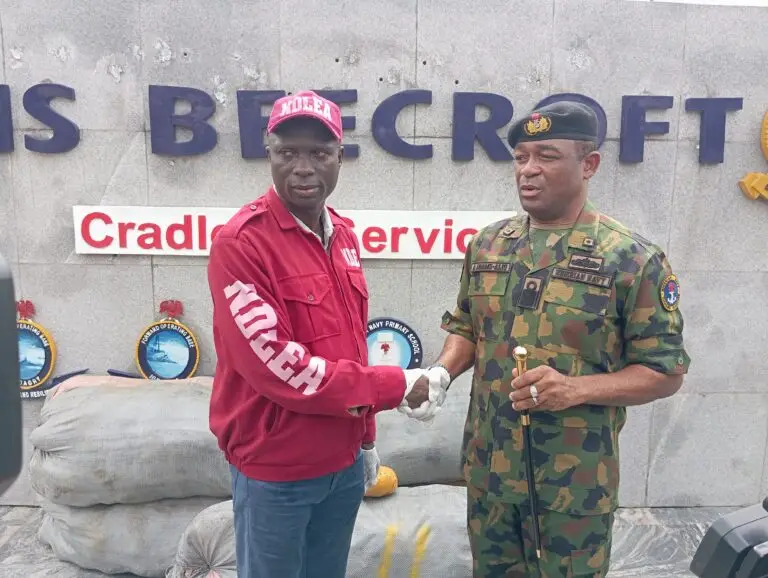
Naval Operation Ends Drug Syndicate Hands Over 489kg Cannabis To NDLEA

The Nigerian Navy Ship (NNS) BEECROFT disrupted a drug syndicate, putting its members on the run and seizing 489kg of cannabis sativa.

The Commander of NNS BEECROFT, Commodore Aiwuyor Adams-Aliu, told journalists on Friday that the narcotics had been handed over to the National Drug Law Enforcement Agency (NDLEA) for further action.

“NNS BEECROFT’s patrol team, acting on credible intelligence, seized 489kg of smuggled cannabis sativa on Wednesday night around Abule Osun, Amuwo Odofin, Lagos State.

“The perpetrators abandoned the illegal items and are currently on the run, but we are tracking them.

“We have an idea of their location, and they will soon be arrested and handed over to the appropriate authorities,” he said.

Adams-Aliu, who recently assumed command of NNS BEECROFT, said his mission was to reposition the ship to fulfill its mandate of securing the waterways in and around Lagos State.

He added that the strength of his mission was drawn from the vision of the Chief of Naval Staff, Vice Adm. Idi Abbas.

He said the chief of naval staff was committed to building a mobile, agile, professional, and dedicated navy to secure Nigeria’s maritime domain and support national security in collaboration with other agencies.

“Crimes that originate on land and extend to the sea always return to land.

“We will deal decisively with perpetrators who continue their illegal activities.

“Some of these smugglers come from neighbouring countries, attempting to exploit our waterways.

“We know their routes, but that will no longer be allowed,” Adams-Aliu added.

The Commander said that NNS BEECROFT would continue to work with sister agencies to eliminate criminal activities.

“The handing over of the seized narcotics reflects the collaboration between security agencies,” he said.

The Deputy Controller of Narcotics, Festac Town, Mr Gbenga Adejumo, described the Nigerian Navy as the agency’s biggest collaborator in the fight against drug abuse and trafficking.

Adejumo thanked the Navy for its efforts and said he hoped the collaboration between the two agencies would continue until all sponsors of drug abuse were brought to justice.

He explained that drugs handed over to the NDLEA were destroyed by burning after a court injunction had been obtained.

“We conduct the burning far from residential areas to prevent health risks.

“While the agency is working towards a safer alternative, this remains the approved method for destroying seized drugs,” Adejumo said.

FCT Polls: ADC Faces Litmus Test As Wike’s Moves Bolster APC, Rattle PDP

0

As residents of the Federal Capital Territory (FCT) head to the polls on Saturday, February 21, 2025, to elect chairmen and councillors across the six area councils, the elections are shaping into a crucial test of strength for the opposition coalition rallying under the African Democratic Congress (ADC).

The polls, to be conducted in Abaji, Abuja Municipal Area Council (AMAC), Bwari, Gwagwalada, Kuje and Kwali, are widely seen as a referendum on emerging political realignments in the territory, amid open backing of the All Progressives Congress (APC) by the FCT Minister, Nyesom Wike, a member of the Peoples Democratic Party (PDP).

The ADC, buoyed by prominent opposition figures including former Labour Party presidential candidate, Mr Peter Obi, and former Vice President Atiku Abubakar, has intensified its campaign, urging residents to reject the ruling APC.

In AMAC, the ADC chairmanship candidate, Dr. Moses Paul, described his ambition as the product of years of community engagement.

“Preparation for leadership does not begin a few days before an election. It is built over time through service and sacrifice,” he said, insisting that the contest represents “a turning point” for residents seeking accountable governance.

Paul pledged cooperation with lawful authorities, including the FCT administration, if elected, but stressed that his primary loyalty would remain with the people.

“Leadership is not about ego; it is about responsibility. I will work with every lawful authority in the interest of our people,” he stated.

On questions surrounding indigeneity, he maintained that service, rather than birthplace, should define leadership credentials in the cosmopolitan capital.

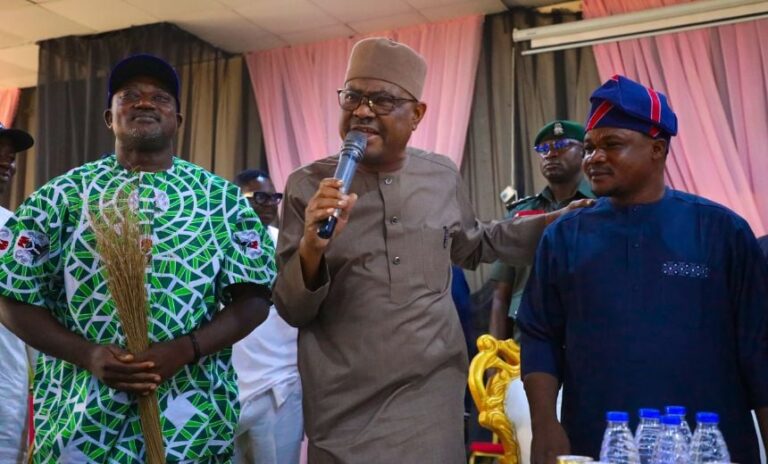
However, the elections have been overshadowed by the assertive intervention of the FCT Minister, Nyesom Wike, who has openly declared support for candidates aligned with President Bola Tinubu’s agenda, regardless of party affiliation.

Wike, while addressing supporters in Abuja last week, said he would ensure that only candidates backing the President emerge victorious.

“I have a duty to support any candidate that supports President Tinubu to win,” he said, adding that he owed “no apology” for his stance.

His position has triggered significant shifts within the PDP. In Bwari, the PDP chairmanship candidate, Julius Adamu, stepped down in favour of the APC candidate, Joshua Ishaku Musa. Similarly, in AMAC, the PDP’s Hon. Zadna Dantani withdrew from the race to back the incumbent APC candidate, Hon. Christopher Zakka Maikalangu.

Party insiders attribute both withdrawals to strategic recalibrations influenced by the minister’s political weight in the territory, effectively blurring party lines and consolidating support for the APC in key councils.

Across markets and neighbourhoods, residents expressed cautious optimism mixed with fatigue over campaign promises.

Aisha Abdulkadir, a trader in Bwari market, lamented what she described as a cycle of absentee leadership. “We are tired of leaders who come during campaigns and then disappear,” she said.
Joy Okon, a provision seller at Dutse market, called for competence over ambition, while a mobile phone dealer, Emmanuel Chukwuemeka, emphasised the need for improved infrastructure and security.

Others, like civil servant Victoria Odumu, said their votes would be guided by track record rather than rhetoric.

Security agencies have announced a 12-hour restriction of movement across the FCT from 6am to 6pm on election day to ensure a hitch-free exercise.

With the ADC seeking to assert itself as a viable opposition platform and the APC benefiting from high-profile cross-party endorsements, Saturday’s vote may redefine the political equilibrium in the nation’s capital — and signal the trajectory of broader opposition realignments ahead of future national contests.

Senate Queries Viability of N58.47trn 2026 Budget Amid Revenue Gaps

0

The Senate has raised serious concerns over what it described as persistent poor implementation of federal budgets, warning that recurring zero allocations and non-release of funds to Ministries, Departments and Agencies (MDAs) cast doubt on the Federal Government’s ability to execute the proposed N58.472 trillion 2026 budget.

The upper chamber’s Committee on Appropriations voiced the reservations on Thursday during an engagement with the Federal Government’s Economic Management Team at the National Assembly, Abuja.

The session also reviewed the capital components of the 2024 and 2025 budgets, which the executive plans to conclude by March 31.
Chairman of the Committee, Adeola Solomon Olamilekan, said the wide gap between revenue projections and actual performance in recent years undermined confidence in the government’s fiscal projections.

In attendance were the Minister of Finance and Coordinating Minister of the Economy, Wale Edun; the Minister of Budget and Economic Planning, Atiku Bagudu; the Chairman of the Nigeria Revenue Service (NRS), Zach Adedeji; and the Accountant-General of the Federation, Shamsedeen Babatunde Ogunjimi.

Edun, who spoke first, maintained that the 2024 and 2025 budgets were being funded and implemented steadily. His position, however, drew sharp reactions from lawmakers, who argued that implementation performance on the ground did not reflect such assurances.

Adedeji sought to provide context, stressing that budget performance hinges on realistic revenue projections.

“Efficiency is not about the size of the budget but about how much can actually be implemented,” he said. “If you assume resources that do not materialise, implementation challenges are inevitable.”

But the explanation failed to assuage the committee. Olamilekan insisted that responsibility for the recurring shortfalls lies squarely with the executive arm.

“This document before us originated from the executive,” he said. “The projections and the challenges came from the executive, not the legislature. The gap between projected and realised oil revenue is wide.

“How do we explain 18 per cent performance in one year and projections of 36.5 per cent the next year when actual performance remains below expectations?” he queried.
He warned that with debt financing already elevated, the government must reconsider its approach.

“Do we reduce the N58.472 trillion 2026 budget, or proceed and adjust along the way? If certain assets were disposed of to reduce debt, the overall debt stock would decline, and future borrowing costs could ease.”

Also addressing the committee, the Minister of State for Finance, Doris Nkiruka Uzoka-Anite, assured lawmakers that 30 per cent of the capital components of the 2024 and 2025 budgets would be fully implemented before the end of the first quarter.

She disclosed that payments for outstanding 2024 capital projects would commence immediately, noting that the government’s financial management system had been restored.

“For 2025, MDAs have been directed to upload their cash plans by Monday, after which payments will begin. We are ready to start, but the MDAs must complete their documentation requirements,” she said.

The exchange underscored growing tension between the legislature and the executive over fiscal discipline, revenue realism and the sustainability of Nigeria’s expanding budget framework.

PENGASSAN To Tinubu: Withdraw Executive Order Undermining Petroleum Industry Act

0

The Petroleum and Natural Gas Senior Staff Association of Nigeria (PENGASSAN) has urged President Bola Tinubu to immediately withdraw the recent executive order mandating the direct remittance of oil and gas revenues to the Federation Account Allocation Committee (FAAC), describing the directive as a violation of the Petroleum Industry Act (PIA).

The President had, in February, signed an executive order stripping the Nigerian National Petroleum Company Limited (NNPC) Limited of its powers to deduct oil revenues at source before remitting to FAAC.

Addressing journalists on Thursday, PENGASSAN National President, Festus Osifo, characterised the directive as “a direct attack” on the PIA, particularly Sections 8, 9 and 64 of the Act.

“The executive order signed by the President is a direct assault on the PIA,” Osifo said. “An executive order cannot override the provisions of an existing law duly enacted by the National Assembly.”

He argued that the President, by issuing the directive, had effectively set aside a law of the Federal Republic of Nigeria through executive fiat, warning that such a move could undermine investor confidence in the oil and gas sector.

While acknowledging the President’s constitutional powers to issue executive orders, Osifo maintained that such powers must not conflict with extant legislation.

“We believe Mr President may not have been fully briefed on the far-reaching implications of this order,” he said, adding that Tinubu’s background in the oil industry and his previous experience at ExxonMobil would ordinarily incline him to protect, rather than weaken, the regulatory framework designed to attract investment.

Osifo warned that allowing the executive order to stand could send negative signals to both local and international investors, who may fear that the government could alter fiscal and regulatory terms through administrative directives.

He likened the development to a hypothetical scenario in which the President issues an executive order setting aside the Independent National Electoral Commission (INEC) or arbitrarily reducing statutory pension contributions, stressing that executive actions cannot supersede statutory provisions.

Describing the order as “troubling” and “an aberration,” the PENGASSAN leader cautioned that failure to recall it could have severe implications for workers in the sector.

“If this order is not withdrawn, our members risk being declared redundant, as NNPC may be unable to meet its obligations,” he warned.

The union called on the Presidency to review the directive and align any fiscal reforms with the framework established under the Petroleum Industry Act to preserve stability and investor confidence in Nigeria’s oil and gas industry.

Fubara Mourns Senator Barinada Mpigi, Describes Death As Great Loss To Rivers

0

Governor of Rivers State, Siminalayi Fubara, has expressed deep sorrow over the death of Senator Barinada Mpigi, who represented Rivers South-East Senatorial District in the National Assembly.

Mpigi, 64, was until his death the Chairman of the Senate Committee on Works in the 10th National Assembly.

His passing has thrown political stakeholders in Rivers State and beyond into mourning, given his long-standing influence in the state’s political landscape.

In a statement issued on Wednesday by his Chief Press Secretary, Onwuka Nzeshi, Governor Fubara described the late lawmaker as a “brother, consummate politician and one of the leading lights in Rivers State politics.”

The governor said Mpigi’s death came at a critical time when his experience and services were still needed by the people of the state, particularly at the federal level where he played a key role in legislative oversight on infrastructure development.

Fubara prayed for the repose of the senator’s soul and urged his family and associates to find comfort in what he described as a life of impact and service.

He commiserated with the immediate family of the deceased, the people of Rivers South-East Senatorial District and members of the Senate, noting that Mpigi left behind a legacy of dedication to public service and commitment to the development of Rivers State.

A seasoned politician, Mpigi was regarded as a prominent figure in Rivers politics, contributing significantly to legislative debates and constituency development initiatives.

His role as Chairman of the Senate Committee on Works placed him at the centre of oversight responsibilities on federal road projects and other critical infrastructure across the country.

Funeral arrangements are expected to be announced by the family.