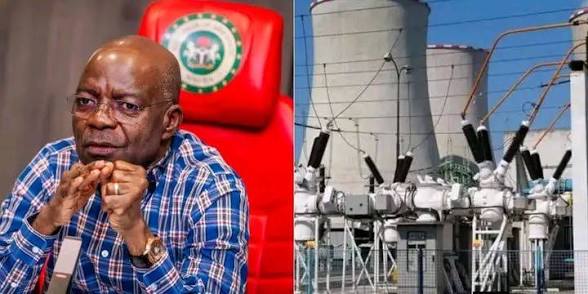
Governor Alex Otti has unveiled an ambitious plan to disconnect Abia State from Nigeria’s national electricity grid, signalling a decisive shift toward energy independence in response to the country’s persistent power supply challenges.
Speaking on the initiative, Otti disclosed that his administration is already in advanced negotiations with foreign partners to actualise the project, describing it as a private sector-led effort backed by government support.
According to the governor, the state’s Commissioner for Power is currently in the Netherlands engaging potential investors and technical partners, as groundwork intensifies for what could become one of the most far-reaching subnational energy reforms in Nigeria.
“Our vision is clear: to detach the entire state from the national grid,” Otti said, underscoring the scale and urgency of the plan.
He explained that the move is driven by the need to guarantee stable and reliable electricity for households, industries and businesses, long hampered by erratic supply from the national grid.
Framing the project as a people-centred intervention, the governor added, “It is all for us,” emphasising its anticipated impact on economic growth and quality of life.
The proposal marks a significant moment in Nigeria’s evolving power sector, as states increasingly explore decentralised energy solutions to overcome structural inefficiencies in the national system. If strongly concluded, Abia’s full disengagement from the grid could redefine subnational participation in electricity generation and distribution, potentially setting a precedent for other states seeking to chart independent energy pathways.
The Centre for Peace, Democracy and Development (CPDD) has raised concerns over a recent social media and some online news medium which misrepresented comments made by Nigeria’s Chief of Defence Staff, Gen Olufemi Oluyede, regarding the killing of terrorists, warning that such inaccuracies could undermine ongoing military operations.
In a statement on Friday, CPDD Convener Akin Daniels said the reports some on Facebook, which has gained traction online, distorted the context of the CDS’s remarks and created a misleading narrative that does not reflect the realities of ongoing military engagements across insurgency-affected areas.
CPDD noted that at a time when troops are recording measurable successes against insurgent groups, the spread of misinformation could weaken public confidence and inadvertently embolden criminal elements seeking to exploit gaps in public perception.
The group stressed that the Armed Forces of Nigeria remain bound by established rules of engagement and international best practices, adding that comments attributed to the CDS in the viral post were taken out of context and risk misinforming the public.
It therefore called on journalists, bloggers and social media influencers to exercise restraint and professionalism by verifying facts before dissemination, especially on sensitive national security matters that could influence troop morale and public cooperation.
The organisation further warned that sensational reporting could serve the propaganda objectives of terrorist groups such as Boko Haram and Islamic State West Africa Province, which are known to exploit misinformation as part of their psychological warfare strategies.
CPDD emphasised that while the media has a constitutional role in holding authorities accountable, it must also act in ways that do not jeopardise national security efforts, urging all stakeholders to prioritise accuracy, responsibility and national interest as Nigeria continues its fight against insurgency.
The Centre for Peace, Democracy and Development (CPDD) has raised concerns over a recent social media and some online news medium which misrepresented comments made by Nigeria’s Chief of Defence Staff, Gen Olufemi Oluyede, regarding the killing of terrorists, warning that such inaccuracies could undermine ongoing military operations.
In a statement on Friday, CPDD Convener Akin Daniels said the reports some on Facebook, which has gained traction online, distorted the context of the CDS’s remarks and created a misleading narrative that does not reflect the realities of ongoing military engagements across insurgency-affected areas.
CPDD noted that at a time when troops are recording measurable successes against insurgent groups, the spread of misinformation could weaken public confidence and inadvertently embolden criminal elements seeking to exploit gaps in public perception.
The group stressed that the Armed Forces of Nigeria remain bound by established rules of engagement and international best practices, adding that comments attributed to the CDS in the viral post were taken out of context and risk misinforming the public.
It therefore called on journalists, bloggers and social media influencers to exercise restraint and professionalism by verifying facts before dissemination, especially on sensitive national security matters that could influence troop morale and public cooperation.
The organisation further warned that sensational reporting could serve the propaganda objectives of terrorist groups such as Boko Haram and Islamic State West Africa Province, which are known to exploit misinformation as part of their psychological warfare strategies.
CPDD emphasised that while the media has a constitutional role in holding authorities accountable, it must also act in ways that do not jeopardise national security efforts, urging all stakeholders to prioritise accuracy, responsibility and national interest as Nigeria continues its fight against insurgency.
The Centre for Peace, Democracy and Development (CPDD) has raised concerns over a recent social media and some online news medium which misrepresented comments made by Nigeria’s Chief of Defence Staff, Gen Olufemi Oluyede, regarding the killing of terrorists, warning that such inaccuracies could undermine ongoing military operations.
In a statement on Friday, CPDD Convener Akin Daniels said the reports some on Facebook, which has gained traction online, distorted the context of the CDS’s remarks and created a misleading narrative that does not reflect the realities of ongoing military engagements across insurgency-affected areas.
CPDD noted that at a time when troops are recording measurable successes against insurgent groups, the spread of misinformation could weaken public confidence and inadvertently embolden criminal elements seeking to exploit gaps in public perception.
The group stressed that the Armed Forces of Nigeria remain bound by established rules of engagement and international best practices, adding that comments attributed to the CDS in the viral post were taken out of context and risk misinforming the public.
It therefore called on journalists, bloggers and social media influencers to exercise restraint and professionalism by verifying facts before dissemination, especially on sensitive national security matters that could influence troop morale and public cooperation.
The organisation further warned that sensational reporting could serve the propaganda objectives of terrorist groups such as Boko Haram and Islamic State West Africa Province, which are known to exploit misinformation as part of their psychological warfare strategies.
CPDD emphasised that while the media has a constitutional role in holding authorities accountable, it must also act in ways that do not jeopardise national security efforts, urging all stakeholders to prioritise accuracy, responsibility and national interest as Nigeria continues its fight against insurgency.
The Niger Delta Development Commission (NDDC) has initiated an emergency intervention to overhaul electricity supply at its headquarters complex, with the formal handover of the project to Income Electrix, an integrated power solutions firm.
At the handover ceremony, the Director of Community and Rural Development, Engr. Theophilus Alagoa—represented by Deputy Director Mr Olorunlara Olumide, said the project aims to connect the Commission’s headquarters to a more stable power source through the Port Harcourt Electricity Distribution Company (PHED) bilateral feeder.
In a statement signed and issued by Seledi Thompson-Wakama, Director, Corporate Affairs of the NDDC, he explained that the intervention is designed to curb the Commission’s heavy reliance on diesel generators while ensuring a more reliable and uninterrupted power supply.
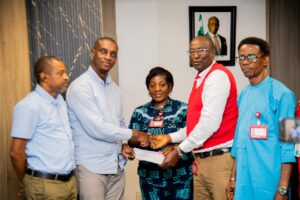
NDDC Deputy Director, Community and Rural Development, Mr Olorunlara Olumide (2nd right) handing over project documents to the Business Development Manager of Income Electrix Ltd, Mr Omo Adam (2nd left) at the NDDC headquarters in Port Harcourt, With them are the NDDC Director Corporate Affairs, Dr Tony Omah (right); the Head of engineering, Income Electrix Ltd, Peekate Eric (left); and the NDDC head facility management in Admin and Human Resources, Engr Dr Alalibo Erefaa (middle).
“We are here in respect of an emergency work awarded to Income Electrix to connect the NDDC head office to PHED. This meeting also serves as the formal introduction and handover of the contractor for the project,” he said, urging the contractor to meet expectations and promptly flag any execution challenges.
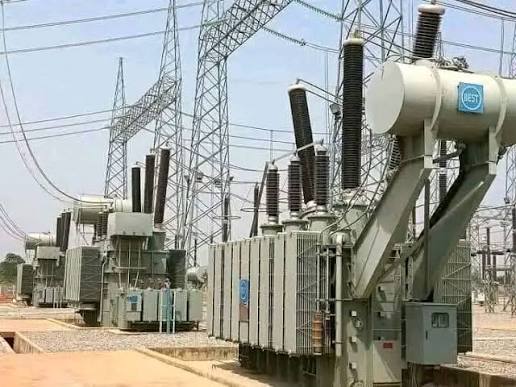
Alagoa outlined the scope of the project to include the construction of a 33KV double-circuit line from Hypercity Roundabout, installation of a 1.5MVA 33/0.415KV distribution substation, and the upgrade of an existing 500KVA transformer at the annex. The upgrade will convert the current 11/0.415KV transformer to a 33/0.415KV system, alongside improvements to the 33KV feeder switchgear at the supply end.
Also speaking, the Deputy Director of Administration and Human Resources, Engr. Erefa Alalibo, assured that the Commission’s project monitoring unit would ensure strict compliance with technical standards and specifications throughout execution.
In his response, Income Electrix representative, Mr Umo Adam, pledged the company’s commitment to delivering the project within agreed timelines and quality benchmarks.
Meanwhile, Director II, Corporate Affairs, Dr Tony Omah, stressed the importance of thorough needs assessment in project planning, noting that such evaluations enhance relevance and long-term impact. He further called on stakeholders to take ownership of the project to guarantee sustainability, while urging the contractor to uphold the highest standards.
The 128th inaugural lecturer at Rivers State University, Professor Emmanuel Osilemme Ekwulo, has called for a fundamental overhaul of Nigeria’s highway pavement systems, warning that poor design practices and weak standards, not just inadequate funding, are at the heart of the country’s persistent road failures.
Delivering a lecture titled “Removing Roadblocks: Rebuilding The Foundation For Reliable Highway Pavement Infrastructure” in Port Harcourt, Ekwulo argued that Nigeria’s roads will continue to deteriorate prematurely unless critical engineering principles are strictly applied and enforced.
According to him, recurring defects in the nation’s highways stem from a combination of faulty design processes, substandard construction materials, weak regulatory enforcement, poor drainage systems, and widespread disregard for professional ethics. He stressed that these systemic failures have undermined the durability of road infrastructure despite significant financial investments.
“Premature pavement failures in Nigeria are not due to lack of funds alone, but largely due to poor design decisions, weak material standards, and absence of accountability,” he said.
Ekwulo proposed the adoption of the mechanistic-empirical design approach, a scientifically grounded method for predicting pavement performance, as a pathway to improving road quality. He also advocated the development of a localized framework, the Nigerian Empirical and Mechanistic Pavement Design System (NEMPADS), to reflect the country’s unique environmental and material conditions.
He further recommended stricter quality control measures, including independent audits, the establishment of a national database for material characterization, and compulsory traffic load analysis for all road projects. The use of modified binders and advanced materials, he added, would enhance pavement resilience.
To ensure sustainability, the professor called for the implementation of a National Pavement Management System to coordinate maintenance and monitoring efforts nationwide, noting that consistent upkeep is essential to prolonging road lifespan.
Ekwulo emphasized the need for stronger collaboration between academia and industry, urging universities to lead applied research initiatives and pilot projects that can deliver practical solutions to Nigeria’s infrastructure challenges.
Earlier, the Vice Chancellor of Rivers State University, Professor Isaac Zeb-Obipi, said universities must play a frontline role in addressing national development issues through research-driven interventions. He described the lecture as timely, noting that the neglect of core engineering standards has contributed significantly to the country’s failing highways.
The event, held at the Dr. Ezenwo Wike Senate Building in Port Harcourt, also featured the formal decoration of Ekwulo as the institution’s 128th inaugural lecturer.
Reiterating his position after the lecture, Ekwulo maintained that with proper design methods, quality materials, and strict adherence to global standards, Nigeria’s roads can achieve their intended lifespan of 10 to 20 years or more.
His message was clear: without a return to engineering fundamentals and accountability, investments in road infrastructure will continue to yield poor results.
Tension has gripped Ekowe in Southern Ijaw Local Government Area of Bayelsa State following the alleged extrajudicial killing of a young man by members of the community.
The victim, identified as Emi Sigah, an indigene of Ekowe and a married father of two, was reportedly beaten to death on March 24, 2026, over allegations of attempting to sexually assault an underage girl.
According to sources, the community’s traditional ruler, Andy Godwill Toboro, allegedly ordered members of the youth wing to subject the suspect to public flogging across various compounds in the community.
The punishment, which reportedly involved moving the victim from one compound to another, degenerated into fatal violence as he succumbed to injuries sustained during the ordeal.
The incident has triggered unrest in the community, with aggrieved youths, friends and family members of the deceased protesting against what they described as a brutal and unlawful act.
Residents said the situation has created an atmosphere of fear and tension, raising concerns over a possible breakdown of law and order if urgent intervention is not undertaken by the state government.
Meanwhile, the state police command has launched an investigation into the incident. The traditional ruler and some members of his cabinet have reportedly been arrested and are currently in police custody.
Sources further revealed that the monarch had earlier been petitioned by over 70 stakeholders in the community, alleging high-handedness, financial recklessness and autocratic leadership, with the petition pending before the state government prior to the incident.
Community stakeholders have called for a thorough investigation and justice for the deceased, while urging authorities to take swift action to restore calm in the area.
The Executive Secretary and Chief Executive Officer of the Rivers State Contributory Health Protection Programme, Dr. Vetty Agala, has called on residents to amplify awareness of the state’s health insurance scheme to boost enrolment and access to quality healthcare.
Agala, represented by the agency’s Head of Planning, Dr. Juliet Aleme, made the appeal on Wednesday, March 25, 2026, during a sensitisation and enrolment meeting at the palace of the Eze-elect of Oyigbo, Eze Samuel N Azuh, in Oyigbo Town.
Group photography with the 600 level medical students.
aHe stressed that wider dissemination of information about the scheme would deepen public awareness and encourage more residents to take advantage of the initiative championed by Governor Siminalayi Fubara.
Agala explained that the programme is designed to provide affordable and quality healthcare services to residents across the state’s 23 local government areas, eliminating financial hardship at the point of care.
He further noted that both federal and state governments have already covered premiums for vulnerable groups, urging residents of Oyigbo and beyond to enrol for seamless healthcare delivery.
Responding, Azuh commended the initiative and assured that his people would embrace the scheme. He, however, appealed for an expansion of the vulnerability category to accommodate more citizens, while also urging the inclusion of eye care services and surgeries.
Group photograph with the Eze-elect, Oyibo and Pamo delegates/students.
Earlier, the Head of Community Medicine at PAMO University of Medical Sciences, Dr. Chidinma Opara, disclosed that research conducted by 600-level medical students revealed low awareness of the scheme and poor utilisation of primary healthcare centres in Oyigbo.
She said the institution partnered with RIVCHPP to bridge the awareness gap and enhance community access to the programme’s benefits, particularly among vulnerable populations.
As part of the collaboration, officials conducted an assessment visit to the PAMO University Teaching Hospital, with ongoing discussions to onboard the facility as a service provider for RIVCHPP enrollees.
The Niger Delta Development Commission (NDDC) has distributed relief materials to residents of Ogu-Bolo in Rivers State, in response to the recent flood disaster that displaced families, destroyed farmlands and worsened economic hardship in the area.
Presenting the items on behalf of the Managing Director, the Director II, Education, Health and Social Services, Engr. Jeremiah Onolejoloni, said the intervention underscores the commission’s commitment to alleviating the plight of vulnerable communities across the Niger Delta.
According to a statement by the Director of Corporate Affairs, Seledi Thompson-Wakama, the gesture followed the devastating impact of flooding on livelihoods in the community.
The Managing Director noted that the commission, in collaboration with the Derek and Davia Foundation, provided financial support to facilitate the distribution of essential food items and household materials to affected residents.
He described the initiative as part of efforts to address pressing needs, adding that it also reflects government’s solidarity with citizens facing economic challenges.
“This intervention goes beyond palliatives. It is a demonstration of government’s presence, compassion and commitment to supporting families in distress, in line with the renewed hope agenda of the President,” he said.
He urged community leaders to ensure fair distribution of the items and encouraged residents to sustain peace and support development programmes.
The Paramount Ruler of Ogu-Bolo, Chief Joachim Amachiri, commended the commission for the timely intervention, noting that it would provide much-needed relief to victims of the flood.
He reaffirmed the community’s support for NDDC initiatives aimed at improving living conditions in the region.
Also speaking, a consultant on the programme, represented by Dr George Smile, praised the commission’s responsiveness to disaster-affected communities, disclosing that plans were underway, in partnership with development stakeholders, to extend similar support to neighbouring areas.
In another development, the NDDC, has donated broadcast equipment to the National Youth Service Corps, NYSC, to boost its capacity to communicate and enhance youth development in the country.
Speaking during the presentation of the communication equipment at the NYSC National Directorate Headquarters in Abuja, the NDDC Managing Director, Dr Samuel Ogbuku, said the intervention would galvanise the NYSC’s initiative in providing a strategic platform for national integration.
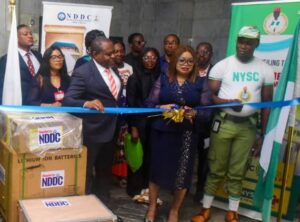
Director, NDDC Liaison Office, Abuja, Mrs Mary Nwaeke (middle) cuts the tape to hand over broadcast equipment to the National Youth Service Corps, at the NYSC National Directorate Headquarters in Abuja.With her is the NYSC Director, Media, Mr Emeka Mgbemena.
Ogbuku, who was represented by the Director, NDDC Liaison Office, Abuja, Mrs Mary Nwaeke, said that the NYSC plays a strategic role in bringing young people together.
According to the NDDC boss, “When you support the NYSC, you are empowering the nation because the scheme brings together youths from all parts of the country.
“Communication is very important, and we must ensure that it is done effectively. The NDDC recognises communication as a vital tool for national growth and development.
“That is why the Commission decided to make this presentation to boost the capacity of the NYSC radio station, so it can effectively engage corps members and inform the public about its activities and impact.”
He added that the NDDC was committed to identifying and addressing institutional gaps to support national development.
“NDDC steps in wherever there are gaps in society. After proper assessment, we provide the needed support to strengthen institutions and improve service delivery,” he said.
The NDDC boss explained that the intervention included a complete inverter system with a lithium battery for an uninterrupted power supply; a 2-kilowatt Italian-made, energy-efficient radio transmitter compliant with National Broadcasting Commission regulations; and the full renovation of the station’s wiring system in both recording and live studios to eliminate audio noise and enhance sound quality.
Also speaking, the Director-General of NYSC, Brig.-Gen. Olakunle Nafiu, commended the NDDC for the donation, describing it as timely and impactful.
Nafiu, who was represented by the Director, Media, Mr Emeka Mgbemena, said the equipment would enhance operations at the NYSC radio station and improve training for corps members in broadcasting.
He described the donation as a major boost to the Scheme’s broadcasting capacity, noting that the NYSC Radio Station, which has been in operation for over four years, serves as a critical training platform for corps members.
The Director-General stated that the station is largely operated by Corps Members who acquire practical broadcasting skills while contributing to its daily operations. He further disclosed that more than 12 Corps Members who trained at the station in the past three years have secured employment with media organisations.
He assured the NDDC that the equipment would be put to effective use to ensure uninterrupted transmission and improved service delivery.
The NYSC Director-General expressed appreciation to the NDDC for the intervention and assured that the equipment would be effectively utilised to strengthen the station’s mandate to educate, inform, and entertain.
Nigerians may begin to experience a gradual improvement in electricity supply as ongoing maintenance on a major gas pipeline nears completion, the Chief Technical Adviser to the Minister of Power, Adebayo Olowoniyi, has said.
Olowoniyi, who spoke on Thursday during an appearance on Arise Television, disclosed that full restoration of gas supply to power plants is expected within the next two weeks.
His comments follow a recent apology by the Minister of Power, Adebayo Adelabu, over persistent outages that have disrupted homes, businesses and industries nationwide.
Defending the minister’s stance, Olowoniyi said the apology reflected leadership and accountability rather than an admission of personal fault.
“I think, first of all, I’d like to start with the apology from the Honourable Minister, which we believe is all about taking leadership in the sector,” he said.
“Not necessarily directly his fault for the challenges that we have, but as the Minister of Power, it was the right leadership step to take ownership and ensure that solutions are provided in the shortest possible time.”
He attributed the recent drop in electricity generation to maintenance work on a critical gas pipeline supplying fuel to several power plants, stressing Nigeria’s heavy reliance on gas-fired power.
“One of the major gas pipelines in Nigeria was undergoing maintenance, and gradually that process is being completed,” he said.
According to him, restoration of gas pressure will enable power plants to return to their previous generation levels recorded in recent months.
“We’re sure that within the next two weeks, full gas pressure will be back on the pipelines, and power plants will be able to get enough gas to return to their levels of generation seen in the last two to three months,” Olowoniyi added.
He noted that early signs of recovery were already evident.
“From yesterday, we have started to see gradual improvement as pressure builds up, and this will continue over the next couple of weeks,” he said.
Earlier in the week in Abuja, Adelabu attributed the outages to factors beyond the government’s immediate control but assured Nigerians that supply would stabilise soon.
He reiterated the Federal Government’s target to boost electricity generation to 6,000 megawatts before the end of 2026, describing the current disruption as temporary.
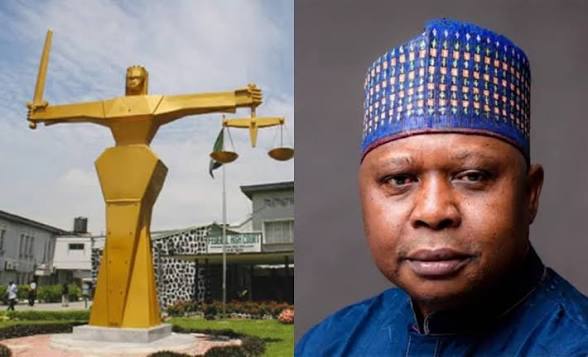
A High Court of the Federal Capital Territory (FCT) has ordered the arrest of factional National Chairman of the Peoples Democratic Party (PDP), Kabiru Turaki, over his failure to appear in court in a case instituted by the Inspector-General of Police (IGP).
Justice U.P. Kekemeke issued the order after Turaki did not attend proceedings and offered no justification for his absence. The judge held that his failure to appear was inexcusable.
The IGP had filed a one-count charge against Turaki, accusing him of providing false information to the police in a petition dated October 2022.
Meanwhile, the PDP faction led by Turaki has rejected any suggestion of aligning with the ruling All Progressives Congress (APC) ahead of the 2027 general elections.
Speaking on Thursday during an appearance on Arise Television’s Morning Show, the faction’s National Publicity Secretary, Ini Ememobong, described any move to endorse President Bola Tinubu as “immoral, unjust and unfair.”
According to Ememobong, the party’s ongoing reconciliation process must reinforce its role as a credible opposition force rather than diminish its independence.
“It is improper, immoral and unjust for an opposition party of the standing of the PDP to endorse the presidency or candidature of President Bola Tinubu,” he said.
He expressed confidence that ongoing reconciliation efforts within the party would be guided by reason rather than sentiment, insisting that the outcome must strengthen the PDP’s position as a viable alternative to the ruling party.
The Coroner Court sitting in Lagos has adjourned proceedings in the inquest into the death of journalist, Pelumi Onifade, to April 7, 2026, following the failure of the Chief Medical Director of Lagos State University Teaching Hospital to comply with its directive to produce a report on an unidentified body linked to the case.
Onifade, a reporter with Gboah TV, was reportedly shot while covering the #EndSARS protests on October 24, 2020.
At the resumed hearing, counsel to Media Rights Agenda and the Onifade family, Alimi Adamu, urged the court to issue a Form 48 against the CMD for disobeying its order to provide details concerning a body tagged 1385.
The body was reportedly received by LASUTH from Ikorodu General Hospital on November 3, 2020, with a post-mortem said to have been conducted later that month.
However, the presiding coroner, Temitope Oladele, declined the application, stating that the court would grant the CMD a final opportunity to comply with its directive.
The initial order, issued on November 18, 2025, directed LASUTH to produce a comprehensive report on the unidentified body. Following continued non-compliance, the court, on March 3, 2026, issued a fresh order specifically mandating the CMD to submit the report within 14 days.
Despite confirmation that the directive had been duly served, LASUTH neither submitted the report nor sent a representative to court at the last sitting.
Adamu informed the court that the bailiff had effected service of the order and urged verification of compliance, which the coroner confirmed had not been met.
While acknowledging the repeated disobedience, Oladele cautioned against immediate enforcement proceedings, noting that bureaucratic delays in institutional settings could affect the transmission of court documents.
She directed counsel, alongside Mr Monday Arunsi, to follow up with LASUTH to ascertain reasons for the non-compliance and ensure prompt adherence to the order.
The inquest was instituted pursuant to a judgment of the Federal High Court, delivered by Ayokunle Olayinka Faji on July 19, 2024.
In the ruling, the court ordered the Lagos State Government to investigate the circumstances surrounding Onifade’s death, conduct a coroner’s inquest, and ensure the identification and prosecution of those responsible.
The matter was subsequently adjourned for mention.