The Nigerian Union of Journalists (NUJ), Rivers State Council, has condemned the attack on a journalist with Naija/Beat/Classic FM, Port Harcourt, Ambassador Allwell Ene, by suspected hoodlums in the state.
In a statement signed by its Chairman, Comrade Paul Bazia-Nsaneh, and Secretary, Dr Ijeoma Tubosia, the union said the incident occurred on Monday, April 13, 2026, at Garrison Junction in Port Harcourt, while the journalist was carrying out legitimate news-gathering duties.
The NUJ described the attack as unwarranted and called on the Rivers State Police Command to immediately apprehend those responsible and take necessary steps to address the trauma suffered by the victim.
According to the statement, Ene was brutally assaulted, sustaining multiple lacerations and swollen eyes, while his phone was seized and destroyed by the attackers. The assailants were also said to have torn his clothes and forcefully taken him to an undisclosed location before he was eventually rescued.
“The NUJ is disheartened by this ugly incident. Rather than treat journalists as partners in nation-building, members of the public, in many cases, continue to see them as enemies to be attacked,” the statement said.
“It is unacceptable that in a civilised society, a journalist would be assaulted in the line of duty. This is a clear violation of his fundamental rights,” it added.
The union, therefore, urged the government and the police to ensure that the perpetrators are brought to justice, while also calling for adequate compensation for the victim and measures to prevent a recurrence.
Delta State Governor, Sheriff Oborevwori has reaffirmed the commitment of the Niger Delta Development Commission (NDDC), the Delta State Government, and Chevron Nigeria Limited to ensure strict quality standards in the execution of the 70.75-kilometre Omadino–Okerenkoko–Escravos Road and associated bridges in Warri North Local Government Area.
Oborevwori gave the assurance in Asaba while receiving members of the National Assembly Committees on NDDC, led by Asuquo Ekpenyong, Chairman of the Senate Committee on NDDC, during a courtesy visit to Government House.
The delegation, which included the NDDC Managing Director, Samuel Ogbuku, and Delta State Office Director, Engr. Joseph Onoriode, was in the state to commence a two-day inspection of NDDC projects in Delta and Cross River states.
The governor expressed satisfaction with ongoing tripartite engagements involving the state government, NDDC, and Chevron on the strategic road project. He noted that the infrastructure would link Warri to key oil-producing coastal communities, boosting economic activity, strengthening security, and accelerating development across the region.
He added that his administration was collaborating closely with the commission to fast-track delivery, reiterating its commitment to transparency, accountability, and cost-effective execution of infrastructure projects.
Earlier, Ekpenyong commended the governor’s infrastructure drive and underscored the Senate’s backing for NDDC’s “Renewed Hope” projects aimed at delivering tangible benefits to host communities.
According to him, the joint Senate and House of Representatives committees are undertaking verification tours of NDDC projects to ensure accountability and value for money.
Ekpenyong further stated that the 10th Senate, under the leadership of Godswill Akpabio, remains committed to supporting the commission in delivering projects to the highest standards.
“Our visit is not only to inspect but to ensure timely completion of projects for the benefit of our people,” he said, pledging continued collaboration with state governments and the NDDC to address development challenges in the Niger Delta.
The All Progressives Congress (APC) has scheduled May 18, 2026, for its governorship primaries across the country, as part of early preparations for the 2027 general elections.
Under the timetable, aspirants — including Siminalayi Fubara of Rivers State — are expected to know their fate following the exercise.
Details of the schedule were contained in a two-page document signed by the party’s National Organising Secretary, Sulaimon Arugungu, and obtained on Monday.
The party fixed May 24, 2026, for hearings of petitions arising from House of Assembly primaries, while appeals related to governorship, House of Representatives, and Senate primaries will be entertained on May 25.
APC also announced that governorship aspirants will pay ₦10 million for the expression of interest form and ₦40 million for the nomination form. For presidential hopefuls, the fees are pegged at ₦30 million and ₦70 million, respectively.
Sales of nomination forms will commence on April 25 at the party’s national secretariat and close on May 2, with completed forms to be submitted by May 4, 2026.
The development follows the defection of Fubara from the Peoples Democratic Party (PDP) to the APC in December 2025, a move widely seen as a significant shift in the political dynamics of Rivers State.
As the timetable unfolds, the party has reiterated its call for support for President Bola Tinubu and its candidates nationwide ahead of the 2027 polls.
Tension gripped Yenagoa on Monday as heavily armed security operatives sealed off Ijaw House along Sani Abacha Road, halting the planned National Executive Council (NEC) election of the Ijaw National Congress.
A combined team of stern-looking personnel from the Nigeria Police Force and the Department of State Services took control of the premises as early as 7 a.m., denying access to delegates and stakeholders.
At least eight police vans were strategically positioned around the complex, while DSS operatives maintained a strong presence within the facility, effectively shutting down all activities.
An aide to one of the candidates, who arrived with escorts from the Nigerian Army and the Nigeria Security and Civil Defence Corps, was informed by a senior police officer that the barricade was enforced on the orders of the Commissioner of Police.
The development followed a directive by the Conference of Ijaw Traditional Rulers and Elders, which had earlier called for the suspension of the election amid rising disputes and petitions against the NEC and its Electoral Committee.
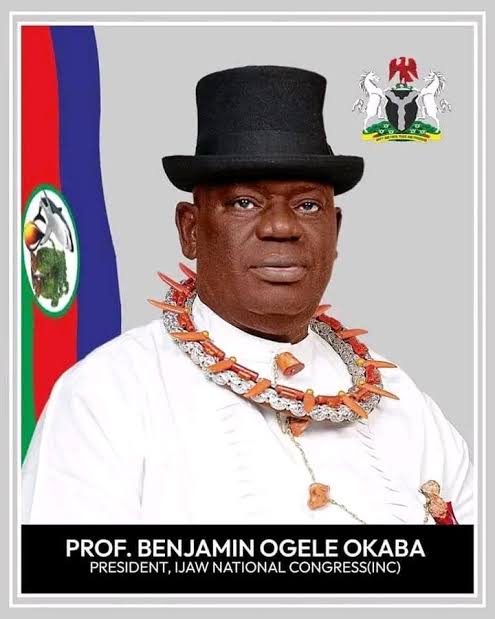
At a press briefing on Sunday, the Chairman of CITRE and Bayelsa State Traditional Rulers Council, King Bubaraye Dakolo, cited multiple constitutional breaches under the Prof. Benjamin Okaba-led NEC, warning that the prevailing tension among delegates made a credible election impossible.
He emphasised that, as the final arbiter under the INC constitution, CITRE had formally written to the Bayelsa State Police Command to prevent any gathering at Ijaw House pending the resolution of the disputes.
The disruption underscores a deepening leadership crisis within the INC, a body regarded as the foremost socio-cultural organisation representing the interests of the Ijaw people across Nigeria and the diaspora. For millions of Ijaw people worldwide, the INC serves not only as a unifying platform but also as a critical voice in advocacy, resource control, environmental justice and regional development in the Niger Delta.
Observers warn that the inability to conduct a peaceful and credible NEC election could weaken the Congress’ moral authority at a time when coordinated leadership is vital to addressing longstanding socio-economic and political challenges confronting Ijaw communities globally.
As security remains tight around the venue, uncertainty persists over when the electoral process will resume, raising fresh concerns about stability within one of the Niger Delta’s most influential ethnic institutions.
Nigeria’s capital market regulator, the Securities and Exchange Commission Nigeria, has directed an immediate freeze on the assets of 13 individuals and entities over alleged links to terrorism financing.
The directive, which takes effect without delay, targets 10 individuals and three companies recently listed on the Nigeria Sanctions List by the Nigeria Sanctions Committee.
In a circular issued to capital market operators, the Commission said the action is backed by provisions of the Terrorism (Prevention and Prohibition) Act, 2022, which empowers authorities to block access to funds tied to designated persons or groups without prior notice.
The SEC ordered all operators to identify and immediately freeze accounts linked to the affected parties, halt all transactions, and report any such assets or attempted dealings to the Sanctions Committee Secretariat.
“The directive is binding on all capital market operators and must be enforced without delay,” the Commission stated, warning that hesitation could undermine efforts to curb illicit financial flows.
Regulators disclosed that some of the individuals had previously been convicted by the Abu Dhabi Federal Court of Appeal in April 2019 for offences connected to terrorism financing, including raising funds abroad and channeling them into Nigeria to support activities linked to Boko Haram. Sentences ranged from 10 years’ imprisonment to life terms.
The SEC also highlighted the role of corporate entities in masking illicit transactions, noting that some of the affected companies were used as conduits for cross-border fund movements.
Describing the measure as preventive rather than punitive, the Commission said the objective is to disrupt financial networks that sustain terrorism before funds are deployed.
It warned that non-compliance would attract severe consequences, including civil and criminal sanctions, as well as reputational damage for defaulting institutions.
The directive extends beyond financial institutions to include designated non-financial businesses and professions, underscoring what the SEC described as a more aggressive and comprehensive approach to combating money laundering and terrorism financing.
Operators were further advised to strengthen compliance systems through real-time name screening, asset monitoring, and prompt reporting, while ensuring that affected clients are not tipped off ahead of enforcement.
Rivers State Governor, Siminalayi Fubara, has paid glowing tribute to the late Amanyanabo of Opobo Kingdom, Dandeson Douglas Jaja, describing him as a fulfilled and exemplary ruler whose life reflected peace, resilience and selfless service.
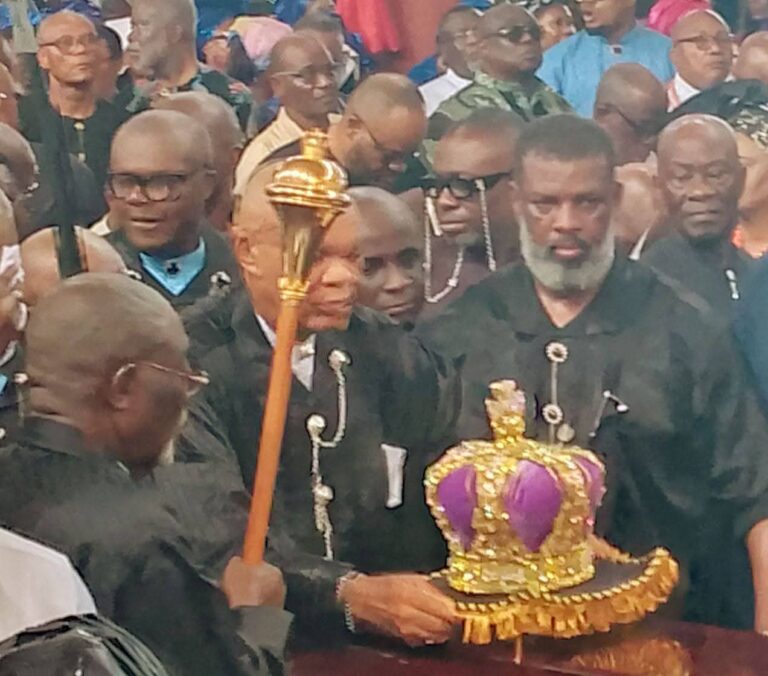
Fubara spoke on Saturday at the funeral service held at St. Paul’s Anglican Church, where dignitaries, traditional rulers and members of the Opobo community gathered to honour the monarch, who died at 83.
The governor said the late king’s life was worthy of emulation, marked by calmness and dignity even in adversity. He recalled the prolonged succession dispute that lasted over two decades, noting that the monarch’s composure ensured sustained peace in the kingdom.
“He kept his cool and the kingdom remained peaceful. He was a man of class and dignity who treated as his children without discrimination,” Fubara said.
He added that the monarch’s reign would remain a reference point in Opobo’s history, noting that beyond the founding fathers, he stands among rulers who left a lasting imprint on the kingdom.
According to him, the late king’s era witnessed significant political milestones, including the emergence of both a deputy governor and a governor from the kingdom, a feat he said history would not forget.
Fubara urged scholars and historians to properly document the monarch’s legacy, describing him as a leader who triumphed despite turbulent circumstances.
Addressing members of the royal family, the governor stressed the need for unity and hard work, cautioning against disputes over inheritance. He said success is not transferable but must be earned through individual effort.
“What you inherit are assets; you do not inherit success. The king has done his part; what we celebrate today is his success, and it cannot be transferred. Everyone must work for their own success,” he said.
He warned that internal conflict would undermine the monarch’s peaceful legacy, urging family members to avoid actions that could bring disrepute to his memory.
Fubara also highlighted the fleeting nature of material possessions, advising the family to focus on enduring values and future development rather than short-term gains.
He concluded that it was an honour to celebrate the life of the late monarch, whose legacy of peace, humility and service, he said, would continue to inspire generations within and beyond Opobo Kingdom.
President Bola Tinubu has reaffirmed the Federal Government’s commitment to deepening collaboration with state governments, commending the Bayelsa State administration for what he described as purposeful leadership and effective partnership with the centre.
Speaking at a stakeholders’ meeting held at the Government House Banquet Hall in Yenagoa, the President said greater achievements would be recorded when all tiers of government work in close synergy.
Earlier, Tinubu inaugurated four major projects executed by the Bayelsa State Government, including a 60-megawatt gas turbine, the dualised New Yenagoa City Road, the 630-metre Angiama-Oporoma Bridge, and the Sagbama–Ekeremor Road—initially started by the Niger Delta Development Commission (NDDC).
Dignitaries at the event included the NDDC Managing Director, Dr Samuel Ogbuku; Executive Director, Corporate Services, Hon. Ifedayo Abegunde; and Bayelsa State representative on the NDDC Board, Senator Dimaro Denyanbofa.
The President noted that the projects reflected the spirit of cooperation underpinning his administration’s Renewed Hope agenda.
“You have done a great job. I have commissioned very transformative projects that are creating opportunities, jobs and renewed hope for our nation,” he said.
Tinubu further stressed the importance of stable electricity to national development, noting that the state’s Independent Power Plant would drive industrialisation and economic growth.
“There can be no industrialisation, skill development or empowerment without power. I assure Nigerians that we will have electricity to power our growth,” he added.
In his remarks, Bayelsa State Governor, Douye Diri, lauded the Federal Government for creating an enabling policy environment for development.
He said the administration’s reforms, particularly in the power sector, had facilitated the delivery of reliable, independent energy through the state’s gas-fired turbines.
Diri also highlighted the completion of the Angiama-Oporoma Bridge, describing it as a long-overdue project that corrected decades of neglect.
He further commended the Federal Government for supporting key infrastructure initiatives, including waivers for the importation of equipment for the Independent Power Plant and the award of the second phase of the Nembe-Brass Road.
The governor said sustained collaboration between the state and federal authorities had accelerated development, as efforts intensify to boost national security and increase crude oil production to over two million barrels per day.
An extraordinary shift in the Premier League title race is gathering pace, with Manchester City surging ominously toward long-time leaders Arsenal and threatening to upend what once appeared a settled campaign.
As reported by ESPN, the permutations are as simple as they are seismic: should City win their two games in hand and overcome Arsenal in their looming showdown, the gap at the summit would vanish entirely. Points would be level. Momentum would not.
What had seemed, for months, like Arsenal’s title to lose has suddenly become precisely that.
“If Manchester City win their two matches in hand and defeat Arsenal next weekend, the two clubs will share the same points,” one widely shared assessment noted. “We might be witnessing one of the most remarkable collapses in history.”
Such language, once unthinkable, now reflects a growing unease around Arsenal’s position. The north London side, so assured for much of the season, are staring at the full force of a familiar and unforgiving reality: a late charge from a City side that specialises in them.
Under Pep Guardiola, City have built a reputation for relentless, clinical finishes — turning pressure into precision, and tight races into processions. The closing stretch of a season is their natural habitat.
Arsenal, by contrast, now face a defining test of nerve. Composure, resilience and belief will be required in equal measure against opponents who rarely falter when it matters most.
The impending meeting between the two is no longer merely a fixture. It is a potential pivot point — a match that could tilt not only the table but the psychology of the title race itself.
Victory for City would do more than erase a deficit; it would plant doubt, shift belief and redraw the emotional landscape of the run-in. Arsenal’s margin for error, once generous, has all but disappeared.
With the title hanging in the balance, the Premier League finds itself on the brink of a finale rich in tension and consequence, a contest that may yet be remembered as one of the most dramatic in recent memory.
Nigeria’s opposition party, the African Democratic Congress (ADC), has intensified pressure on the Chairman of the Independent National Electoral Commission (INEC), Joash Amupitan, calling for his immediate resignation over allegations of political bias.
The party issued the warning on Saturday, vowing to escalate civil disobedience if Amupitan remains in office. The latest controversy stems from alleged past social media posts suggesting sympathy toward the ruling All Progressives Congress (APC).
INEC, through its spokesman Adedayo Oketola, had earlier dismissed the claims, cautioning against misinformation and the activities of impersonators online. The commission reaffirmed its commitment to credible elections and urged Nigerians to rely on verified communication channels.
However, the issue gained momentum after US-based Nigerian scholar Farooq Kperogi published a column alleging that archived posts linked to Amupitan’s name reflected pro-APC sentiments, including perceived support for President Bola Ahmed Tinubu.
The publication sparked widespread debate on social media, with opinions sharply divided over the authenticity and implications of the alleged posts.
Reacting, ADC spokesman Bolaji Abdullahi described the revelations as a serious threat to the credibility of Nigeria’s electoral system.
“In a democracy, the umpire must not only be independent but must be seen to be independent beyond doubt,” Abdullahi said. “What we are witnessing is a grave affront to that principle.”
He further alleged attempts to manipulate digital records linked to the controversy, describing such actions as “a calculated assault on truth and accountability.”
According to him, Amupitan’s continued stay in office undermines public confidence in INEC and sets a dangerous precedent.
“The referee cannot wear the jersey of one of the teams,” he added.
“Professor Amupitan must resign immediately. Anything less is unacceptable.”
The ADC also disclosed plans to update its petitions to relevant institutions, including international bodies and the Nigerian Bar Association, while pledging to intensify protests until the INEC chairman steps down.
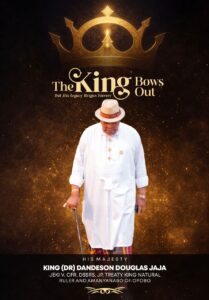
The ancient kingdom of Opobo will on Saturday, April 11, 2026, bid a final farewell to one of its most distinguished sons and revered monarchs, His Majesty, King Dr. Dandeson Douglas Jaja, Jeki V—an embodiment of candour, refinement, and enlightened traditional leadership.
His passing marks the end of an era defined by cultural revival, administrative excellence, and dignified royalty.
Photo Credit: Dappa Solomon Media
Born on April 28, 1942, King Dandeson Jaja came from a distinguished royal lineage as the son of King Douglas Jaja, former Amanyanabo of Opobo and Chancellor of the University of Jos, and Queen Violet.
King Dandeson Jaja, addressed as Jeki V, was the second child and the second son among the 12 children of his father, King Douglas Jaja, Amanyanabo of Opobo and former Chancellor of University of Jos. His mother was Queen Violet. His siblings include: Prince Arthur (late), Prince Lawrence (late), Prince Douglas Obiesigha (late), Prince Macdonald (late), Princess Daisy Ibalafagh (late), King Charles, Prince Alfred, Princess May, Prince Eugene Barachua, Princess Sotonye and Princess Ibikiri.
As the second son in a large and prominent family, he was raised within a tradition steeped in history, responsibility, and service.
He attended St. Paul’s Primary School, Opobo Town, Rivers State from where he moved to National Grammar School, Nike, Enugu, in the then Eastern Region of Nigeria, for his post primary education. On the completion of his secondary education, he traveled to the United Kingdom to pursue his tertiary education at Hull College of Higher Education.
His early education in Opobo and Enugu laid a solid foundation for a global outlook, later refined through studies in the United Kingdom. His formative years in engineering and banking—spanning the Opobo Boat Yard, the Central Bank of Nigeria, and a brief stint with Barclays Bank in the UK—equipped him with the discipline, precision, and managerial acumen that would later define his reign.
Ascending the throne in 2003 after a prolonged but peaceful legal tussle that tested the unity and resilience of Opobo Kingdom, King Jaja emerged not only as a legitimate ruler but as a symbol of reconciliation and collective identity. His reign, which spanned 45 years, having been proclaimed king in 1980, was marked by stability, development, and cultural pride.
A modern monarch in every sense, King Jaja seamlessly blended tradition with contemporary governance. He served in several high-profile roles, including Chairman of the Rivers State Council of Traditional Rulers and Chancellor of the Federal University Dutse-Ma in Katsina State. In these capacities, he demonstrated rare administrative depth, earning recognition for his ability to manage people and institutions with tact and foresight.
Yet, it was perhaps in the cultural sphere that his legacy shines brightest. A custodian of Ibani heritage, he championed the revival of indigenous language, customs, and artistic expression. He institutionalized festivals, reformed masquerade traditions, such as the Owu-Ogbo and Nwaotam,and understood and displayed the dance steps of the “ngunume” and “okporo,” beats. He elevated the Opobo International Boat Racing and Regatta to national prominence. His advocacy ensured Opobo’s cultural footprint extended beyond regional boundaries, reinforcing identity in an era of rapid globalization.
King Jaja was also a master of cultural diplomacy, having facilitated Opobo’s participation in FESTAC ’77, and later creating enduring platforms for cultural exchange and recognition. Through the Opobo Kingdom Awards, he honoured excellence and service, strengthening communal bonds and inspiring civic responsibility.
In personal bearing, the monarch was the very definition of elegance. Whether adorned in regal traditional attire or formal Western dress, his appearance reflected meticulous attention to detail and a deep understanding of the symbolism of kingship. His style was not mere aesthetics—it was a statement of identity, discipline, and pride.
Despite his elevated status, King Jaja remained deeply spiritual and grounded in faith. A devout Christian, he was actively involved in church life, offering quiet philanthropy and drawing strength from his beliefs. His humility was evident in his oft-expressed conviction that ultimate power rests with God alone.
Under his leadership, Opobo witnessed notable infrastructural and developmental strides, including road projects, shoreline protection, and strategic advocacy for educational institutions. These efforts underscored his vision of a progressive kingdom anchored in both heritage and modernity.
Above all, King Dandeson Douglas Jaja will be remembered as a monarch of rare candour—forthright yet diplomatic, principled yet compassionate. He ruled not with ostentation, but with quiet authority, intellectual depth, and an unwavering commitment to his people.
He is survived by his wife, children, grandchildren, and a grateful kingdom that now celebrates a life of purpose, dignity, and enduring impact.
As Opobo transitions to a new chapter under his successor, the legacy of Jeki V will remain indelible—a timeless reminder that true royalty lies not merely in heritage, but in character, service, and vision.
By Adagogo Cockeye Brown, PhD
brown.adagogo@ust.edu.ng