Home Blog Page 172

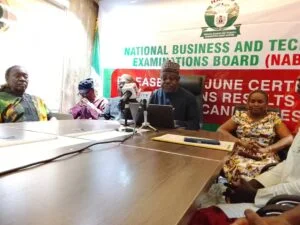
NABTEB Releases 2025 Exam Results, Records Improved Performance In Mathematics

0

The National Business and Technical Examinations Board (NABTEB) has released the results of the 2025 June/July National Business Certificate (NBC) and National Technical Certificate (NTC) examinations.

The released results is with significant improvements in candidates’ performance, particularly in Mathematics.

The Registrar/Chief Executive Officer, Dr Mohammed Mohammed, while announcing the results in Abuja on Thursday, disclosed that a total of 92,875 candidates registered for the examinations across 1,892 centres nationwide.

Mohammed said of this 92,875 registered candidates, 89,621 results were graded.

According to him, there is an increase of 37.08 per cent in enrollment and 10.77 per cent in examination centres compared to 2024.

“Out of the 92, 875 registered candidates, 89,621 candidates were graded, representing 96.50 per cent  of total enrollments.

“Furthermore, 57,651 (62.07 per cent) males and 35,224 (37.93 per cent) females enrolled for the examinations.

” In English language, 85,476 were graded with an overall pass of 79,575 (93.10 per cent) and 5,901 (6.90 per cent) fail.

“However, in comparison with the 2024 results, 63,866 (95.87 per cent) pass and 2,753 (4.13 per cent) fail.

“In mathematics, 85,805 were graded, the overall pass is 81,172 (94.60 per cent), and the fail is 4,633 (5.40 per cent),” he said.

Comparing performance in Mathematics  Mohammed said in 2024, 60,849 (91.39 per cent) pass and 5,738 (8.61 per cent) fail.

This, he said inferred that more candidates passed Mathematics while fewer candidates passed English Language this year when compared to last year’s examination results.

On examination malpractice, the registrar  revealed that 435 candidates (0.47 per cent) were involved in 516 cases of malpractices, a reduction compared to 349 candidates (0.52 per cent) involved in 524 cases in 2024.

The NABTEB boss commended the Federal Ministry of Education for support, particularly in driving the federal government’s Technical and Vocational Education and Training (TVET) initiatives.

This initiative, he said aligned with President Bola Tinubu’s Renewed Hope Agenda of equipping Nigerian youths with 21st-century skills to close industry skills gaps.

Mohammed urged Nigerians to stop laying emphasis on paper qualifications but put more efforts on skills, noting that skills-based knowledge was enough for overall development of the country.

He further announced that registration for the 2025 November/December NBC/NTC and Advanced NBC/NTC examinations had commenced.

Mohammed urged prospective candidates to visit the NABTEB portal @novdec.nabteb.gov.ng or its offices nationwide for registration guidelines.

Film Corporation Lauds FG For Improving Nigeria’s Creative Economy

0

Nigerian Film Corporation (NFC) has commended the Federal Government’s efforts for improving the nation’s creative economy assets to attract domestic and foreign investors.

NFC said this in a statement issued by its Director, Public Affairs, Mr Brian Etuk in Abuja on Wednesday.

Etuk said Managing Director/Chief Executive Officer of NFC, Dr Ali Nuhu,
made the commendation at a Nigeria’s delegation meeting.

The meeting was attended by Mr Sun Yeli, the Minister of Culture and Tourism of the People’s Republic of China, and Nigeria’s Minister of Art, Culture, Tourism and the Creative Economy, Barr Hannatu Musawa.
Nuhu commended Federal Government’s effort in leveraging cross border opportunities to unlock, promote and grow the country’s creative economy.

The NFC boss said Musawa’s foresight, determination and drive in improving the nations creative economy assets to attract both domestic and foreign investors were commendable.

He said the meeting aimed at strengthening the existing relations, enhancement of a robust and sustainable people- to- people exchanges, utilising the rich and distinctive cultures, creative and tourism assets of both countries.

He said the Federal Ministry of Art, Culture, Tourism and the Creative Economy’s efforts focused on improving the offerings of Nigeria’s creative sectors.

According to him, the improvement includes innovative approaches, support structures and reforms that have enabled the inflow of domestic and offshore partnerships and increased investments.
Nuhu added that the minister informed her host of the need for both countries to expeditiously engage, initiate and activate all provisions of the existing memorandum of understanding (MoU) on cultural exchanges between both countries.
According to him, this includes the outcomes of the recent visit by Nigeria’s President Bola Tinubu to China.

The film corporation boss highlighted the global impact of Nigeria’s creative industries and the inherent great opportunities for a stronger and sustainable cross border partnerships and collaborations.

He further commended and requested for the recommencement of the human capital support and scholarship scheme for lecturers of the National Film Institute (NFI) under the Students/Lecturer Educational Exchange Programme at the Beijing Film Academy.

“The programme, which was initiated in 2006, but unfortunately discontinued six years after.

“I am equally highlighting for the grant funding of the Safe Nigeria Audio-Visual Heritage preservation, digitisation and archiving project being undertaken by the NFC at the National Film, Video and Sound Archive (NFVSA).

” There is need to promote the exhibition, marketing, financing, film co-production and value chain exchanges through the participation of the People’s Republic of China at the annual Nigeria’s ZUMA international film festival held in Abuja nation’s capital,” he said.

Responding, Mr Yeli averred that Nigeria and China would continue to exert significant and great impact on the world creative economy by promoting strong export growth in creative goods and services.

According to him, China was excitedly ready to engage and uphold her cultural relations with Nigeria.

” For Nigeria, the nudge to further grow the creative sectors is being achieved through domestic and offshore collaborative partnerships, innovative government policy frameworks that support technological advancements, as well as a friendly and safe investment environment”.

Ellison With $393 Billion Topples Musk To Become World’s Richest Person

0

The nearly one year reign of Tesla boss, Elon Musk, at the top of Bloomberg’s Billionaires Index, as the world’s richest person has come to an end, at least for now.

This is because Oracle co-founder, Larry Ellison, whose fortune reached a record $393 billion on Wednesday, as against Musk’s $385 billion, is now sitting on top of the ladder.

Bloomberg reports that Ellison’s fortune went up by a record $101bn on Wednesday after Oracle reported quarterly results that beat expectations and signalled further growth in its cloud business.

The 81-year-old tech billionaire’s gains mark the biggest one-day jump ever recorded on Bloomberg’s index.

Oracle’s shares, which had already risen 45 per cent this year, soared 41 per cent after the company announced strong bookings and an upbeat outlook for its cloud infrastructure unit.

He previously lost the crown to Amazon’s Jeff Bezos and LVMH boss Bernard Arnault.

Tesla shares have fallen 13 per cent this year.

The company’s board has proposed a massive pay package for Musk that could make him the world’s first trillionaire if he hits a series of ambitious target.

Billionaire philanthropist Bill Gates no longer ranks among America’s 10 Richest People.

The Microsoft cofounder, who reigned for nearly a quarter century as America’s richest person, no longer makes the very top of this year’s ranking of the country’s wealthiest people, according to Forbes report on Wednesday.

Gates was long known as the richest person in America. Starting in 1991, he ranked either first or second on the Forbes 400 list of the country’s wealthiest people every year for nearly three decades.

He fell below the No. 2 spot in 2021. Now, for the first time in 34 years, Gates is not even in the top ten.

He ranks No. 14 on this year’s Forbes 400–just behind Bloomberg LP cofounder Mike Bloomberg and one spot ahead of the country’s (and the world’s) richest woman, Walmart heiress Alice Walton.

Of course, Gates still commands a massive fortune–Forbes estimates he’s worth $107 billion, the same as a year ago.

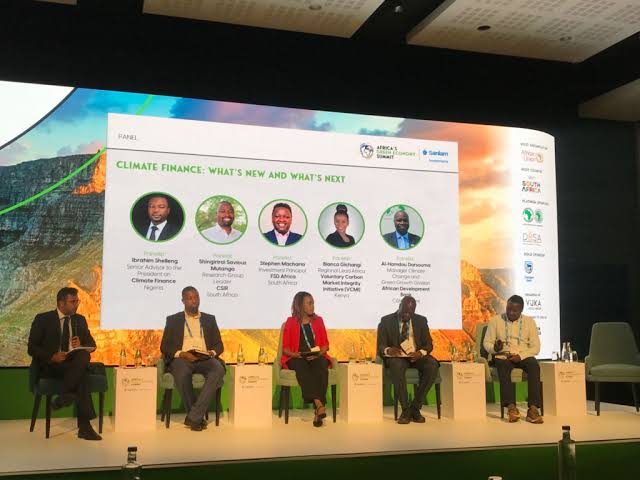
Green Economy: ‘Africa’s 60 Percent Of World’s Solar Resources, Critical Minerals, Great Potential For Growth’

0

Teresa Ribera, Executive Vice-President of the European Commission for a Clean, Just and Competitive Transition, has called for deeper partnerships among African countries in addressing climate change challenges.

She also highlighted Africa’s untapped potential in the green economy.

“Africa is home to 60 per cent of the world’s best solar resources, 30 per cent of critical minerals, and a young and optimistic generation ready to innovate.

“Yet nearly 600 million people still lack access to electricity. Closing this gap is urgent, and possible.”

Ribera noted that the EU remained Africa’s largest trading partner and investor, and urged both continents to build on the partnership to achieve shared climate goals.

“Together, we can turn potential into reality, build clean energy systems, add value to raw materials, create decent jobs, and strengthen resilient communities.”

She said the upcoming Africa–EU Summit in Luanda presented an opportunity to renew commitments under Economic Partnership Agreements (EPAs) and deepen cooperation.

“We can use our path to Luanda’s summit as a chance to reaffirm our willingness to move forward together,” Ribera said.

Ribera made the call during her address at the opening ceremony of the Second Africa–EU Climate Summit (ACS2) on Wednesday in Addis Ababa, Ethiopia.

The summit, themed “Accelerating Global Climate Solutions: Financing for Africa’s Resilient and Green Development”, focused on strategic measures to fight climate change across both continents.

“Working together on the great challenges is the best way to strengthen knowledge and response capacity, to identify effective measures, to learn from our neighbours, and to join forces,” Ribera said.

She noted that Africa and Europe shared not only history and geography but also a common vision and pressing global challenges.

“Together, Africa and Europe represent 40 per cent of the global population.

“We gather amid interconnected crises and inequalities that affect both continents.

“This demands not just development for Africa, but fair development and equal opportunities for African peoples.”

Ribera stressed the importance of multilateralism, the rule of law, and human dignity in the face of global instability.

“At a time when multilateralism, the rule of law and principles of human dignity are being questioned, staying firm is imperative.

“In these turbulent times, Europe will not give up on its responsibilities.”

She warned that climate change was already impacting lives and livelihoods and said that adaptation must remain a central pillar of mutual cooperation.

Ribera highlighted the Team Europe Initiative on Climate Change Adaptation and Resilience, currently being advanced by seven EU member states.

“The initiative includes investments in preparedness, community support for displacement, and access to Copernicus satellite data.

“From the Global Shield to regional climate security programmes, our goal is clear: preparedness saves lives, strengthens peace, and creates stability that attracts investment and supports economic growth,” she said.

Ribera also emphasised the significance of upcoming international decisions, including the adoption of the International Maritime Organisation’s Net Zero Framework, which will introduce emissions limits and greenhouse gas pricing in the shipping industry.

“This framework aims to balance ambitious decarbonisation with inclusive benefits and will create new economic opportunities, such as green fuels and infrastructure development.”

She reaffirmed the EU’s commitment to climate finance, noting that the 1.3 trillion dollars roadmap adopted in Baku was a key component of the global climate agenda.

“It’s not only about raising ambition, but also about shifting mindsets and building new governance tools that can deliver climate finance at the scale required.”

Ribera called for urgent reform of the international financial system to overcome structural barriers such as high capital costs, rising debt burdens, and investment risks.

Onne Customs Generates N476 Billion In 8 Months- Babandede

0

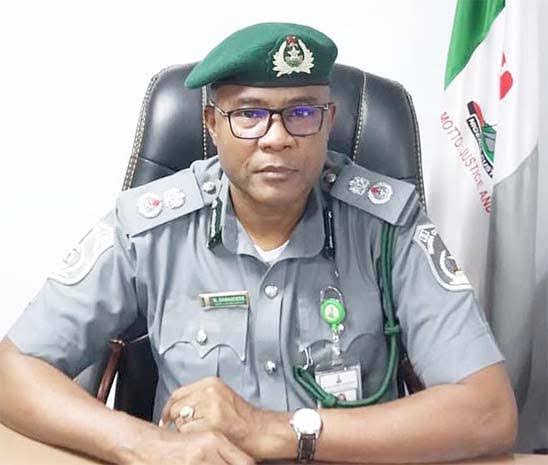
The Nigeria Customs Service (NCS), Onne Area 11 generated the sum of N476 billion between January and August 2025.

The immediate past Comptroller of the area, Mr Muhammad Babandede, stated this on Wednesday, September 10, 2025, while handing over to Aliyu Alkali, who is now the new Comptroller of the Area.

Babandede, who resumed at Onne command in May 2024, has now been promoted to the rank of an Assistant Comptroller of Customs and subsequently redeployed to Zone A, Lagos Command.

Recounting his achievements while in Onne, Babandede stated that before his redeployment, he had surpassed half his target for 2025.

For this year, 2025, my target is N700 billion, as at the end of August, we had already generated N476 billion. This feat is a testament to hard work and dedication of officers and men.

Speaking at the handover ceremony, Babandede thanked officers and sister agencies at the command for support during his tenure as the Comptroller.

He noted that the support paid off, resulting in high-level achievements under his watch.

“2024 was one of the best years concerning revenue generation. My revenue target last year was N618 billion, but we generated N639 billion.

“So far, more than N1.6 trillion has been generated under my leadership, my job was not limited to revenue generation, it also covered trade facilitation too.

“Commendable milestones in the area of trade promotion also topped our mandate as we confiscated 844 assorted rifles, 112,500 rounds of armunitions and over 77 million bottles of Tramadol syrup alongside several illicit, expired medicines and contrabands.

Babandede also commended the Nigeria Drug Law Enforcement Agency (NDLEA), NAFDAC, and the DSS for their collaboration.

He also noted that the command during his tenure embarked on several projects for Cooperate Social Responsible to host community, orphanage homes, children as well as persons living with disabilities.

In his response, the new comptroller, Alkali, described Onne command as a familiar unit having served in other capacities within maritime space.

“Onne Area 11 Command is not new to me, I have been a member of the maritime family more than once, and I want to assure a smooth work relationship with all stakeholders.

“My agenda is clear, and it includes safety, revenue generation, and security of the country. I assure you that my doors are open for legitimate engagements,” he said.

Enforce Supreme Court Ruling On LG Autonomy, NULGE Tells Tinubu

0

The Nigeria Union of Local Government Employees (NULGE) has called on President Bola Tinubu to urgently implement the Supreme Court judgment granting full autonomy to local governments across the country.

In a communiqué signed by Mr Aliyu Kankara, President-General of NULGE, and issued at the end of the union’s National Executive Council (NEC) meeting, on Tuesday in Abuja, communiqué, the NEC-in-session urged the government to take immediate steps toward implementing the judgment without further delay

“This undue delay undermines the principles of democracy and denies the people at the grassroots the numerous benefits associated with the autonomy of local government administration.

“It is expected that a democratic and people-oriented government should abide by the tenets of democracy and respect the rule of law,” the statement read.

The union also condemned the seizure of local government allocations in Osun State, describing the action as unjust and detrimental to grassroots development.

“The unlawful seizure of funds has crippled service delivery, distorted development plans, and worsened the suffering of Osun people,” it added.

It would be recalled that over a year after the Supreme Court ruling was delivered, it is yet to be enforced by the federal government.

On workers’ welfare, NULGE expressed concern over the non-implementation of the national minimum wage in some states.

“It described the failure as callous and unfair, especially given the current harsh economic realities.

“This inaction is unfair to our members, who are crucial to the development of the third tier of government, particularly during these challenging times.

“We urge these governments to review and improve their wage structures to ensure fair compensation for local government workers.”

The NEC further called on the federal government to intervene in the Osun political crisis and ensure the immediate restoration of the seized local government allocations in the interest of peace, justice, and sustainable development.

Regarding the recent demolition of NULGE’s National Secretariat, the union appealed to the Minister of the Federal Capital Territory to intervene and ensure redress.

FG Has Implemented 80% Of 2024 Budget- Minister

0

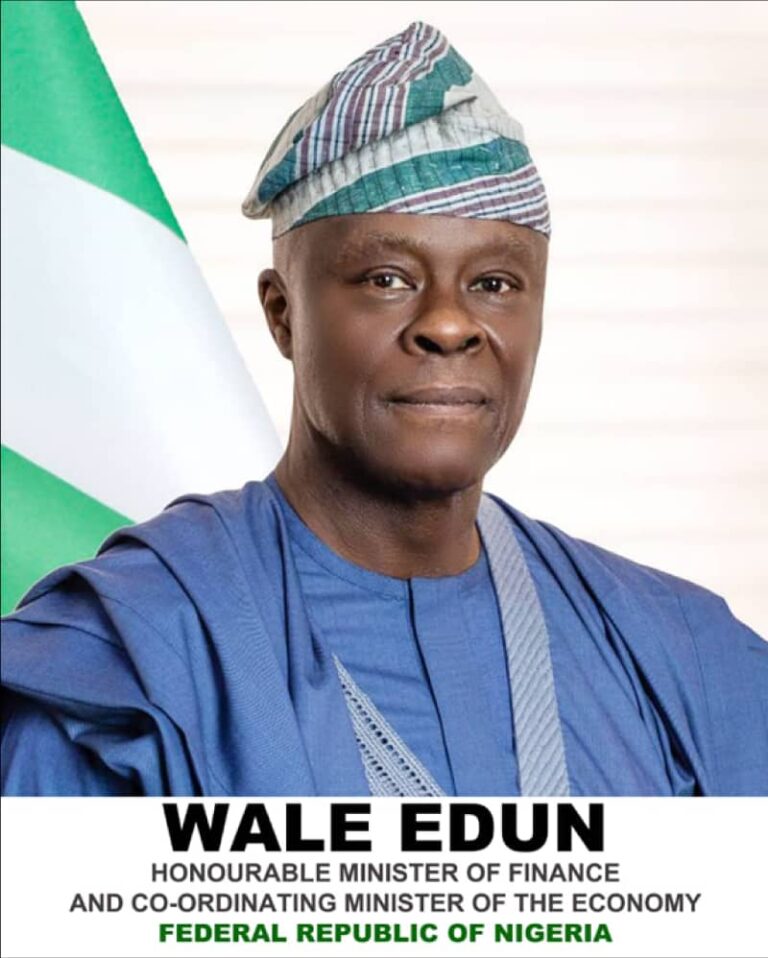
Nigeria’s Minister of Finance, Wale Edun has declared that the Federal Government has as at September 2025, implemented about 80 per cent of the 2024.

The Minister who spoke to newsmen shortly after himself and Minister of Budget and National Planning, Atiku Bagudu engaged with the House of Representatives Committee on Appropriation over the implementation pace of 2024–2025 Appropriation Acts.

The roundtable engagement was for a review of the 2024 budget performance done by all relevant stakeholders present.

“Basically, overall it is around 80 per cent implemented; as you know, the budget for 2024 was extended by the National Assembly till December, so it is still running. So it is still a work in progress.

“We looked at 2025 budget and we ensured that, projects that touch the grassroots, provide support, resources and facilities such as roads, irrigation, other infrastructure projects are given adequate attention and priority,” he said.

On his part, Bagudu said that members of the committee appreciated all the achievements under President Bola Tinubu’s administration.

He said that the lawmakers commended the Executive’s respect for the National Assembly and the excellent working relationship between the Federal Government and the Legislature.

Bagudu said that the lawmakers have supported all the major reform initiatives which have produced the result, including the latest tax reforms.

The minister said that the committee and the executive have interfaced and noted areas for improvement.

Earlier, the House of Representatives Committee on Appropriation had engaged Minister of Finance, Mr Wale Edun and Minister of Budget and National Planing, Mr Atiku Bagudu over the implementation pace of 2024–2025 Appropriations Act

Addressing newsmen after the roundtable held behind closed doors in Abuja on Wednesday, the Chairman of the committee, Rep. Abubakar Bichi (APC–Kano), said that Nigerians were deeply concerned about the budget execution.

He said that the engagement was in line with the National Assembly’s constitutional mandate to monitor budget performance and ensure effective service delivery to Nigerians.

“We have engaged with the Minister of Finance and the Minister of Budget; both of them acknowledged the concerns and agreed to work harder so that Nigerians can begin to see visible results from the budget.

“Basically, members are concerned seriously about that and the Minister of Budget and the Minister of Finance also confirmed to us that Nigerians will see a lot of changes and developments for this budget.

“Before we stretched to 2026, you will see serious changes between now to the end of the year, they have made their promises to us so let us see how far we can go,” he said.

FG Moves To Curb Glitches In Digital Payment, E-commerce

0

The Federal Government is working towards removing all stumbling blocks against seamless digital payments and e-commerce across the country.

The Deputy Chief of Staff to the President, Ibrahim Hadejia, said this in Abuja on Wednesday during a stakeholders’ roundtable.

The effort being spearheaded by the Office of the Vice-President through the Ministry of Industry, Trade and Investment, and development partners aims at ensuring that the citizens seamlessly transfer money using their mobile phones and other devices.

Hadejia reiterated the resolve by the administration of President Bola Tinubu to drive financial inclusion, using different strategies for different digital payment infrastructure. This, according to him, is with a view to essentially reach the last mile and serve the financially excluded.

He said that there were very few countries in the West that have the kind of ease of payment and banking that is available in Nigeria.

“It doesn’t happen anywhere in the world, and by the time we begin to address these issues, we can use that reach to enter into the e-commerce stage.

” And like I said, from our own perspective we are also worried about the exclusion that is inherent in that so that every Nigeria, no matter where he is, can have access to quality, simple financial services that are beyond educational and poverty levels.

“From the Office of the Vice-President’s perspective, we look at the Digital payment and identity as really the last stumbling block in opening up e-commerce in Nigeria.
“Yes, there is e-commerce going on, but I think the biggest impediments surround the ease of payment, the identity issue, and several things we are pushing, which are all interlinked.

“We are pushing and driving financial inclusion in the Office of the Vice President, which has to do with the strategy for different digital payment infrastructure that will essentially reach the last mile and serve the financially excluded.

“So, resolving these will amount to killing several birds with one stone. We have been to India and seen what robust PPI can do to e-commerce, and not just e-commerce but trade generally,” he said.

Hadejia assured that by the time the government was able to make payment seamless, cell phone users would be able to receive and make payment easily.
He added, ” We have seen situation where hawkers’ RQ code on their trade, taxes, and statistics are staggering.

” You have a situation where, in a few years, the amount or volume of transaction from that platform is even in excess of the traditional credit card.

” So, you have the likes of Wizard and Master card taking an interest, jumping into their space.
“And, of course, to also identify why the African Free Continental Trade Agreement has simply refused to gain the traction that it should have several years after it was established.

“We can also point to the fact that the issues have to do potentially with the cross-border payment and the identity issue. We are hoping that discussions like this will offer solutions.”

Hadejia further stated that the roundtable would enable the government to gather enough information and data to make a case from its perspective in regulation and, infrastructure.

He said, ” This includes enacting laws to ensure that most of the issues that have been stagnating the expulsion of e-commerce are addressed.”

The Principal Research Fellow, International Economic Development Group, Dr Max Mendez-Parra, ODI Global, said the organisation had been working with the African Continental Free Trade Secretariat and other African countries on Digital Trade.

Mendez-Parra explained that the implementation of the AFCTA was transformative for the African economy, especially on the Nigerian economy.
He added that the ODI was assisting government and AFCTA Secretariat in Accra on different aspects associated with the AFCTA.

Mendez-Parra said,”In particular, we are supporting the negotiations and implementation of the investment protocol and the digital trade protocol as well.
“So, we have been working with the AFCTA. And this is what has brought us to Nigeria.
“Already, this is our fourth year that we have been here, and we are teaming up with the Office of the Vice President to basically enhance different aspects associated with the implementation of the Digital trade protocol in Nigeria.”
The Minister of Industry, Trade and Investment, Dr Jumoke Oduwole, said the ministry and the AFCTA secretariat had come up with an initiative called the ‘AFCTA DG pass’.

According to her, the initiative is aimed at operationalising the digital identities.
Oduwole, represented by her Special Adviser, Patience Okala, explained that the initiative was still at its infant stage, expressing hope that the conversations at the roundtable, as well as the concerns that are raised could fill into the process.
The Special Assistant (SA) to the President on Information Communications Technology (ICT) Policy, Salisu Nakande, said the project came into light two years ago, with the support of the Vice-President, Kashim Shettima.

“And this year is more importantly about the conversation across the payment which we are doing in alignment with the Federal Ministry of Industry, Trade and Investment.

” We believe that as much as Nigerians want to trade, they need to be able to make payments in a seamless way across board, and there is a lot of economy to tap in there. So, that is the basic for this conversation,” he said.

Shettima Hails Kaduna Gov’s Skills Council Setup

0

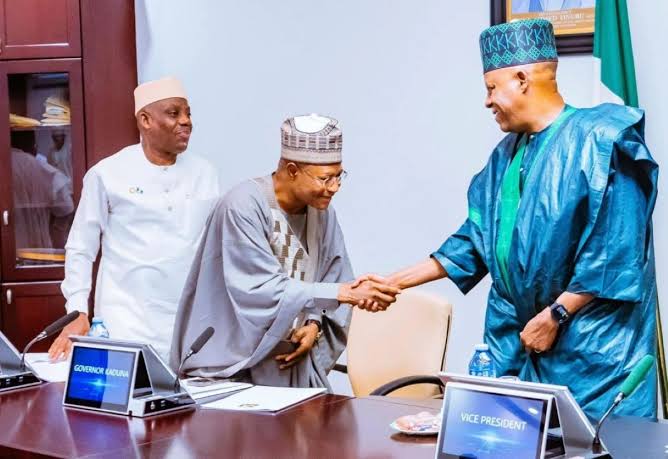
Nigeria’s Vice-President, Kashim Shettima, has hailed Gov. Uba Sani of Kaduna State for establishing and chairing the state’s first Council on Skills.Shettima made the commendation during the 7th meeting of the National Council on Skills (NCS) at the Presidential Villa, Abuja, describing Sani’s leadership as exemplary and urging other states to replicate the initiative.

He emphasised the need for collective action to drive the administration’s skills acquisition agenda under President Bola Tinubu’s Renewed Hope Agenda.

“The era of operating in silos is over.

“We must collaborate across agencies, ministries, and sectors to empower Nigerians with the skills they need to thrive,” Shettima said.”

The vice-president highlighted the importance of inter-agency harmony and stressed that no funding or progress could be achieved without a unified approach.

“This goes beyond our own convenience.

“It’s about empowering the ambitious artisan in Kaura Namoda, supporting the mid-career professional in Ebute-Metta, and equipping technical colleges across Nigeria to become true centres of excellence,” he added.

Sani, in his remarks, noted that the Kaduna Vocational and Skills Development Institute had recently enrolled more than 30,000 students.

He thanked the vice-president for his support in advancing the council’s job creation goals.

Minister of Education, Dr Olatunji Alausa, also commended Sani for his role in the commissioning of the Institute of Vocational Training and Skills Development.

He announced that technical colleges had been directed to focus solely on relevant skills-based courses for the new academic year.

Epidemic: African Health Experts Canvas National Epidemic Surveillance, Research Systems Strengthening

0

African health leaders have stressed the urgent need to strengthen national epidemic surveillance and research systems as the foundation for regional and global preparedness.

They made the call at a high-level panel on epidemic surveillance at the 2nd Lassa Fever International Conference in Abidjan, Côte d’Ivoire, on Wednesday.

The event convened by the West African Health Organisation (WAHO), has the theme: “Beyond Borders: Strengthening Regional Cooperation to Combat Lassa Fever and Emerging Infectious Diseases.”

The gathering seeks to reaffirm regional commitment, mobilise political will, and drive collective action against Lassa fever and other emerging infectious diseases.

West Africa, experts said there is urgent need to strengthen response to VHFs, including Lassa fever.

Experts from Liberia, Guinea, Sierra Leone, Nigeria, Côte d’Ivoire and the World Health Organisation (WHO) shared their experiences and lessons from past viral haemorrhagic fever outbreaks, including Ebola and Mpox at the event.

Dr Minnie Sankawulo-Ricks, Medical Director of Phebe Hospital and School of Nursing, Liberia, said that early detection of outbreaks in her facility begun with a community-based surveillance system integrated into the national health structure.

She noted that community health workers and volunteers act as the first line of defence, reporting unusual symptoms, deaths, or disease clusters from even the most remote villages.

“My facility uses WhatsApp groups for real-time reporting between the community, facility and county levels.

“This has greatly improved the timeliness and accuracy of data shared with health authorities,” she said.

Sankawulo-Ricks added that her centre now has a PCR laboratory, reducing test results from more than a week to less than six hours.

However, she highlighted ongoing barriers such as logistical delays, poor infrastructure, limited internet access and inadequate incentives for community health workers.

From Guinea, Prof. Alpha Keita, Rector of the University of Conakry, underscored the progress in genomic surveillance since the 2013 to 2016 Ebola outbreak.

“In 2013, it took three months to confirm the first Ebola cases. By 2021, confirmation was possible in 24 hours and sequencing within nine days,” he said.

But Keita warned that political commitment and sustainable financing are still lacking, with genomic surveillance often dismissed as a “research luxury”.

In Sierra Leone, Dr Donald Grant, Head of clinical, public health and research activities related to Lassa fever recalled how the 117 hotlines introduced during Ebola transformed reporting.

“Today, community health workers and epidemiology trainees feed into an integrated system that covers both human and animal health.

“Yet challenges remain, including internet connectivity, dependence on donor funding and limited laboratory access outside major cities”.

Nigeria’s Dr Muntari Hassan, Deputy Director and head of the Surveillance Division at the Nigeria Centre for Disease Control and Prevention, called for regional harmonisation of data platforms, noting past efforts by WAHO and ECOWAS to develop a unified reporting system.

Dr Ibrahima Fall, Global Public Health leader, said Africa must not only adopt new digital tools, but also invest in national analytical capacity.

“Eighty per cent of African countries still lack adequate institutional capacity for data analysis.

“Without strong national systems, regional or global platforms cannot function effectively,” Fall, who is now the CEO of Institut Pasteur de Dakar, warned.

Prof. Mamadou Samba, Director-General of Health, Côte d’Ivoire, closed the session by stressing that Africa must finance its own research and health priorities, rather than rely on external partners.

“These are our diseases, our families and our populations. Unless we take responsibility and invest in our own systems, progress will remain limited,” he said.

The experts agreed that building trust with communities, investing in digital tools, and ensuring sustainable domestic financing are critical for Africa’s preparedness against future epidemics.