

Home Blog Page 142

How We Intend To End Godfatherism, Budget Padding -ADC … Pledges To Redesign Governance In Nigeria

0

If in 2027, Nigerians vote into power the African Democratic Congress (ADC), the country will witness an end to the culture of godfatherism, budget padding, and patronage-driven politics. While a new new model of governance that is built on transparency, innovation, and citizen participation would be enthroned.

In a statement shared on Friday on the official account of the ADC coalition mobilisation wing, ADC Vanguard on X, and titled, “No Godfathers, No Budget Padding: How ADC Plans to Redesign Governance,” the party said Nigerian politics has “for too long revolved around personalities rather than principles, and power has been used for patronage rather than progress.”

“The African Democratic Congress (ADC) stands to change that narrative, not by making vague promises but by introducing a complete redesign of how governance should work in a modern democracy,” the statement read.

According to the party, its vision “begins with one simple but radical idea: government must serve citizens, not politicians.”

“That means every project, every policy, and every kobo spent must be judged by its direct impact on the people, not by how much it enriches those in power,” it said.

The statement further noted that with an ADC-led government, “a minimum of 70% of all budgeted projects will be mandated to directly benefit local communities, rather than disappearing into bureaucratic bottlenecks or inflated contracts.”

The party said it intends to make governance “measurable, transparent, and accountable,” adding that “every naira spent by the government will be traceable through an open digital ledger, accessible to citizens in real time.”

“With blockchain-backed systems, Nigerians will be able to see where public funds go from federal ministries to the smallest local projects,” the statement continued.

Calling transparency “the foundation of a new social contract between government and citizens,” the ADC said it would harness the potential of Nigerian youth by involving them directly in governance and accountability processes.

“We will harness Nigeria’s youth, our greatest natural resource, by channeling their creativity, digital skills, and entrepreneurial drive into the governance process.

“Young Nigerians will not only be employed by the government but empowered to audit it,” the statement said.

Through “public dashboards, community-driven data verification, and citizen participation platforms,” the ADC said governance would become “an open system where the people are both the beneficiaries and the watchdogs.”

Rejecting what it described as “the old order that thrives on secrecy and selective empowerment,” the party said its model would “embrace collaboration, performance, and service delivery.”

“Ministries and agencies will operate like value-driven enterprises, focused on measurable results rather than political favors,” the party added.

Ministers, it said, would be “appraised quarterly, not by their loyalty to party leaders but by their impact on lives, infrastructure, and social indicators.”

“This is governance redesigned: a model where public service becomes a performance contract, not a reward for political allegiance. A system where competence replaces connections, merit overtakes mediocrity, and transparency replaces corruption,” the ADC declared.

According to the statement, the party is not offering “another round of empty promises” but “a system that works.”

“The ADC is not coming to join the old game; we are coming to change the rules entirely.

“We believe government should function like a well-run business, but one where the citizens are the shareholders and the dividends are better roads, safer communities, quality education, affordable healthcare, and jobs,” it said.

The party concluded that its vision represents “a movement for responsible governance, where innovation meets integrity, and leadership is redefined as service.”

“The ADC is not asking Nigerians to dream of change. We are building it, one transparent policy at a time,” the statement concluded.
Mobile Court Convicts 33 Persons For Traffic Violations In CRS …Two For Attempted Bribery Of FRSC Officers

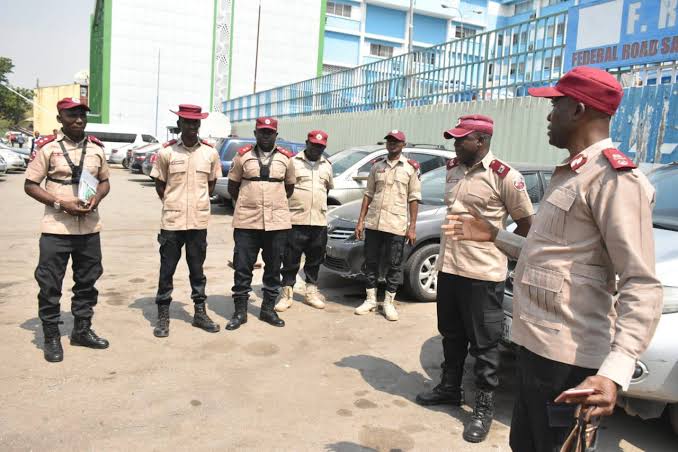
A mobile court presided over by Magistrate Okokon Essien on Friday convicted 33 of the 38 offenders who were arraigned by the Federal Road Safety Corps (FRSC) in Cross River State for various traffic infractions.

The remaining five offenders were cautioned and discharged after appropriate sensitisation.
Two, out of the 33 were convicted for attempted bribery, seven for overloading while 19 were convicted for driving license violation and penalties were handed down in accordance with the law.

Sector Commander of the FRSC, Cross River State Command, Innocent Etuk, said at the sitting that mobile court proceeding remains a vital tool in enforcing traffic regulations in the state.

Emphasising the importance of the mobile courts, Etuk stated that they remained a vital tool in ensuring compliance and deterring habitual violators inline with FRSC establishment Act 2007.

Speaking further, the sector commander said the mobile court was focused to achieve the Corps’ Corporate Strategic Goal for 2025 which was to reduce road traffic crashes and fatality by 10 per cent.

“We also want to ensure that traffic offences such as overloading, attempt to corrupt marshals on duty, use of worn-out tyres, driver’s license violations and use of mobile phones while driving are curbed.

“To achieve this, we ensure strict enforcement of traffic rules, continuous public enlightenment, and collaboration with stakeholders,” he said.
Etuk urged motorists to obey traffic regulations, ensure their vehicles were in good condition, and cultivate safe driving habits to ensure that the roads remained safe for all users.

Africa CDC Pushes For Ebola Vaccines, Mpox System Integration Into Health Systems

0

The Africa Centres for Disease Control and Prevention (Africa CDC) has renewed calls for preventive Ebola vaccination in high-risk areas and announced plans to integrate Mpox response into routine health systems.

Prof. Yap Boum, Deputy Incident Manager at Africa CDC’s Incident Management Support Team, made the disclosure during a virtual press briefing on Thursday, outlining new developments in epidemic preparedness and vaccine deployment.

He said the Ebola virus from the recent Democratic Republic of Congo (DRC) outbreak was sequenced within 24 hours by Dr Placide Mbala’s team at the Institut National de Recherche Biomédicale (INRB).

“The sequencing confirmed a new spillover event, with the strain closely related to the virus first identified in 1976, highlighting continued threats of zoonotic diseases in Ebola-endemic areas like Kasai.

“This is the seventh Ebola outbreak in Kasai. It’s time to protect frontline workers through preventive vaccination.

“This should be our next priority to avoid further public health emergencies,” Boum said.

He said that 500,000 Ebola vaccine doses were available through the International Coordinating Group (ICG), and the DRC had already developed a vaccination plan for high-risk workers and communities.

Boum urged Angola, Congo-Brazzaville, and other neighbouring countries to strengthen cross-border coordination and prepare for potential Ebola spillovers through surveillance and early vaccination strategies.

On Mpox, Boum said Africa CDC had mobilised six million vaccine doses for affected countries and was providing technical support to improve access and containment in hotspots across the continent.

Countries such as Liberia, Kenya, Ghana, and Guinea are currently receiving vaccine shipments and response support, based on outbreak intensity and readiness to implement targeted immunisation activities.

“We are now integrating Mpox vaccination into the African Primary Immunisation (API) framework to ensure continuity and build long-term demand for vaccine production within Africa,” he said.

Also speaking, Dr Kyeng Mercy, Head of the Epidemic Intelligence Unit, said Africa CDC had developed a continental roadmap to guide transition from emergency response to sustainable health system integration.

“Our aim is to preserve emergency response capacity and translate it into national health systems. Countries must adapt the roadmap and begin implementing it in line with their local needs,” she said.

Mercy added that some countries had already initiated their national transition plans and called on others to do the same to maintain epidemic preparedness momentum post-crisis.

She also said Africa CDC was working with partners like the World Health Organisation (WHO) and Gavi, the Vaccine Alliance, to secure 10 million cholera vaccine doses for rapid deployment.

Mercy emphasised the importance of coordinated multi-disease outbreak strategies and stronger resource mobilisation to improve readiness, response speed, and recovery capacity across all African Union member states.

Why We Advocate Abolition Of Death Penalty, By Amnesty International

0

Amnesty International has urged the federal and state governments to abolish the death penalty.

Mrs Barbara Magaji,the Programmes Manager of Amnesty Internationa, made the call during a stakeholders dialogue to commemorate the World Day Against Death Penalty.

The programme was organised by Amnesty International in collaboration with the French Embassy in Nigeria on Thursday in Abuja.

Magaji stressed the need to remove all provisions in national and state laws that violate international human rights law, especially provisions that allow the death penalty.

She also urged the government to ensure that the criminal justice system was sufficiently resourced and capable of investigating crimes effectively.

She added that the law should be able to support victims and guarantee fair trials without recourse to the death penalty.

According to her, the federal government should, through the National Assembly, consider the abolition of the death penalty for all crimes in the ongoing Nigerian Constitutional Amendment process.

“This is because there is no convincing evidence that the death penalty has a unique deterrent effect on crimes.

“In Nigeria presently, 26 states and the FCT have introduced or amended existing laws prescribing the death penalty for kidnapping, banditry, cattle rustling, and cultism.

“In spite of the introduction of the death penalty, the country continues to record an increase in banditry, abduction, and general criminality. ”

Magaji noted that the Amnesty International research on the violence and killings in Nigeria showed an increase in general insecurity, unlawful killings, and kidnap for ransom.

“This is in spite of the introduction of the death penalty to crimes of banditry, kidnapping, cattle rustling, and cultism.

“Our documentation of insecurity in 2024 indicates that there have been over 181 incidents resulting in extra-judicial killings arising from banditry/terrorism, urban crime and herdsmen farmers conflict and SGBV.

“This has led to over 3169 deaths. In 2024, 881 people were kidnapped. In 2025, there were 2313 deaths arising from 204 insecurity incidents with some situations resulting in the kidnapping of 1025 people,” she said.

Magaji explained that the rising insecurity in Nigeria was a combination of several factors that affected society at different levels, from the national to the community level.

She added that the underlying causes of insecurity needed to be addressed broadly and a comprehensive crime prevention mechanism deployed rather than the quick fix approach that was ineffective.

She said that Amnesty International was opposed to the death penalty in all cases.

“Amnesty International considers that death penalty violates the right to life as enshrined in the Universal Declaration of Human Rights and the African Charter on Human and Peoples’ Rights.

“The death penalty is often imposed after a grossly unfair trial. But even when trials respect international standards of fairness, the risk of executing the innocent can never be fully eliminated.

“The death penalty will inevitably claim innocent victims, as has been persistently demonstrated. The trend towards abolition of the death penalty is clear.

“In opposing the death penalty, Amnesty International is in no way seeking to condone the crimes for which those sentenced to death were convicted,” she added.

She noted that Amnesty International acknowledged fully the suffering of victims of violent crime and their families and recognised the duty of governments to protect their rights.

“Amnesty International also believed that people found guilty following a trial that met international fair trial standards should be held accountable but without recourse to the death penalty,” she said.

According to her, presently, 143 countries have now abolished the death penalty in law or practice.

Downsizing Of Federal Civil Service: Walson-Jack Allays Workers’ Fears Over Staff Audit

0

Mrs Didi Walson-Jack, Head of the Civil Service of the Federation (HCSF), says the ongoing Personnel Audit and Skills Gap Analysis (PASGA) initiative is not aimed at downsizing workers, but aimed at ensuring up-to-date data to reposition the Federal Civil Service.

Walson-Jack stated this in Abuja on Thursday at a sensitisation programme on the PASGA project, organised by the office of HCSF for Permanent Secretaries, Directors and consultants of the initiative.
Represented by Dr Deborah Odoh, Permanent Secretary, Service Policies and Strategies Office, Walson-Jack said the project was designed to strengthen personnel data integrity, align competencies with organisational needs, and promote evidence-based human resource management.

“The unique thing about this exercise is that it is not just a personnel audit but also a skills gap analysis,” she said.

She explained that the project would enable government to have reliable data for effective planning, deployment and decision-making in the civil service.

“Over the years, the Service has grappled with fragmented and outdated personnel information, leading to inefficiencies and misalignments.
“Through PASGA, we are setting a new standard, one that is transparent, data-based, and performance-oriented.

“This reform will deliver accurate personnel records, identify existing skills gaps, and support targeted training and redeployment aligned with the evolving needs of government,” she said.

According to her, the exercise will help assess the competencies of each staff member, identify gaps and plan relevant training to ensure that personnel are properly deployed.
“With this initiative, we will reposition and build capacity across the Service. We have already commenced digital literacy training with National Information Technology Development (NITDA) to enhance staff capacity and efficiency.

“Eventually, there will be no need for downsizing. Instead, we will reposition staff and ensure effective performance,” she said.
Also speaking, Dr Danjuma Kalba, Permanent Secretary, Common Services Office, described PASGA as a major step towards building an efficient, accountable and digitally driven civil service.

According to him, the project aligns with the Federal Civil Service Strategy and Implementation Plan 2025 (FCSSIP25), especially in areas of digitisation, talent management and organisational efficiency.

“As the coordinating ministry and seat of the number one civil servant in Nigeria, the office of the HCSF remains steadfast in leading transformative reforms that uphold professionalism and service excellence,” Kalba said.

Also speaking, Mr Ayo Muritala, Senior Managing Partner, Knewrow Performance Engineering, one of the project’s consultants, said PASGA, also known as Project Phoenix, represents renewal and rebirth in the Federal Civil Service.
“This is more than an audit or data exercise. It is a strategic reform instrument designed to help government understand the people who power the public service.

“It is about data, but beyond data, it is about identity, capability, and national performance,” he said.

President Bola Tinubu had earlier directed a comprehensive PASGA across the federal service to enhance professionalism and effective service delivery.

Akwa Ibom Assembly Passes 25 Bills … Commences Third Legislative Session

0

The Akwa House of Assembly has renewed commitment to enact legislations that would bring succour to the wellbeing of the citizens of the state during their third legislative engagements.

This is as the Assembly announced that it passed 25 out of the 70 bills that came before it in the last two legislative sessions.

The Chairman, House of Assembly Committee on Information, Mr Jerry Otu, made the remark during a press conference in Uyo on Friday, marking the commencement of the third legislative year.

Otu highlighted significant achievements of the 8th Assembly over the past two years in its core functions of lawmaking, oversight, and representation.

He disclosed that the assembly in its last two sessions received 70 bills and successfully passed 25.

According to him, since its inception in June 2023, the 8th Assembly has received a total of 44 bills in its first session, with 13 successfully passed.

“In the second session, 26 bills were introduced, resulting in the enactment of 12.

“In the current third legislative session that began in June, this year, one bill has been passed out of five received.

“During the period, complaints from dissatisfied citizens and civil servants have been given fair hearing, leading to immediate resolutions in some cases, while others have been recommended for further legislative actions,” he said.

Otu said that the shortcomings in the operations of certain government agencies had been identified and addressed after thorough investigations.

He commended the 8th Assembly for maintaining a harmonious environment free of conflict, attributing the success to the leadership quality of the Speaker, Mr Udeme Otong.

The house chairman reaffirmed the assembly’s commitment to fostering a close relationship with the media to ensure accurate reporting of its activities.

We Have Reactivated Every Sector Of The System, Fubara Tells Rivers Traditional Rulers … Restates Commitment To Development, Peace

0

Rivers State Governor, Sir Siminalayi Fubara, has stated that governance has been reactivated, with major stalled projects revived across the local government areas, reaffirming his commitment to development and peace in the State.

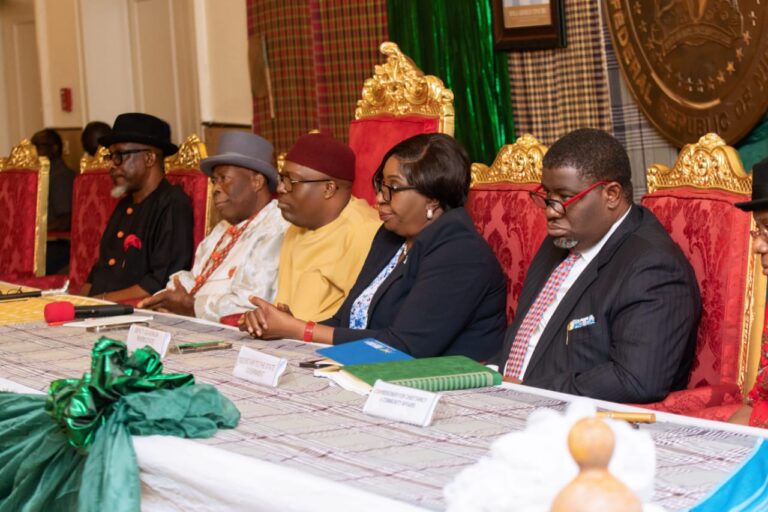
Governor Fubara disclosed this during a meeting held at the Banquet Hall, Government House, Port Harcourt on Thursday, with traditional rulers to acquaint them of the return of governance after the emergency rule in the State.

The Governor informed the traditional rulers of the government’s efforts to reactivate stalled projects across the state, assuring them that major works, including the Port Harcourt Ring Road, hospitals, and roads, have resumed.

He emphasized that the interests of Rivers people remain paramount in all government undertakings, adding that the administration is committed to addressing any challenges facing the communities.

“My meeting with you this afternoon is to tell you that we are back. It’s not me, all of us. Government has started again. Our projects, if you are aware, most of the project sites have all reopened. The Ring Road has restarted. The hospitals are mobilized back to sites. The roads, as at today, we’ve had meetings with all the contractors. They’ve all moved back to sites.

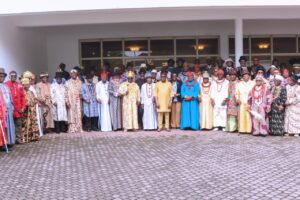
Rivers State Governor, Sir Siminalayi Fubara (10th right); his Deputy, Prof Ngozi Odu (9th right); Chairman, State Traditional Rulers Council, Eze Chike Worlu Wodo (11th right); and other traditional rulers shortly after a meeting at the Banquet Hall, Government House, Port Harcourt on Thursday.

“Also, the issues of other developments. I believe that most of them that were truncated, we will revisit them. Because at the end of the day, it has to do with the people. We must make sure that the interests of our people are supreme in whatever we’re doing. If you observe, every sector of the system has been activated.”

He acknowledged the unique position of the traditional rulers as the closest leaders to the people and vital role they play as custodians of culture and grassroots leaders in fostering peace and driving development, and appealed to them to continue to maintain peace within their domains as a way of supporting government initiatives.

Governor Fubara pledged to respect the traditional institutions, describing them as the ancestors and pillars of the state, and assured them of continued engagement and support.

“You cannot control from Port Harcourt, living in Government House, to decide what happens in the most interior place in Kula. You might have a local government chairman; you might have a councillor, but who is the closest, who controls the sub-leaders of the families, communities that make up the big Kingdoms? It is you all here that control them. So, if we have to pray for peace, if we have to yield for development, who should be the people I should always listen to? It is you.

“You know the problem, you understand the needs of the people. So, we are appealing that we need more peace. You want us to succeed, ensure that you maintain peace in your communities. Ensure that you support the government programmes. On my own part, I will give you the respect that you deserve.”

The Governor further announced plans to fulfill pending commitments to the traditional rulers, including the provision of vehicles and other benefits according to their hierarchy, promising that these would be delivered by the end of November.

He also addressed the importance of the quarterly council meetings, urging the Council Chairman to remain apolitical and focused on promoting the collective interests of the State.

In his remarks, the Chairman of the Rivers State Council of Traditional Rulers, Eze Chike Worlu Wodo, Eze Oha Apara (IV), Paramount Ruler of Apara Kingdom, reminisced the experience of the state and traditional rulers during the emergency rule, and expressed gratitude to God for the return of the Governor. He thanked him for the maturity and courage exhibited during the trying moment.

In their separate speeches, the Oba, Eze Ogba of Ogbaland, Eze Nwachukwu Nnam Obi, the III; the Amanyanabo of Bonny, King Asimini William Dappa Pepple III, Perekule XI; the Amanyanabo of Abonnema, King Disreal Gbobo Bob-Manuel; and the Eze of Omuma Kingdom, King Onyekachi Amaonwo; noted the organic support Rivers people have for the Governor, ascribing his return to God’s answer of the people’s prayers.

They noted that Rivers State is back on its feet, and urged the Governor to continue with the developmental projects that he had always put in place, and focus on youth empowerment, job creation and community development.

Saying that these are the surest foundations for enduring peace, they assured the Governor of the traditional institution’s commitment and readiness to continue to support the government’s developmental efforts.

China Launches 600th Long March Rockets Into Orbit

China’s Long March rocket series achieved its 600th space launch on Thursday with a successful deployment of Long March-8A internet satellites into orbit.

According to the China Aerospace Science and Technology Corporation, the Long March rockets have delivered nearly 1,400 spacecraft into orbits and conducted over 86 per cent of the country’s space launch missions to date.

“These rockets have provided solid support for the implementation of major aerospace projects, such as China’s manned spaceflights, BeiDou navigation and deep space exploration,” it said in a statement.

“Among the 24 rocket variants developed since the maiden flight of the Long March-1 rocket, 11 are classified as new-generation launch vehicles.

”In the most recent 100 missions, new-generation rockets have accounted for 40 percent, emerging as an important force supporting the country’s high-density launches,” it said.

The company also noted that the Long March rocket series had been actively adapting to market demands, with the share of commercial launches steadily rising.

The Long March-8A rocket, in particular, is known for its cost-effectiveness and high adaptability, having successfully undertaken multiple satellite internet constellation deployment missions.

Reps Demand Transparency, Accountability From ACRESAL Coordinator

0

The House of Representatives Committee on Environment has demanded the immediate submission of counterpart funding details from the project coordinator of Agro-Climatic Resilience in Semi-Arid Landscapes, Abduhamid Umar.

In a statement signed Chukks Okoh, Head of Media. House of Representatives Committee on Environment and made available to reporters, they are also to submit project plans and sites to enable the committee to track them while carrying out their oversight functions.

Speaking in Abuja Thursday, Rep Mike Etaba, Chairman of the Committee, noted that it has become imperative to visit the project sites to immediately confirm that the purpose of setting up the intervention initiative is not derailed.

“We are working for Nigerians. As such, every kobo spent on any project must be seen to worth it. ACRESAL is a specialist intervention, and we want to ensure that it is carrying out its mandate effectively. We need to also, that the National Coordinator has been spending money according to specifications, ” he insisted.

The committee is billed to look at the books of ACRESAL to make sure the National Coordinator is doing the right thing.

ACRESAL is a World bank assisted project in Northern Nigeria that aims at tackling land degradation and climate changes with the view of improving the life of the people.

CBN Gov Woos Foreign Investors, Assures Conducive Business Environment In Nigeria … Foreign Reserve Hits $43.4bn

0

The Central Bank of Nigeria (CBN) has assured foreign investors that the government will continue to advance reforms and unlock opportunities for sustainable investment and growth.

CBN Governor, Yemi Cardoso, gave the assurance on Wednesday in Washington, while addressing investors at the Nigeria Investors Forum held on the sidelines of IMF/World Bank annual meetings.

He said that the nation’s external reserves had risen to 43.4 billion dollar, the highest level in five years.

Cardoso assured the investors that the government would continue to advance reforms and unlock opportunities for sustainable investment and growth.

“The CBN and the Ministry of Finance have been working hand in hand to ensure alignment, stability and clarity for investors.

“Nigeria’s focus remains clear, strengthening our fundamentals, advancing reforms and unlocking opportunities for sustainable investment and growth.

“We are encouraged by the progress made so far and remain confident that ongoing reforms are laying a stronger foundation for a more resilient economy,” he said.

CBN Deputy Governor on Economic Policy, Mohammed Abdullahi, said that the series of reforms introduced by the government had led to significant improvement in foreign exchange inflows.

Abdullahi said that monthly turnover in the forex market had risen by 56.4 per cent to 8.6 billion dollars in 2025, up from 5.5 billion dollars in 2024.

“Over the last two years, we have really focused a lot on improving FX inflow into the economy, and we have seen a significant jump.

” Average net flows between January 2023 and July have doubled.

“FX supply at the official window has significantly improved and has been driven by order-based quotation, a lot of reforms around remittances and all the other issues mentioned, ” he said .

These, he said, include the clearance of backlogs and outstanding obligations

“Capital flows, which, during the 2019 to 2020 period collapsed by over 75 per cent have significantly improved and have therefore strengthened our external position.

“We now have deeper and more functional financial markets, much more robust and transparent,’” Abdullahi said.

He said that the CBN stood as a net supplier by less than about one per cent of market turnover.

“We are actually a net buyer in the market.

“We have, over the last two years, been rebuilding external buffers to provide resilience to shocks.

” Our gross reserves are at a five-year high of 43.4 billion dollars as of October, enough to cover 11 months of imports.

” We have also deliberately improved the quality and quantum of our net FX reserves.

“Between 2024 and 2025, we have released almost 13 billion dollars back to local and international banks in a way that allows for organic growth of our reserves,” he said.

Sanyade Okoli, the Special Adviser to the President on Finance and Economy, also said that government was committed to achieving seven per cent economic growth between 2027 and 2028.

Okoli said that the growth would come through diversification and investment in infrastructure.

“Our target is seven per cent by 2027 to 2028.

” When the IMF increased its forecast a week later for 2025, we are forecasting four per cent growth, rising to around five per cent next year.

“That four per cent is already the highest, with Q2 showing 4.3 per cent growth.

” We know that we need to diversify the economy and we are seeing results.

” In Q2, 13 per cent of sectors grew above seven per cent.

“To achieve seven per cent GDP growth, you need enough sectors growing at or above that level.

” In Q1, nine sectors grew above seven per cent, in Q2, it was 13.

“Our dependence on oil for total exports has reduced to about 57.5 per cent in the first half of this year compared to last year.

“Oil now accounts for about four per cent of GDP, down from eight per cent in 2021, ”Okoli said.

He said that the economy was diversifying, adding that resilience is building.

“To unlock long-term growth, we must invest; the government alone cannot do it.

“We are pursuing partnerships with the private sector and development partners to crowd in capital.

“On roads, the highway development and management Initiative has identified over 10 routes for PPPs,” he said.

He further said that on power, Nigeria was partnering with the World Bank and AfDB to mobilise about 32 billion dollars to improve access to reliable electricity.

On digital infrastructure, he said fiber-optic coverage is ongoing to ensure connectivity for the youths.