The Ministry of Petroleum Resources and its two agencies have jointly opposed the bill to establish the National Commission for the Decommissioning of Oil and Gas Installations (NC-DOGI), 2024.
The agencies are the Nigerian Upstream Petroleum Regulatory Commission (NUPRC) and the Nigerian National Petroleum Company Limited (NNPC Ltd.)
A statement in Abuja by Eniola Akinkuotu, Head, Corporate Communications and Media, NUPRC said that the position was delivered at a public hearing organised by the House of Representatives Committee on Petroleum Resources (Upstream).
In his submission, the Minister of State for Petroleum Resources, Dr Heineken Lokpobiri, said contrary to assumptions by the lawmakers, creating a Commission for decommissioning and abandonment would not address any community issues as these were already being taken care of.
Lokpobiri said the issues were taken care of by the Host Community Development Trust Fund (HCDT), which had generated nearly N400 billion for community development projects.
He said that Nigeria had been recording new Final Investment Decisions (FIDs) and witnessing renewed activities in upstream, midstream, and downstream operations, developments that were stagnant for over a decade before the Renewed Hope administration of President Bola Tinubu.
He, therefore, said that the creation of the NC-DOGI risked scaring away investors.
The minister also said that creating a new agency to handle decommissioning and abandonment would duplicate the responsibility already vested in the NUPRC as provided by Sections 232 and 233 of the Petroleum Industry Act (PIA) 2021.
He advised the committee to step down the bill, citing that a predictable and stable legal framework attracts investors.
In his presentation, the Commission’s Chief Executive, NUPRC, Mr Gbenga Komolafe said creating a different Commission to handle decommissioning and abandonment did not align with global best practices, where they were domiciled with the upstream regulator.
The CCE said the issue of decommissioning was not a stand-alone affair and would lead to having a separate regulator dealing with Field Development Plan (FDP) and a different agency handling decommissioning and abandonment.
“This will make the NUPRC not to have full line of sight on the FDP as decommissioning and abonnement is an integral part of any FDP and will jeopardise the intended objective of the development plan.” he added.
He said that between 2014 and 2021, Capital expenditure for oil and gas investment declined by about 75 per cent due to lack of a stable legal and regulatory framework until the emergence of the PIA.
The CCE aligned with the position of the Minister and stated that Nigeria has now put in place the PIA, tinkering with it will send wrong signals to the international community.
“ Creating such will show that we have again started to create an unstable framework which will be a disincentive to the investments.”
The Executive Vice-President, Upstream, NNPC, Mr Udobong Ntia, agreed with the minister and the CCE that there was no need for the establishment of a new agency.
Ntia said that decommissioning and abandonment were not a regular exercise but an activity that could take place at the end of the life of a field which could take years.
“What will such a commission be doing when the NNPC, for instance, has no decommissioning and abandonment until 2045?” he asked.
Earlier, the Chairman, House Committee on Petroleum Resources, (Upstream), Mr Alhassan Doguwa, said that the bill was conceived in order to address local environmental issues and challenges within oil producing communities.
Mr Edwin Okon, Executive Chairman, Cross River Internal Revenue Service (CRIRS) says professional bodies will be its prime target in 2026 for tax infractions.
Okon disclosed this in Calabar during a training session organised by IRS for selected key tax paying companies across the state.
The IRS boss said the purpose of the training is to enlighten companies on the newly introduced 2025 Tax Reform Act.
No fewer than 50 firms, operating in the state, attended the training.
The theme of the training: “Understanding the New PAYE Framework: Implications and Opportunities,” was used to discuss the practical aspects of the revised Pay-As-You-Earn (PAYE) system.
According to the chairman, private firms must do the right thing at the right time by ensuring that they file their returns at the end of every year while for individuals, it’s January 31.
He called on the companies to use the online platform of the service in making their remittances.
He noted that the state’s IRS had been working towards enabling taxpayers to generate their tax clearance from the comfort of their homes.
“By 2026, even if your financial transactions is little as your letterhead, if you are sending instructions to a bank or any financial institution, you must state your Tax Identification Number (TIN).
“Some companies may need to redesign their official letterheads to include their tax identification numbers, as it would become a mandatory requirement,” he explained.
He encouraged organisations to use IRS’s online platform for remittances, sensitise their staff on the importance of compliance, and refuse to give cash to any IRS staff as tax payment.
Delivering a presentation on ‘’Overview of the Nigerian Tax Reform Act 2025,’’ Mr Esien Ukorebi, former IRS Chairman in the state, outlined the objectives, key provisions, and compliance models of the new tax law.
He explained that the reform would commence in January, 2026, adding that 97 to 98 percent of Nigerian workers would either pay PAYE or experience reduced PAYE obligations by the time.
“Tax compliance goes beyond payment; it means fulfilling all obligations as required by law, individuals earning below ₦30,000 per month are exempted from tax but must still register with the tax authorities,” he explained.
Also speaking, Mr Daniel Anko, a resource person, emphasised the importance of possessing a valid Tax Clearance Certificate (TCC), whether as an employer or employee.
According to him, while employees’ incomes are taxed monthly, business owners are assessed at the end of the year, after which they have 90 days to file their returns.
Anko added that CRIRS had made tax payment more convenient through digital channels that allowed taxpayers to complete transactions without visiting the tax offices physically.
On her part, Mrs Lilian Ugbong, Technical Adviser to the Chairman of CRIRS, spoke on innovations introduced by the Joint Revenue Board (JRB) in implementing the 2025 Act.
She explained that the Joint Tax Board (JTB) had evolved into the JRB, with expanded powers and responsibilities aimed at improving tax compliance and harmonising revenue processes across Nigeria.
“The Act has strengthened the JRB’s authority and enhanced its collaboration with the Nigeria Governors’ Forum (NGF) to drive tax reforms and increase revenue generation,” she noted.
The Federal University of Transportation (FUT), Daura, Katsina, has called for partnerships with Caliphate Aviation Training Centre, Kano and Federal Airports Authority of Nigeria (FAAN) for improved manpower in aviation.
This is contained in a statement issued in Katsina on Saturday by Mr Umar Usman, the institution’s Public Relations Officer.
Usman quoted the FUT Vice Chancellor, Prof. Umar Adam-Katsayal as making the call in Kano at a centenary celebration of Malam Aminu Kano International Airport (MAKIA).
According to Adam-Katsayal, the call, extended to other stakeholders, was necessary, and also aimed to transform the Nigerian aviation sector.
Adam-Katsayal further commended the organisers of the event, which marks the 100-years anniversary of the first aircraft landing in Nigeria, at the Kano airport.
The V-C lamented the level of progress made in the sector, saying: “the development witnessed should have been more than what is currently available.”
He pointed out that: “There is the need for more attention to be given to the aviation sector of the country.
“We are talking about 100 years. We need to look back and assess the achievements recorded within this period.”
While observing that the university was established to provide the needed manpower in the nation’s transport sector, Adam-Katsayal assured the institution’s readiness to partner with all relevant stakeholders in the discharge of its expected mandates.
“The university is ready to undertake research for improved aviation services including its logistics,” the vice chancellor assured.
The Federal Government and the Government of Germany are pushing for stronger multilateral cooperation to advance peace and security globally, and to uphold respect for international law.
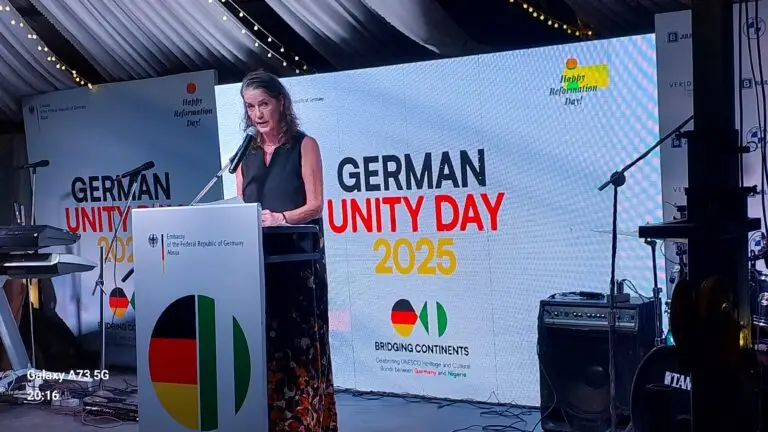
Mrs Annett Gunther, the Ambassador of the Federal Republic of Germany to Nigeria and ECOWAS said this at the German Unity Day celebration in Abuja on Friday.
The celebration was with the theme, “Bridging Continents: celebrating UNESCO Heritage and Cultural Bonds between Germany and Nigeria”.
Gunther said that it was as way to underscore cultural heritage as a bridge between continents.
According to her, the aim is to stress the importance of valuing cultural tradition and history for shaping a people’s sense of identity and unity.
She said that both countries had witnessed 65 years of diplomatic relations which has made them to grow stronger partnerships.
The envoy said that this year’s celebration highlighted the growing relations of both countries.
She said that a meeting of German-Nigerian Binational Commission, under the leadership of both countries Foreign Ministers, was scheduled to hold in Berlin in the first week of November.
“We will discuss ways to further expand this partnership, particularly in the areas of energy and climate cooperation, investment and mineral resources, cultural exchange and migration.
“Germany and Nigeria as strong economies and most populous countries in their respective continents, want to join forces and come closer together and adjust their partnership to new opportunities.
“Nigeria is a strong partner in preserving the international rules-based order, based on international law and the UN Charter, and a strategic partner for Germany in Africa,” she said.
She expressed Germany’s commitment to continue its strong cooperation programme with Nigeria.
“We will continue our engagement and deepen the cooperation in the security sector.
“We also endeavour to strengthen our economic and trade relations further, work on climate issues, energy transition, renewable and future sources of energy such as hydrogen,’’ she said.
Ambassador Yusuf Tuggar, the Minister of Foreign Affairs, commemorated the unification of Germany and its enduring friendship and strategic partnership with Nigeria.
Tuggar was represented by Ambassador Wahab Akande, the Chief of Protocol, Ministry of Foreign Affairs.
He said that Germany stood as a beacon of innovation, resilience and global cooperation which Nigeria is proud to count among its most valued partners.
He said that the bilateral relations of both countries had witnessed remarkable growth, particularly, in the area of trade.
“The trade volume between Nigeria and Germany has surged by an impressive 30 per cent, reaching an all-time high of three billion euros.
“This milestone reflects not only the resilience of our economies, but also the mutual trust and shared vision that bind our nations.
“Over 90 German companies now operate in Nigeria, contributing to job creation and technology transfer, and reinforcing Germany’s position as Nigeria’s second-largest trading partner in Sub-Saharan Africa,” Tuggar said.
He said that beyond commerce, Nigeria and Germany had deepened cooperation through strategic agreements.
“Earlier this year, they renewed a vital Memorandum of Understanding on defense cooperation amongst others,’’ he said.
The Kebbi Police Command has confirmed the abduction of the Deputy Speaker of the State House of Assembly, Alhaji Muhammad Sama’ila-Bagudo, by suspected bandits in Bagudo Local Government Area of the state.
The Police Public Relations Officer (PPRO), CSP Nafi’u Abubakar, made the disclosure in a statement issued in Birnin Kebbi on Saturday.
Abubakar said the incident occurred on Friday night at about 8:20 p.m., when a gang of armed men stormed Bagudo town and kidnapped the lawmaker shortly after observing Isha’i prayer on his way home.
He said that the command had since deployed a combined team of police tactical unit, military personnel, and vigilantes to track down the abductors and ensure safe rescue of the deputy speaker.
“The joint team is currently combing the bandits’ routes and nearby forests with a view to rescuing the lawmaker unhurt and arresting the perpetrators of the dastardly act,” Abubakar said.
He added that the Commissioner of Police in the state, Mr Bello Sani, had reiterated the command’s determination to protect the lives and property of residents across the state.
“The CP has also appealed to members of the public to remain vigilant and continue to support the police and other security agencies to ensure peace and stability in the state,” the PPRO pleaded.
For many families, a loaf of bread on the breakfast table is an everyday essential as well as a means to fight unemployment and promote community development.
This is the belief of an engineer and entrepreneur, Mr Henry Dakpokpo, who just unveiled what he called the “Bread Box” in Apo area of the Federal Capital Territory.
Speaking in an interview in Abuja, Dakpokpo said the Bread Box was an innovation by Platterz Bakery to create jobs in many neighbourhoods across the country.
He said that he is using a solar-powered, mobile bakery to create jobs and bring affordable bread closer to the people.
He said the project was designed to address two major national challenges, which are unemployment and access to basic needs.
“We discovered that rent and logistics costs make bread expensive in many communities.
“So we decided to build our own movable, containerised bakery that can operate anywhere, powered entirely by solar energy.
“It helps us save costs, employ more young people, and bring bread closer to the people, ” he said.
Dakpokpo said the idea was not just about profit but about providing meaningful employment.
“Unemployment is at the root of many social problems — robbery, drug abuse, and other vices,” he noted.
“If people are gainfully employed, they won’t have time for such activities. Each Bread Box location will employ between 12 and 15 young people directly and more indirectly as distributors.
“So far, Platters Bakery employs about 92 workers across the country and plans to expand to ten Bread Box locations by the end of next year.
“Every community we enter, we’re taking young people off the streets and giving them a source of livelihood. That’s what keeps us going,” he added.
The entrepreneur disclosed that each bread box was a fully equipped, modern bakery housed in a repurposed container and powered completely by solar panels.
According to him, it allows for on-site baking from dough mixing to packaging so customers can buy fresh bread straight from the oven.
“It is mobile, clean, and environmentally friendly. We’re not on the national grid at all. Everything runs on solar,” he said.
According to him, each bread box represents hope, a small but scalable model for national development.
“Our dream is to see Nigerian youths engaged, empowered, and contributing meaningfully to the economy.
“If we can meet people’s daily needs while creating jobs, then we are truly building the nation from the grassroots,” he said.
For many residents, the bread box has made life easier.
The initiative changed how people access basic food in his community.
Hasley believes the concept supports the Federal Government’s push for inclusive economic growth through small and medium enterprises (SMEs).
“I saw when they started building it; I didn’t know what it was, but now I come here every evening for fresh bread. It is convenient, it is affordable, and you can see that they employ people from our area.
“That is how the economy should work through local production and local consumption.
“What this government wants is for people to be productive, to create jobs and reduce dependence.
“If the government can support more of these innovations with grants or tax incentives, we’ll have more people employed and less pressure on the cities,” he said.
Hasley commended the bakery for the innovation, adding that they used high premium materials in baking the bread.
He urged the bakery to sustain the standard to be able to achieve the objective of job creation and meeting customers’ expectations.
At Rivers State University’s 121st Inaugural Lecture, Professor Isaac Eyi Ngulube retraced his journey through the “rough beasts” of scholarship, unveiling groundbreaking linguistic theories and urging Nigeria to embrace language as the foundation of culture, identity, and national progress.
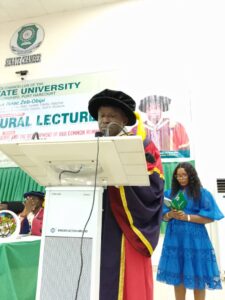
Prof. Ngulube delivering the lecture.
The 121st Inaugural Lecture of Rivers State University (RSU), held on Wednesday, October 29, 2025, at the Dr. Nyesom Ezenwo Wike Senate Building, turned into a celebration of intellect, resilience, and the transformative power of words.
Delivering the lecture titled “The Career of Rough Beasts: Language, Literature, and the Development of Our Common Humanity,” Professor Isaac Eyi Ngulube, a scholar of English and Linguistics, traced his academic journey through trials and triumphs — what he described as a lifelong confrontation with “rough beasts.”
Opening the event, Vice Chancellor Professor Isaac Zeb Obipi hailed the lecture as “a journey through perseverance and growth,” explaining that the “rough beasts” symbolized the defining struggles that shaped Ngulube’s intellectual path.
“In confronting these beasts, he has emerged stronger — a true emblem of intellectual courage and creativity,” Obipi said.
Recalling his early years, Ngulube told the audience that his passion for learning was kindled in childhood.
“The journey into the ring to confront the strange beasts began when I was only seven years old, playing in the living room of my namesake, Mr. Isaac Okparaji Keewi Eyi of blessed memory.”
From those humble beginnings, Ngulube’s curiosity blossomed into groundbreaking work in linguistics and literature. He presented his Coaxal Grid, a linguistic model that unites phonetics, syntax, pragmatics, and applied linguistics to deepen understanding of language as a living system.
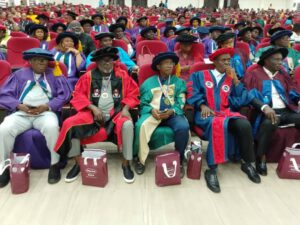
Academics at the lecture
“Language feeds Literature and Literature bleeds Language,” he declared, emphasizing their interdependence as engines of creativity, communication, and civilization.
He described language as “a purely human and non-instinctive means of communicating ideas and emotions,” noting that “the word is a fundamental need in language; you cannot study language without the use of language.”
Quoting Scripture — “Let there be light, and there was light” — Ngulube illustrated the power of words to create and transform. He urged parents to be cautious with their utterances, warning that “what they refer to their children as is what they will automatically end up becoming.”
Drawing inspiration from Chinua Achebe, he reinforced the link between language and civilization.
“If you take away language from us, we return to the primitive era,” he said, adding that any society that seeks progress must “place the study of its language high on its agenda.”
Ngulube called for Nigerian universities to adopt English for Specific Purposes (ESP) — a model that aligns English teaching with students’ academic and professional goals. He also pressed for the inclusion of indigenous languages in tertiary education curricula, describing them as vital for preserving Nigeria’s cultural and linguistic identity.
A pioneer in language development, Ngulube has created government-approved orthographies for four Nigerian languages — Ibani, Ikwerre, Khana, and Ogba — and developed the Lambda Theory, designed to improve translation and comprehension across languages.
He urged the Federal Government to commit more strongly to mother-tongue and multilingual education, supported by structured teacher training, research grants, and a reformed national language policy. He also challenged the media to become “partners in linguistic development, not mere conveyors of borrowed speech.”
In his closing remarks, Vice Chancellor Professor Obipi praised Ngulube for “conquering the rough beasts” of scholarship and for his outstanding contributions to English studies, literature, and education.
He highlighted RSU’s recent victory in the Bilingual Community Project organized by the French Embassy, describing it as proof of the university’s rising excellence in language studies. He reaffirmed RSU’s commitment to strengthening English and Linguistics programs, fostering research collaboration, and expanding facilities for its language centers, including the French Language sector.
The lecture ended with a standing ovation as academics, students, and guests celebrated a scholar whose career reflects the endurance of the human spirit and the timeless truth that language — when understood and valued — remains humanity’s most powerful instrument of light and progress.
Chief Samuel Ogbuku, Managing Director of Niger Delta Development Commission, NDDC, has dissociated himself from a recent report in the Media attributing his rumoured arrest to the Bayelsa State Governor, Senator Douye Diri.
In a statement signed by Dr. Willie Etim, SA Media to the MD of NDDC, Dr. Ogbuku condemned in very strong terms the news report attributed to a former Deputy National Publicity Secretary of the All Progressives Congress (APC), which insinuated a rift between himself and the Governor, and cautioned that there is no rivalry in the APC Family in Bayelsa State.
According to the statement, “it is also important to clarify that any comments or opinions expressed by anyone on political matters in Bayelsa State should be regarded strictly as their personal views and not as a representation of the views or position of Dr. Ogbuku.”
“The attempt to link the governor to political controversies or rumours of arrest is both misleading, mischievous, and unnecessary.
“We want to use this medium to express our sincere apology for any embarrassment the publications may have caused the Governor and call on all party faithful to exercise restraint in public commentary, especially when such remarks could mislead the public or misrepresent facts,” the statement concluded.
It would be recalled that a few days ago, the Niger Delta Development Commission (NDDC) threatened legal action against two national newspapers for allegedly publishing false reports linking its Managing Director, Dr. Samuel Ogbuku, to a purported plot to overthrow the administration of President Bola Ahmed Tinubu.
According to the NDDC, both The Punch and Daily Times newspapers recently published stories suggesting that Dr. Ogbuku was implicated in an alleged coup plan. The Commission has since described the reports as entirely baseless, defamatory, and damaging to the reputation of both the Managing Director and the federal government agency.
In a statement issued in Port Harcourt, the NDDC demanded a public retraction and apology from the two newspapers, calling the publications “false and reckless fabrication
intended to mislead the public.”
The Commission’s counsel, Adedipe and Adedipe Legal Practitioners, led by Chief Ayodeji Adedipe, SAN, has issued a formal legal notice to The Punch, Daily Times, and other media outlets that circulated the report. The letter demanded the withdrawal of the story and an unreserved public apology.
According to Chief Adedipe, the publications “falsely alleged that Dr. Samuel Ogbuku, Managing Director of the Niger Delta Development Commission, was arrested by military intelligence for co-sponsoring a failed coup plot against President Tinubu.”
“The report further claimed, without any factual or evidential basis, that Dr. Ogbuku transferred funds from NDDC contracts to finance the alleged coup. These allegations are entirely false, malicious, and defamatory,” Adedipe stated.
The letter emphasized that Dr. Ogbuku had not been arrested, questioned, or invited by any authority regarding any alleged coup or financial misconduct. It also accused the newspapers of breaching journalistic ethics by failing to contact either Dr. Ogbuku or the NDDC for clarification before publishing the story.
“This reckless and damaging report has caused Dr. Ogbuku and his family deep emotional distress, embarrassment, and reputational harm,” the letter read. “Friends, associates, and colleagues have inundated him with calls expressing concern over the unfounded claims.”
Through his legal representatives, Dr. Ogbuku demanded that The Punch and its editor, Awwal Owolabi, immediately retract the story from all platforms and publish a written apology in at least four national newspapers, including five consecutive editions of The Punch, across print, online, and social media.
The NDDC warned that failure to comply within seven days of receiving the legal notice would result in both civil and criminal proceedings under the Cybercrimes (Prohibition, Prevention, etc.) Act, 2015 (as amended in 2024) and other relevant laws of the Federal Republic of Nigeria.
In Andoni, a new road is emerging from the swamps, cutting through mangroves and waterways, stretching steadily toward the Atlantic Ocean. The 13.52-kilometer Ngo–Atlantic–Oyorokoto Road is far more than an engineering project; it is a bold declaration of purpose. It tells the story of a people long isolated by geography, and a government now determined to connect them to opportunity.
This road is not just a physical link between communities. It is a symbol of resilience, vision, and leadership that refuses to be defined by obstacles. Where others saw impenetrable swamps, creeks and restless tides, Governor Siminalayi Fubara saw a canvas for renewal and growth.
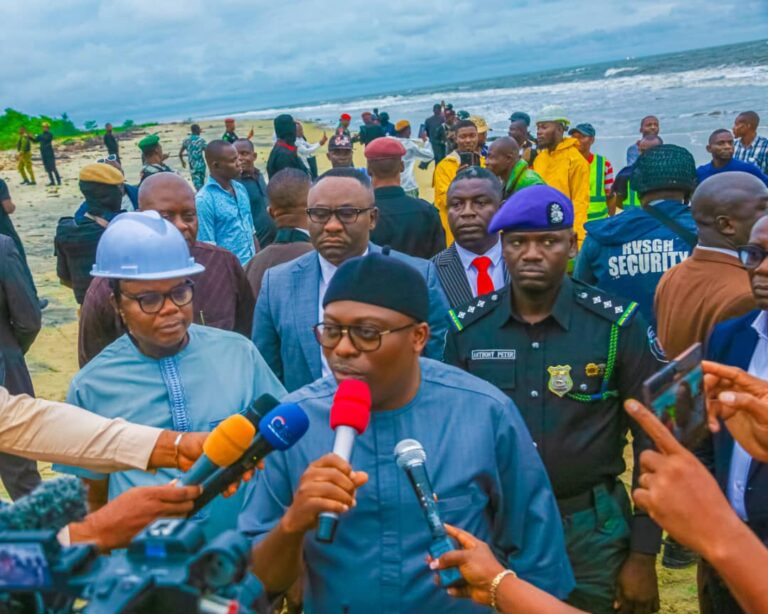
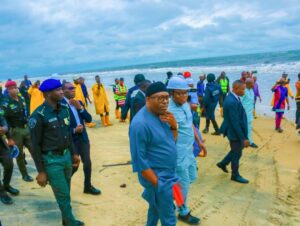
Rivers State Governor, Sir Siminalayi Fubara (middle); inspecting the Atlantic beachfront during an on-the-spot assessment of progress of work on the Ngo-Atlantic-Oyorokoto Road, in Andoni Local Government Area of the State, on Tuesday, October 28, 2025.
On Tuesday, October 28, 2025, the Governor led from the front, personally inspecting the Ngo-Atlantic-Oyorokoto Road project site. His boots sank slightly into the freshly graded earth before stepping onto sandy patches closer to the Atlantic shoreline. He walked quietly but with purpose, embodying his conviction that leadership is about action, not rhetoric.
Journalists, residents, and construction workers followed closely as he surveyed the site. Standing beneath the open evening sky with the salty Atlantic breeze sweeping across the wetlands, Governor Fubara declared, “This is a virgin road, 13.52 kilometers of a new pathway to the blue economy.” His words carried the weight of commitment, echoing a vision already taking physical form.
The terrain here is harsh and unyielding. Thick mangrove forests, deep swamps, and shifting tidal channels have long discouraged development. Yet, under Governor Fubara’s leadership, this difficult landscape is being conquered through engineering innovation, steady funding, and unwavering political will.
A fascinating view of the Atlantic Ocean from the beachfront at the terminus of the Ngo-Atlantic axis of the 13.52kilometers Ngo-Atlantic-Oyorokoto Road in Andoni Local Government Area on Tuesday, October 28, 2025.
Originally, the Ngo–Oyorokoto Road was conceived as a single access route to the famous Oyorokoto Beach, one of Nigeria’s most celebrated coastal destinations. But destiny had other plans. During preliminary works, Governor Fubara drew the attention of engineers and surveyors to a newly discovered, untouched Atlantic-facing beachfront, a pristine expanse of white sand and deep blue waters that revealed enormous potential for tourism, trade, and marine exploration.
Recognising the significance of this discovery, the Governor immediately approved an expanded project scope to open up this new frontier for development. “We will not limit progress to a single beach,” he said. “This new Atlantic-facing front will be developed as part of our blue economy vision.” That decision transformed the project from a local access road into a state-defining infrastructure initiative.
Every meter of the Ngo–Atlantic–Oyorokoto Road now tells a story of determination and transformation. The mangroves, the swampy creeks, and the ever-shifting Atlantic tides are being subdued by vision, planning, and relentless execution. Beyond asphalt and concrete, the road represents hope, a gateway to a more prosperous coastal future.
Andoni’s coastal identity runs deep. It is home to a proud fishing tradition, the vast Ikuru Atlantic Beach, and the legendary Oyorokoto settlement, often described as West Africa’s largest fishing community. For generations, fishing has sustained the people here, but development has been slow. High costs of fishing gear, poor access routes, and the lack of modern facilities, among others, have long limited their full economic potential.
The stretch of the Ngo-Atlantic axis of the Ngo-Atlantic-Oyorokoto Road in Andoni Local Government Area during an inspection visit to the project site on Tuesday, October 28, 2025.
Now, that story is beginning to change. When completed, the Ngo–Atlantic–Oyorokoto Road will usher in a new era for the region’s fishing industry, aquaculture ventures, and marine tourism. Improved access will reduce costs, expand markets, and attract new investors. The Atlantic coastline holds vast opportunities for eco-tourism, recreation, and maritime trade. With strategic port and shipping development, Andoni could emerge as another vital node in Rivers State’s expanding logistics and trade network.
Oyorokoto, the fishing capital of the region, stands to benefit the most. A 2016 study estimated 2,572 active fishermen in the settlement, engaged mainly in artisanal fishing. They harvest a rich variety of seafood, from fish and crabs to shrimps, oysters, and sea snails, sustaining both local consumption and commercial trade.
Scientific data reinforces this productivity. A 2016 study on Black Tiger Shrimp recruitment in the Andoni estuaries recorded about 350 artisanal shrimp fishers, with peak catch rates reaching 78.11 kilograms per person per hour in September. Another study conducted in 2019 near the Bonny Estuary found that 57.7 per cent of fin fish were caught during the dry season, and 42.3 per cent in the wet season, totalling 4,800 individual fish.
Between 1999 and 2000, researchers identified 63 species of fish caught by artisanal fishers in the Andoni River system, with Tilapia guinensis accounting for four per cent of the total. A 2022 study revealed that fish marketing in Andoni was profitable, with vendors earning an average monthly profit of ₦623,386.67. The Food and Agriculture Organisation (FAO) reported over 250 canoes operating in Oyorokoto by 2016, while a 2023 survey found that most male residents aged 41 to 50 were engaged in artisanal fishing, earning a gross margin of about ₦112,092 per month.
Despite this strong foundation, challenges have persisted. Inadequate infrastructure, limited access to capital, and poor storage facilities have long constrained the potential of Andoni’s fisheries. For years, community leaders lamented government neglect, calling for investment in roads, jetties, and cold storage facilities. Governor Fubara’s administration has listened, and acted.
The stretch of the Atlantic-Oyorokoto axis of the Ngo-Atlantic-Oyorokoto Road in Andoni Local Government Area during an inspection visit to the project site on Tuesday, October 28, 2025.
The Ngo–Atlantic–Oyorokoto Road is not just a response to years of neglect; it is a deliberate strategy to open Andoni to the wider world. By linking fishing settlements directly to markets and ports, the road will reduce post-harvest losses, lower transportation costs, and create a more efficient value chain for the fishing industry. It will also stimulate tourism and hospitality opportunities, including cruises, water sports, and coastal resorts. Supporting sectors such as accommodation, transport, logistics, recreation, and local cuisine are expected to flourish as the area opens up to visitors and smart businesses.
One remarkable trait of Governor Fubara’s administration is its refusal to be deterred by difficult terrain. What many once described as impossible has become achievable under his leadership. The completion of the Andoni section of the Ogoni–Andoni–Opobo Unity Road stands as proof. That 27.52-kilometer link, featuring three major bridges, was first initiated under Dr. Peter Odili decades ago but was completed only in 2024 by Governor Fubara. Its delivery finally gave Andoni communities road access to the rest of the state.
The Ngo–Atlantic–Oyorokoto Road builds on that legacy. It carries the same spirit of persistence and transformation. Like the Unity Road, it will not only connect places but also unite people, bridging history and progress, and linking traditional fishing villages to the modern economy they are now poised to enter and relish.
This vision aligns with other major infrastructure projects across the state, notably the Trans-Kalabari Road, which, as of October 27, 2025, had achieved 75 per cent completion in piling works. Together, these projects are weaving a network of connectivity that binds riverine and coastal communities into one thriving economic fabric.
As night falls over the swamps and creeks of Andoni, the Ngo–Atlantic–Oyorokoto Road gleams under floodlights, a silver ribbon cutting through the darkness. To onlookers, it represents more than construction; it is a living symbol of progress, proof that even the most challenging landscapes can yield to determined leadership.
For Governor Fubara, infrastructure is not merely about concrete and steel, it is about people. Roads, he often says, are lifelines that deliver hope, awaken trade, and reconnect forgotten communities to the heartbeat of the state. Every project, in his view, must have a human face and a lasting economic impact.
For the people of Andoni, this road means everything. It is a bridge to prosperity, a path to opportunity, and a guarantee that they will no longer be left behind. It promises to attract tourists, energise local businesses, and improve access to schools, healthcare, and essential services.
Ultimately, the Ngo–Atlantic–Oyorokoto Road sends a clear message beyond Andoni’s borders: Rivers State will not be constrained by geography or history. With vision, courage, and persistence, even the most remote corners can be transformed into engines of prosperity. It reflects a government determined to translate potential into progress and resources into results.
As the Governor’s convoy departed that October 28 evening, the Atlantic waves whispered promises of renewal. The air carried the scent of salt and hope. In the distance, construction lights flickered across the wetlands, marking a future being built one metre at a time. The Ngo–Atlantic–Oyorokoto Road now stands as a monument to bold leadership, resilience, and foresight, a road laid not just on earth and asphalt, but on vision, courage, and the unwavering belief that progress is possible against all odds.
This, indeed, is a dream come true for the present generation! And generations yet unborn will in decades to come remember the driver who brought this vision to manifest reality: a simple but courageous and foresighted leader from neighbouring Opobo, Governor Siminalayi Fubara.
By Nelson Chukwudi
_Chukwudi is the Chief Press Secretary to the Rivers State Governor, and writes from Government House, Port Harcourt.
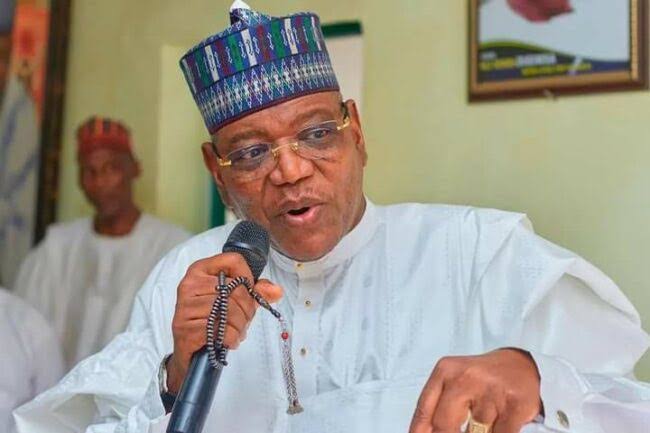
The Federal High Court in Abuja on Friday refused to grant an application filed by former Gov. Sule Lamido of Jigawa, seeking an order restraining the Peoples Democratic Party (PDP) from proceeding with its scheduled national convention.
Lamido, in the motion ex-parte moved by his lawyer, Jeph Njikonye, SAN, had prayed the court to make the interim order, pending the hearing and determination of the motion on notice filed alongside.
Justice Peter Lifu, in a ruling, rather ordered the PDP and the Independent National Electoral Commission (INEC) that are defendants in the suit to come and show cause why the ex-governor’s reliefs should not be granted.
Lamido, who is the plaintiff in the fresh suit marked: FHC/ABJ/CS/2299/2025, named the PDP and INEC as 1st and 2nd defendants.