



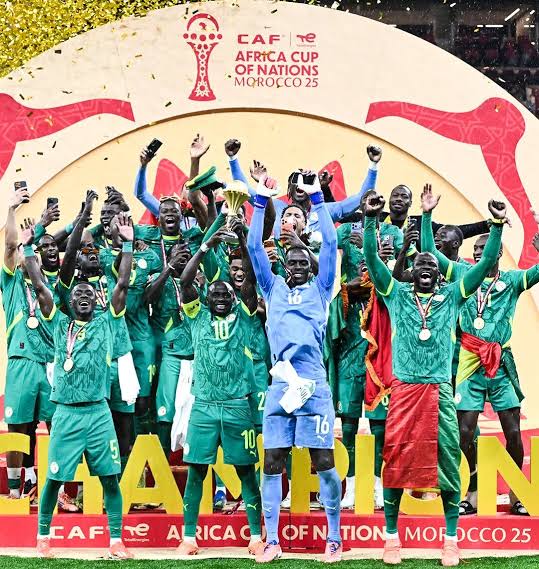
Senegal have launched a fierce legal challenge to reclaim the Africa Cup of Nations title after the Confederation of African Football (CAF) sensationally overturned the result of January’s final and awarded the title to Morocco.
In a decision that has reverberated across the game, CAF’s appeals committee ruled that Senegal’s temporary walk-off during the final against Morocco in Rabat constituted a breach of tournament regulations, effectively treating the incident as a forfeit. The original 1-0 extra-time victory for Senegal has therefore been annulled, with Morocco handed a 3-0 win on paper.
The controversy centres on a chaotic closing phase of the final, when Senegal’s players left the pitch in stoppage time to protest a disputed penalty decision.
Although captain Sadio Mane persuaded his teammates to return and the match was completed, CAF determined that the act of leaving the field without permission violated its statutes.
Senegal’s football federation reacted with fury, condemning the ruling as “unjust, unprecedented and unacceptable,” and confirming an imminent appeal to the Court of Arbitration for Sport (CAS).
At the heart of their argument lies a simple principle: the match was finished, a winner was decided on the pitch, and the trophy was awarded. In their view, any retrospective reinterpretation undermines the integrity of competition.
Mane, who played a pivotal role in restoring order during the final, struck a similarly defiant tone. The forward described the decision as a “stain” on the tournament, insisting Senegal had proven themselves “through play, not politics.”
However, pundits are worried over the prospect of overturning CAF’s ruling at CAS, which they think is far from straightforward.
CAS panels traditionally give weight to governing bodies’ regulations, particularly where rules — such as those concerning abandonment or refusal to play — are clearly defined.
CAF has cited specific provisions allowing disciplinary bodies to impose forfeits when teams leave the field without authorisation, even if play later resumes.
However, Senegal’s case may hinge on proportionality and precedent:
Senegal can argue the game was ultimately played to its conclusion under the referee’s authority.
Referee discretion: If match officials allowed play to continue without formally abandoning the fixture, Senegal may claim the sporting result should stand.
Sanction severity: CAS could consider whether stripping a title — after the fact — is excessive compared with alternative punishments such as fines or suspensions.
Legal experts often note that CAS is willing to intervene where a governing body’s decision appears disproportionate or inconsistently applied, though outright reversals of match outcomes remain rare.
Beyond the legal battle, the episode raises deeper questions about governance in African football — from the application of rules to the role of officiating in high-stakes matches.
For Morocco, the position is procedural: CAF’s regulations were invoked and enforced. For Senegal, it is existential — a belief that a title earned on the pitch has been removed in a boardroom.
With the appeal looming, the final outcome may yet shift again. But for now, the 2025 AFCON has become less a celebration of football than a test case for how the sport adjudicates chaos — and whether justice lies in the letter of the law or the result of the game itself.