



Obi of Onitsha Receives King Jeki VI in Historic Royal Visit as Opobo Prepares for Coronation
There are visits, and there are encounters between thrones. In Onitsha, two ancient royal traditions met in an atmosphere rich with history, dignity and symbolism as His Majesty, King Charles Douglas MacPepple Jaja, Jeki VI, Amanyanabo of Opobo, led a high-powered delegation of the Alapu Council of Opobo Kingdom to the palace of His Majesty, Nnaemeka Alfred Achebe, the Obi of Onitsha.
The visit was history and royal diplomacy in its most enduring African form. One monarch received by another and two revered institutions acknowledging bonds forged long before the boundaries and political arrangements of modern Nigeria.
Behind the Royal visit and the invitation to the Coronation of Jeki VI of Opobo Kingdom on September 26, 2026, stood the weight of a throne whose history occupies a remarkable place in the story of the Niger Delta and of Africa’s encounter with European imperial power.
The throne of Opobo is no ordinary stool. It carries the legacy of King Jaja, the extraordinary 19th-century statesman, merchant prince and founder of Opobo who, following the events of 1869, established a new political and commercial state at the strategic gateway to the Imo River.
Opobo rapidly emerged as a formidable trading power. From his new capital, King Jaja exercised authority over important palm-oil trading routes into the hinterland and built a prosperous kingdom whose commercial influence fundamentally altered the balance of power in the eastern Niger Delta.
So substantial was that authority that Britain dealt directly with Jaja as King. A treaty concluded in 1873 acknowledged his royal status, while subsequent dealings between Opobo and the British were conducted in the language and practice of relations between recognised political authorities.
Jaja fiercely guarded that independence. When expanding British commercial and imperial interests eventually collided with Opobo’s insistence on controlling its own markets and waterways, the confrontation became one of the defining episodes of the colonial encounter in the Niger Delta. His removal and exile in 1887 did not erase the throne he had established. If anything, the story of his resistance transformed it into an enduring symbol of courage, political intelligence, enterprise and the determination of an African people to govern their own affairs.
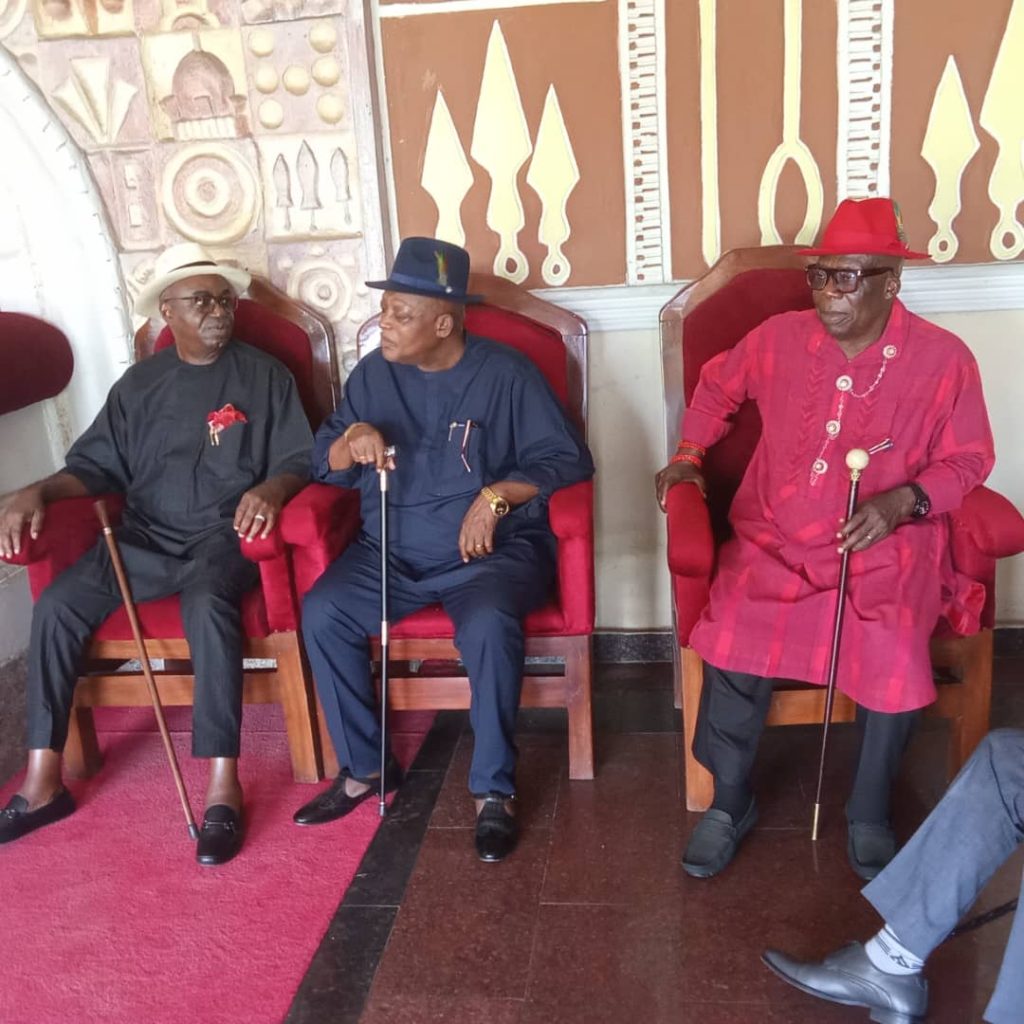
More than a century later, it was to that historic throne that King Charles Douglas MacPepple Jaja had been called. And it was as custodian of that inheritance that Jeki VI entered the palace of the Obi of Onitsha. The moment carried its own quiet grandeur. Before him sat the Obi of Onitsha, His Majesty Nnaemeka Achebe, himself custodian of one of Nigeria’s most respected traditional institutions. Around them were chiefs and traditional rulers, men representing institutions whose histories have survived colonialism, independence, constitutional change and the passage of generations.
The exchange therefore spoke a language older than contemporary politics: the language of kingdoms.
Receiving the Opobo monarch and his delegation, the Obi of Onitsha warmly welcomed his royal guest and reflected on the longstanding ties between Onitsha and Opobo — two historic riverine kingdoms whose peoples were connected through commerce, movement and interaction during the great era of trade along the Niger and its adjoining waterways.
He also paid moving tribute to the late Amanyanabo of Opobo, His Majesty King Dandeson Douglas Jaja, Jeki V. For the Obi, the departed monarch had been more than a fellow traditional ruler. He remembered him as a friend, a brother and a colleague. That remembrance gave the visit a deeper poignancy.
King Dandeson had occupied the throne of Jaja with distinction. His passing closed an important chapter in Opobo’s history. The emergence of a successor, and the orderly transition that followed, therefore represented more than the selection of a new monarch; it demonstrated the resilience of an institution and the unity of a kingdom determined to preserve the sanctity and continuity of its throne. The Obi commended the people of Opobo for the peaceful transition and congratulated King Jeki VI on his emergence as Amanyanabo.
Then came a gesture of particular significance. The Obi of Onitsha indicated his intention to be present in Opobo for the coronation. For Opobo, the promise carried meaning beyond attendance at a ceremony. It was an affirmation from one throne to another at a defining moment of succession: a respected monarch acknowledging the heir to one of the Niger Delta’s most storied royal institutions and standing with the kingdom as another chapter of its history begins.
King Jeki VI, in turn, formally informed the Obi of the forthcoming coronation and extended the invitation of the throne and people of Opobo to His Majesty and his Council. He expressed the appreciation of Opobo Kingdom for the warmth of the reception and for the friendship, affection and respect that have continued to exist between the two royal institutions.
Then, as African diplomacy has done for generations, ceremony spoke where words alone could not. Kola was presented and shared. Drinks followed. Gifts passed between the two royal delegations.
Pleasantries were exchanged between chiefs and traditional rulers. Yet beneath the warmth lay profound symbolism. These were not merely social courtesies. In the traditional diplomatic grammar of Africa’s kingdoms, the breaking of kola, the exchange of gifts and the receiving of one monarch in the court of another are gestures of honour, friendship, goodwill and mutual recognition.
For a kingdom now approaching one of the most solemn moments in its history, the Onitsha visit also offered a glimpse of what the coronation of Jeki VI represents. On September 26, the crown will rest upon a new head, but the throne remains the throne of Jaja. It is the throne of the man who built a powerful trading state on the waterways of the Niger Delta; who negotiated with foreign powers; who defended his kingdom’s economic interests against some of the most formidable commercial and imperial forces of his age; and whose name still commands recognition far beyond the shores of Opobo.
Kings have occupied that throne since him. Generations have come and gone. Nigeria itself was created, colonised and became independent. The institution endured.
Now, as King Charles Douglas MacPepple Jaja, Jeki VI, prepares for his coronation as the sixth Amanyanabo of Opobo, the kingdom is not simply preparing for a colourful ceremony. It is preparing for the renewal of a covenant between a people and their throne.
The journey to Onitsha was therefore fitting. A king went forth from the an ancient Kingdom received by a brother king equal status. Across the palace courtyard, amid kola, gifts, memories and the measured courtesies of royalty, two thrones spoke to each other and History was listening.